

Having a Piece of Jewelry Made with an Emerald
An emerald is less forgiving than a diamond or sapphire. If you are planning a one-of-a-kind piece with one, it is best to decide on setting, type of jewelry, and care before the first line is drawn.
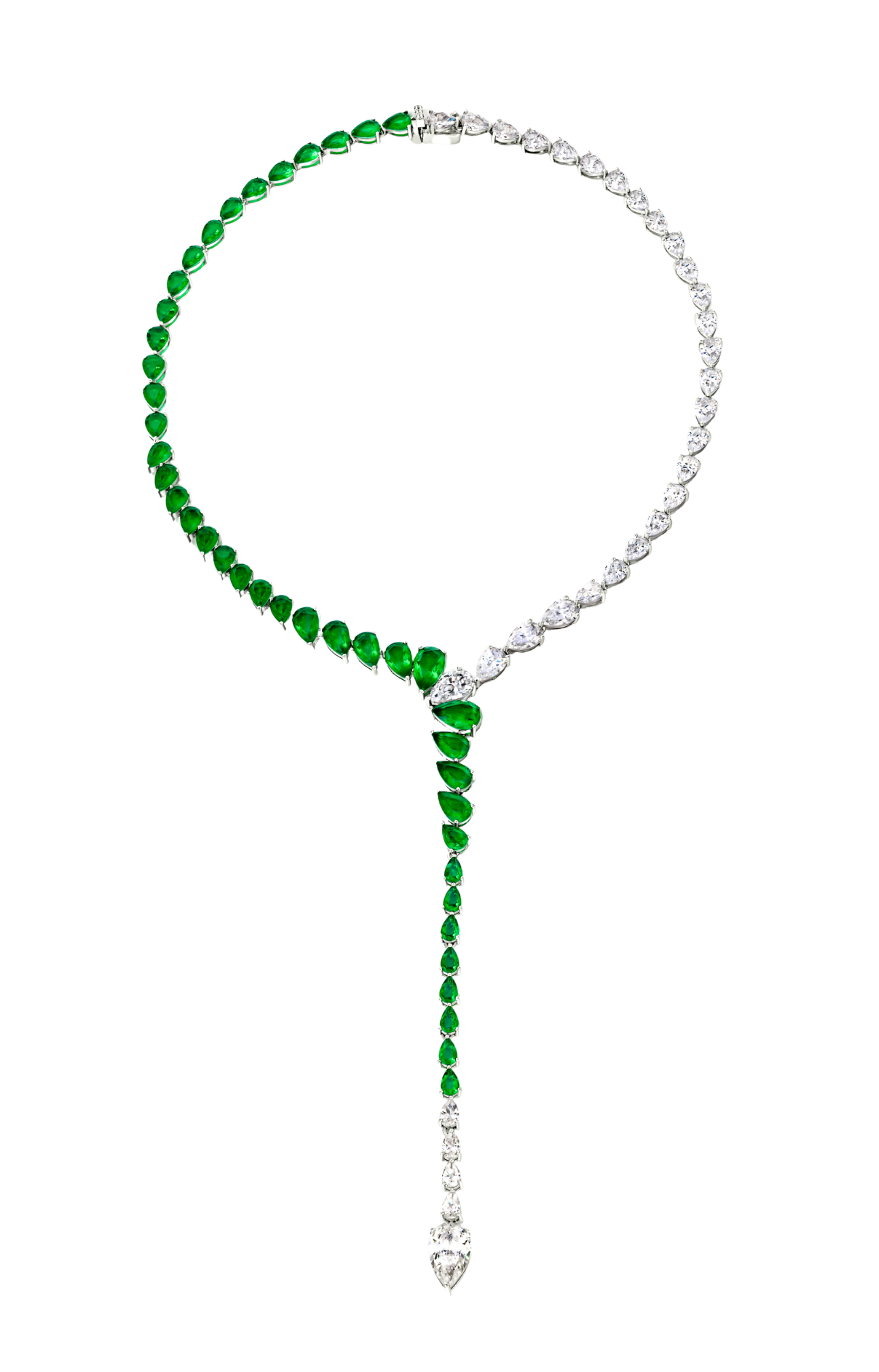
A piece of jewelry with an emerald begins with the stone, not with the drawing. Emeralds almost always have fine fractures, are more brittle than corundum, and are usually filled with oil or resin. Design and setting should therefore protect corners and edges, the laboratory report should state the filling, and care should do without ultrasonic cleaning, steam, and heat.
At a glance
- Mineral
- Beryl, green to bluish green variety
- Mohs hardness
- 7.5 to 8
- Toughness
- Fair to good, more brittle than ruby and sapphire
- Common treatment
- Filling of fractures with oil, wax, or resin
- Stated in SSEF report
- Amount of filler: none, minor, moderate, or significant
- Common cut
- Emerald cut with faceted corners
- Cleaning
- Warm soapy water, no ultrasonic, no steam
The stone determines the design
In a one-of-a-kind piece with an emerald, the stone comes first. According to GIA, almost all emeralds have distinct fractures, known in the trade as fissures. The cutter plans the cut so that these fractures weaken the finished stone as little as possible. Anyone who fixes the design before the stone later forces a sensitive stone into a form that was not intended for it.

The emerald is the green to bluish green variety of the mineral beryl. At 7.5 to 8 on the Mohs scale, it is hard enough to resist everyday scratches. GIA describes its toughness, the resistance to impact and breakage, as fair to good. It therefore requires more care when worn than ruby or sapphire. For the design, this means: protection comes before effect.
How to recognize the quality of an emerald
The value of an emerald is determined above all by its color. According to GIA, bluish green to pure green hues with strong saturation and a tone that is not too dark are sought after. The color should be evenly distributed, without visible color zoning. If the hue is too yellowish or too bluish, the stone is no longer an emerald but another variety of beryl.
Inclusions are normal in emeralds and often visible to the naked eye. Stones without visible inclusions are very rare. What matters is whether the inclusions reduce transparency. A vivid green stone with fine internal features can look more beautiful than a pale, clear one. If, on the other hand, inclusions significantly reduce transparency and clarity, the value drops sharply. More on the effect of the cut is explained in the guide Emerald cut choices.
- Color: green to bluish green, strong, not too dark.
- Distribution: even, without visible color zoning.
- Transparency: high, inclusions must not cloud it.
- Fractures: check their position relative to the surface and the corners.
- Filling: type and amount according to the laboratory report.
Filling, report, and disclosure
Most emeralds are treated. According to estimates cited by GIA, 90 percent or more have fillers in their fractures. Oils, waxes, and natural and artificial resins are used. They make the fractures appear less visible. How stable a filling is depends on the material. Light and chemicals can alter oils, resins, and polymers in fractures that reach the surface.
In its report, the Swiss laboratory SSEF states the filler and the amount in four levels: none, minor, moderate, or significant. An insignificant amount is not mentioned. The disclosure of treatments refers to the Blue Books of CIBJO. The GIA identification report states detectable treatments and, on request, the origin. More under Emerald treatment and origin report.
Good to know
In SSEF's own words, origin determination is an expert opinion. The laboratory compares microscopic features, trace elements, and spectra with its reference collection. A country of origin in the report is therefore a reasoned assessment, not proof.
Cut and setting protect the stone
The step cut with beveled corners bears the emerald's name. According to GIA, it is the most common shape for this stone, partly because the faceted corners reduce the risk of damage. Sharp points, as on pear or marquise shapes, are vulnerable and need a protective setting at exactly that spot. For the emerald, the shape of the emerald cut is therefore also a protective measure.

A bezel setting encloses the edge of the stone with metal. GIA describes it as very good protection for the edges. Prongs show more of the stone but hold it at only a few points. With an emerald, no one should tighten the prongs with force, because an existing fracture can extend in the process. How settings for colored gemstones are chosen in principle is shown in the guide Settings for colored gemstones.
| Type of jewelry | Everyday stress | Consequence for the emerald |
|---|---|---|
| Ring | High: knocks against table edges, doors, bags | Bezel or protected corners, do not set the stone too high |
| Bracelet | Medium to high: contact with tables and watches | Low settings, stones protected at the sides |
| Earrings | Low | More freedom in shape and open setting |
| Pendant, necklace | Low | Larger or more sensitive stones possible |
Assessment by wearing situation. The toughness of an individual stone depends on the position and size of its fractures.
How the piece is made
For an emerald, the process follows the same logic as for any bespoke piece, with one difference: the stone should be looked at again before every working step. At Vikar Ahmed, the path leads in three steps from the design through a three-dimensional visualization with CAD to realization as a one-of-a-kind piece in the in-house atelier in Idar-Oberstein. The emeralds come mainly from Colombia, with additional stones from Zambia. Vikar Ahmed accepts light colorless oiling, usually with cedarwood oil, but rejects synthetic resins and colored oil, and clients are always told whether and how heavily a stone has been oiled.
- Examine stone and reportClarify color, transparency, position of fractures, and filling according to the laboratory report before a design is created.
- DesignSketch with type of jewelry, proportion, and a setting that suits the weak points of the stone.
- VisualizationThree-dimensional CAD model on which height, protection of the corners, and wearing comfort are checked.
- Setting by handThe goldsmith sets the stone with little pressure and without heat at the stone.
- Handover with care instructionsNotes on cleaning and on checking the setting are part of the handover.
How long design and production take depends on the design, the stone and the work involved, so a fixed date belongs early in the conversation. Clarify in advance whether the emerald comes with a report from an independent laboratory such as GIA or SSEF, and ask for the laboratory and report number. An overview of the path to your own piece is given in the guide Having jewelry made.
Common mistakes with emerald jewelry
- Fixing the design first and looking for the stone afterward.
- Choosing an emerald for clarity alone and putting color second.
- Regarding a report without information on filling as complete.
- Setting a large emerald high and open in an everyday ring.
- Setting pointed shapes without protecting the points.
- Having the piece cleaned in an ultrasonic bath or with steam.
The most common mistake concerns care years later. A ring is handed in for cleaning, and the workshop's device is an ultrasonic bath. For a diamond, this is usually harmless, for a filled emerald it is not. Anyone handing in a piece with an emerald for cleaning, resizing, or repair should name the stone explicitly and mention the filling stated in the report.
Care after the handover
According to GIA, the safest way to clean an emerald is with warm soapy water and a soft brush. Ultrasonic cleaning can further weaken stones that are already fractured. Hot steam can drive oil or uncured resin out of the fractures. Heat can extend existing fractures. Even hot dishwater can damage filled emeralds. Rings with emeralds should therefore not be worn while washing dishes or cooking.
A filling can change over the years, depending on the material and stress. If an emerald suddenly looks cloudier or shows new lines, that is a reason to have it examined by a gemologist. How setting checks, cleaning or a later resizing will be handled is best clarified before the handover. Further knowledge about the stone is gathered on the page Emerald.
Frequently asked questions
How do you recognize a good workshop for jewelry with emeralds?
The workshop should examine the stone before the design, present or obtain a laboratory report stating the filling, show a three-dimensional design, and set by hand. Vikar Ahmed makes one-of-a-kind pieces in its in-house atelier in Idar-Oberstein and works with emeralds mainly from Colombia, with additional stones from Zambia.
Is an emerald suitable for a ring worn every day?
Yes, with limitations. Its hardness of 7.5 to 8 is sufficient against scratches, but its toughness is only fair to good. A bezel or protected corners, a setting that is not too high, and taking the ring off for housework and sports make it suitable for everyday wear.
Does an emerald have to be oiled?
No, but most are. Untreated emeralds are rare. What matters is that the filling is disclosed. An SSEF report states the filler and the amount from minor to significant, and does not mention an insignificant amount.
Which setting protects an emerald best?
The bezel setting, because the metal encloses the entire edge and shields the edges from knocks. Prongs are possible if they cover the corners of the stone and are set without excessive pressure. The best choice also depends on where the fractures lie in the stone.
Can emerald jewelry be cleaned in an ultrasonic bath?
No. Ultrasonic cleaning can further weaken fractured stones, and steam can drive oil or soft resin out of the fractures. Warm soapy water with a soft brush is safe. For any repair, the workshop should be told that a filled emerald is set in the piece.
How many inclusions are normal in an emerald?
Visible inclusions are the rule in emeralds, and eye-clean stones are very rare. Inclusions only become critical when they significantly reduce transparency or lie as fractures close to corners and edges. Then the value drops, and the setting must give the stone particular protection.
Private consultation
Whether an emerald is better suited to a ring, a necklace, or earrings can be clarified with the stone in hand and in conversation. Vikar Ahmed offers consultations by appointment in the showroom in Idar-Oberstein, and virtually on request. Custom projects begin after the inquiry has been reviewed. Request an appointment for a private consultation.
Further reading
- Gemstone: Emerald
- Having an emerald set
- Colombian emeralds
- Glossary: Treatment
- Jeweler for clients from the Nahe region
Sources
- GIA: Emerald Quality Factors, accessed 2026-11-17
- GIA: Emerald Care and Cleaning, accessed 2026-11-17
- GIA: Emerald Description, accessed 2026-11-17
- GIA: Gem Treatment, accessed 2026-11-17
- SSEF: Emerald, Füllung und Herkunft im Bericht, accessed 2026-11-17
- GIA: Colored Stone Reports, accessed 2026-11-17
- GIA 4Cs: Complete Guide to Engagement Ring Settings, accessed 2026-11-17
- Vikar Ahmed: Bespoke, accessed 2026-11-16
- Vikar Ahmed: Collections, accessed 2026-11-16
- GIA: Gem Laboratory, accessed 2026-11-17
- SSEF Swiss Gemmological Institute, accessed 2026-11-17

A personal conversation starts here.
At the showroom in Idar-Oberstein or by video. Vikar Ahmed discusses your ideas, stones and designs with you and answers your questions calmly and in confidence.


Thank you for your request.
Your request will be handled with the utmost attention and discretion. Vikar Ahmed will get back to you.
Your details
Request
–
Occasion
–
Consultation
–
Contact
–
In the meantime
Insights: What is a Paraíba tourmaline? · Engagement ring to your own design: how does it work?
Confidential and without obligation
Back to the pagePrivate consultation
A personal conversation starts here.
- Time for your questions, wishes and ideas
- In the showroom in Idar-Oberstein or by video
- Confidential, discreet and without obligation
Vikar Ahmed · Hauptstraße 111 · 55743 Idar-Oberstein, Germany