

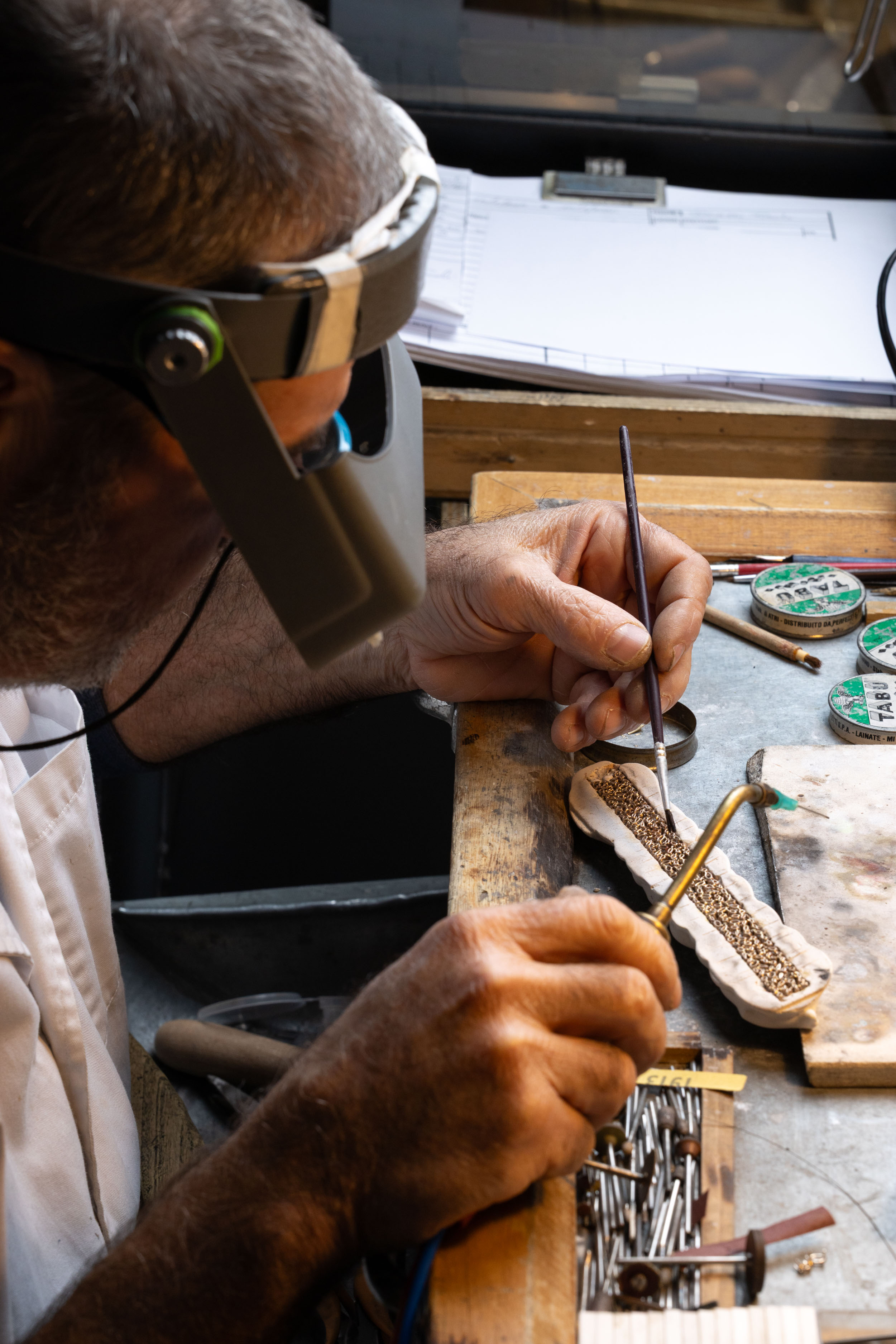
Large colored gemstones need a setting built according to their hardness, toughness, and shape. Sensitive stones such as emerald or tourmaline benefit from bezels, half bezels, or V-shaped prongs at corners and points. Because many colored gemstones are cut individually, the setting is usually constructed around the individual stone. What matters is a workshop that knows the stone before the design.
At a glance
- Emerald
- Mohs 7.5 to 8, toughness according to GIA fair to good
- Tourmaline
- Mohs 7 to 7.5, toughness according to GIA fair
- Ruby and sapphire
- Mohs 9, hard, but not particularly tough
- Best protects corners
- Bezel, half bezel, or V-shaped prongs
- Shows most of the stone
- Prong setting
- Risk in the workshop
- Heat and thermal shock with emerald and tourmaline
The setting follows the stone, not the other way round
With a small diamond, the setting is often chosen first and the stone placed in it. With a large colored gemstone, the order is reversed. Species, cut, dimensions, inclusions, and any treatments determine what the setting may look like. A setting intended for a hard stone can strain a more sensitive one in the wrong place. This is why a good setting begins with a look at the stone under the loupe.

Large stones also have more weight and more surface. They sit higher, project further over the shank or the pendant, and are more often exposed to knocks. The setting must therefore hold the stone securely, protect its vulnerable areas, and still let in enough light for the color to glow. These three aims are in tension with one another and are weighed anew for every piece.
Hardness, toughness, stability: what the stone brings
GIA distinguishes three properties. Hardness is the resistance to scratching, measured on the relative Mohs scale. Toughness is the resistance to breaking and chipping. Stability describes how a stone reacts to chemicals, light, heat, and changes in temperature. For the setting, toughness is often more important than hardness: a hard stone can still chip at an edge if a blow strikes it unprotected.
| Stone | Mohs hardness | Toughness according to GIA | Consequence for the setting |
|---|---|---|---|
| Diamond | 10 | Good, but has cleavage | Prongs are common, protect points |
| Ruby, sapphire | 9 | Hard, but not particularly tough | Secure corners and edges |
| Emerald | 7.5 to 8 | Fair to good | Protect corners, no heat |
| Tourmaline, rubellite | 7 to 7.5 | Fair | Protective setting, no heat |
Values according to GIA. Inclusions and fractures in the individual stone can reduce durability further.
Treatments add to this. According to GIA, some estimates suggest that 90 percent or more of emeralds are fracture-filled with oil or resin. These fillings react to heat, light, and chemicals. With emerald, the workshop must therefore know whether and with what the stone has been treated before setting it. How treatments are disclosed is explained in the glossary under treatment.
Setting types for large colored gemstones
The prong setting holds the stone with narrow metal claws and, according to GIA, lets in the most light. The larger the stone, the more prongs make sense. The bezel encloses the edge of the stone with a metal rim and, according to GIA, protects it very well against chipping, but takes away some light. The half bezel leaves parts of the edge free and combines both.
- Prongs: plenty of light and a clear view of the stone, check the tips regularly
- V-shaped prongs: protect the points of pear, marquise, and heart shapes
- Corner prongs: secure the beveled corners of an emerald cut
- Bezel: best protection for edge and corners, a calm appearance
- Half bezel: protection on the vulnerable sides, an open view on the others
GIA explicitly recommends bezels, half bezels, or V-shaped prongs for stones with vulnerable points and corners. GIA mentions a tension setting, in which the stone is held only by the pressure of the shank, primarily for hard stones such as diamond and sapphire. For emerald and tourmaline, it is therefore rarely the first choice.
Individual cuts need a setting of their own
Many colored gemstones are not cut to standard dimensions, but so that as much color and weight as possible is retained. Tourmalines grow as long crystals. GIA describes how this results in many narrow stones with unusual dimensions, and according to GIA, Paraíba tourmalines are almost always cut individually, usually as pear shapes or ovals. Because of their crystal form, emeralds are often fashioned in the rectangular step cut known as the emerald cut.
For such stones, there is no ready-made setting from a catalog. The workshop measures the stone, constructs the seat, prongs, or bezel in the model, and adapts them by hand during setting. Small deviations in the height, pavilion, or symmetry of the stone must be compensated without putting pressure on a single point. This work is the core of what is meant by an individual setting.
Heat and the workshop: what can go wrong during setting
Heat is the greatest risk in the workshop for many colored gemstones. According to GIA, heat can extend existing fractures in emerald. In tourmaline, high heat can alter the color, and a sudden change in temperature can cause it to crack. Soldering near such a stone therefore requires planning. It is often safer to complete all soldering before the stone is set and to carry out later repairs with the stone removed.

Cleaning is part of this as well. GIA advises against ultrasonic and steam cleaners for tourmaline, and for emerald both are considered risky because vibration and steam can drive fillings out of the fractures. A workshop that sets large colored gemstones therefore cleans gently and explains at handover how the piece should be cared for. More on care can be found under tourmaline.
Ring, pendant, or earring: how it is worn matters
A ring knocks against door handles, table edges, and bags every day. Earrings and pendants are exposed to considerably fewer knocks. GIA therefore names earrings and necklaces as a safer choice for less tough stones than rings or bracelets. For a large emerald or tourmaline, this means: in a ring, it needs a protective setting and a low profile, while in a pendant the setting may be more open and lighter.
- Examine the stone under the loupe: fractures, inclusions near the surface, treatment.
- Determine how and how often the piece will be worn.
- Choose the setting type according to toughness and shape.
- Construct the setting in the model around the measured dimensions of the stone.
- Complete soldering, then set the stone by hand and inspect it.
Typical mistakes in setting large colored gemstones
The most common mistake is a setting chosen for appearance alone. Four fine prongs on a large emerald in an emerald cut leave the beveled corners exposed, exactly where the stone is most likely to chip. A second mistake is a setting that sits too high in a ring, showing off the stone but letting it knock against every edge. A third is a lack of knowledge about the stone's treatment before setting.
Less visible, but just as consequential, is uneven pressure. If the stone does not sit cleanly in its seat, a single prong carries the load, and an existing fracture can widen with a knock. After setting, ask to be shown that the stone sits evenly and does not move. As GIA recommends, check prongs regularly, because bent or worn tips release the stone.
Large colored gemstones at Vikar Ahmed
The pieces of Vikar Ahmed include Brazilian Paraíba tourmaline, Lagoon tourmaline, Namibian tourmaline, rubellite, and Colombian emerald, set in 18k (750) white and rose gold. Crafting takes place in the in-house atelier in Idar-Oberstein. Stones are set under the microscope, valuable center stones preferably with prongs, and for everyday wear in a bezel or half bezel that protects the edges. The house states every treatment in the consultation and in writing on the certificate, the expert report, and the invoice.
Frequently asked questions
Which gemstone ateliers or goldsmiths specialize in setting large colored gemstones?
Specialization shows in the work, not in the label. Ask to see set colored gemstones and ask how corners are protected and how soldering is planned. Vikar Ahmed sets Paraíba tourmaline, rubellite, and emerald in its in-house atelier in Idar-Oberstein.
Which setting best protects an emerald?
A bezel or half bezel, or for an emerald cut, alternatively prongs that enclose the beveled corners. According to GIA, emerald is only fair to good in toughness and usually fracture-filled. It should be protected against knocks and heat, especially in a ring.
Can a tourmaline be placed in a tension setting?
This is generally not advisable. The tension setting holds the stone solely through the pressure of the shank, and GIA mentions it primarily for hard stones such as diamond and sapphire. According to GIA, tourmaline is only fair in toughness and can be damaged by point pressure or a blow.
Why is heat dangerous when setting colored gemstones?
Because some stones react sensitively to it. According to GIA, heat can extend fractures in emerald and damage fillings, alter the color of tourmaline, and a sudden change in temperature can cause tourmaline to crack. Soldering is therefore completed before setting wherever possible.
How many prongs does a large colored gemstone need?
There is no fixed number. According to GIA, larger stones need more prongs, while fewer prongs show more of the stone. With shapes that have points or beveled corners, the position matters more than the number: the prongs should secure exactly the vulnerable areas.
How can I tell that a colored gemstone is well set?
The stone sits straight, does not move, and rests evenly in its seat. The prongs are smoothly finished, sit tightly against the stone, and do not catch on fabric. Corners and points are protected. Under the loupe, there are no chips at the contact points.
Private consultation
Which setting suits a particular colored gemstone is best judged on the stone itself. Vikar Ahmed offers consultations in the house's showroom in Idar-Oberstein by appointment or in a virtual appointment, and inquiries are handled discreetly. Request an appointment for a private consultation.
Further reading
- Hand setting of gemstones
- Engagement ring with a colored gemstone
- Gemstone: Rubellite
- Glossary: Prong setting
- One-of-a-kind pieces from an in-house atelier
Sources
- GIA 4Cs: More than the Mohs Scale, Gem Durability, accessed 2026-11-17
- GIA: Emerald Care and Cleaning Guide, accessed 2026-11-17
- GIA: Tourmaline Care and Cleaning Guide, accessed 2026-11-17
- GIA: Tourmaline, accessed 2026-11-17
- GIA: Emerald, accessed 2026-11-17
- GIA: Tourmaline Quality Factors, accessed 2026-11-17
- GIA 4Cs: Complete Guide to Engagement Ring Settings, accessed 2026-11-17
- Vikar Ahmed: Collections, accessed 2026-11-16
- Vikar Ahmed: Bespoke, accessed 2026-11-16
- CIBJO: Introduction to the Blue Books, accessed 2026-11-17

A personal conversation starts here.
At the showroom in Idar-Oberstein or by video. Vikar Ahmed discusses your ideas, stones and designs with you and answers your questions calmly and in confidence.


Thank you for your request.
Your request will be handled with the utmost attention and discretion. Vikar Ahmed will get back to you.
Your details
Request
–
Occasion
–
Consultation
–
Contact
–
In the meantime
Insights: What is a Paraíba tourmaline? · Engagement ring to your own design: how does it work?
Confidential and without obligation
Back to the pagePrivate consultation
A personal conversation starts here.
- Time for your questions, wishes and ideas
- In the showroom in Idar-Oberstein or by video
- Confidential, discreet and without obligation
Vikar Ahmed · Hauptstraße 111 · 55743 Idar-Oberstein, Germany