

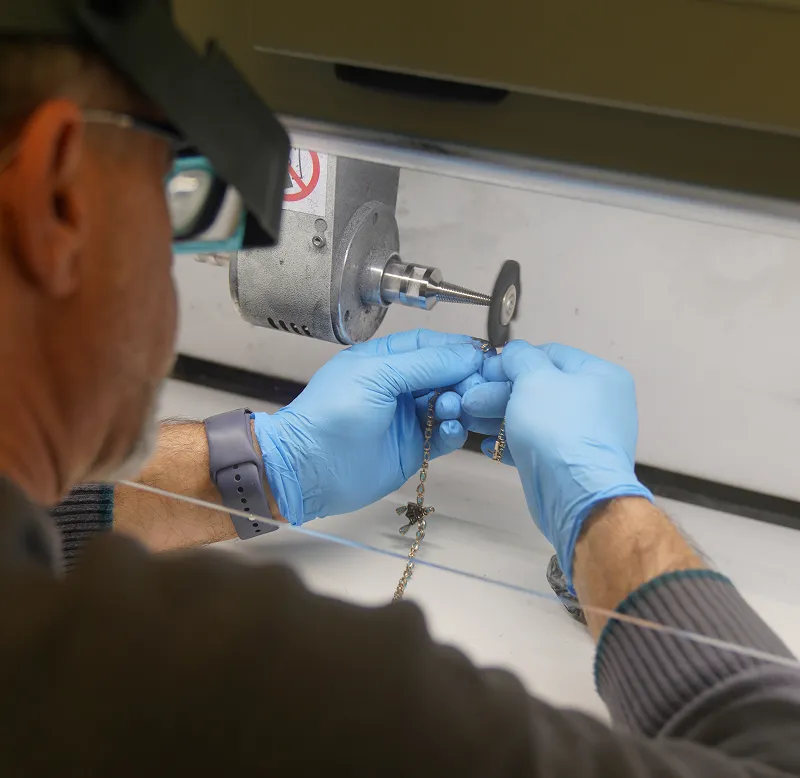
In hand setting, a setter places each stone individually and adapts prongs, bezel, or beads to its actual dimensions. This is worthwhile above all for large stones, fancy shapes, sensitive colored gemstones, and one-of-a-kind pieces. In series production, stones are sometimes set by machine or even before casting. You can recognize good hand setting by even holds that sit against the stone without gaps.
At a glance
- Hand setting
- Each stone is placed and secured individually by a setter
- Typical tools
- Gravers, burs, punches, loupe or microscope
- Especially useful for
- Large stones, fancy shapes, sensitive colored gemstones, one-of-a-kind pieces
- Setting types
- Prong, bezel, channel, pavé, basket
- Sign of good work
- Holds sit evenly against the stone without gaps
- Care
- Check the setting regularly, a loose stone wears down the prong
What hand setting means
Setting means enclosing a stone in metal so that it holds securely and shows its light. In hand setting, this is done stone by stone by a setter, a specialized goldsmith. The setter cuts the seat for the stone into the metal, places the stone, and pushes prongs, bezel, or small metal beads over its edge by hand. In doing so, the setter works to the actual stone, not to a standard measurement.

This distinguishes hand setting from series production methods. There, stones are sometimes set by machine or placed in the wax model and cast together with the metal. That is economical for uniform, small stones. Yet stones are never entirely identical. Their girdle, the outer edge of the stone, varies in thickness and shape, and fancy shapes have sensitive points. The hand compensates for these differences, series production only to a limited extent.
Which setting types are done by hand
Almost every setting type can be done by hand, but the effort differs. GIA describes the common types in its guide to ring settings. In goldsmith training, it teaches setting fancy shapes in bezel, V-prongs, and channel as a discipline of its own. The table shows what the hand achieves in each of the main setting types.
| Setting type | What the setter does | What matters |
|---|---|---|
| Prongs | Shorten and shape the prongs and lay them over the stone | Equal length, gap-free seat, smooth tips |
| V-prongs | Enclose the points of a pear or marquise | Protects the point from chipping |
| Bezel | Press the metal rim against the stone all around | Even rim without folds or gaps |
| Channel | Set stones in a groove between two walls | Stones at one height, no tilting |
| Pavé | Hold many small stones with metal beads | Even beads, stones close and level |
Setting types according to the GIA guide to ring settings, supplemented by the setter's work.
When hand setting makes the difference
For a small round diamond in a standard setting, the difference is minor. The larger, more valuable, or more sensitive a stone, the more the hand matters. A diamond has a hardness of 10 on the Mohs scale, but according to GIA it can break along its cleavage direction from a hard blow. Pointed shapes are therefore usually set with prongs that protect the corners. A setter applies pressure precisely where the stone can bear it.
- Large center stones whose seat must be matched exactly to the stone.
- Fancy shapes such as pear, marquise, or emerald cut with sensitive corners.
- Colored gemstones with low toughness or fillings, such as emerald or tanzanite.
- One-of-a-kind pieces for which no series form exists.
- Pavé and halo settings in which many small stones should lie level.
With colored gemstones, sensitivity to heat and pressure comes into play. According to GIA, tanzanite has fair to poor toughness and tends to cleave, while emeralds are often filled with oil or resin and do not tolerate heat well. A setter therefore plans the order in which soldering and setting take place. More on choosing the right setting for colored gemstones in the guide Settings for colored gemstones.
How to recognize a good setting
Good setting work is barely noticeable, poor work is. Take a loupe and look at the stone from above and from the side. Holds should sit against the stone without a visible gap and be of equal length and shape. The stone must not sit crooked. Small stones in pavé should lie on one plane, and the metal beads should be equal in size and round.

- Tap the stone gently with a fingernail: it must neither rattle nor turn.
- Check the prongs from the side: even, with no gap to the stone.
- Run a cloth over the prongs: nothing should catch.
- Look at the bezel all around: a closed rim without folds.
- Look at the underside: clean openings, no burrs.
A prong that catches on fabric is more than a nuisance. It can bend open and loosen the stone. Loose stones, in turn, wear down the prong over time, according to GIA. What defines a prong setting in detail is explained in the glossary, and the particular features of small stones in the Glossary: Pavé.
Handwork or series: an honest assessment
Industrially produced jewelry is not bad. Modern methods deliver consistent results, and for simple pieces with small stones that is sufficient. A handmade one-of-a-kind piece is the better choice when the stone is special, the shape does not follow a standard, or the piece is to be worn for generations. The additional effort lies in the setter's time, which is measured by the individual stone and cannot be shortened.
Many workshops combine both. The basic structure is made with the help of CAD and casting, while setting and polishing are done by hand. What matters is who sets the stone in the end and how much time is available for it. Ask about this in the conversation. How a goldsmith's workshop and a larger operation differ is examined in the comparison Goldsmith or in-house atelier.
Caring for a hand-set piece
Even the best setting needs attention. According to GIA, prongs wear and occasionally need to be rebuilt, and stones need to be tightened. Ultrasonic and steam cleaners can loosen stones in their setting. Professionals therefore check jewelry for loose stones before such cleaning. At home, warm water with a little dish soap and a soft brush are sufficient. Have your piece checked after a knock, even if nothing is visible from the outside.
Particular care applies to pavé and channel settings. According to GIA, rings with pavé or channel settings are harder to resize. Plan the ring size carefully before setting. For heirlooms that are to be reset, the guide to the individual setting is worth a look.
Hand setting at Vikar Ahmed
Vikar Ahmed names gemstone setting and hand polishing as working steps of its own atelier in Idar-Oberstein. Setting is done under the microscope, most often with prongs, a bezel or half bezel, and as pavé and micro-pavé. According to the house, every surface, including every hidden edge, is worked by hand during polishing. The house's Signature Bangle features a double row of hand-set diamonds. The house describes its work with the words “modern technology, genuine handcraft”: visualization with CAD, production by goldsmiths with decades of experience.
Frequently asked questions
Is a one-of-a-kind hand-set piece worth the premium over machine-set jewelry?
For large, valuable, or sensitive stones and for fancy shapes, yes, because the setter adapts every hold to the actual stone and measures the pressure. For simple pieces with small, uniform stones, the difference is smaller. What matters is how long and how often you intend to wear the piece.
Handmade one-of-a-kind piece or industrially produced jewelry: which is the better choice?
The one-of-a-kind piece, if you are looking for a piece with its own design and a special stone that is to be worn for decades. Industrially produced jewelry is sufficient for simple pieces where uniformity is no disadvantage. Many workshops combine technology and handwork, so ask which steps are done by hand.
Which goldsmiths would you recommend for an engagement ring with a hand-set diamond?
Look for a workshop that does the setting itself and shows you the design in advance. Vikar Ahmed makes engagement rings individually in Idar-Oberstein and names gemstone setting and hand polishing as work steps. More on the ring itself in the guide Engagement ring from the in-house atelier.
How can I tell whether a stone was set by hand?
It often cannot be determined with certainty from the outside. Indications are finely and individually shaped prongs, a gap-free seat, and even metal beads in pavé that are matched precisely to each stone. The most reliable answer is the workshop's information on who set the stone.
How often should a setting be checked?
Regularly, and always after a hard knock. On rings worn daily, prongs wear faster than on pendants or earrings. A loose stone can wear down the prong over time. A setter checks the seat and hold of the stones and tightens them if needed.
Can a setter treat every gemstone the same way?
No. Hardness, toughness, cleavage, and treatments determine how much pressure and heat a stone can bear. A diamond withstands more pressure than a tanzanite, and a filled emerald does not tolerate heat. The setter chooses tools, setting type, and the order of work steps accordingly.
Private consultation
How your stone is best set can be clarified with the stone and the design in hand. Vikar Ahmed offers consultations by appointment in the showroom in Idar-Oberstein or virtually, and treats every inquiry with discretion. Custom projects are reviewed on request. Request a private consultation.
Further reading
- Glossary: Prong setting
- An individual setting for your own stone
- Settings for colored gemstones
- Gemstone: Diamond
- Engagement ring from the in-house atelier
Sources
- GIA 4Cs: Complete Guide to Engagement Ring Settings, accessed 2026-11-17
- GIA: Graduate Jeweler Program, accessed 2026-11-17
- GIA: Diamond Care and Cleaning Guide, accessed 2026-11-17
- GIA: Tanzanite Care and Cleaning Guide, accessed 2026-11-17
- GIA: Emerald Care and Cleaning Guide, accessed 2026-11-17
- GIA 4Cs: The Mohs Scale of Hardness, accessed 2026-11-17
- Vikar Ahmed: Bespoke, accessed 2026-11-17
- Vikar Ahmed: Startseite, accessed 2026-11-17

A personal conversation starts here.
At the showroom in Idar-Oberstein or by video. Vikar Ahmed discusses your ideas, stones and designs with you and answers your questions calmly and in confidence.


Thank you for your request.
Your request will be handled with the utmost attention and discretion. Vikar Ahmed will get back to you.
Your details
Request
–
Occasion
–
Consultation
–
Contact
–
In the meantime
Insights: What is a Paraíba tourmaline? · Engagement ring to your own design: how does it work?
Confidential and without obligation
Back to the pagePrivate consultation
A personal conversation starts here.
- Time for your questions, wishes and ideas
- In the showroom in Idar-Oberstein or by video
- Confidential, discreet and without obligation
Vikar Ahmed · Hauptstraße 111 · 55743 Idar-Oberstein, Germany