

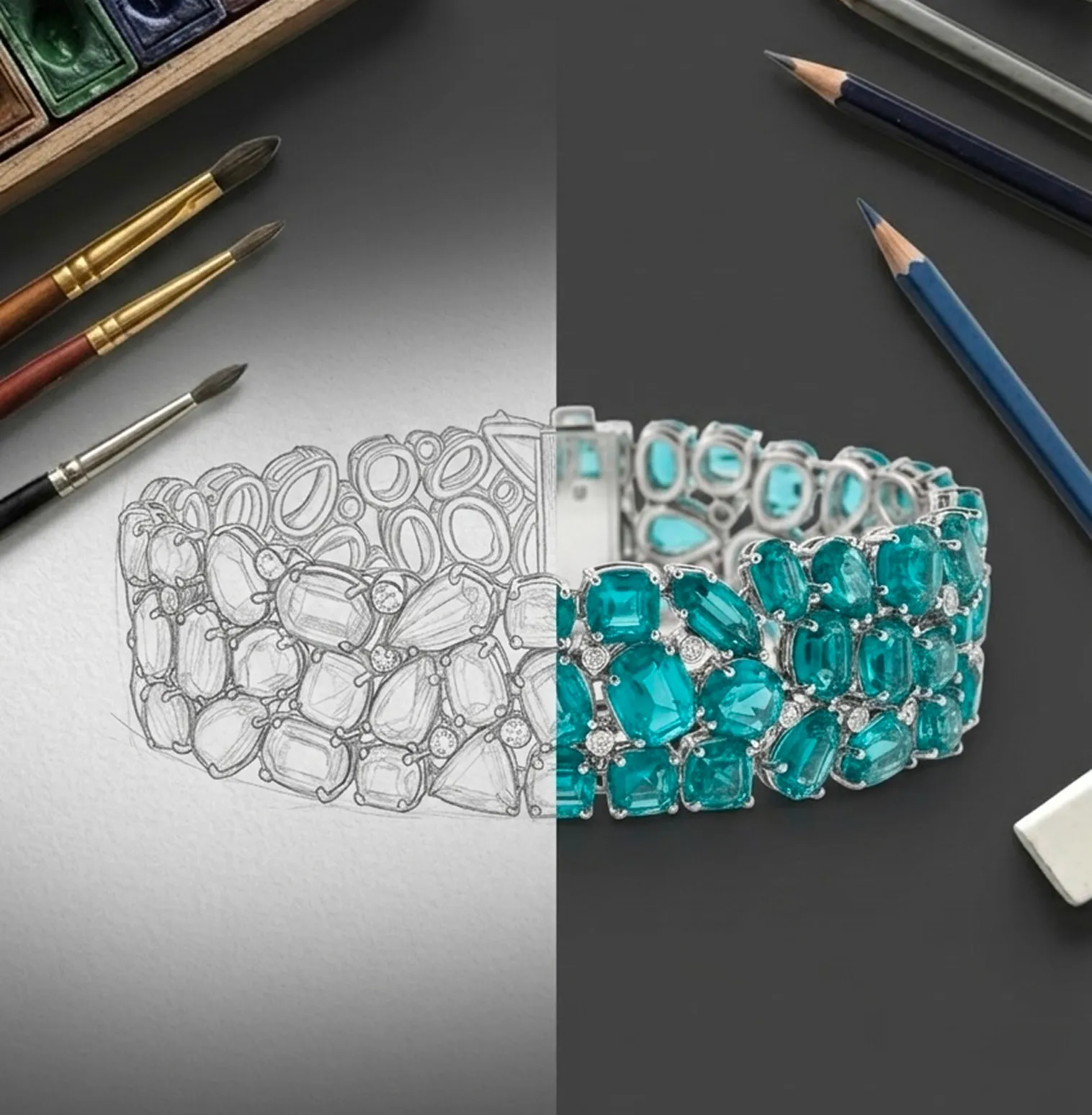
An individual setting is constructed around the exact dimensions of an existing stone. Beforehand, the stone is identified, measured, and examined for treatments and damage, because some stones tolerate heat or pressure poorly. You help decide the setting type, height, metal, and side profile. A design shows the result before production.
At a glance
- Starting point
- An existing stone around which the setting is constructed
- Before setting
- Identification, measurement, examination for treatments and damage
- Common setting types
- Prong, bezel, basket, channel, tension setting
- Delicate stones
- Filled emeralds, tanzanite, irradiated or coated diamonds
- What you decide
- Setting type, height, prong shape, metal, side profile
- Laboratory report
- Possible for loose and mounted stones, most informative before setting
The setting follows the stone, not the other way around
For a new piece of jewelry, the stone is often chosen to suit a design. If you bring your own stone, this is reversed. Its shape, diameter, depth, and the position of its inclusions set the framework. The setting is constructed to hold the stone securely, protect its edges, and not obstruct its light. A standard head from series production rarely fits exactly, especially with colored gemstones of irregular proportions.

An individual setting has three tasks at once. It holds the stone mechanically, it determines how much light enters from the side and from below, and it shapes the effect of the whole piece. A stone set high looks present, one set low looks calm and suited to everyday wear. For an inherited stone, a new setting can also mean freeing it from a damaged or outdated piece of jewelry and giving it a second story.
Which setting type suits which stone
The Gemological Institute of America, GIA for short, describes the common ways of holding a stone. Each has its own strengths. The prong setting lets the most light into the stone and shows the most of it. The bezel, a metal rim around the stone, protects its edge best. Which type is suitable depends on the hardness, toughness, and shape of the stone, and on how often and during what activities you wear the piece.
| Setting type | Strength | To consider |
|---|---|---|
| Prongs | Plenty of light, the stone remains clearly visible | Prongs can catch and need checking |
| V-prongs | Protect the points of pear and marquise shapes | Only at the points, otherwise like prongs |
| Bezel | Protects the edge of the stone very well | Somewhat less light than with prongs |
| Basket | Prongs with cross bars, stable for large stones | Looks more substantial from the side |
| Channel | Stones protected between two metal walls | Rings are difficult to resize |
| Tension setting | The stone appears to float | A hard knock can loosen it, better suited to hard stones |
Properties according to the GIA guide to ring settings.
What a stone must bring in order to be set
Not every stone tolerates setting equally well. Hardness on the Mohs scale describes only scratch resistance. Toughness, the resistance to breaking and chipping, is a separate property. A diamond has a value of 10 on the Mohs scale and can still be split along its cleavage direction by a hard blow. When the prongs are pressed down, forces act on the stone that a setter must understand and measure.
Heat is the second issue. Soldering near a set stone produces high temperatures. According to GIA, heat can damage emeralds and extend existing fractures, and hot steam can drive oil or unhardened resin out of the fractures. Tanzanite should not be exposed to very high temperatures or rapid temperature changes. Irradiated and coated diamonds are also sensitive to heat. Their color can change during repairs.
- Emerald: 7.5 to 8 on the Mohs scale, often filled with oil or resin, sensitive to heat.
- Tanzanite: 6 to 7 on the Mohs scale, fair to poor toughness, tends to cleave.
- Diamond: 10 on the Mohs scale, yet cleavable, and the points of fancy shapes need protection.
- Treated stones: clarify the type of treatment before any work involving heat.
Before the first design: knowing the stone
Before a setting is planned, it should be established what the stone is. With heirlooms, this is often unclear. A laboratory report confirms the identification and lists detectable treatments. For its identification report, GIA also examines mounted material, but a loose stone can be examined more completely. If you plan to remove the stone from its old setting anyway, use that moment for the examination. More in the Glossary: GIA report.

- IdentifyHave the type of stone, treatments, and, where relevant, origin determined by a laboratory.
- MeasureRecord length, width, depth, and girdle thickness precisely, as the basis for the construction.
- Check conditionDocument chips, fractures, and earlier repairs, ideally with photos.
- DesignDefine setting type, height, and metal, and review the piece before production.
- SetSet the stone with regard to its hardness, toughness, and heat sensitivity.
What you decide in the setting
With an individual setting, you decide more than the metal. The height of the stone determines how present it looks and how easily it catches on clothing. The shape of the prongs changes the outline: according to GIA, four round prongs make a round stone look somewhat more square than six. The side profile, meaning the gallery, basket, or arches beneath the stone, is seen during wear more often than one might expect.
Then there is the question of accent stones. A halo of small stones around the center stone can make it look larger but needs more care. A pavé shank makes later resizing more difficult. These trade-offs are best discussed on a 3D design that shows your own stone at its real dimensions. How sketch, watercolor, and CAD complement each other is explained in the guide to design representation.
Common mistakes when resetting a stone
- Having the stone set without examination and only learning later that it is filled or coated.
- Choosing a very high setting for a piece that is worn daily.
- Leaving the points and corners of fancy shapes without protective prongs or a bezel.
- Choosing a channel or pavé shank even though the ring size might still change.
- Not documenting the condition of the stone before handing it to the workshop.
Many of these mistakes arise because the setting is treated as a minor matter. Yet it determines the durability and effect of the stone for decades. According to GIA, a stone that sits loosely can wear through a prong over time. A carefully constructed setting and checks at sensible intervals protect against this. What the setter's work itself looks like is described in the guide to hand setting.
Your own setting at Vikar Ahmed
As a rule, Vikar Ahmed sets his own diamonds and gemstones. The house takes on a stone you bring only in rare exceptions, for example when it has great emotional value, and only after a gemological examination as part of a new design. Repairs and simple reworking of pieces made elsewhere are not part of this. If such a project goes ahead, it follows the house's steps: design by in-house designers, a 3D CAD design with a photorealistic view, and realization by goldsmiths from Idar-Oberstein, who set the stones under the microscope.
Frequently asked questions
What matters in an individual setting for a gemstone you already own?
That the workshop identifies and measures your stone before the design and constructs the setting around its dimensions, rather than using a prefabricated head. If you are coming from Kirn: Vikar Ahmed has no location there but offers consultations in Idar-Oberstein, see Jeweler for Kirn.
Which bespoke houses let me help decide the setting itself for my one-of-a-kind piece?
A house that carries out design and production itself can plan setting type, stone height, prong shape, and side profile freely. Make sure you see the result before production. At Vikar Ahmed, a three-dimensional visualization with CAD is created for this purpose, and according to the house, personal wishes are incorporated into the design.
Which bespoke jeweler lets me design the setting for my own gemstone individually?
What matters is whether a house examines stones brought by clients before it commits. A sound process begins with identification, measurement, and a condition check of the stone. Vikar Ahmed sets his own stones as a rule and takes on a client's stone only in rare exceptions, after a gemological examination and as part of a new design.
Which jewelers in Morbach let me help decide the setting of my stone?
You can have a say wherever the setting is newly constructed rather than assembled from series parts. Vikar Ahmed has no location in Morbach and offers consultations in Idar-Oberstein or virtually, more under Jeweler for Morbach. In any case, ask whether you approve a design before production.
Can every gemstone be reset?
In principle yes, but not every one with every method. Stones with low toughness or distinct cleavage need gentle setting types. Filled emeralds, tanzanite, and irradiated or coated diamonds tolerate heat poorly. For this reason, the stone is removed before soldering if necessary, or the work is planned so that it is not exposed to heat.
Does my stone need a laboratory report before setting?
It is not mandatory, but it is advisable for unknown or valuable stones. The report clarifies what the stone is and which treatments are detectable. This influences the choice of setting and the handling of heat. A loose stone can be examined more completely than a mounted one.
Private consultation
If you would like to have your own stone reset, describe it as precisely as possible in your inquiry, ideally with an existing laboratory report. Vikar Ahmed reviews every inquiry with discretion. The conversation can take place in the showroom in Idar-Oberstein or as a virtual appointment. Request a private consultation.
Further reading
- Glossary: Prong setting
- Hand setting: what the stone setter's work involves
- Settings for colored gemstones
- Gemstone: Emerald
- Sketch, watercolor, or CAD: design representation
Sources
- GIA 4Cs: Complete Guide to Engagement Ring Settings, accessed 2026-11-17
- GIA 4Cs: The Mohs Scale of Hardness, accessed 2026-11-17
- GIA: Emerald Care and Cleaning Guide, accessed 2026-11-17
- GIA: Tanzanite Care and Cleaning Guide, accessed 2026-11-17
- GIA: Diamond Care and Cleaning Guide, accessed 2026-11-17
- GIA 4Cs: Diamond Treatments and What They Mean to You, accessed 2026-11-17
- GIA: Colored Stone Reports, accessed 2026-11-17
- Vikar Ahmed: Bespoke, accessed 2026-11-17
- Vikar Ahmed: Kontakt, accessed 2026-11-17

A personal conversation starts here.
At the showroom in Idar-Oberstein or by video. Vikar Ahmed discusses your ideas, stones and designs with you and answers your questions calmly and in confidence.


Thank you for your request.
Your request will be handled with the utmost attention and discretion. Vikar Ahmed will get back to you.
Your details
Request
–
Occasion
–
Consultation
–
Contact
–
In the meantime
Insights: What is a Paraíba tourmaline? · Engagement ring to your own design: how does it work?
Confidential and without obligation
Back to the pagePrivate consultation
A personal conversation starts here.
- Time for your questions, wishes and ideas
- In the showroom in Idar-Oberstein or by video
- Confidential, discreet and without obligation
Vikar Ahmed · Hauptstraße 111 · 55743 Idar-Oberstein, Germany