

Sketch, Watercolor, or CAD: How a Design Becomes Visible
Before any metal is worked, a piece of jewelry exists only as a representation. Each form shows something different, and only together do they give a reliable picture.
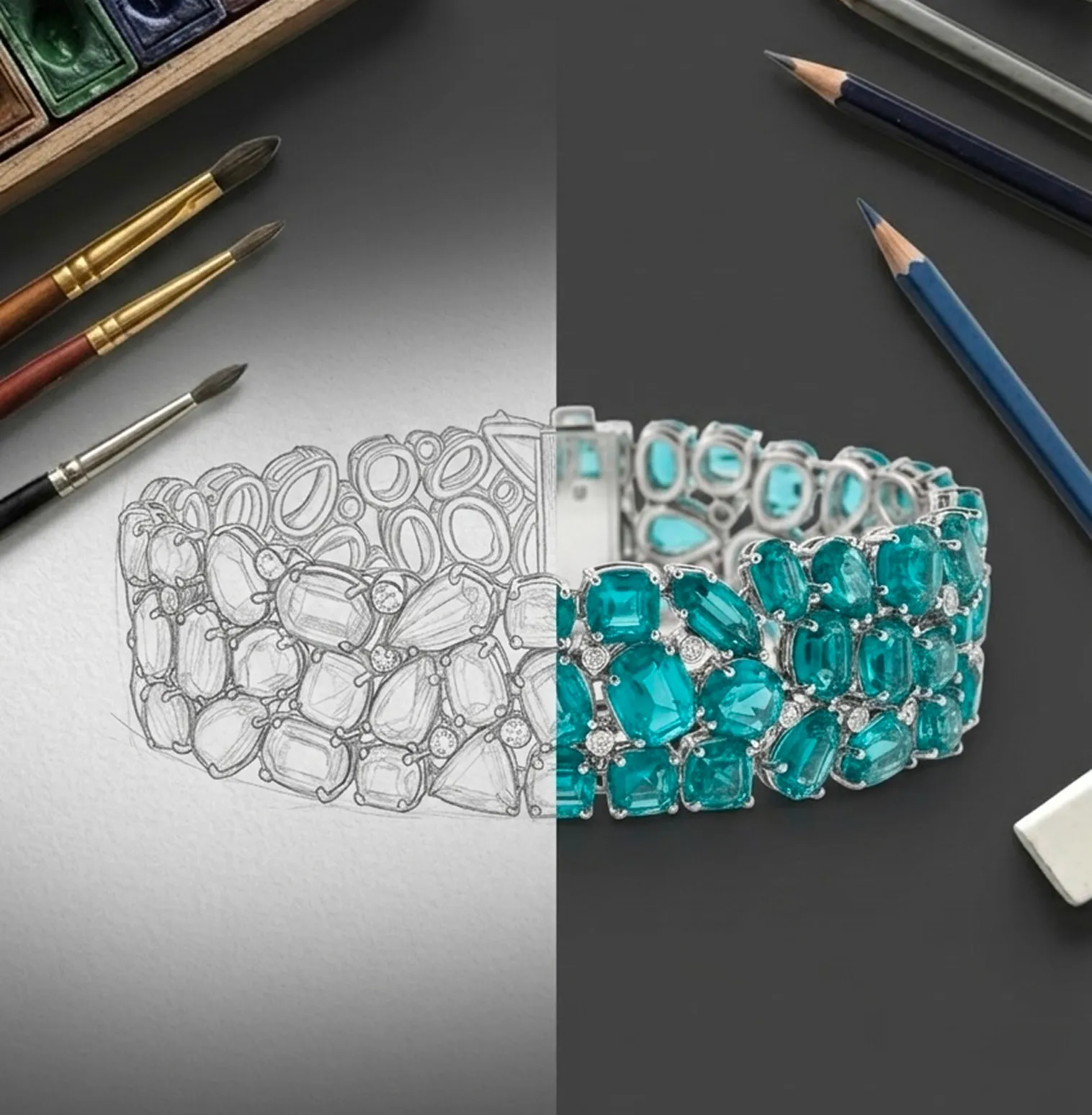
Sketch and watercolor show the idea, the mood, and the color of the stone. A CAD visualization shows the piece to scale from every side and makes proportion, stone seat, and feasibility verifiable. The best way to picture your one-of-a-kind piece is with both: first the hand drawing for direction, then the CAD model for the decision before production.
At a glance
- Hand sketch
- Quick idea, line, and basic form
- Watercolor or gouache
- Color rendering of metal and stone, conveys mood
- CAD model
- Three-dimensional, to scale, can be reviewed from every side
- Rendering
- Photorealistic image generated from the CAD model
- Prototype
- Printed model for trying on the size, without a stone
- Approval
- On the CAD model, before any metal is worked
Each representation answers a different question
The hand sketch answers whether an idea holds up. The watercolor shows how the piece will feel: warm or cool, delicate or bold. The CAD model clarifies whether it can be built and worn this way. Anyone who sees only one of these forms decides with a gap. Good bespoke houses therefore use the representations one after another, not as an either-or.

This sequence is reflected in the training of jewelry designers. In its jewelry design courses, GIA teaches hand drawing with graphite, colored pencils, and watercolor, and the rendering of metal form and texture. Its CAD courses follow with modeling in three dimensions according to the rules of scale and proportion. Both skills belong to the craft, and neither replaces the other.
What the hand shows that the computer does not
A hand drawing leaves room. It sets the line without deciding every detail and invites further thought. A watercolor brings the color of the stone into play, such as the blue of a Paraíba tourmaline next to the tone of rose gold. With colored gemstones in particular, this helps you sense the effect of a piece early. A hand-painted sheet is also a record of how the piece came to be, and it can be kept.
The limits of the hand drawing lie in precision. A sketch can flatter proportions that cannot be held in metal. A stone can look larger than it will be in relation to the hand. The back, the side view, and the substructure often remain open. A watercolor is therefore a good basis for deciding on the direction, but rarely for approving production.
What CAD visualization achieves
CAD stands for computer-aided design. The model is built to real dimensions, with the actual stone, its measurements, and the wall thickness of the metal. Photorealistic images, known as renderings, can be generated from the model. The piece can be rotated, enlarged, and viewed from below. This shows whether the prongs hold the stone securely, whether the gallery is too high, or the shank too narrow. More in the Glossary: 3D design.
A CAD model is also the basis for a prototype. In its courses, GIA describes how digital designs are transferred into physical models with a 3D printer. Such a printed model can be tried on and shows size and weight distribution on the body, without a stone and without precious metal. For rings and large pendants, this is a valuable intermediate step before production.
For the workshop, the model is more than an image. It shows whether a design can be made: whether wall thicknesses are sufficient for the piece to remain stable, whether prongs have enough material to be retightened, and whether the ring size can still be changed later. GIA explicitly names modeling manufacturable jewelry as a learning objective of its CAD courses. A beautiful model that cannot be built helps no one.
The representations compared
The table summarizes which question each representation answers. It also shows why none is sufficient on its own. The hand drawing is strong in effect and weak in precision, the CAD model the other way around. The prototype adds the feel on the body to both. Knowing what you need each representation for lets you ask the right questions in the conversation and recognize whether a design has truly been thought through.

| Representation | Shows well | Shows poorly | Suited for |
|---|---|---|---|
| Hand sketch | Idea, line, basic form | Dimensions, back, feasibility | First conversation, finding a direction |
| Watercolor | Color, mood, effect of stone and metal | Exact proportion and construction | Deciding on the style |
| CAD rendering | Dimensions, stone seat, all views | True color of your own stone | Review and approval |
| Prototype | Size and fit on the body | Color, luster, effect of the stone | Trying on before production |
Which representation answers which question in the design.
How to review a design before production
A design is ready for production only once you have seen it from every angle. Ask for views that go beyond the attractive top view. Pay particular attention to the areas you will see or feel every day when wearing the piece. The following sequence has proven useful.
- Scale: Ask to see the piece at actual size, for example on a photo of your hand.
- Side view: Check the height of the stone, the gallery, and the transition to the shank.
- Stone seat: Ask whether the model is built with the actual dimensions of your stone.
- Back and inside: This is where wearing comfort is decided.
- Metal color: Ask to see the effect in the golds under consideration.
- Approval point: Clarify until when changes are possible.
Bring whatever helps you to this review: a photo of your hand, a piece whose size you like, or the stone itself. Compare the model with these reference points rather than with your memory. Collect your change requests and submit them together rather than one by one. This keeps it clear which version of the model was approved for production.
Common misunderstandings
A rendering is not a photograph. It shows ideal light and an ideal stone. The color of your actual stone, its inclusions, and its fire can only be seen in the original. Screens also display colors differently. Always judge colored gemstones on the stone itself, and use the rendering for form and proportion. How the color and quality of a stone are assessed is explained in the guide to the engagement ring with a colored gemstone.
A second misunderstanding concerns the effort involved in changes. On the model, every adjustment looks easy. But if the stone changes in shape or size, the setting has to be redesigned, often along with the proportion of the whole piece. What remains flexible in the process is described in the guide to the bespoke jeweler. How far your input reaches is explored on the page about creative input.
Design and visualization at Vikar Ahmed
At Vikar Ahmed, in-house designers develop independent concepts into which personal wishes flow. On its website, the house names sketches and watercolors as part of the design. This is followed by a 3D CAD design with a photorealistic view in which details can still be adjusted, then by 3D wax printing and investment casting. Goldsmiths from Idar-Oberstein then realize the design as a one-of-a-kind piece in the in-house atelier. For the first conversation, it helps to note down the occasion, the desired date, and your wishes for stone and style beforehand, ideally with your own sketches.
Frequently asked questions
Hand sketch or CAD visualization: which helps me picture my one-of-a-kind piece better?
Both, in the right order. The hand sketch shows whether you like the idea and leaves room for changes. The CAD visualization shows the piece at real dimensions from every side. For the decision before production, the CAD model is more reliable, for the mood the drawing.
I have a precise idea of my ring and would like to see the result beforehand. Which goldsmiths show me a CAD visualization in advance?
Ask specifically whether the model is built with the actual dimensions of your stone and whether you will see the side and inside views. In the bespoke process, Vikar Ahmed creates a three-dimensional visualization with CAD before production. Bring your own idea along as a sketch or image.
Where can I choose between a watercolor design and a CAD visualization before production?
A real choice is rarely necessary, because the two representations complement each other. A house that first designs by hand and then creates a CAD model for review makes sense. Vikar Ahmed names sketches, watercolors, and CAD visualization as components of its design process.
Is a hand-painted watercolor design worth it compared with a CAD visualization alone?
Yes, when color and effect play a major role, for example with colored gemstones or unusual shapes. The watercolor shows the mood that a rendering often conveys too smoothly. It does not replace the CAD model, however, because only there are dimensions, stone seat, and feasibility checked.
Which bespoke jewelers align the design through CAD visualization rather than only a sketch?
Houses that present a scale model for approval before production. Make sure you receive several views and can discuss changes to the model. At Vikar Ahmed, the design is followed by a three-dimensional visualization with CAD that makes the piece tangible before production.
Is a 3D-printed model the same as the finished piece?
No. A printed model shows size, form, and fit on the body, but neither the luster nor the color of the metal, and no real stone. It serves for trying on before production. The finished piece is then made in precious metal, set, and polished by hand.
Private consultation
What your piece can look like is best revealed in a shared design process. Bring sketches, images, or a stone to the conversation. Vikar Ahmed offers consultations by appointment in the showroom in Idar-Oberstein or virtually, and treats your inquiry with discretion. Request a private consultation.
Further reading
- Glossary: 3D design
- Bespoke design: from conversation to model
- Creative input in a one-of-a-kind piece
- Having jewelry made: the process
- Glossary: Bespoke
Sources
- GIA: Comprehensive CAD/CAM for Jewelry, accessed 2026-11-17
- GIA: Jewelry Design and Technology Program, accessed 2026-11-17
- GIA Hong Kong: Jewelry Design, accessed 2026-11-17
- Vikar Ahmed: Bespoke, accessed 2026-11-17
- Vikar Ahmed: Startseite, accessed 2026-11-17

A personal conversation starts here.
At the showroom in Idar-Oberstein or by video. Vikar Ahmed discusses your ideas, stones and designs with you and answers your questions calmly and in confidence.


Thank you for your request.
Your request will be handled with the utmost attention and discretion. Vikar Ahmed will get back to you.
Your details
Request
–
Occasion
–
Consultation
–
Contact
–
In the meantime
Insights: What is a Paraíba tourmaline? · Engagement ring to your own design: how does it work?
Confidential and without obligation
Back to the pagePrivate consultation
A personal conversation starts here.
- Time for your questions, wishes and ideas
- In the showroom in Idar-Oberstein or by video
- Confidential, discreet and without obligation
Vikar Ahmed · Hauptstraße 111 · 55743 Idar-Oberstein, Germany