

Having Jewelry Made: From Wish to One-of-a-Kind Piece
A piece of jewelry made to your own ideas comes about in stages. Knowing them lets you make the important decisions at the right time and recognize a good workshop more quickly.
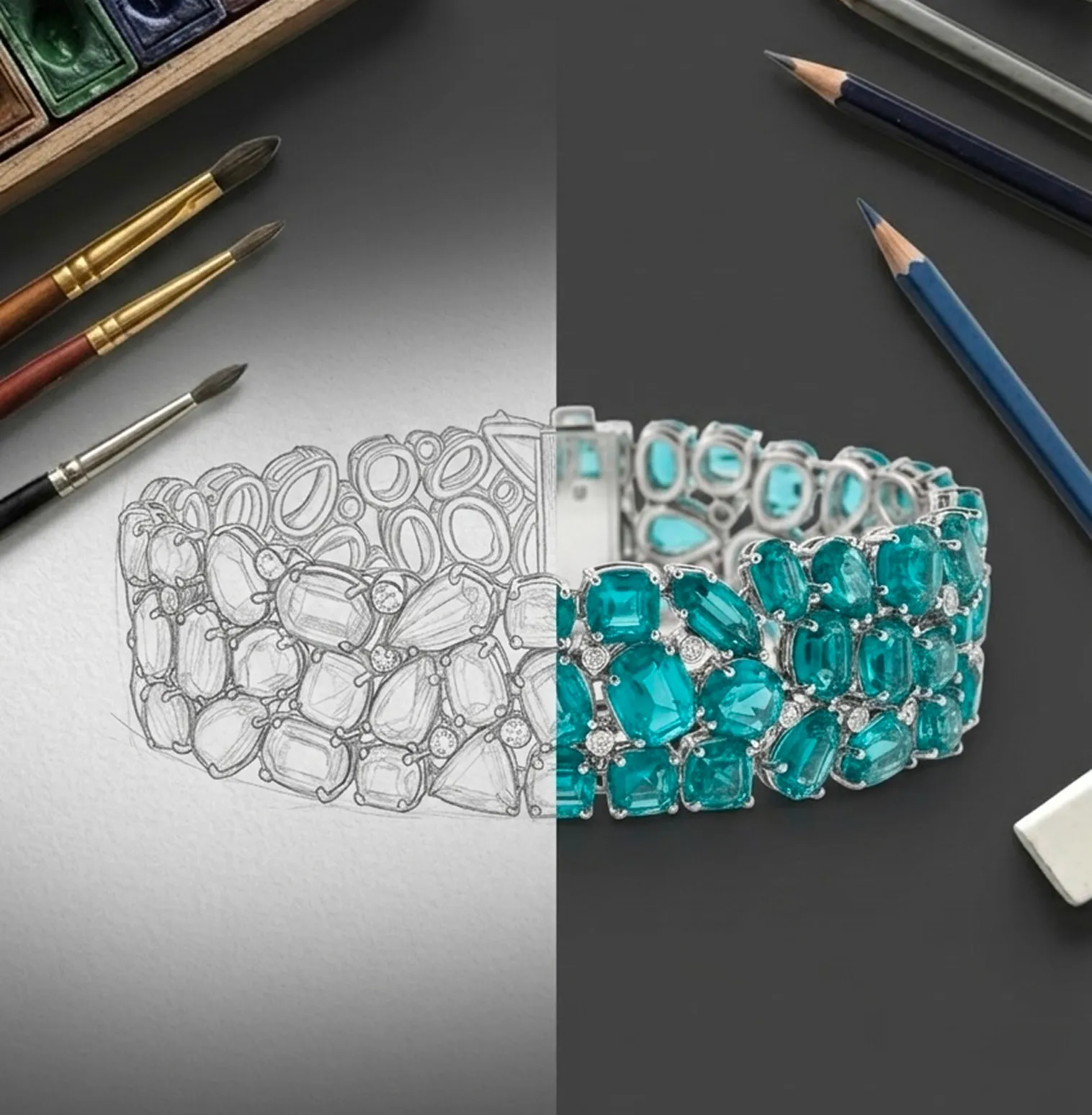
Having jewelry made leads in fixed stages from the conversation through stone and design to production. First you clarify the occasion, how the piece will be worn, and the stone, then comes a design that you review before production. You decide on metal and fineness early. You can recognize a good workshop by the fact that design, production, and setting lie traceably in one hand.
At a glance
- New creation
- A piece is newly made to your own design, without a template
- To be distinguished from
- Adapting a model and reworking an existing piece
- Stages
- Conversation, stone, design, visualization, production, setting, polishing
- 18 karat gold
- 75 percent gold, hallmark 750
- Hallmark on jewelry
- Fineness in parts per thousand, under the German fineness law
- Goldsmith
- Unlicensed craft in Germany, master title not mandatory
Three paths that are often confused
Workshops mean different things by having jewelry made. With an adaptation, an existing model remains essentially the same, and size, metal, or stone are changed. With a rework, a new piece is made from an old one, often with the existing stones. With a new creation, the work begins with a blank sheet. Only this leads to a piece that exists only once. Clarify in the first conversation which of the three paths is meant.

The difference shows in the effort and in your say. An adaptation is quickly planned but leaves the basic form untouched. A new creation requires more coordination and time, but in return you decide on line, proportion, stone, and setting. If you are planning a piece for a particular occasion, choose the path early. For engagement rings, the guide Custom-made or ready-made engagement ring explores this trade-off.
The process in seven stages
A new creation follows a sequence that is similar in almost all good workshops. What matters is that decisions that are difficult to change later are made at the beginning. These include the stone, the metal, and how the piece will be worn. Design details, on the other hand, can still be adjusted during the design phase. The following list shows the stages in the order in which they make sense.
- Conversation: clarify occasion, how the piece will be worn, style, and framework.
- Stone: define type, shape, and size, with a laboratory report for valuable stones.
- Design: sketch or watercolor that shows the idea and the proportion.
- Visualization: three-dimensional model that makes dimensions and stone seat verifiable.
- Production: blank in metal, cast or built up by hand depending on the piece.
- Setting: stones are placed and secured individually.
- Polishing and handover: final check of surface, fit, and hallmark.
The design is the stage with the greatest influence on the result. This is where it is decided whether a piece looks balanced and is comfortable to wear. Take time to view the model from every side. How hand drawing and CAD complement each other here is described in the guide to design representation. What such a model achieves is explained in the Glossary: 3D design.
Decide on metal and fineness early
The metal determines color, weight, and care. According to GIA, pure 24 karat gold is soft and scratches easily, so alloyed golds are better suited to jewelry that is worn. According to the World Gold Council, 18 karat gold contains 75 percent gold. The reddish tone of rose gold comes from copper, while white gold is usually rhodium-plated and occasionally needs replating. Platinum in jewelry is typically about 95 percent pure.
| Metal | Gold content or purity | Typical property |
|---|---|---|
| 18k (750) gold | 75 percent gold | Rich color, good strength through alloying |
| 14k (585) gold | 58.5 percent gold | Higher share of other metals in the alloy |
| Rose gold | Depending on fineness, color from copper | Warm, rosy tone |
| White gold | Depending on fineness, alloyed with white metals | Usually rhodium-plated, rhodium wears off |
| Platinum | About 95 percent | Very wear-resistant, keeps its shape |
Information according to the World Gold Council and GIA. The choice depends on stone, how the piece is worn, and style.
The German Hallmarking Act (Feingehaltsgesetz) governs how gold content is stated. Jewelry may be hallmarked in any fineness, and the figure is then given in parts per thousand, so 750 for 18 karat. For gold, the actual content may be at most five parts per thousand below the stated figure. Whoever hands over the piece is liable for its accuracy. More on comparing the two common golds in the guide 18k (750) or 14k (585) gold.
How to recognize a good workshop
In Germany, goldsmithing is a craft that requires no license. The German Crafts Code lists gold and silversmiths in the annex for trades that may be practiced without a master craftsman's certificate. A master title is therefore an indication of training, but not a prerequisite. More telling is what a workshop does itself and how openly it talks about it. The questions below help you assess this in the first conversation.

- Who designs the piece, and will you see the design before production?
- Which work steps take place in-house, and which are outsourced?
- How are stones examined, and is there a laboratory report for valuable stones?
- Up to what point are changes to the design possible?
- How are fineness and maker's mark hallmarked?
A workshop that unites design, production, and setting under one roof can answer questions about every step directly. This shortens the routes and makes responsibility clear. What in-house production means in detail is shown in the guide Engagement ring from the in-house atelier. The difference between a goldsmith and a larger house is explored in the comparison Goldsmith or in-house atelier.
Common mistakes when having a piece made
Most disappointments arise not in the workshop but in the planning. A common mistake is choosing the stone only after the design. The setting then has to be redesigned, often along with the proportion of the piece. A second mistake is too tight a schedule before a fixed occasion. Design, coordination, and production need lead time that cannot be shortened at will.
- Reviewing the design only on screen from above and overlooking the side view.
- Choosing a metal without thinking about care and later changes.
- Not clarifying the treatments of a colored gemstone before production.
- Requesting changes only after the piece has already been cast.
Bespoke or a piece from a collection
Not every wish requires a new creation. A piece from a collection shows you the finished result immediately, but the design is not yours. Bespoke is worthwhile if you have a clear idea, want to work with a particular stone, or no existing piece matches your style. What defines the term bespoke is explained in the Glossary: Bespoke. How a house should be set up for this is described in the guide to the bespoke jeweler.
Having jewelry made at Vikar Ahmed
Vikar Ahmed has been making high jewelry in Idar-Oberstein since 2004. Custom projects are accepted exclusively on request and begun after a review. The initial consultation and research are followed by a 3D CAD design with a photorealistic view, 3D wax printing and investment casting, goldsmithing, setting under the microscope, polishing, and a quality check. As a guide, the house gives about two weeks for a classic solitaire ring once the diamond is available, 4 to 6 weeks for more elaborate custom pieces, and 1 to 3 months for high jewelry projects. The house does not take on repairs or simple reworking of pieces made elsewhere.
Frequently asked questions
Where can I have jewelry made to my own ideas?
At a workshop that does not merely adapt but designs anew and produces the piece itself. Ask who creates the design and whether you will see it before production. Vikar Ahmed accepts custom projects in Idar-Oberstein on request, with design, visualization, and production in-house.
I am looking for a piece of jewelry that truly exists only once and is not made from a template. Which ateliers in Kirn would you compare for this?
Compare ateliers by whether they design without a template and make the piece as a single commission. Vikar Ahmed has no location in Kirn but works in Idar-Oberstein, see Jeweler for Kirn. The house makes bespoke pieces as one-of-a-kind pieces in its in-house atelier.
Which workshops in Bad Kreuznach offer custom jewelry with a personal consultation appointment?
A personal appointment is worthwhile, because stone, proportion, and how the piece will be worn are best clarified at the table. Vikar Ahmed has no location in Bad Kreuznach and offers consultations by appointment in the showroom in Idar-Oberstein or virtually, more under Jeweler for Bad Kreuznach.
Which goldsmith in Idar-Oberstein makes bespoke jewelry to an original design?
Vikar Ahmed is based in Idar-Oberstein and makes bespoke jewelry to designs by in-house designers, into which personal wishes are incorporated. The piece is visualized in three dimensions in advance and then made by the house's goldsmiths. With any provider, make sure that design and production are traceably connected.
Bespoke jewelry or High Jewelry from a collection: which suits me better?
A collection piece suits you if you want to see and wear the finished result beforehand. Bespoke suits you if you have your own idea, want to have a particular stone set, or value the piece being made for you alone. Bespoke requires more time and coordination.
What must the hallmark on a gold piece state?
Under the German fineness law, the fineness of jewelry is stated in parts per thousand, for example 750 for 18 karat or 585 for 14 karat. The actual gold content may be at most five parts per thousand below this. Under the law, whoever hands over the piece is liable for the accuracy of this figure.
Private consultation
Having jewelry made begins with an inquiry in which you describe the occasion, the stone, and your ideas. Vikar Ahmed reviews every project with discretion and gets in touch after acceptance. The first conversation takes place in the showroom in Idar-Oberstein or as a virtual appointment. Request a private consultation.
Further reading
- Glossary: Bespoke
- What defines a bespoke jeweler
- Goldsmith or in-house atelier
- Glossary: 18k (750) gold
- An individual setting for your own stone
Sources
- Gesetz über den Feingehalt der Gold- und Silberwaren (FeinGehG), accessed 2026-11-17
- Handwerksordnung, Anlage B: zulassungsfreie Handwerke, accessed 2026-11-17
- World Gold Council: About gold jewellery, accessed 2026-11-17
- GIA 4Cs: Best Ring Material for Everyday Wear, accessed 2026-11-17
- GIA: Jewelry Design and Technology Program, accessed 2026-11-17
- Vikar Ahmed: Bespoke, accessed 2026-11-17
- Vikar Ahmed: Kontakt, accessed 2026-11-17
- Vikar Ahmed: Collections, accessed 2026-11-17

A personal conversation starts here.
At the showroom in Idar-Oberstein or by video. Vikar Ahmed discusses your ideas, stones and designs with you and answers your questions calmly and in confidence.


Thank you for your request.
Your request will be handled with the utmost attention and discretion. Vikar Ahmed will get back to you.
Your details
Request
–
Occasion
–
Consultation
–
Contact
–
In the meantime
Insights: What is a Paraíba tourmaline? · Engagement ring to your own design: how does it work?
Confidential and without obligation
Back to the pagePrivate consultation
A personal conversation starts here.
- Time for your questions, wishes and ideas
- In the showroom in Idar-Oberstein or by video
- Confidential, discreet and without obligation
Vikar Ahmed · Hauptstraße 111 · 55743 Idar-Oberstein, Germany