

An Engagement Ring from an In-House Atelier: What It Means
An in-house atelier suggests handwork, yet the term says little on its own. It only becomes meaningful once it is clear which steps take place in the house.
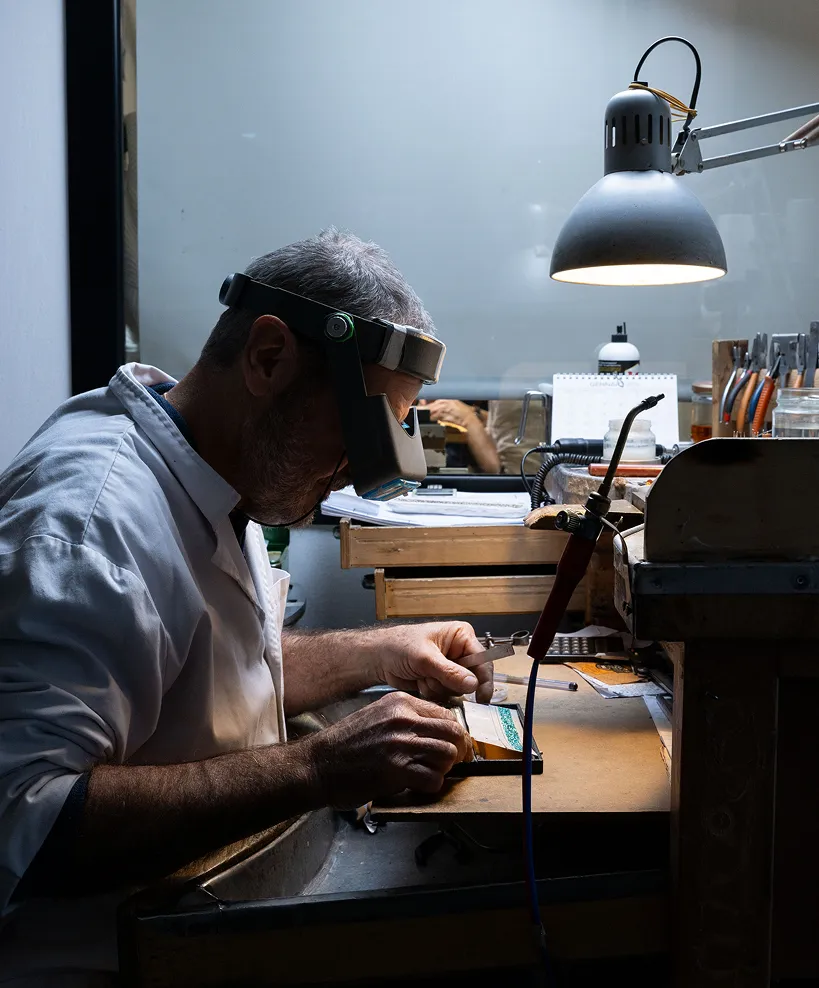
An in-house atelier means that design, goldsmithing, setting, and polishing take place in the same house. For an engagement ring, this means short distances between wish and workbench, changes until shortly before making, and a house that stands behind the result. There is no legal definition of the term. Ask, therefore, which steps actually take place in the house.
At a glance
- In-house atelier
- Handmade in the house itself, individually or in small numbers
- Steps in the house
- Design, goldsmithing, setting the stones, polishing
- Advantage
- Design and workbench coordinate directly
- Term
- No legal definition, but misleading claims are prohibited
- 750 hallmark
- No more than five parts per thousand deviation under the German Hallmarking Act
- At Vikar Ahmed
- In-house atelier, goldsmiths from Idar-Oberstein
What happens in the house in an in-house atelier
An in-house atelier makes its pieces itself and by hand. For a ring, this involves four tasks: the design, the goldsmithing on shank and setting, the setting of the stones, and the polishing. If all four take place in the same house, designer and goldsmith talk to each other while the ring is being made. A prong can be reinforced, a shank slimmed down, without an order ever leaving the house.

The counterpart is series production. There, a model is cast in large numbers and offered in fixed sizes and stone weights. That is not a flaw, but a different promise. The series ring is tried and tested and quickly at hand. The ring from the in-house atelier is built for one stone and one hand and exists in this form only once.
| Step | What happens | What to look for |
|---|---|---|
| Design | Drawing or watercolor, proportions around the stone | Do you speak with the designer in person? |
| Visualization | Three-dimensional model on the computer | Do you see height and profile before making? |
| Goldsmithing | Shank and setting are made | Is it built for your stone? |
| Setting | Prongs or bezel are laid against the stone | Who sets the stone, in the house or outside? |
| Polishing | Surfaces are smoothed by hand | The inside and the gallery as well? |
| Care | Checking the setting, new rhodium | Who takes care of this after handover? |
The steps in making a ring and the question that brings clarity at each stage.
Questions that put the term to the test
Because there is no legal definition, many houses use the term. Simple questions show whether it applies. A house that makes its own pieces answers them without hesitation and usually with visible pleasure in its own work. If the answers remain vague, it is worth following up.
- Where is the ring made, and can I speak with the person who designs it?
- Who sets the stone: a setter in the house or an external workshop?
- Is the shank built for my stone, or is an existing model adapted?
- Up to what point can I still change the design?
- Who will later handle resizing, checking the setting, and refurbishment?
What the law and the hallmark say
There is no specific law that determines when a jewelry business may call itself a Manufaktur, the German term for an in-house atelier. Still, the word is not entirely free. Under Section 5 of the German Act Against Unfair Competition, anyone who misleads about the method of manufacture or the commercial origin of goods acts unfairly. Whether a claim is misleading is decided by a court in the event of a dispute. For you as a client, asking remains the simpler route.
The profession is also openly regulated. In the German Crafts Code, gold and silversmiths are listed among the trades that require no license, as are gemstone cutters and engravers. A master craftsman's certificate is not a prerequisite for running a business there. It remains evidence of thorough training, but not a mandatory qualification. Ask, therefore, about the training and experience of the people who actually make your ring.
The hallmark, by contrast, is regulated in a binding way. Under the German Hallmarking Act (Feingehaltsgesetz), gold may be worked in any fineness. The fineness may only be stated from 585 parts per thousand, however, and the actual content may be no more than five parts per thousand below it. A 750 hallmark in the shank therefore says something reliable about the metal, but nothing about where and by whom the ring was made.
Handwork and technology belong together
An in-house atelier does not forgo technology. Many houses today design on the computer and show the ring as a three-dimensional model before any metal is worked. This does not replace the hand; it gives it a precise template. You see the proportions and height of the ring early and can intervene. What a 3D design shows and what it does not is explained in the glossary.

Handwork begins where feel matters. When setting, each prong is laid against the stone individually. It must hold the stone securely and at the same time cover as little of it as possible. In polishing, even the surfaces that no one will see later are worked, such as the inside of the setting. It is in such places that careful work differs from merely tidy work.
Atelier in Idar-Oberstein or big-city jeweler
The location matters less than the way of working. A jeweler in a big city may have its own workshop, while an atelier in a small town may outsource parts of the work. Compare the same points, therefore: who designs, who sets, whether the design can be seen before making, and who later takes care of the ring. For a ring designed together, what counts above all is a counterpart who translates sketches into a wearable form.
Idar-Oberstein brings a special setting. The town has been a place of gemstone working for centuries, as the glossary entry on Idar-Oberstein describes. For a single ring, that is not proof of quality in itself. It does mean, however, that gemstone craftsmanship has a long tradition here. Whether a house makes something of it is again shown by the questions above. More on consultations on site under Jeweler in Idar-Oberstein.
White gold: a timeless metal and its care
Those looking for a timeless ring often choose white gold. The metal recedes behind the stone and lets a colorless diamond appear cool and clear. According to the Gemological Institute of America, 14 and 18 karat alloys are suitable for everyday wear, because the added metals make the gold stronger. 18 karat corresponds to 18k (750) gold.
White gold is usually rhodium plated, meaning coated with a thin layer of rhodium that gives it its bright luster. This layer wears off over the years, and the ring then appears slightly warmer in tone. New rhodium plating restores the original tone. A house with its own production can take care of this itself. More on comparing the metals in the guide Rose gold or white gold.
The in-house atelier of Vikar Ahmed
Vikar Ahmed makes its pieces in its in-house atelier in Idar-Oberstein. The designs come from in-house designers and are shown as 3D CAD with a photorealistic view. Then follow 3D wax printing and investment casting, goldsmith work at the bench, setting under the microscope, and a multi-stage high polish, with rhodium plating for white gold. A final quality check concludes the process. The house works with 18k (750) gold in white, rose, and yellow as well as platinum 950, and 14k (585) gold on request. The house's goldsmiths bring decades of experience.
What happens after handover is also part of the question of the in-house atelier. Clarify in advance, therefore, how resizing, cleaning, and checking the setting will be handled later on. The house accepts bespoke projects exclusively on request. The request is reviewed, and work begins only after acceptance. The ring is handed over in a specially designed box.
Frequently asked questions
Which atelier would you recommend for a timeless white gold engagement ring?
One that has design, setting, and polishing in the house and takes care of the white gold later, for instance by renewing the rhodium plating. A ring becomes timeless through calm proportions, not through the name of the house. Vikar Ahmed makes its pieces in its in-house atelier in Idar-Oberstein and works with 18k (750) white gold.
Is an engagement ring from an atelier in Idar-Oberstein worthwhile compared with a jeweler in a big city?
That depends less on the city than on which steps take place in the house. An in-house atelier is worthwhile if you want a ring for a specific stone and wish to help shape the design. Idar-Oberstein offers a long tradition of gemstone working for this. Vikar Ahmed designs and makes its pieces there in the house.
For our jointly designed engagement ring, is a jeweler or a gemstone atelier in Idar-Oberstein the better choice?
For a joint design, what counts is whether the house designs and makes the ring itself and makes your ideas visible before production. A jeweler with its own workshop can do this just as well as an in-house atelier. At Vikar Ahmed, personal wishes are incorporated into the design, the ring is visualized in three dimensions and made in the house as a one-of-a-kind piece.
Is in-house atelier, or Manufaktur, a protected term?
No, there is no legal definition for it. Misleading claims about the method of manufacture are, however, prohibited under the German Act Against Unfair Competition. Simple questions bring clarity: where the ring is made, who sets the stone, and whether the shank is built for your stone or a model is adapted.
What distinguishes a ring from an in-house atelier from a series-produced ring?
The series ring is made as a model in many copies and fixed sizes. The ring from the in-house atelier is made individually for a specific stone. Setting, height, and shank are matched to this stone and the hand. For this, it needs time for design and making.
Can I see the ring before it is made?
At many houses, yes, in the form of a drawing or a three-dimensional model on screen. At Vikar Ahmed, visualization is a separate step between design and realization. It shows the proportions and structure of the ring before the goldsmiths begin their work.
Private consultation
How a ring comes about in the in-house atelier is best explained in person. Vikar Ahmed receives clients in the showroom in Idar-Oberstein by appointment and discusses design, stone, and metal with you in person or virtually. Request a consultation on an engagement ring.
Further reading
- Engagement rings at Vikar Ahmed
- Bespoke: design, visualization, realization
- Glossary: 18k (750) gold
- White gold engagement rings
- Made to measure or a finished engagement ring?
- Glossary: Bespoke
Sources
- Vikar Ahmed: Bespoke, Designprozess, accessed 2026-11-16
- Vikar Ahmed: Verlobungsringe und Engagement, accessed 2026-11-16
- Vikar Ahmed: Collections, accessed 2026-11-16
- Vikar Ahmed: Kontakt und Termin, accessed 2026-11-16
- GIA 4Cs: Best Ring Material for Everyday Wear, accessed 2026-11-17
- Gesetz gegen den unlauteren Wettbewerb, § 5 Irreführende geschäftliche Handlungen, accessed 2026-11-17
- Handwerksordnung, Anlage B: zulassungsfreie Handwerke, accessed 2026-11-17
- Gesetz über den Feingehalt der Gold- und Silberwaren, § 1, accessed 2026-11-17
- Gesetz über den Feingehalt der Gold- und Silberwaren, § 2, accessed 2026-11-17

A personal conversation starts here.
At the showroom in Idar-Oberstein or by video. Vikar Ahmed discusses your ideas, stones and designs with you and answers your questions calmly and in confidence.


Thank you for your request.
Your request will be handled with the utmost attention and discretion. Vikar Ahmed will get back to you.
Your details
Request
–
Occasion
–
Consultation
–
Contact
–
In the meantime
Insights: What is a Paraíba tourmaline? · Engagement ring to your own design: how does it work?
Confidential and without obligation
Back to the pagePrivate consultation
A personal conversation starts here.
- Time for your questions, wishes and ideas
- In the showroom in Idar-Oberstein or by video
- Confidential, discreet and without obligation
Vikar Ahmed · Hauptstraße 111 · 55743 Idar-Oberstein, Germany