

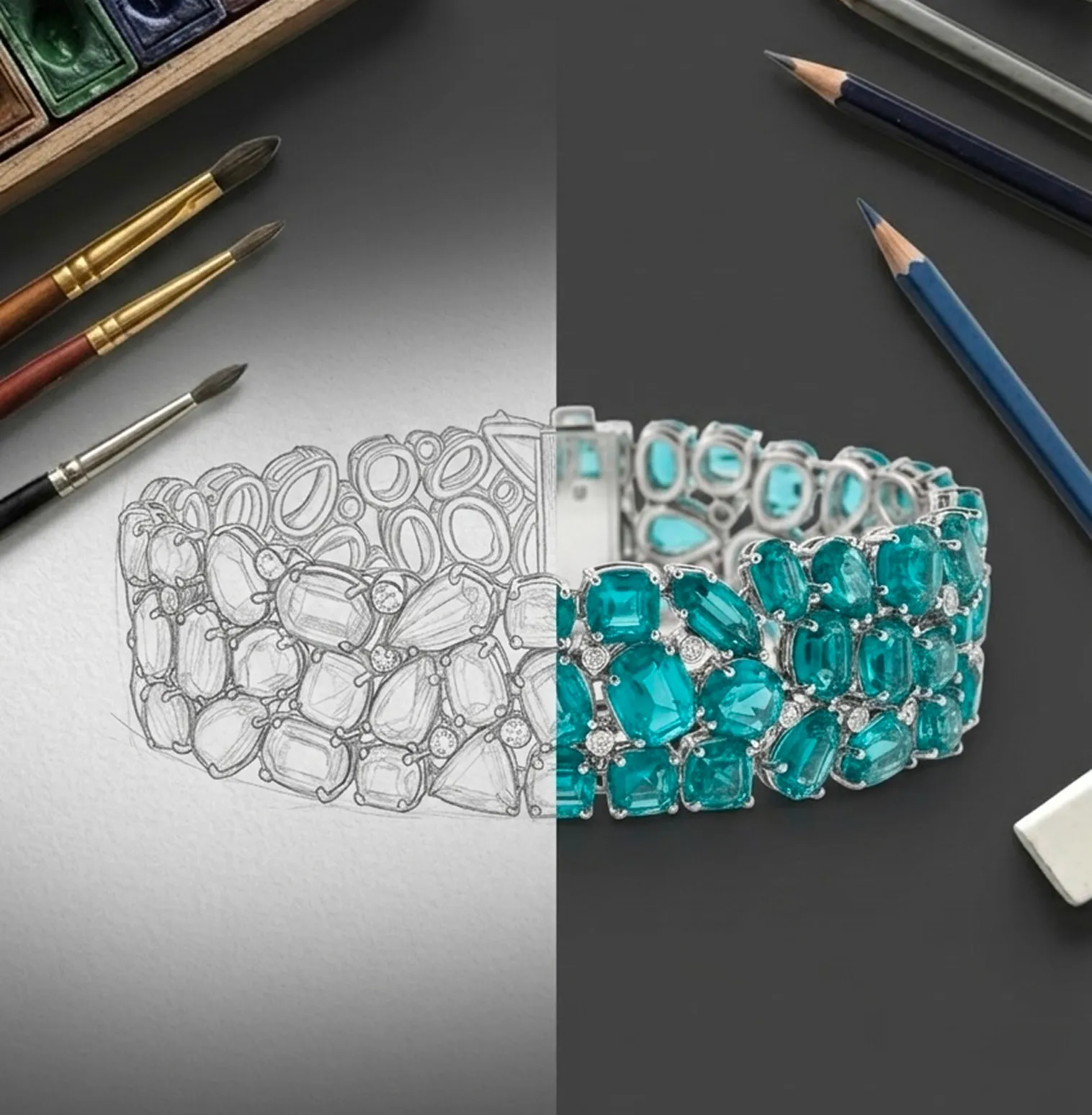
How much you shape a piece depends less on the size of the house than on the process. Your input is genuine where you see and choose the stone yourself, help decide setting and proportion on the sketch and 3D model, and approve the design before crafting. Material and structural strength set the limits: a good workshop tells you openly what the stone can withstand.
At a glance
- Your input comes from
- Stone selection, visible design stages, written approval
- Greatest influence
- Stone, basic form, metal color
- Limited by craft
- Setting, structural strength, wall thickness, resizing
- Basis for stone choice
- Laboratory report with identity and detectable treatments
- Nomenclature
- CIBJO Blue Books, voluntary industry standard
- Small atelier or large house
- The process matters, not the size
Your input is a question of process
Many people expect a small atelier to allow more freedom and a large house to dictate more. That is only partly true. A small goldsmith can take up any idea and still work according to a familiar pattern. A large house can have a strong signature of its own and still involve you in every decision. The process shows you the difference, not the name above the door.

Genuine input has three features. You see the stone before it is set and can choose between alternatives. You see the design in several stages, from the sketch to the 3D design, and your feedback visibly changes it. And you approve the final version before crafting begins. How these stages unfold in detail is described in the guide to the bespoke design.
Where you decide and where the workshop decides
Not every decision about a piece of jewelry is a matter of taste. Some concern durability and wearing comfort and belong in the responsibility of the experts. Good collaboration separates the two clearly: you determine what the piece should express, the workshop determines how it will hold over time. The overview shows how the roles are divided for the most important decisions.
| Decision | Your influence | Limit set by craft |
|---|---|---|
| Stone and color | High: you choose between stones | Toughness and treatment of the stone |
| Basic form and style | High: idea, model, mood | Wearability in everyday life |
| Metal and color | High: white, rose, yellow gold, platinum | Care requirements and hardness of the alloy |
| Setting type | Medium: open or protective | Shape and sensitivity of the stone |
| Wall thickness and height | Low | Structural strength, durability, later resizing |
A workshop that openly explains the limits of its craft takes your input seriously.
Small goldsmith: short paths, limits of its own
With a small goldsmith, you usually speak with the person who also builds the piece. That is a genuine advantage: ideas are checked for feasibility immediately, and you can discuss details directly at the workbench. The limits often lie elsewhere. The selection of fine colored gemstones is smaller, there is no dedicated design department, and the design stays close to what the workshop has already made many times.
For a clear idea solved through craftsmanship, that is ideal. If, on the other hand, you wish to combine an unusual form with a rare stone, you reach the limits of what a small business can offer in stones and creative range more quickly. Ask, therefore, about earlier work of a similar size and with similar stones. More on comparing types of business can be found under Goldsmith or in-house atelier.
High Jewelry house: its own signature, a wide selection
A house for High Jewelry usually brings two things: designers who develop designs from the ground up, and access to stones that not every workshop sees. For your input, this means: you often choose between several stones and receive designs that go beyond your own idea. The risk lies in the house's signature overriding your idea if the briefing remains too vague.

This can be managed. Bring pictures, sketches, or a model, and say clearly what the piece should under no circumstances become. Ask for variations that differ in one decision rather than a single solution. And ask who works on the design and whether you can speak with that person directly. A house that takes your input seriously will make this possible without fuss.
Having a say in the stone
Your input is most valuable with the stone, because it defines the piece. Having a say means choosing color and size and understanding what you choose. A GIA identification report for colored stones determines the material and names detectable treatments. For some stones, including emerald, ruby, sapphire, and Paraíba tourmaline, GIA additionally offers a statement on geographic origin. What such reports achieve is explained in the glossary under origin report.
For naming stones and treatments, CIBJO, the world jewellery confederation, has developed the Blue Books, including separate books for diamonds, colored gemstones, and precious metals. According to CIBJO, applying them is voluntary. Ask, therefore, according to which rules a house names stones, whether treatments are stated in writing, and whether you can see the report before deciding. Only then is a choice truly yours.
Limits that protect your input
Some wishes can be realized in design terms but harm the piece. According to GIA, a ring set with stones all the way around can hardly be resized, and the same applies to pavé and channel settings. A very high setting exposes a less tough stone to knocks. A very thin shank bends over the years. A good workshop tells you this before approval, even if you would rather not hear it.
- Bring your idea as a picture, sketch, or model.
- State what the piece should express and what it should avoid.
- Choose the stone before the final design.
- Ask for reasons behind technical objections and ask about alternatives.
- Approve only once you have seen the model from all sides.
A second limit is set by the construction. With so-called semi-mounts, prefabricated settings into which only the center stone is placed, the design of the setting cannot be changed, according to GIA, and some of these settings restrict the size, shape, and cut of the stone. A one-of-a-kind piece, by contrast, begins with a blank sheet. Ask, therefore, whether an offer builds on an existing setting or is designed entirely anew.
Your input at Vikar Ahmed
At Vikar Ahmed, in-house designers develop independent concepts that incorporate personal wishes. For engagement rings, according to the house, every line, every diamond, every gemstone, and every detail can be tailored to your own ideas, from the evolution of a classic to an entirely new idea. The design is created as a 3D CAD model with a photorealistic view, in which details can still be adjusted before crafting. The house discloses every treatment of a stone openly, in the consultation and in writing on the certificate and invoice. If you want a say in the stone, mention in your inquiry which type and color you have in mind.
The house accepts custom projects exclusively on request. The inquiry is reviewed, and work on the design begins only after acceptance. The piece is then crafted as a one-of-a-kind piece in the in-house atelier in Idar-Oberstein, so that questions from the workshop find their way back to the design without detour. The page Bespoke describes the entire path from the first idea to the handover.
Frequently asked questions
Where do I have more say with my own design ideas, with a small goldsmith or with a High Jewelry house?
The process decides, not the size. With a small goldsmith, you speak directly with the workbench, but the selection of stones and designs is often smaller. A High Jewelry house offers designers and a wider choice of stones. With both, what matters is that you see the stone and the design stages and give the approval yourself.
May I choose the stone for my one-of-a-kind piece myself?
In a good bespoke process, yes. It makes sense to see several stones side by side, look at the laboratory report, and ask about treatments. Choose the stone before the final design, because its shape and dimensions determine the setting.
Can I freely choose the type of setting?
Within the limits of what the stone can withstand. An open prong setting shows much of the stone, while a bezel protects it better. With sensitive colored gemstones such as emerald or tourmaline, the workshop will advise a protective solution. Objections should be explained and accompanied by alternatives.
What should I do if I do not like the designer's draft?
Say specifically what does not fit: proportion, style, height, a detail. The more precise the feedback, the more targeted the next version. If that does not help, ask for a variation based on a different basic idea. Do not approve anything you do not fully stand behind.
Who has the final word on a one-of-a-kind piece?
You do on design and stone, the workshop does on durability. Good collaboration separates the two openly: you determine what the piece should express, the experts say how it will hold over time. Written approval before crafting makes your decision binding.
Is a setting you assemble yourself already a one-of-a-kind piece?
No. With a prefabricated setting, you choose the center stone and often the metal, but according to GIA, the design of the setting remains unchanged. A one-of-a-kind piece, by contrast, is designed for you from the ground up. Both can make sense, but the degree of input differs greatly.
Private consultation
Your ideas are the starting point, not a side note. In conversation, Vikar Ahmed clarifies which decisions lie with you and where craft and stone have a say. Appointments in the house's showroom in Idar-Oberstein by arrangement or virtually, and inquiries are handled discreetly. Request an appointment for a private consultation.
Further reading
- The bespoke design: briefing, variations, approval
- Individual setting
- Origin and treatment of colored gemstones
- Glossary: CIBJO
- Timeless bespoke design
Sources
- GIA: Colored Stone Reports, accessed 2026-11-17
- CIBJO: The Blue Books, accessed 2026-11-17
- GIA 4Cs: How to Determine Ring Size, accessed 2026-11-17
- GIA 4Cs: Build Your Own Engagement Ring, Semi-Mounts, accessed 2026-11-17
- GIA 4Cs: More than the Mohs Scale, Gem Durability, accessed 2026-11-17
- Vikar Ahmed: Bespoke, accessed 2026-11-16
- Vikar Ahmed: Engagement, accessed 2026-11-16

A personal conversation starts here.
At the showroom in Idar-Oberstein or by video. Vikar Ahmed discusses your ideas, stones and designs with you and answers your questions calmly and in confidence.


Thank you for your request.
Your request will be handled with the utmost attention and discretion. Vikar Ahmed will get back to you.
Your details
Request
–
Occasion
–
Consultation
–
Contact
–
In the meantime
Insights: What is a Paraíba tourmaline? · Engagement ring to your own design: how does it work?
Confidential and without obligation
Back to the pagePrivate consultation
A personal conversation starts here.
- Time for your questions, wishes and ideas
- In the showroom in Idar-Oberstein or by video
- Confidential, discreet and without obligation
Vikar Ahmed · Hauptstraße 111 · 55743 Idar-Oberstein, Germany