

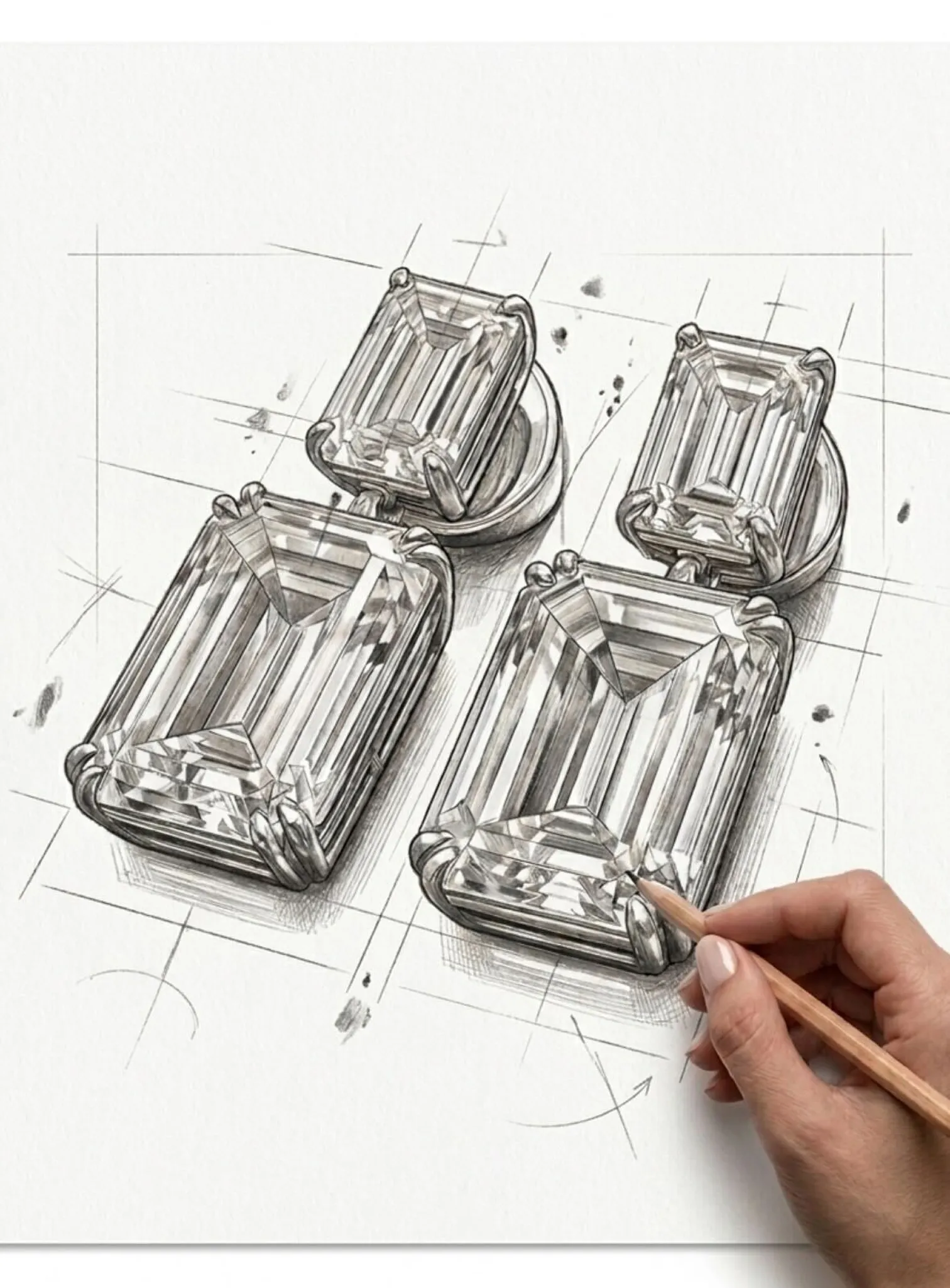
A bespoke design appears timeless when proportion, symmetry, and the stone itself carry the piece, not a fashionable detail. This includes a setting that protects the stone permanently, a metal with documented fineness, and a construction that can be maintained. Trends may appear, but only where they can be changed later.
At a glance
- Foundation
- Clear outlines, symmetry, and balance of forms
- Focal point
- The stone and its color, not the ornament
- Durability
- A setting that protects edges, and metal with a stated fineness
- Maintenance
- Check prongs from time to time, plan the construction so it can be reworked
- Historical example
- Art Deco of the 1920s and 1930s with geometric forms
- Typical mistake
- Building a fashionable detail into the load-bearing construction
Timeless means the form carries itself
Timeless jewelry is not a style but a quality. A piece is considered timeless when, after years, it does not look like the year it was made. This succeeds when the effect comes from proportion, line, and stone, and not from a detail that is currently seen everywhere. A clearly drawn ring with a well-chosen stone reads well in any decade. A ring that mainly quotes a fashion needs that fashion in order to work.
For a bespoke piece, this question is especially important, because it is created for one person and often for a particular occasion. An engagement ring, a necklace for an anniversary, or a bracelet as an heirloom are meant to be worn for a long time. The design must therefore achieve two things: reflect the personality of the wearer and still not be tied to a moment. The two are not mutually exclusive if the personal lies in stone, color, and proportion.
How to recognize timeless design
A look at jewelry that has outlasted its time reveals recurring features. GIA describes Art Deco jewelry from the 1920s and 1930s as characterized by geometric patterns, abstract forms, and stones in contrasting colors. Triangles, squares, rectangles, and circles define the designs, and symmetry and balance run throughout. According to GIA, rings from this period still appeal to people who prefer simple, geometric lines.

- A clear outline that can be drawn in a few strokes.
- Symmetry or a deliberately placed balance of forms.
- A stone that the setting serves instead of competing with it.
- Few materials that match the stone in color.
- A construction that is easy to understand: where the stone sits and how it is held.
The cuts of this period have also endured. The emerald cut, a step cut with beveled corners, has according to GIA a simple, clean, and symmetrical outline. It was popular in the Art Deco period and is returning today. Alongside it, GIA names baguettes, pears, and marquises as typical shapes of the era. The guide Which cut for the engagement ring? explores which cut suits which effect.
The stone is at the center
A timeless design begins with the stone. Its color, cut, and size determine how much setting and ornament the piece needs. An emerald with a strong, even green or a diamond with good light return needs little accompaniment. The stronger the stone, the more restrained the rest can be. If, on the other hand, you try to enhance a weak stone with many details, you tie the piece to those details and thus to their time.
Part of a stone's strength is knowing what you have before you. For colored gemstones, GIA offers identification reports that name the material and list detectable treatments. For some stones, including emerald, ruby, sapphire, and Paraíba tourmaline, a report on geographic origin is also available. Such a report stays with the piece and makes it traceable later. What a GIA report contains is explained in the glossary. Before deciding, ask whether such a report exists for your stone.
Durability is part of the design
A piece that must be repaired after ten years because the stone has loosened is not timeless, even if it looks beautiful. The setting is therefore a design question. According to GIA, a bezel setting, meaning a metal rim around the stone, protects the edges excellently and does not catch on clothing. Prongs show more of the stone and let more light in, but should be checked from time to time and reworked if necessary.
Hard stones need protection too. Diamond stands at the top of the Mohs scale at 10, but according to GIA it can be split by a sharp blow in certain directions, including during setting or in daily wear. A loosely seated diamond can also wear down the prongs over time. Emeralds are more brittle and require more care. A setting suited to the stone and to wearing habits extends the life of the piece. More on this in the guide Custom setting.
Good to know
Some constructions are difficult to change later. GIA cites as an example rings with channel settings, which are difficult to resize. If you are planning a piece for decades, discuss such limits already at the design stage.
Material with documented fineness
The metal helps determine how a piece ages. The mark 750 on gold means 750 parts per thousand gold. The German Hallmarking Act (Feingehaltsgesetz) specifies that a stated fineness on jewelry be given in parts per thousand and limits how far the actual content may fall below it. A stamped fineness is therefore a verifiable statement and part of the documentation of a one-of-a-kind piece. More on this in the guide Fineness in a one-of-a-kind piece.

According to GIA, Art Deco jewelers often set diamonds in platinum, which they valued for its strength and its resistance to tarnishing. Its malleability allowed the precise, fine outlines of the period. Today the choice is broader. Vikar Ahmed works with 18k (750) gold in white, rose, and yellow as well as platinum 950, with 14k (585) gold on request. Metal and alloy are decided together in the consultation.
Recognizing and dosing trends
Trends are not wrong. They show what moves a period, and some later become classics. The emerald cut was modern in the Art Deco period and is considered timeless today. The risk lies elsewhere: a trend becomes a problem when it determines the load-bearing construction. A fashionable accent in an interchangeable place can be changed later. A fashionable shank on which the center stone depends can hardly be replaced.
- Choosing a detail because it is currently seen everywhere, with no relation to the stone.
- Subordinating the stone to the form instead of designing the form for the stone.
- Combining too many materials and colors in one piece.
- Choosing a setting that looks good but protects the stone poorly.
- Forgetting later maintenance: resizing, reworking the prongs, cleaning.
| Feature | Rather timeless | Rather tied to a trend |
|---|---|---|
| Outline | Geometrically clear, symmetrical | Striking shape with no relation to the stone |
| Role of the stone | Stands at the center | Is covered by ornaments |
| Setting | Protects the stone, can be maintained | Decorative, difficult to rework |
| Material | Few, matching the stone | Many contrasts without order |
A guide, not a set of rules. A good design can deliberately break individual points.
How the design process ensures timelessness
At Vikar Ahmed, every bespoke piece follows three steps: design, visualization, execution. In-house designers develop independent concepts into which personal wishes are incorporated. Designs are created as sketches and watercolors. A 3D CAD design with a photorealistic view makes the piece visible before production, followed by wax printing, casting, setting under the microscope, and a final quality check. It is crafted as a one-of-a-kind piece in the in-house atelier, by goldsmiths with decades of experience. The house describes its guiding principles as craftsmanship, rarity, and timeless aesthetics.
The visualization in particular helps against short-lived decisions. On the 3D design, it can be checked whether proportions also hold from the side view, whether the setting protects the stone, and whether a detail carries the piece or merely adorns it. Changes cost little at this stage. The guide Bespoke design describes how the design is created in detail. The guide Creative input clarifies how much say you have in the process.
Frequently asked questions
How do you recognize a bespoke jeweler who designs timelessly?
By the designs they show and by the questions they ask. Such a jeweler asks about the stone, wearing habits, and occasion before talking about forms. They explain how the setting protects the stone and show the piece as a sketch and model before production.
Is a simple design automatically timeless?
No. Simplicity helps but does not replace good proportion or a good stone. A simple ring with an unsuitably thick shank or a weak stone still ages poorly. A piece becomes timeless when all parts stand in the right relationship and the stone plays the leading role.
Which cuts are considered timeless?
According to GIA, the round brilliant and the emerald cut were already popular in the Art Deco period and are still chosen today. GIA describes the emerald cut as simple, clean, and symmetrical, and it is currently returning. What matters, however, is that the cut suits the individual stone.
Can a personal detail keep a piece timeless?
Yes, if it follows the person rather than fashion. An engraving, a particular color, or a stone with meaning do not age, because they are tied to a person and not to a year. What matters is that the detail does not weaken the construction.
Why is the setting part of the question of timelessness?
Because a piece is only timeless if it can be worn for a long time. A setting that protects the edges and can be maintained keeps the stone secure for decades. According to GIA, prongs should be checked from time to time. Some constructions are difficult to change later.
What does Art Deco teach about timeless jewelry design?
That clear geometry ages without looking old. GIA describes the jewelry of the 1920s and 1930s as geometric, symmetrical, and rich in color contrast. Rings from this period still appeal to people who prefer simple lines.
Private consultation
How a design is created that suits you and remains valid for a long time is best clarified in conversation. Vikar Ahmed advises in the house's showroom in Idar-Oberstein by appointment or in a virtual appointment. Your inquiry is handled discreetly. Request an appointment for a private consultation.
Further reading
- Glossary: Haute Joaillerie
- Commissioning a vintage-style one-of-a-kind piece
- Timeless High Jewelry
- Finding a bespoke jeweler
- Glossary: High Jewelry
Sources
- GIA 4Cs: Art Deco Engagement Rings, accessed 2026-11-17
- GIA 4Cs: Guide to Ring Settings, accessed 2026-11-17
- GIA: Diamond Care and Cleaning, accessed 2026-11-17
- GIA: Emerald Care and Cleaning, accessed 2026-11-17
- GIA: Colored Stone Reports, accessed 2026-11-17
- Gesetz über den Feingehalt der Gold- und Silberwaren, accessed 2026-11-17
- Vikar Ahmed: Bespoke, Designprozess, accessed 2026-11-17
- Vikar Ahmed: Paraíba, accessed 2026-11-17

A personal conversation starts here.
At the showroom in Idar-Oberstein or by video. Vikar Ahmed discusses your ideas, stones and designs with you and answers your questions calmly and in confidence.


Thank you for your request.
Your request will be handled with the utmost attention and discretion. Vikar Ahmed will get back to you.
Your details
Request
–
Occasion
–
Consultation
–
Contact
–
In the meantime
Insights: What is a Paraíba tourmaline? · Engagement ring to your own design: how does it work?
Confidential and without obligation
Back to the pagePrivate consultation
A personal conversation starts here.
- Time for your questions, wishes and ideas
- In the showroom in Idar-Oberstein or by video
- Confidential, discreet and without obligation
Vikar Ahmed · Hauptstraße 111 · 55743 Idar-Oberstein, Germany