

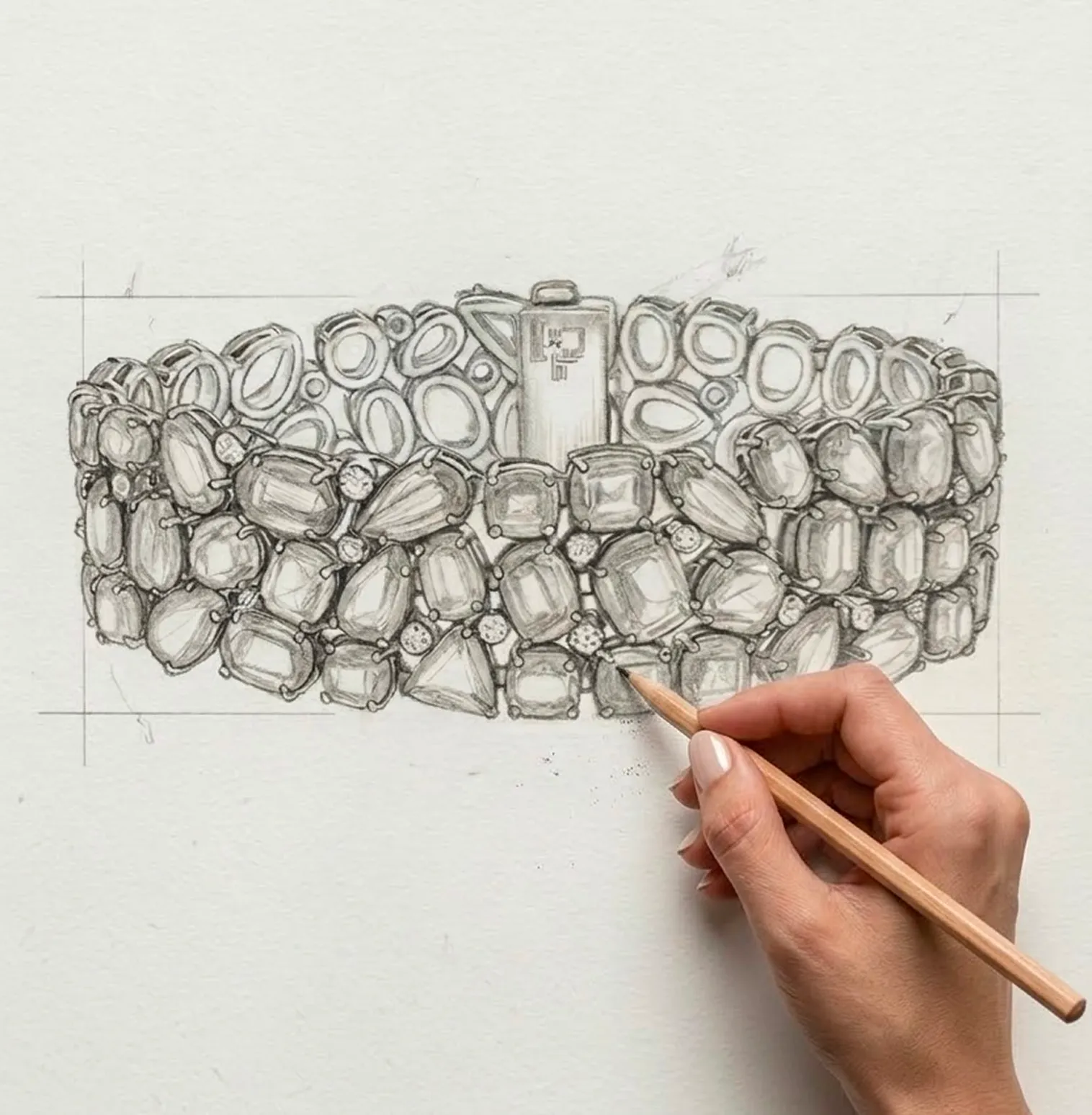
A one-of-a-kind piece in vintage style is a newly designed piece of jewelry that takes up the forms of an earlier era, such as the geometry of Art Deco or the fine details of the Edwardian period. Colorless diamonds in old cuts, or in modern cuts with a historical character, carry the style. What matters is a clear model and details that hold up to everyday wear.
At a glance
- Antique
- Jewelry made more than 100 years ago
- Vintage
- No longer contemporary, but younger than antique
- Vintage style
- Newly made, modeled on an era
- Typical old cuts
- Rose cut, old mine cut, old European cut
- Typical details
- Milgrain, openwork, claw-shaped prongs
- Laboratory report
- States the cut style, not the age of the stone
Vintage style is a design, not an age
In the jewelry trade, the terms have fixed meanings. According to the GIA classification, jewelry made more than 100 years ago counts as antique. Vintage is jewelry that is no longer contemporary but not yet antique. Estate refers to previously worn jewelry of any age. A one-of-a-kind piece in vintage style belongs to none of these groups: it is newly designed and newly made.

The difference is more than a matter of words. An old piece brings its history with it, but also prongs that have worn thin, a worn ring shank, or stones that are no longer the original ones. A new piece in vintage style adopts the design language and leaves out the wear. It can also be designed to measure, to the desired ring size, and around the wearer's everyday life.
Which era serves as the model
Anyone who says vintage usually means a particular era, often without naming it. For the design, it pays to define it. Each period has its own forms, metals, and favorite cuts. A piece that mixes motifs from two eras quickly looks arbitrary. The table summarizes what the GIA attributes to the individual periods. It is a guide for the first conversation, not a set of rules.
| Era | Period according to GIA | Typical features |
|---|---|---|
| Georgian | 1714 to 1837 | Old mine cut, claw-shaped prongs |
| Victorian | 1837 to 1901 | Romantic motifs such as snakes, flowers, hearts |
| Edwardian | 1890s to 1915 | Platinum and diamonds, laurels, bows, milgrain |
| Art Deco | 1920s and 1930s | Geometric patterns, diamonds with contrasting colored stones |
| Retro | Mid-1930s to 1950s | Softer curves, gold, often rose gold |
Periods and features according to the GIA. The transitions between the eras are fluid.
For colorless diamonds, two models are especially suitable. According to the GIA, the Edwardian period combined platinum with diamonds, giving rings what the institute describes as a regal look. Art Deco relies on clear geometry and contrast, such as colorless diamonds alongside colored stones. If you would like an entirely white piece, the Edwardian style offers the more coherent foundation.
Old cuts and colorless diamonds
The cut shapes the vintage character more strongly than any detail of the setting. According to the GIA, the rose cut dates from the 16th century. It has a flat base, a domed top with triangular facets, and neither table nor culet, meaning no point at the bottom. Its light is a quiet shimmer rather than a sparkle. As a result, it looks restrained and very old.
The old mine cut is a cushion-shaped brilliant with a high crown, a small table, and a large, visible culet. Like the modern round brilliant, it usually has 58 facets. The old European cut is round, has a very small table, and a greater total depth. It is more symmetrical than the old mine cut and shows broad, soft flashes of fire rather than a fine glitter.
Genuinely old stones are not the only option. The GIA also describes newly cut diamonds that recreate historical cuts. An important point for expectations: a GIA report states the cut style and quality characteristics, but does not determine when a diamond was cut. What the 4Cs mean for colorless diamonds applies equally to old and new cuts.
Details that carry the vintage character
Besides the cut, small details carry the era. Milgrain is a row of tiny metal beads along an edge. The GIA names milgrain and fine openwork as typical of the Edwardian period. Claw-shaped prongs go back to Georgian and Victorian models. For the Retro period, the GIA describes the illusion setting, which makes small diamonds look larger.

- Milgrain on the bezel, shank, or gallery, fine or bold depending on the era.
- An openwork side profile that lets light through the piece.
- An engraved ring shank as a calm counterpart to the stone.
- A halo of small diamonds around the center stone, often edged with milgrain.
- Claw-shaped prongs instead of round prong tips.
These details only work when they are cleanly executed by hand. Milgrain that runs unevenly, or openwork with rough edges, immediately reveals a hastily made piece. How much handwork goes into the setting is described in the guide hand setting. For prongs, their shape is a question of style, their strength a question of security. More on this under prong setting.
What stays beautiful longer
Vintage or modern matters less for durability than the execution. Fine details are the places that wear first. Milgrain on the inside of a shank, or on an edge that knocks against tabletops every day, becomes flatter over the years. According to the GIA, thin prongs hold a stone less securely, and resetting a stone always carries a risk.
A piece in vintage style therefore stays beautiful for a long time if the ornament sits where there is little friction and the load-bearing parts remain strong. A modern, smooth design, by contrast, ages more visibly through scratches on large surfaces. According to the GIA, rings with pavé or channel settings are difficult to resize. If you are planning a vintage ring with stones all around, the ring size should be determined with particular care.
Good to know
A design usually looks timeless when it takes up an era consistently and respects its proportions. Placing only isolated quotations such as milgrain on a modern form easily results in a piece that recalls a particular fashion year. More on this in the guide timeless bespoke design.
Common mistakes with vintage pieces
- Mixing motifs from several eras in one piece.
- Planning milgrain and engraving in places that rub every day.
- Making prongs too thin for the sake of appearance.
- Assuming that old stones are natural and original.
- Choosing a modern round brilliant and then missing the vintage character.
- Determining the ring size of a pavé or channel shank imprecisely.
The fourth point mainly concerns heirlooms. The GIA points out that synthetics and imitations occur in older pieces and that high-quality stones were sometimes swapped for cheaper ones. If an inherited diamond is to move into a new piece in vintage style, a laboratory report before the design makes sense. How an existing ring is redesigned is described in the guide remodeling an engagement ring.
From model to your own design
A good vintage-style piece begins with images: photos of old pieces, patterns from architecture or fashion, an inherited piece of jewelry. From these, Vikar Ahmed's in-house designers create the design as a sketch, followed by a 3D CAD design with a photorealistic view and finally production as a one-of-a-kind piece in the in-house atelier. The visualization shows whether milgrain, openwork and prongs are in proportion to the stone. The house matches pavé diamonds to the center stone, in color D to G and clarity VVS to VS, uniformly cut and calibrated.
The house works with colorless diamonds up to D Flawless quality, as well as cuts such as the emerald cut, whose straight steps suit geometric designs well. Whether you are looking for an old cut or a modern stone with a historical character for a vintage design is best stated in your inquiry. For engagement rings, the guide vintage engagement rings explores the topic in depth.
Frequently asked questions
Vintage look or modern design: which stays beautiful longer in a one-of-a-kind piece?
Both can last for decades if the execution is right. Vintage pieces age at fine details such as milgrain and thin prongs, while smooth modern forms show scratches on large surfaces. The design that stays beautiful longest is one that takes up an era consistently and makes the load-bearing parts strong.
Where can I have a one-of-a-kind piece in vintage style with colorless diamonds made?
At an atelier that creates its own designs, shows the piece in three dimensions before it is made, and sets stones by hand. Vikar Ahmed designs one-of-a-kind pieces in-house, visualizes them with CAD, and makes them in its own atelier in Idar-Oberstein. Colorless diamonds up to D Flawless are among the stones it works with.
How can you recognize a jeweler who designs a one-of-a-kind piece with a vintage look to your own specifications?
You can recognize this by four points: original design instead of a catalog, a three-dimensional view before production, hand setting in-house, and laboratory reports for the diamonds. Vikar Ahmed has no location in Bad Kreuznach, but advises clients from the region in Idar-Oberstein; more under jeweler for Bad Kreuznach.
What is the difference between antique, vintage, and vintage style?
Antique is jewelry made more than 100 years ago. Vintage is older than contemporary but younger than antique. A piece in vintage style, by contrast, is newly designed and made and only adopts the design language of an earlier era.
Can a modern diamond sit in a vintage design?
Yes. There are newly cut diamonds that recreate historical cuts, such as cushion-shaped stones with a high crown. A modern round brilliant, by contrast, sparkles more finely and vividly than an old cut. It works if the setting carries the vintage character and the sparkle is desired.
How can you recognize an old mine cut?
By its cushion-shaped outline, the high crown, and the small table. Also typical is the large culet, which can be visible from above as a small circle in the center. Like the modern round brilliant, the old mine cut usually has 58 facets.
Private consultation
Which era suits you and which cut carries the desired character is best discussed with images and stones at hand. Vikar Ahmed offers consultations by appointment in the showroom in Idar-Oberstein or virtually. Request an appointment for a private consultation.
Further reading
- Vintage engagement rings
- Timeless bespoke design
- Gemstone: Diamond
- Glossary: D Flawless
- Jeweler for Bad Kreuznach
Sources
- GIA 4Cs: How to Shop for Antique and Vintage Engagement Rings, accessed 2026-11-17
- GIA 4Cs: Antique Diamond Cuts, History and Craftsmanship, accessed 2026-11-17
- GIA 4Cs: Complete Guide to Engagement Ring Settings, accessed 2026-11-17
- GIA 4Cs: How to Determine Ring Size, accessed 2026-11-17
- Vikar Ahmed: Bespoke, accessed 2026-11-16
- Vikar Ahmed: Collections, accessed 2026-11-16

A personal conversation starts here.
At the showroom in Idar-Oberstein or by video. Vikar Ahmed discusses your ideas, stones and designs with you and answers your questions calmly and in confidence.


Thank you for your request.
Your request will be handled with the utmost attention and discretion. Vikar Ahmed will get back to you.
Your details
Request
–
Occasion
–
Consultation
–
Contact
–
In the meantime
Insights: What is a Paraíba tourmaline? · Engagement ring to your own design: how does it work?
Confidential and without obligation
Back to the pagePrivate consultation
A personal conversation starts here.
- Time for your questions, wishes and ideas
- In the showroom in Idar-Oberstein or by video
- Confidential, discreet and without obligation
Vikar Ahmed · Hauptstraße 111 · 55743 Idar-Oberstein, Germany