

Vintage engagement ring: acquired antique or newly made?
If you love vintage, there are two paths: a ring with its own history or a new ring with an old character. What each path means for condition, stones, and everyday wear.
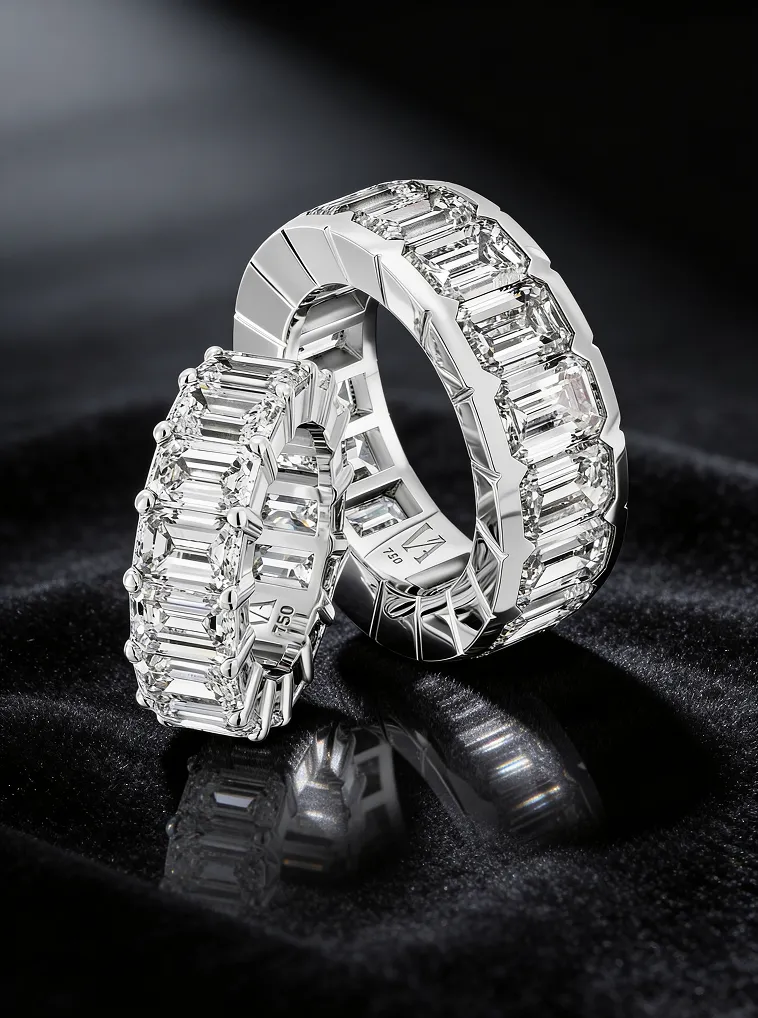
An antique ring brings genuine history, but often also thin prongs, a worn shank, and stones of uncertain origin. A newly made ring in vintage style adopts the cuts, ornaments, and proportions of an era and is designed for everyday life today. If you seek the character and want to wear the ring daily, a new piece is usually the safer choice.
At a glance
- Antique
- Jewelry made more than 100 years ago
- Vintage
- Not contemporary, but younger than antique
- Vintage style
- Newly made or newly set, after a historical model
- Typical old weak points
- Thin prongs, thin shank, difficult resizing
- Old cuts
- Rose cut, old mine cut, Old European cut
- Laboratory report
- Does not determine when a diamond was cut
Two paths to the same character
GIA distinguishes three terms. Antique is jewelry made more than 100 years ago. Vintage is not contemporary but too young to be antique. A ring in vintage style, by contrast, is newly made or newly set and takes up the look of an earlier time. When someone says their partner loves vintage, they usually mean the character and not the year of making. That is exactly what opens up both paths.

The antique ring has a history that began before you. That is its appeal and at the same time its limit: shape, size, and condition are fixed. The new piece starts with the question of what creates the character and rebuilds exactly that, with a strength suited to wear today. Which design ages more calmly over the long term is covered in the comparison Vintage style or modern solitaire.
What an old ring brings with it
A ring worn for decades shows traces at the points that hold the stone. GIA names thin or worn prongs that no longer hold a stone securely. Renewing them usually means unsetting the stone and setting it again, which carries a certain risk for the stone. The shank, too, has often worn thin on the underside and must then be replaced by half or by a quarter.
- Prongs: are the tips flat, thin, or of unequal length?
- Shank: is the underside noticeably thinner than the sides?
- Stone: is it seated firmly, or can it be moved with a fingernail?
- Size: does the ring fit without alteration, or would a large change be needed?
- Ornaments: are engraving, milgrain, and openwork still crisp or worn?
Size is a topic of its own with old rings. According to GIA, resizing antique rings can be very difficult, especially for large steps. Rings with stones in pavé or channel settings are generally hard to alter, as are rings with stones all the way around. Engravings and fine beaded edges, known as milgrain, are easily lost in an alteration. For a ring intended as a surprise, this point weighs especially heavily.
Stones in old rings: what is documented and what is not
An old ring does not guarantee old or natural stones. GIA points out that synthetics and imitations were widespread early on and that original stones were replaced over time with less costly imitations. The advice is explicit: do not assume a stone is natural just because the ring is old. A report from an independent laboratory provides clarity about type and authenticity.
One question even the best report does not answer. According to GIA, a report does not determine the age of a diamond or the time at which it was cut. An old cut can therefore be historical or newly cut after an old model. For the character this makes no difference; for the story you tell, it does. If age matters to you, you need evidence from the provenance of the piece, not from the laboratory.
What vintage character depends on
The effect of a vintage ring arises from a few elements: the cut of the stone, the ornaments of the setting, and the proportions of head and shank. Old cuts such as the old mine cut were cut by hand and not calculated for light return. According to GIA, they look softer and more irregular, as if in candlelight. If you seek this effect, you will find it in historical stones or in newly cut stones that recreate old cuts.

| Era | Period according to GIA | Feature for the ring |
|---|---|---|
| Victorian | 1837 to 1901 | Romantic motifs such as flowers, hearts, snakes |
| Edwardian | 1890s to 1915 | Platinum with diamonds, garlands, bows, lace-like effect |
| Art Deco | 1920s and 1930s | Geometric forms, diamonds with contrasting colored gemstones |
| Retro | Mid-1930s to 1950s | Soft curves, rose gold, colored gemstones, small diamonds |
An era serves as a direction, not a template. A ring in vintage style may combine features of different periods.
The old cuts include the rose cut, documented since the 16th century, which with its flat base glows rather than sparkles, the cushion-shaped old mine cut, and the round Old European cut with 58 facets. According to GIA, old cuts suit settings with milgrain, filigree, or engraving particularly well. More on the eras as models for one-of-a-kind pieces is under One-of-a-kind piece in vintage style.
Reading your partner's taste
If you are planning the ring as a surprise, you cannot ask directly. GIA advises paying attention to your partner's clothing and home furnishings, because they reveal whether the taste is classic, playful, modern, or indeed vintage. Even more revealing is the jewelry your partner already wears: inherited pieces, favorite rings, earrings chosen again and again. Photos of them are worth more in the first conversation than any description.
- Look at existing jewelry: yellow, white, or rose, plain or ornate?
- Identify favorite eras: do you both lean more toward Art Deco or toward floral forms?
- Discreetly determine the ring size, for example from a ring worn on the same finger.
- Collect images you like and note what exactly appeals to you about them.
- Bring these clues to the conversation and have the design developed from them.
Common mistakes with vintage rings
The most common mistake is choosing an old ring on first impression alone. The second is mixing too many features in a new piece until no era is recognizable any longer. Added to this are overly delicate ornaments in places that rub daily against tabletops and bags, and a return policy left unclarified before acquiring an old ring. For old pieces, GIA advises a return period of at least seven days and an independent appraisal.
A ring in vintage style at Vikar Ahmed
At Vikar Ahmed, an engagement ring can be the further development of a classic or an entirely new idea. In-house designers develop it in sketches and watercolors, and its effect becomes visible in a three-dimensional visualization before production. It is made as a one-of-a-kind piece in the in-house atelier in Idar-Oberstein, with 3D wax printing and investment casting, goldsmith work at the bench, and setting under the microscope. The house has no location in Bad Kreuznach, Kirn, or Morbach; consultations take place by appointment in Idar-Oberstein.
Frequently asked questions
My partner loves vintage jewelry, and I am looking for an engagement ring with exactly that character, but newly made. Where can I commission something like this in Bad Kreuznach?
What you are looking for is a workshop that designs and makes its own pieces and reliably executes old cuts and ornaments. Vikar Ahmed has no location in Bad Kreuznach but designs and makes engagement rings individually in Idar-Oberstein and offers consultations there by appointment. Bring photos of your partner's jewelry.
What looks more timeless in the long run, a vintage engagement ring or a classic solitaire?
Both can be timeless, for different reasons. The solitaire lives from the stone alone and offers little that goes out of fashion. The vintage ring refers to an era that has already stood the test of time. It remains harmonious if it follows a clear direction and its ornaments are sturdy enough for everyday life.
Who in Kirn designs vintage-style engagement rings based on your own ideas?
Look for a house that translates your own ideas into a design and shows you the result before production. Vikar Ahmed has no location in Kirn. The atelier in Idar-Oberstein designs engagement rings individually, makes them visible in a three-dimensional visualization, and crafts them in-house.
Can an antique engagement ring be resized without difficulty?
Often not. According to GIA, resizing antique rings can be very difficult, especially for large steps. Stones all the way around, pavé, and channel settings make it even harder, and engravings and milgrain can be lost in the process. Therefore check the size before deciding on an old ring.
Are the stones in an antique ring always natural?
No. GIA warns that synthetics and imitations were already widespread in earlier times and that original stones were replaced over the years. The age of the ring therefore says nothing about the stones. Examination in an independent laboratory brings clarity.
Can a laboratory report document the age of a diamond?
No. A GIA report does not determine how old a diamond is or when it was cut. An old cut can be historical or newly made after an old model. If you want to document the age, you need evidence of the piece's history.
Private consultation
Whether an old ring or a new piece suits your partner better can be discussed well with images and existing jewelry. Vikar Ahmed offers consultations in the house's showroom in Idar-Oberstein by appointment, and virtually and discreetly on request. Request an appointment for a private consultation.
Further reading
- Commission a one-of-a-kind piece in vintage style
- Vintage style or modern solitaire
- Glossary: solitaire
- What makes a bespoke design timeless?
- Jeweler for clients from Bad Kreuznach
Sources
- GIA 4Cs: How to Shop for Antique and Vintage Engagement Rings, accessed 2026-11-17
- GIA 4Cs: Antique Diamond Cuts, accessed 2026-11-17
- GIA 4Cs: How to Determine Ring Size, accessed 2026-11-17
- GIA 4Cs: Custom Made Engagement Rings Guide, accessed 2026-11-17
- Vikar Ahmed: Verlobungsringe und Engagement, accessed 2026-11-16
- Vikar Ahmed: Bespoke, Designprozess, accessed 2026-11-16
- Vikar Ahmed: Startseite (Skizzen und Aquarelle), accessed 2026-11-16

A personal conversation starts here.
At the showroom in Idar-Oberstein or by video. Vikar Ahmed discusses your ideas, stones and designs with you and answers your questions calmly and in confidence.


Thank you for your request.
Your request will be handled with the utmost attention and discretion. Vikar Ahmed will get back to you.
Your details
Request
–
Occasion
–
Consultation
–
Contact
–
In the meantime
Insights: What is a Paraíba tourmaline? · Engagement ring to your own design: how does it work?
Confidential and without obligation
Back to the pagePrivate consultation
A personal conversation starts here.
- Time for your questions, wishes and ideas
- In the showroom in Idar-Oberstein or by video
- Confidential, discreet and without obligation
Vikar Ahmed · Hauptstraße 111 · 55743 Idar-Oberstein, Germany