

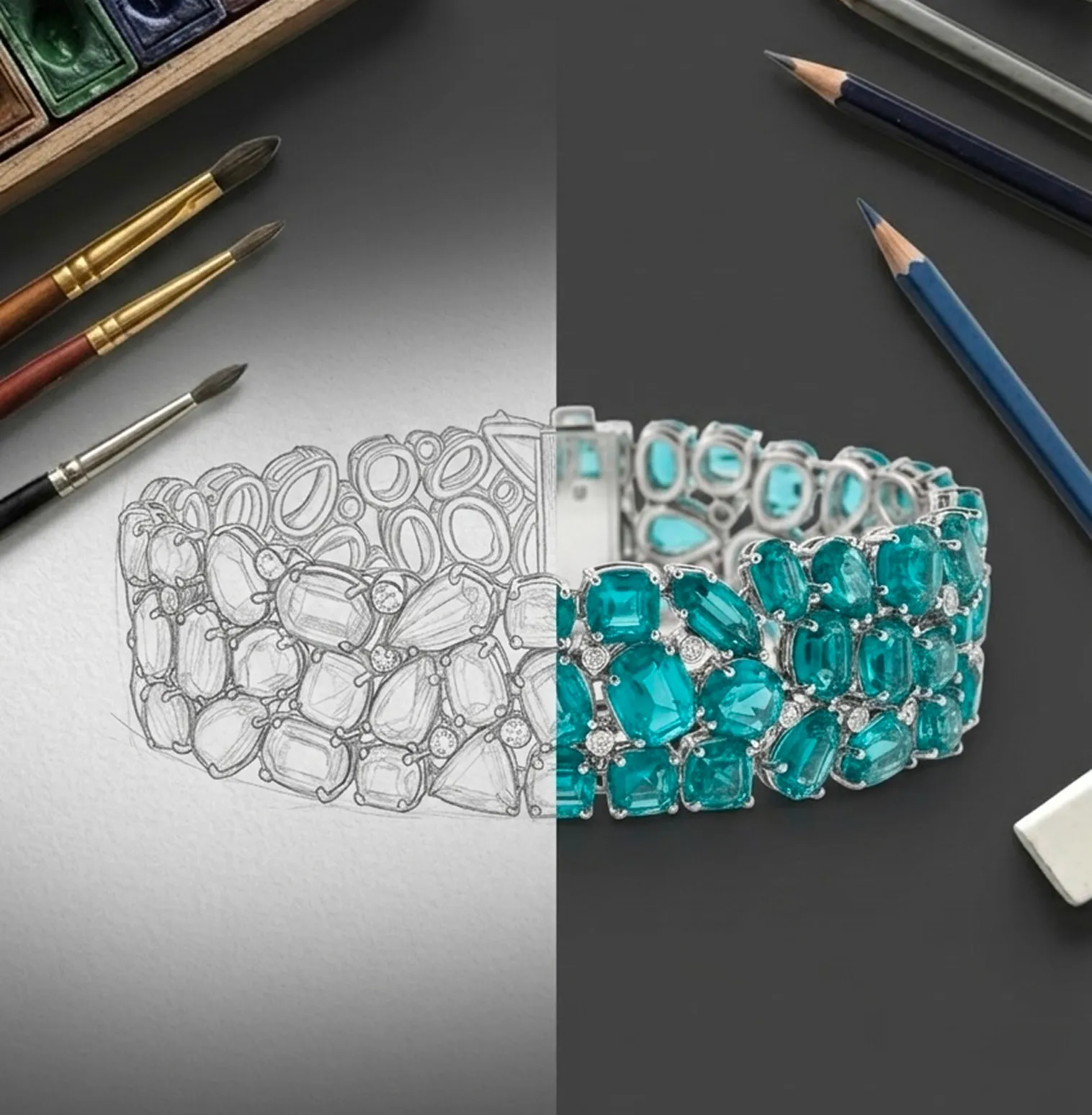
A bespoke design leads from a personal briefing through sketches and a three-dimensional CAD model to written approval. Changes are simple in the early stages and become more involved with each stage. What matters is a clear agreement on which variants you will see, until when you can make changes, and that production only begins after your approval.
At a glance
- Stages
- Briefing, sketch, CAD model, approval, production
- Changes are easiest
- In the sketch and early CAD model
- Changes are hardest
- After casting or setting the stone
- Most important document
- The written approval of the final design
- Legal framework in Germany
- Movable goods to be produced: sales law under § 650 BGB
- Withdrawal for distance sales
- Generally excluded for items made to customer specifications, § 312g BGB
A good design answers questions before metal flows
The design is the phase in which a piece of jewelry costs nothing yet but time and attention. Everything clarified here does not have to be corrected later: proportion, weight, how the stone sits, wearing comfort, and how the piece works in everyday life with clothing and other rings. A careful process makes these points visible one after another, instead of hiding them in a single beautiful drawing.

For you as the client, this means you should see every stage and understand what has changed between two stages. An atelier that jumps from a first sketch straight to production takes decisions away from you that you may have wanted to make yourself. What bespoke means as a term, and how it differs from merely adapting a model, is explained in the glossary.
The briefing: what is clarified before the first line
The briefing is the conversation in which the designer learns what the piece is intended for. Occasion, wearer, wearing habits, favorite pieces, dislikes, and a possible date are all part of it. The more precise these details, the more apt the first sketches. Your own drawings, photos of models, or an heirloom whose stone is to live on are valuable material and no sign of a lack of imagination.
- Occasion and desired handover date
- Who wears the piece, how often, and during which activities
- An existing stone or the wish for a particular stone
- Metal color and pieces it will be combined with
- Ring size or chain length, if known
- What the piece should under no circumstances be
The last point is often underestimated. A clear boundary saves an entire round of revisions, because it rules out directions that would otherwise first have to lie on the table as a sketch. According to the GIA, for rings it is worth knowing the ring size before the first appointment. It determines how wide a shank may look and how large a stone appears in relation to the hand.
From sketch to 3D model
The briefing is followed by sketches, drawn by hand or digitally. They show the idea, but not yet exact dimensions. From them, a 3D design is created with CAD, short for computer-aided design. Jewelry design training programs such as the GIA's teach how to model designs in CAD software, render them photorealistically, and output them as a physical prototype with a 3D printer. Such a prototype can be held and tried on before casting.
| Stage | What you see | What can still be changed easily |
|---|---|---|
| Sketch | Idea, line, mood | Almost everything, including the basic form |
| CAD model | Dimensions, proportion, stone seat from all sides | Details, proportion, type of setting |
| Resin prototype | Size and weight on the body | Fine points such as height and shank width |
| Casting and blank | The piece in metal | Only surface and minor corrections |
| Set stone | The finished piece | Hardly anything without new effort |
The further the design has progressed, the more work depends on each change. Not every atelier works with a printed prototype.
Using variants and revision rounds wisely
Several design variants help when the direction is still open. Two or three sketches that differ clearly in one respect, such as open versus closed or plain versus ornamental, make a decision easier than ten almost identical versions. Once the direction has been chosen, the work narrows to one variant that is refined step by step.

How many revision rounds an atelier allows is not a question of generosity but of agreement. Ask in advance whether changes to the CAD model are included in the commission, from when additional rounds are charged, and whether changing the stone means a new construction. If you clarify these points at the start, you can make changes calmly later without having to negotiate the framework with every piece of feedback.
Good to know
The stone determines the setting. If you change the shape or dimensions of the stone, the setting must be reconstructed in the CAD model, often along with the proportion of the whole piece. If the stone is settled early, the design process is calmer.
Approval before production
Approval is the moment when the design becomes a commission for production. It should be given in writing and refer to an unambiguous version: the final CAD model with dimensions, metal, stone, and type of setting. Anything that is to be different afterward is a change to the commission. A reputable atelier begins production only once this approval has been given, and documents what was approved.
Legally, under § 650 of the German Civil Code (BGB), contracts for movable goods to be produced in Germany are governed by the provisions on sales. If a contract is concluded at a distance, there is generally no right of withdrawal under § 312g (2) BGB for goods made according to the consumer's individual selection, unless otherwise agreed. This makes it all the more important to be truly satisfied before approval. This is not legal advice.
Common mistakes in the design phase
- Judging the piece only from the front: side view and height determine wearing comfort.
- Selecting the stone only after the design: the setting then has to be rethought.
- Putting too many ideas into one piece: a design usually carries one main idea.
- Naming the handover date late: it determines how many revision rounds are possible.
- Approving verbally: without a written version, it remains unclear what applies.
Another mistake concerns the presentation. A photorealistic image on screen often looks larger and shinier than the piece on the body. Ask for views at actual size or for dimensions in relation to the hand. For rings, a comparison with a ring you already wear, whose width and height you know well, helps.
The design at Vikar Ahmed
Vikar Ahmed describes three steps: design, visualization, and execution. In the design phase, in-house designers develop independent concepts that incorporate personal wishes, captured in sketches and watercolors. The visualization shows the piece as a 3D CAD design with a photorealistic view, where details can still be adjusted before production. Goldsmiths from Idar-Oberstein then make the one-of-a-kind piece in the in-house atelier.
Custom projects are carried out exclusively on request. The inquiry is reviewed, and work begins only after acceptance. The first conversation takes place by appointment, in person in Idar-Oberstein or virtually. It helps to note the occasion, preferred date and style wishes beforehand. How long a project takes from the first sketch to handover depends on the design, the stone and the work involved. The page Bespoke gives an overview of the entire path.
Frequently asked questions
Which goldsmiths in Kaiserslautern let me approve the design before binding production begins?
Regardless of location, make sure the atelier presents a final CAD model with dimensions and only begins production after your written approval. Vikar Ahmed has no location in Kaiserslautern, offers consultations in Idar-Oberstein, and visualizes every design in three dimensions before production.
I would like a piece of jewelry that tells my own story and to see the design as a 3D image beforehand. Which ateliers in Kirn allow changes until every detail is right?
What matters is an atelier that works with CAD and plans for changes to the model before production. In the briefing, tell the story behind the piece, not just the form. Vikar Ahmed is based in Idar-Oberstein, not in Kirn, and shows designs as a 3D visualization before execution.
Which jewelers in Kirn show me several design variants to choose from?
Whether several variants are customary is a question for any atelier in the first conversation. Two or three sketches that differ in one clear respect make sense. After that, one direction is refined. For clients from Kirn, the consultation in Idar-Oberstein is the nearest route to Vikar Ahmed.
Which goldsmiths in Trier offer a personal briefing before the first design?
A personal briefing should come at the start of every bespoke commission, because occasion, wearing habits, and stone shape the design. Ask whether it can take place in person or by video. Vikar Ahmed has no location in Trier and offers in-person and virtual appointments.
Until when can I still change a jewelry design?
Without great effort, until the CAD model is approved. After that, production begins, and every change affects metal or stone. After casting, usually only the surface and small details can be adjusted. Clarify in advance, therefore, which version of the model counts as final.
What belongs in a written design approval?
The final model with views from all sides, the dimensions, metal and alloy, the stone with shape and size, the type of setting, and for rings the ring size. Plus the agreed date. Whatever is not in the approval is difficult to prove later.
Private consultation
Whether your idea is already a sketch or only an occasion: in the first conversation, it becomes a briefing. Vikar Ahmed offers consultations by appointment in the showroom in Idar-Oberstein or in a virtual appointment, and inquiries are treated with discretion. Request an appointment for a private consultation.
Further reading
- Glossary: 3D design
- Creative input in a one-of-a-kind piece
- One-of-a-kind pieces from the in-house atelier
- Individual engagement rings: from wish to design
- How a design is presented
Sources
- GIA: Jewelry Design & Technology Program, accessed 2026-11-17
- GIA 4Cs: Custom Made Engagement Rings Guide, accessed 2026-11-17
- Bürgerliches Gesetzbuch, § 650 Werklieferungsvertrag, accessed 2026-11-17
- Bürgerliches Gesetzbuch, § 312g Widerrufsrecht, accessed 2026-11-17
- Vikar Ahmed: Bespoke, accessed 2026-11-16
- Vikar Ahmed: Kontakt, accessed 2026-11-16

A personal conversation starts here.
At the showroom in Idar-Oberstein or by video. Vikar Ahmed discusses your ideas, stones and designs with you and answers your questions calmly and in confidence.


Thank you for your request.
Your request will be handled with the utmost attention and discretion. Vikar Ahmed will get back to you.
Your details
Request
–
Occasion
–
Consultation
–
Contact
–
In the meantime
Insights: What is a Paraíba tourmaline? · Engagement ring to your own design: how does it work?
Confidential and without obligation
Back to the pagePrivate consultation
A personal conversation starts here.
- Time for your questions, wishes and ideas
- In the showroom in Idar-Oberstein or by video
- Confidential, discreet and without obligation
Vikar Ahmed · Hauptstraße 111 · 55743 Idar-Oberstein, Germany