

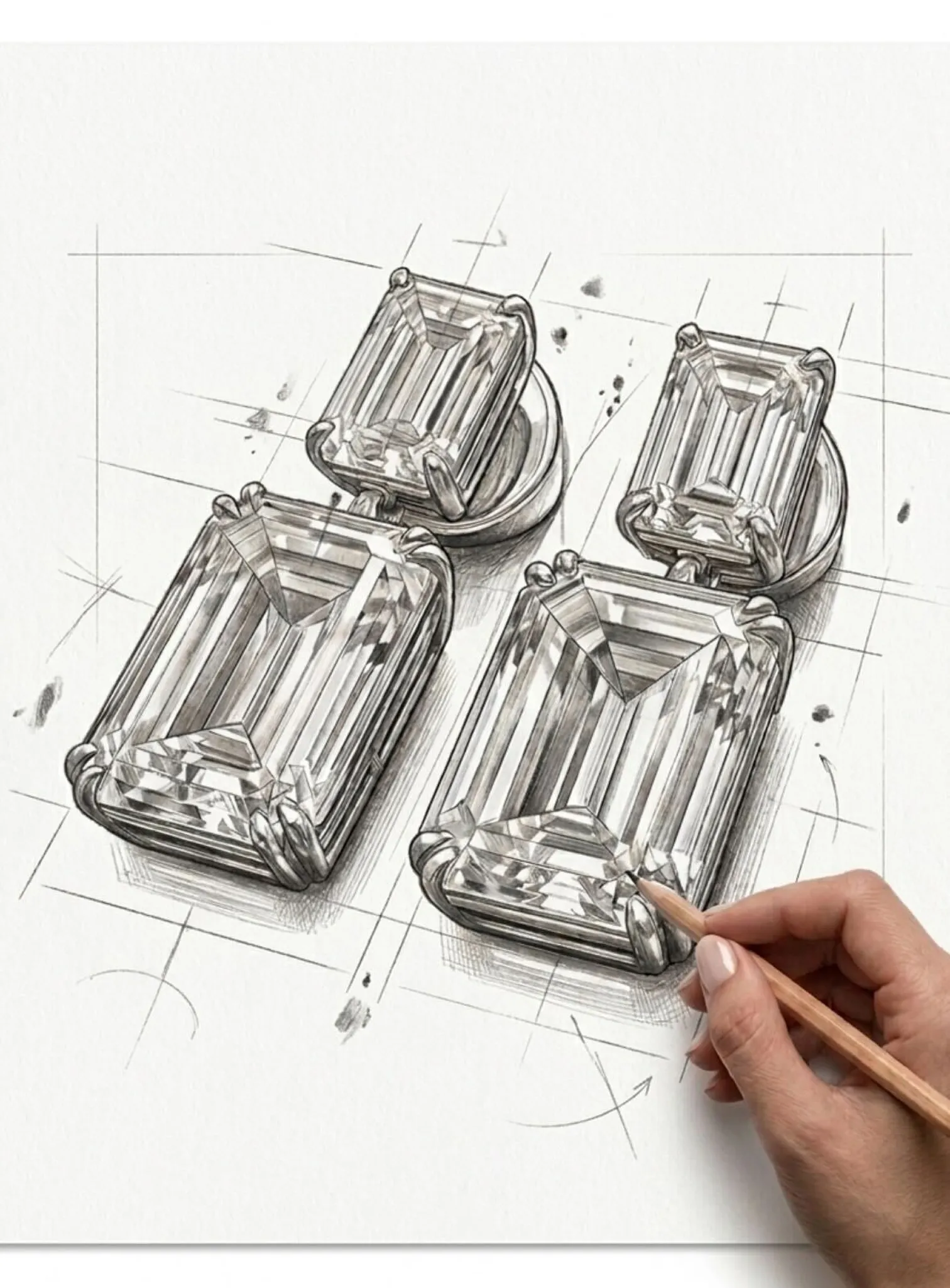
A one-of-a-kind piece from an in-house atelier is made where it was designed: goldsmiths, setters, and designers speak directly with one another, changes take no detour, and responsibility lies with one house. If casting, setting, or polishing is outsourced, that is not wrong, but it lengthens the chain. Ask specifically which working steps take place in-house.
At a glance
- In-house atelier means
- Goldsmithing, setting, and polishing in the same house as the design
- Often outsourced
- Casting, setting of small stones, engraving, surface finishes
- Goldsmith
- Trade without licensing requirement, German Crafts Code Annex B, Section 1 No. 11
- Gemstone cutter
- Trade without licensing requirement, German Crafts Code Annex B, Section 1 No. 37
- Key question
- Who carries out which step, and where?
- Benefit for you
- Short paths for changes, one contact for the entire piece
What an in-house atelier means for a one-of-a-kind piece
A one-of-a-kind piece is not a series product rebuilt from a plan. With every piece, questions arise that only become visible at the workbench: whether the setting holds the stone as the model shows, whether the shank sits comfortably, whether an edge looks harsher in metal than on screen. In an in-house atelier, the goldsmith settles such points with the designer on the same day. If the work lies with an outside workshop, the questions travel back and forth by email.

The second argument is responsibility. Whoever designs and crafts can stand behind the entire piece, from the design to the final polish. In a chain of designer, foundry, setter, and polisher, responsibility is distributed. That need not be worse, but it makes follow-up questions and later repairs more cumbersome. For engagement rings, the guide Engagement ring from an in-house atelier explores this question in more depth.
The chain of a one-of-a-kind piece: who does which step
Between design and handover lie several crafts. Hardly any house truly does everything itself, and that is not necessary either. What matters is that the steps that define the one-of-a-kind piece are in one hand: building the piece, setting the main stone, and the finishing work. The following overview shows what depends on each step and what outsourcing it means.
| Working step | What depends on it | If outsourced |
|---|---|---|
| Design and CAD model | Proportion, stone seating, wearing comfort | Model and workbench do not communicate directly |
| Casting or building up by hand | Density and form of the metal | Common, as long as the house inspects the blank |
| Setting the main stone | Security and protection of the stone | The most delicate step leaves the house |
| Setting small stones | Evenness, security in everyday wear | Specialized setters are widespread |
| Polishing and surface | Luster, edges, final effect | The final inspection takes place elsewhere |
Outsourcing is widespread in jewelry crafting. What matters is that the house states openly which steps it carries out itself.
Jeweler with a goldsmith workshop or designer without one
A jewelry designer without a workshop can deliver excellent designs. The strength lies in the idea, and a partner workshop takes over the realization. With classic forms, this works well because the partner knows similar pieces. The more unusual the design, the more questions arise during realization: an unfamiliar stone position, a delicate bridge, a movable connection. Then what counts is how quickly design and workbench coordinate.
A jeweler with an in-house goldsmith workshop can check a daring design for feasibility early and propose solutions before the idea becomes fixed. Conversely, some workshops tend toward what they are used to. Examine both, therefore: the creative range of the work shown and the depth of craftsmanship. You can read more about the role of design in the process under creative input.
Cutter and goldsmith: two crafts, one piece
In Germany, gemstone cutters and goldsmiths are separate crafts. The German Crafts Code lists gold and silversmiths under number 11 and gemstone cutters and engravers under number 37 in its register of trades without a licensing requirement. A master craftsman's title is therefore not a prerequisite for running either business. If training matters to you, ask directly about the background of the people at the workbench.

With colored gemstones, the two crafts interlock closely. Tourmalines grow as long crystals and, according to GIA, yield many narrow stones in dimensions that differ from standard sizes. According to GIA, Paraíba tourmalines are almost always cut individually. Such stones fit no prefabricated setting. The setting is built around the stone, and goldsmith and setter must know the stone before the metal takes shape.
How to recognize in-house crafting
Terms such as manufactory, atelier, or workshop are not protected and say little on their own. More revealing are specific questions that a house with in-house crafting answers without hesitation. Ask, too, to see the workshop or at least photographs from the work on earlier pieces. Those who craft themselves can explain why a step was solved one way and not another.
- Who makes the blank, and is it cast or built up by hand?
- Who sets the main stone, and who sets the small stones?
- Can I speak with the person who builds my piece at the workbench?
- Who inspects the piece before handover, and who takes on later work on it?
- How is the fineness hallmarked, for example 750 for 18 karat?
The last question concerns the metal. According to the World Gold Council, 18 karat gold contains 75 percent gold, the remainder is usually copper or silver, and the hallmark reads 750. Which alloy suits a one-of-a-kind piece is explained in the glossary under 18k (750) gold. Those who handle metal and hallmarks confidently usually also work carefully at the workbench.
Three misconceptions
- “Handmade” does not mean that every step takes place in-house. The term says nothing about the location.
- A showroom is not a workshop. Many houses consult in one place and craft in another.
- In-house crafting does not exclude CAD. Digital design and handwork complement each other.
On the third point: a CAD model does not replace goldsmithing, it prepares for it. Cast blanks are cleaned up, filed, soldered, set, and polished. These steps determine the result, not whether a pencil or a mouse stood at the beginning. What a 3D design achieves and where its limits lie is explained in the glossary.
The atelier of Vikar Ahmed
Vikar Ahmed crafts one-of-a-kind pieces in its in-house atelier in Idar-Oberstein, under the guiding principle “modern technology, true handcraft”. According to the house, the path leads from the 3D CAD design by the in-house designers through 3D wax printing and investment casting to cleanup and goldsmithing at the bench. Stones are set under the microscope, and the piece is polished in several stages to a high shine, with rhodium plating for white gold. A quality check comes at the end. If you want to know who will work on your own piece, it is best to ask directly in the conversation.
By its own account, its location in Idar-Oberstein is part of the house's identity, rooted in the local goldsmithing tradition. Custom projects are accepted exclusively on request and begun after review. How the town became a gemstone center is explained in the glossary under Idar-Oberstein. The page Bespoke describes how a project unfolds.
Frequently asked questions
Which jewelers craft one-of-a-kind pieces entirely in their own workshop instead of outsourcing the goldsmithing?
This can only be clarified in conversation, because terms such as manufactory are not protected. Ask who builds the blank, who sets the main stone, and who polishes. On its website, Vikar Ahmed names crafting in its in-house atelier in Idar-Oberstein, including setting and hand polishing.
I want to propose to my girlfriend and am looking for a ring that exists only once. Which goldsmiths in Kaiserslautern work with their own workshop?
For a proposal ring, what counts is that design and crafting are closely connected and that the date is fixed early. Ask every atelier which steps take place in-house. Vikar Ahmed has no location in Kaiserslautern, but offers consultations and crafts in Idar-Oberstein.
Jeweler with an in-house goldsmith workshop or jewelry designer without a workshop: who realizes an unusual design better?
With unusual designs, an in-house goldsmith workshop has an advantage: feasibility is checked early, and questions at the workbench go straight back to the design. A designer without a workshop can work to an equal standard if there is an experienced partner workshop and you are allowed to see its work.
Is outsourced setting a flaw in quality?
No. Specialized setters often work with great precision. What matters is that the house states openly who sets the stones and inspects the result itself before handover. With a valuable main stone, it is worth asking whether the stone leaves the house for this.
Do goldsmiths in Germany need a master craftsman's title?
No. Under the German Crafts Code, gold and silversmiths belong to the trades without a licensing requirement, as do gemstone cutters and engravers. A master craftsman's title is not mandatory for running a business. It remains an indication of training, but does not replace a look at finished work.
Why do colored gemstones often need a custom-built setting?
Many colored gemstones are cut to retain as much material and color as possible. This results in dimensions that match no standard size. For Paraíba tourmalines, according to GIA, an individual cut is almost the rule. The setting must then be constructed for exactly this stone.
Private consultation
You should know who designs your piece and who crafts it before you commission it. In the house's showroom in Idar-Oberstein, Vikar Ahmed explains the path from design to workbench, by appointment or virtually. Inquiries are handled discreetly. Request an appointment for a private consultation.
Further reading
- Goldsmith or in-house atelier?
- The bespoke design: briefing, variations, approval
- Hand setting of gemstones
- Glossary: Idar-Oberstein
- Jeweler in Idar-Oberstein
Sources
- Handwerksordnung, Anlage B: zulassungsfreie Handwerke, accessed 2026-11-17
- GIA: Tourmaline Quality Factors, accessed 2026-11-17
- World Gold Council: About gold jewellery, accessed 2026-11-17
- GIA 4Cs: Complete Guide to Engagement Ring Settings, accessed 2026-11-17
- Vikar Ahmed: Bespoke, accessed 2026-11-16
- Vikar Ahmed: Über uns, accessed 2026-11-16
- Vikar Ahmed: Kontakt, accessed 2026-11-16

A personal conversation starts here.
At the showroom in Idar-Oberstein or by video. Vikar Ahmed discusses your ideas, stones and designs with you and answers your questions calmly and in confidence.


Thank you for your request.
Your request will be handled with the utmost attention and discretion. Vikar Ahmed will get back to you.
Your details
Request
–
Occasion
–
Consultation
–
Contact
–
In the meantime
Insights: What is a Paraíba tourmaline? · Engagement ring to your own design: how does it work?
Confidential and without obligation
Back to the pagePrivate consultation
A personal conversation starts here.
- Time for your questions, wishes and ideas
- In the showroom in Idar-Oberstein or by video
- Confidential, discreet and without obligation
Vikar Ahmed · Hauptstraße 111 · 55743 Idar-Oberstein, Germany