

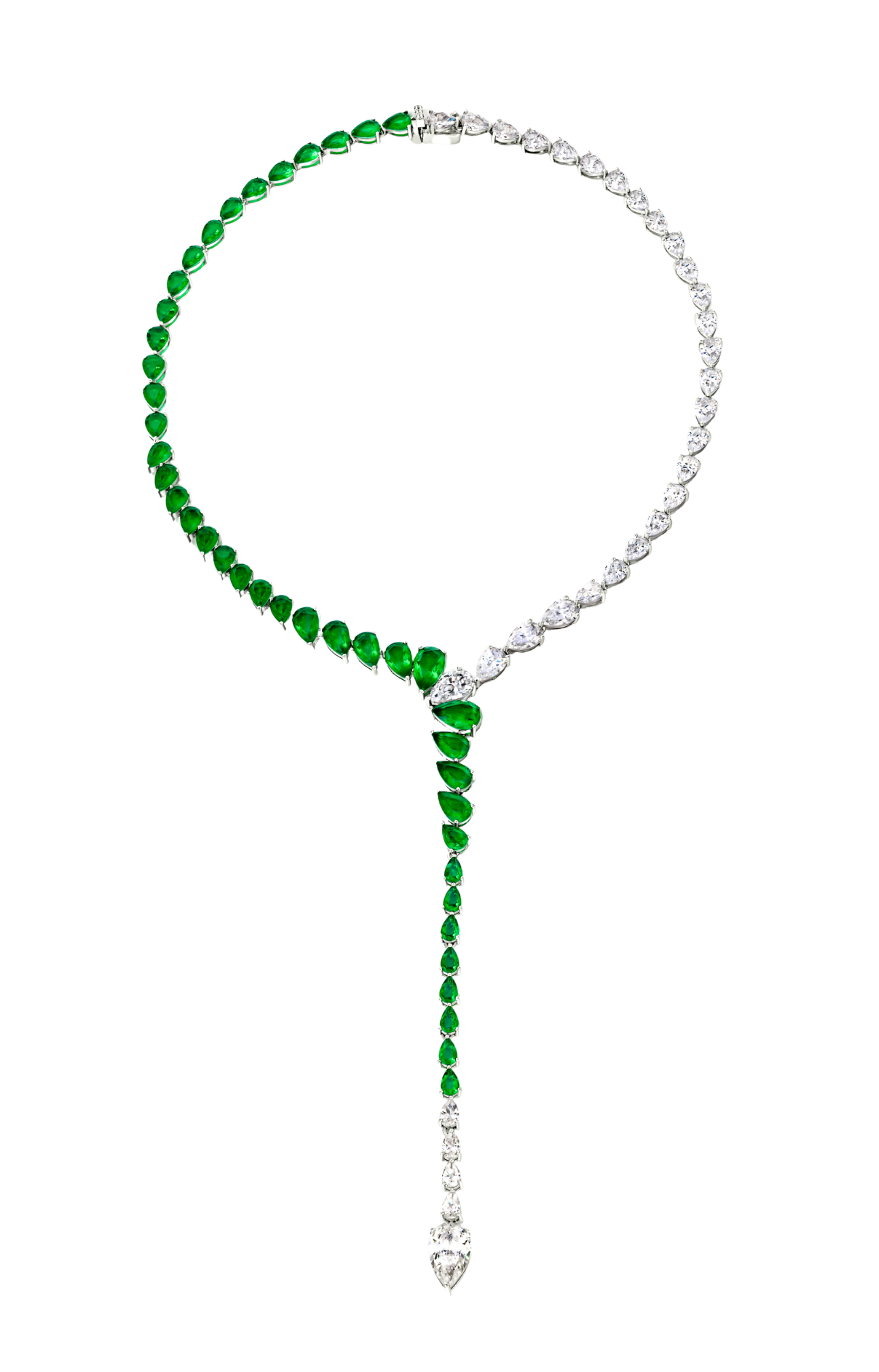
It is best to have a loose emerald set only once the type of stone, filling, and existing fissures are recorded in writing. For a pendant, a bezel or strong prongs that protect the corners are suitable. 18k (750) white gold contains 75 percent gold. In the workshop, heat, steam, and ultrasonic cleaning are kept away from the stone, and soldering is done before setting.
At a glance
- Hardness
- 7.5 to 8 on the Mohs scale, toughness according to GIA fair to good
- Filling
- According to GIA, by some estimates 90 percent or more of emeralds are filled
- Heat
- Can extend existing fissures, so soldering is done before setting
- Report before setting
- Possible on the loose stone, mounted stones receive a Test Report at SSEF
- 18k (750) white gold
- 75 percent gold with white metals, usually rhodium-plated
- Cleaning
- Warm soapy water, no ultrasonic, no steam
Setting begins with examining the stone
If you bring an emerald, you should have it described precisely before handing it over to the workshop. GIA cites estimates according to which 90 percent or more of all emeralds are filled in fissures that reach the surface. The type and amount of filling influence how the stone reacts to heat, light, and cleaning. How laboratories classify the filling is explained in How emeralds are treated.
The best time for a report is before setting. The SSEF laboratory issues its Gemstone Report for individual loose stones. For mounted stones and jewelry, it offers the Test Report. A loose stone can be examined from all sides, including the areas that will later lie under metal. In addition, a record with photos and measurements is worthwhile, documenting visible fissures and edge damage before the work begins.
What the emerald demands of the pendant
An emerald reaches 7.5 to 8 on the Mohs scale and is therefore considered scratch-resistant. GIA rates its toughness only as fair to good, and it is more brittle than corundum, meaning ruby and sapphire. A knock against an edge can therefore damage it more readily than a scratch. For everyday wear, this means the emerald needs more care when worn than most other well-known gemstones.

Around the neck, it is in good hands. For stones with limited toughness, GIA recommends earrings and necklaces, because they knock against hard surfaces less often than rings or bracelets. A pendant hangs freely but swings along and can strike table edges or door frames when you lean forward. The setting should therefore above all protect the corners and the girdle, meaning the edge running around the stone where its upper and lower parts meet.
Which setting protects the emerald at the neck
According to GIA, the bezel, a metal rim around the stone, protects the edges best and reduces the risk of chipping. It covers a little more of the stone and lets in a little less light than prongs. Prongs hold the stone with a few metal claws, let in a lot of light, and show more of the stone. In the classic emerald cut, the vulnerable corners are beveled according to GIA, which gives prongs at the corners a more secure hold.
| Setting | Light in the stone | Edge protection | Suits |
|---|---|---|---|
| Bezel | Somewhat less | Very good, closed all around | Heavily filled stones, daily wear |
| Half bezel | Medium | Good on the long sides | Ovals and pear shapes with an open look |
| Corner prongs | A lot | Good at the corners, open at the sides | Emerald cut with beveled corners |
| Prongs at the sides | A lot | Lower, corners exposed | Rarely advisable for emeralds |
Which setting is suitable also depends on the condition of the stone and on the filling.
18k (750) white gold: what the number means
The number 750 states the gold content in parts per thousand. According to the World Gold Council, 18-karat gold contains 75 percent gold and 25 percent other metals. White gold is created when gold is alloyed with white metals such as palladium or silver. It is usually also plated with rhodium, which produces a harder and brighter surface. More on the alloy can be found under 18k (750) gold in the glossary.
In Germany, the marking on the piece of jewelry is governed by the German Hallmarking Act (Feingehaltsgesetz). Gold jewelry may be stamped in any fineness, and the marking is given in parts per thousand, that is, as 750. The hallmark with company details, intended for gold articles of use, may not appear on jewelry. The provider is liable for the accuracy of the stated fineness. Next to a green stone, cool white gold looks calm and lets the color stand on its own.
Planning bail, chain, and back as well
A pendant consists of more than its setting. The bail, by which it hangs on the chain, must suit the thickness of the chain and be large enough for the pendant to glide freely. If it is too narrow, the chain rubs at one spot and the pendant turns onto its back. If it is too large, it looks heavy next to a small stone. Both can be decided in the design, before any metal is worked.

The back determines light and care. An open back lets light into the stone and makes it brighter, a closed back protects it but collects dust and cleaning residue. With an emerald, the orientation of the stone also counts: it should be positioned so that the filled fissures do not lie at an edge that is often touched during wear. This can only be decided with the stone in hand.
How a client's own emerald is set
The order of the work steps protects the stone. According to GIA, heat can damage emeralds, above all by extending existing fissures. Soldering on bail and setting is therefore done while the stone is not yet in place. After that, the stone is set, polished, and checked, without a steam cleaner and without an ultrasonic bath. A sequence of five steps has proven itself.
- Presenting the stone and documentsThe emerald, any existing report, and your idea of the pendant, ideally with a sketch or photo.
- Recording the conditionMeasurements, photos, and visible fissures are documented before any work and confirmed by both sides.
- Design around the stoneSetting, bail, and back are planned according to the exact measurements of the stone and approved.
- Metalwork without the stoneSoldering and pre-polishing are done before the emerald goes into the setting.
- Setting and final inspectionThe stone is set cold, the fit is checked, and the pendant is cleaned with soapy water.
Common mistakes with an emerald pendant
- Handing the stone to the workshop without a report and without a condition record.
- Soldering while the emerald is already in the setting.
- Cleaning the finished pendant in an ultrasonic bath or with steam.
- Leaving corners exposed on a stone that can swing against edges.
- Planning the bail without considering the chain.
- Choosing a closed back without thinking about cleaning.
Most of these mistakes come from time pressure. An occasion with a fixed date, such as a birthday, tempts one to cut examination and approval short. With an emerald, it is precisely this part of the work that protects the stone. It is therefore better to allow more time than to skip the documentation. Care instructions for the finished jewelry can be found under Having a piece of jewelry made with an emerald.
Setting emeralds in the Naheland
Vikar Ahmed is based in Idar-Oberstein in the Naheland, Hauptstr. 111. Design and production take place in the house's in-house atelier, by goldsmiths from Idar-Oberstein with decades of experience. Gemstone setting and polishing by hand are among the house's work steps, and pieces shown are in 18k (750) white gold and with Colombian emeralds. What else characterizes the region is described under Jeweler in the Naheland.
Vikar Ahmed carries out projects to client specifications exclusively on request. The request is reviewed, and work begins only after acceptance. Vikar Ahmed sets stones brought in by clients only in rare exceptions, for example when they carry high emotional value, after gemological testing and as part of a new design. Therefore mention right away that it concerns your own emerald, and enclose any existing reports. With emerald, Vikar Ahmed accepts only light colorless oiling and rejects synthetic resins and colored oil. How design and model are connected is shown in Choose the stone first, then design the piece.
Frequently asked questions
I have chosen a loose emerald and would like to have it set as a pendant in 18k (750) white gold. Which atelier in the Naheland has its own goldsmithing workshop for this?
Vikar Ahmed works in Idar-Oberstein in the Naheland with its own in-house atelier and goldsmiths from the town, and gemstone setting is among its work steps. However, the house sets stones brought in by clients only in rare exceptions, after gemological testing. Wherever you have the stone set, ask whether soldering is done before setting and who documents the condition of the stone.
Can an oiled emerald be damaged during setting?
Yes, if the workshop is not prepared for it. Heat can extend existing fissures, and hot steam can drive oil or unhardened resin out of the fissures. That is why soldering is done before the stone is in place, and cleaning is done with soapy water. The setting pressure itself must be adapted to the position of the fissures.
Does an emerald need a laboratory report before setting?
It is not required, but it almost always makes sense. On the loose stone, a laboratory can examine all sides and describe the filling. After setting, this is only possible to a limited extent, at SSEF for example as a Test Report for mounted stones. The report also serves as evidence of the condition before the work.
Why is white gold rhodium-plated?
White gold is an alloy of gold and white metals such as palladium or silver. It is not entirely colorless. According to the World Gold Council, a rhodium plating gives the surface more hardness and a brighter luster. Over time, it can wear off in places that are touched often.
Which cut is suitable for an emerald pendant?
The most common is the emerald cut, a rectangular cut with beveled corners. According to GIA, the corners are faceted precisely because they are the most vulnerable point of an emerald. Ovals and pear shapes look softer at the neck but need a setting that protects their point.
How do you clean an emerald pendant?
With warm soapy water and a soft brush, then rinse with clear water and pat dry. According to GIA, ultrasonic cleaners and steam are risky, because vibrations weaken stones with prior damage and steam can dissolve fillers. Perfume and creams should be fully absorbed before putting the pendant on.
Private consultation
An emerald you bring deserves a design that knows its measurements and its condition. Vikar Ahmed advises in the house's showroom in Idar-Oberstein by appointment or in a virtual appointment. Bring the stone and any existing reports. Request an appointment for a private consultation.
Further reading
- Which cut brings out the color of an emerald?
- Colombian emeralds: origin and proof
- Gemstone: Emerald
- Glossary: Prong setting
- A pendant from your own design
Sources
- GIA: Emerald Care and Cleaning, accessed 2026-11-17
- GIA: Emerald Quality Factors, accessed 2026-11-17
- GIA 4Cs: More than Mohs, Gem Durability, accessed 2026-11-17
- GIA 4Cs: Guide to Ring Settings, accessed 2026-11-17
- SSEF: Understanding a SSEF report, accessed 2026-11-17
- World Gold Council: Gold Jewellery, Colour, Carat and Purity, accessed 2026-11-17
- Gesetz über den Feingehalt der Gold- und Silberwaren (FeinGehG), accessed 2026-11-17
- Vikar Ahmed: Bespoke, Designprozess, accessed 2026-11-16
- Vikar Ahmed: Kontakt, accessed 2026-11-16
- CIBJO: Introduction to the Blue Books, accessed 2026-11-17

A personal conversation starts here.
At the showroom in Idar-Oberstein or by video. Vikar Ahmed discusses your ideas, stones and designs with you and answers your questions calmly and in confidence.


Thank you for your request.
Your request will be handled with the utmost attention and discretion. Vikar Ahmed will get back to you.
Your details
Request
–
Occasion
–
Consultation
–
Contact
–
In the meantime
Insights: What is a Paraíba tourmaline? · Engagement ring to your own design: how does it work?
Confidential and without obligation
Back to the pagePrivate consultation
A personal conversation starts here.
- Time for your questions, wishes and ideas
- In the showroom in Idar-Oberstein or by video
- Confidential, discreet and without obligation
Vikar Ahmed · Hauptstraße 111 · 55743 Idar-Oberstein, Germany