

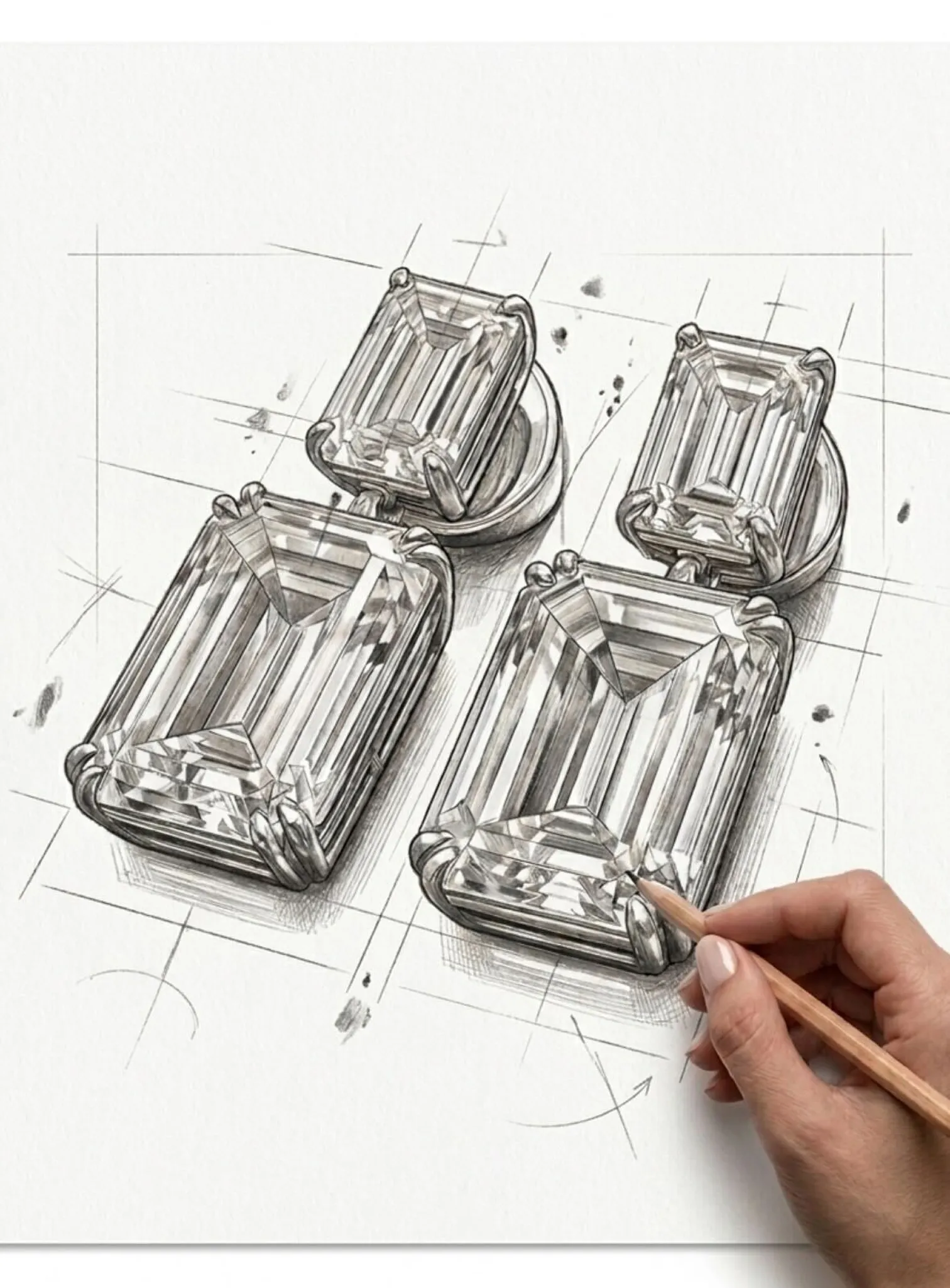
Choosing the stone before the design gives the piece of jewelry its center: the dimensions, shape, and color of the stone determine setting, proportion, and metal. This makes sense for colored stones and for several stones that must match one another. Before the first line is drawn, the species, treatment, exact dimensions, and any damage of the stone should be established.
At a glance
- Order
- Choose the stone, examine the stone, design around the stone, approval, production
- Colored stone
- Color first, then clarity by the standard of the species, cut, size
- Diamond
- Color D to Z, clarity in 11 grades according to GIA
- Clarify before the design
- Species, treatment, dimensions, damage, care requirements
- Laboratory report
- Available from GIA for loose and mounted stones
- Several stones
- Match hue, saturation, and tone to one another
Why the order matters
A design created before the stone sets dimensions that the stone must later meet. This works for diamonds in standard sizes, rarely for colored stones. Every colored stone has its own proportions, its own depth of color, often an individual cut. Paraíba tourmalines, for example, are almost always custom cut according to GIA. A design created around the chosen stone does not have to compromise with a different stone.

The order also changes what you decide on. If you choose the stone first, you decide on what counts most in the end: color, size, presence. The design then translates this choice into form. The other way round, you decide on the form first and then look for a stone that fits into it. Both are legitimate. For a colored stone that means something to you personally, starting from the stone is usually the more coherent path.
What to look for in the selection
With colored stones, color comes before all other characteristics. For emerald, GIA states that it is above all about color; for Paraíba tourmaline, that color counts for more than size. Clarity in colored stones is judged by the standard of the respective species: in emerald, visible inclusions, the so-called jardin, are accepted in the trade, whereas eye-clean stones are rare. How to proceed is explained in Choosing a colored stone.
With diamonds, color and clarity can be defined more precisely. GIA grades color on a scale from D to Z under controlled lighting and clarity in eleven grades under tenfold magnification. Many color differences are not visible to the untrained eye. Anyone selecting a diamond by color and clarity themselves should therefore look at the report and the stone together. The basic terms are explained in 4Cs.
| Criterion | Colored stone | Diamond |
|---|---|---|
| Assessment | Color comes before every other feature | Color and clarity can be graded precisely |
| Color | By appearance and the standard of the gem type | D to Z scale under controlled lighting |
| Clarity | Standard of the gem type; jardin accepted in emerald | Eleven grades under 10x magnification |
| Dimensions | Often custom cut, with individual proportions | Standard sizes common, design can come first |
Colored stone and diamond in selection, based on GIA information.
- Look at the stone under daylight and under lamplight.
- View the stone from several directions; tourmalines show different tones depending on the viewing direction.
- Ask for a report or a written statement on species and treatment.
- Have the dimensions noted, not just the carat weight.
- Have the edges and the point checked for chips.
Several colored stones for a bracelet
A bracelet with several colored stones is the most demanding form of this order. Here, not one stone is chosen, but a sequence. Either all the stones should appear the same in hue, saturation, and tone, or they should form a deliberate gradient. In both cases, the interplay decides. A single stone that turns out lighter or darker disturbs the whole row, even if it is beautiful on its own.
In practice, this means the stones for a bracelet are laid out side by side, in the planned order and on a neutral background. This reveals which stone stands out from the row before the first link is designed. Only when the sequence is fixed does the design determine spacing, settings, and length. Anyone who wants to add to the row later should say so early, because matching stones are hard to find afterward.
On the wrist, there is also the strain. According to GIA, bracelets and rings knock against hard surfaces more often than earrings or necklaces. GIA recommends less tough stones there rather for special occasions. Tourmaline reaches 7 to 7.5 on the Mohs scale, and its toughness is considered fair. According to GIA, emeralds are more brittle than corundum and more delicate during cutting and setting. How to match colors on the wrist is shown in The tourmaline bracelet.
What must be settled before the first line
- Species: Is the stone what it is supposed to be? An identification report answers this.
- Treatment: Heated, oiled, filled? Setting, heat in the workshop, and care depend on it.
- Dimensions: length, width, depth, and shape, measured precisely.
- Condition: existing fractures or chips that could grow during setting.
- Care: Does the stone tolerate ultrasonic cleaning, steam, or solvents?
For colored stones, GIA offers an identification report that describes the species and lists detectable treatments, for loose and mounted stones alike. For some species, including Paraíba tourmaline and emerald, the origin can also be determined. For a stone around which a one-of-a-kind piece is to be created, the right time for a report is before setting. What a report achieves is explained in Gemstone report.
How the design follows the stone
Once the stone is fixed, the design begins with its properties. The shape sets the outline of the setting, the depth the height above the shank or on the pendant, the color the choice of metal. A delicate stone receives a protective bezel setting, which according to GIA encloses the edge and protects well against chipping. A bright stone with plenty of brilliance benefits more from prongs, which let in a lot of light.

With colored stones, a color rendering such as a watercolor helps, because it shows how the tone of the stone works beside metal and accent stones. A three-dimensional model then makes visible whether the stone sits securely in the setting and how the piece looks from the side. How sketch, watercolor, and CAD complement one another is described in Sketch, watercolor, or CAD.
Typical mistakes on this path
- Choosing the stone only from a photo and never seeing the color under your own light.
- Choosing a delicate stone for a ring that is worn every day.
- With several stones, examining only the largest instead of the whole row side by side.
- Asking about treatment only after setting, when the setting can no longer be changed.
- Having the design drawn for a stone that has not yet been measured.
The last point costs the most time. Even small deviations are enough for a finished setting not to fit. The stone should therefore be measured and, if necessary, examined before the final design. The same steps apply to a stone you already own. What also counts in that case is explained in An individual setting for your own gemstone.
Stone and design at Vikar Ahmed
At Vikar Ahmed, every one-of-a-kind piece is created in three steps: design, visualization, realization. The in-house designers work with sketches and watercolors, then with a three-dimensional representation in CAD. Production takes place in the in-house atelier in Idar-Oberstein, with setting and polishing done by hand. It is best to name the stone or color you would like to see at the appointment when you inquire. On request, Vikar Ahmed sends photos or short videos of the stones in daylight in advance, and he states the treatment openly and in writing.
The work begins in Idar-Oberstein, in the Naheland. Clients from Morbach, Birkenfeld, or Kaiserslautern come to the showroom in Idar-Oberstein, because the house has no location in these places. A project made to the client's wishes begins only once the inquiry has been reviewed and accepted.
Frequently asked questions
Is there a jeweler where I can choose the Paraíba first and then have the piece designed as a watercolor?
This order makes sense for colored stones and is common. At Vikar Ahmed, for whom Paraíba tourmaline is at the heart of the house, designs are created as a sketch and watercolor, then as a CAD model. If you already have a stone in mind, name it in your inquiry so the design can start from it.
Which bespoke jeweler lets me select the diamond myself by color and clarity?
Look for houses that show you several stones with reports side by side and explain how color grade and clarity affect the finished piece. A report on the GIA scale makes color and clarity comparable. Whether a grade is visible is best decided on the stone itself.
I want to have a bracelet with several colored stones designed. Which goldsmiths in the Naheland have a good selection of stones for this?
For such a bracelet, what counts is less the number of stones than the opportunity to see a matched row side by side. Vikar Ahmed designs and produces in Idar-Oberstein in the Naheland. If you are planning a row, it is best to describe the color and number of stones in your inquiry.
Which goldsmiths in Birkenfeld let me select the gemstone for my one-of-a-kind piece myself?
Ask whether you will see the stone before the design, whether documents on species and treatment are available, and whether the design will then be created around the stone. Vikar Ahmed has no location in Birkenfeld and advises in the showroom in Idar-Oberstein. More at Jeweler for Birkenfeld.
Does a stone need a laboratory report before the design begins?
For a valuable main stone, it is advisable. The report clarifies the species and detectable treatments, and setting, work involving heat, and care depend on them. For small accent stones, a written description is usually sufficient. The best time is before setting.
What happens if the chosen stone is too delicate for the planned piece?
Then it is better to change the piece rather than the stone. Instead of a ring, a delicate stone can sit in a pendant or earring, or it can receive a protective bezel setting. A good workshop tells you this before the design, not only during production.
Private consultation
If your one-of-a-kind piece is to begin with a particular stone, the first conversation clarifies what the stone brings and what the design needs. Vikar Ahmed advises in the showroom in Idar-Oberstein by appointment or virtually. Request an appointment for a private consultation.
Further reading
- How much you shape a one-of-a-kind piece
- Clarifying gemstone treatment before production
- Glossary: Bespoke
- A Paraíba ring as a one-of-a-kind piece
Sources
- GIA: Colored Stone Reports, accessed 2026-11-17
- GIA: Tourmaline Quality Factors, accessed 2026-11-17
- GIA: Tourmaline Care and Cleaning, accessed 2026-11-17
- GIA: Emerald Quality Factors, accessed 2026-11-17
- GIA: 4Cs Color, accessed 2026-11-17
- GIA: 4Cs Clarity, accessed 2026-11-17
- GIA 4Cs: More than Mohs, Gem Durability, accessed 2026-11-17
- GIA 4Cs: Guide to Ring Settings, accessed 2026-11-17
- Vikar Ahmed: Bespoke, Designprozess, accessed 2026-11-16
- Vikar Ahmed: Kontakt, accessed 2026-11-16

A personal conversation starts here.
At the showroom in Idar-Oberstein or by video. Vikar Ahmed discusses your ideas, stones and designs with you and answers your questions calmly and in confidence.


Thank you for your request.
Your request will be handled with the utmost attention and discretion. Vikar Ahmed will get back to you.
Your details
Request
–
Occasion
–
Consultation
–
Contact
–
In the meantime
Insights: What is a Paraíba tourmaline? · Engagement ring to your own design: how does it work?
Confidential and without obligation
Back to the pagePrivate consultation
A personal conversation starts here.
- Time for your questions, wishes and ideas
- In the showroom in Idar-Oberstein or by video
- Confidential, discreet and without obligation
Vikar Ahmed · Hauptstraße 111 · 55743 Idar-Oberstein, Germany