

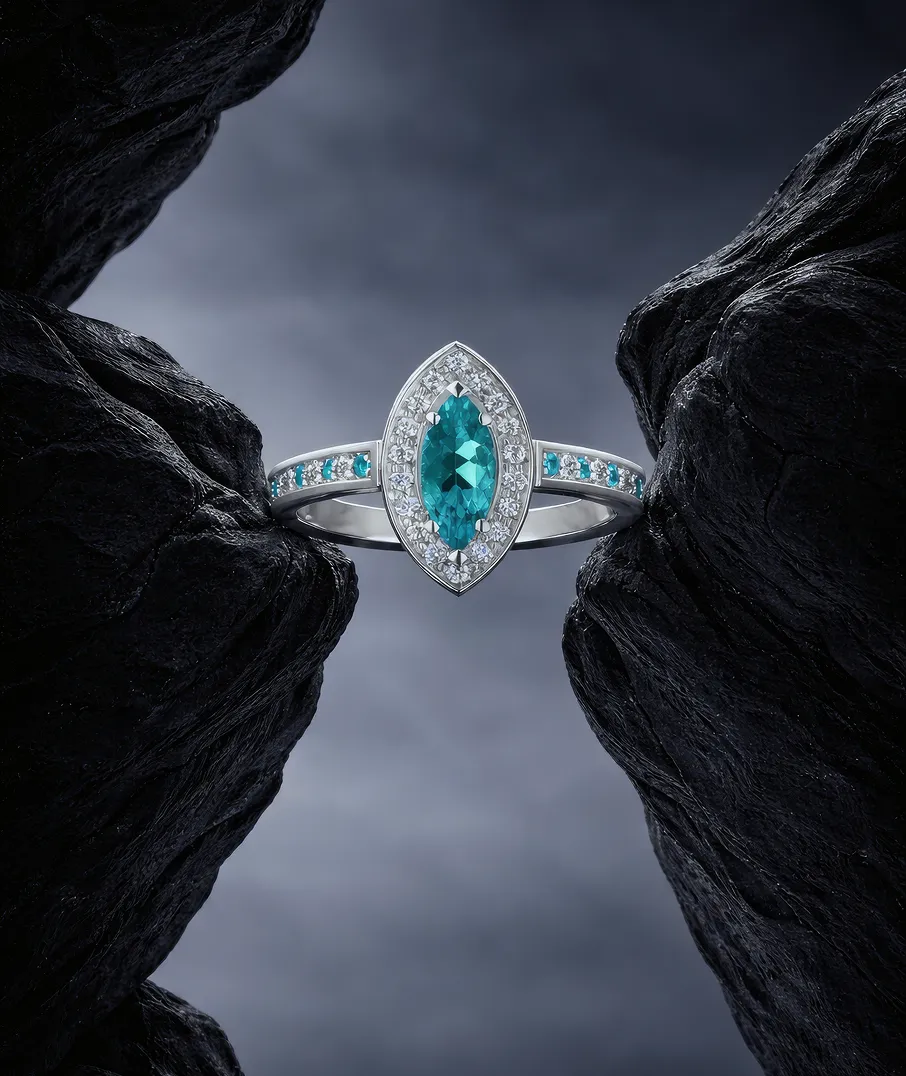
A Paraíba ring is a one-of-a-kind piece when it was designed and made for exactly one stone and is not repeated in this form. You can recognize this by its own design, a setting built to the dimensions of the stone, a report that belongs to this stone, and a workshop that discloses the path from design to ring.
At a glance
- One-of-a-kind piece
- One design for exactly one stone, not repeated
- Cut of the stone
- According to GIA almost always cut individually
- Typical size
- According to GIA rarely over one carat
- Color range
- Greenish blue, bluish green, green, blue, violet
- Record for the stone
- Laboratory report on species, treatment, origin on request
- Record for the ring
- Design, dimensions, metal, stone details in the documents
One of a kind means one ring for exactly one stone
A one-of-a-kind piece is a piece that exists only once. For a ring, this means more than a rare stone in a common setting. The design is created for a specific stone and a specific person, the setting is built to the dimensions of this stone, and the form is not repeated in series afterward. A ring from a collection in which a special stone is set, by contrast, remains a collection ring with a special stone.
This distinction is not a judgment. A well-made collection ring can be a beautiful piece. But anyone explicitly looking for a one-of-a-kind piece should know what to look for, because the term is not protected. How a finished piece and a custom-made piece compare is set out in Finished masterpiece or custom one-of-a-kind piece?. This page goes one step further and asks how to recognize a one-of-a-kind Paraíba ring.
The stone makes every ring different
With Paraíba tourmaline, uniqueness begins with the stone itself. GIA writes that Paraíba tourmalines are almost always cut individually because of the valuable rough material, mostly as brilliant cuts in oval or pear shapes. There are therefore hardly two stones with the same dimensions. A setting that holds a stone securely and free of tension must consequently be built for it. This alone results in a degree of individual production, even with simple designs.

The color, too, differs from stone to stone. GIA names greenish blue, bluish green, green, blue, and violet, with blue and violet in highest demand. According to GIA, some stones contain inclusions of native copper, almost pure metal, which mark the interior. Then there is size: according to GIA, Paraíba tourmalines over one carat are seen only rarely. A design that takes the color and format of such a stone seriously cannot be transferred from another stone.
One-of-a-kind piece, small series, collection ring
Three terms that are easily confused often come up in conversation. A one-of-a-kind piece is made once. A small series repeats a design in small numbers, often with stones of similar size. A collection ring follows a fixed model into which different stones are set. For the Paraíba ring, the table shows how the three approaches differ and which documents you can expect in each case.
| Feature | One-of-a-kind piece | Small series | Collection ring |
|---|---|---|---|
| Design | For one stone and one person | For several similar stones | Fixed model |
| Setting | Built to the dimensions of the stone | Adapted to a few sizes | Standard size, stone chosen to fit |
| Input | Form, metal, details | Mostly metal and size | Mostly only ring size |
| Documents | Design, dimensions, report on the stone | Model details, report | Model details, often a report |
| Repetition | None | In small numbers | Ongoing |
Simplified classification. The transitions are fluid; design and setting are what matter.
Decisions that shape a one-of-a-kind piece
A one-of-a-kind piece arises from decisions that have already been made for a model ring. The first concerns protecting the stone. Tourmaline reaches 7 to 7.5 on the Mohs scale, and GIA rates its toughness only as fair. According to GIA, a bezel setting protects well against chipping, while prongs let more light into the stone and need occasional inspection. How much protection is needed depends on whether the ring is worn daily or for occasions.
The second decision concerns the frame. A halo of diamonds makes the Paraíba appear larger and, according to GIA, needs more care, while a solitaire shows the stone on its own. The third concerns the metal: white gold, rose gold, or platinum change the color impression of the stone. Then there are details that only a one-of-a-kind piece allows, such as a profile of the shank, a hidden engraving, or an accent stone with personal meaning. The comparison of ring styles is explored further in Paraíba ring: solitaire or diamond entourage?.
How to recognize a true one-of-a-kind piece
Whether a ring is a one-of-a-kind piece is shown not by the finished piece but by the path that leads to it. The following questions help you guide the conversation with a workshop. Good answers are specific and in writing. Evasive answers such as “individually adapted” without further details are a sign that a model ring may be meant.

- Is the design created specifically for my stone, and will I see it before production?
- Were the length, width, and depth of the stone measured, and are the dimensions in the documents?
- Does a laboratory report belong to exactly this stone, and is its number in the documents?
- Who makes the ring, and which steps take place in-house?
- Will the design later be reused for other clients?
- Which details on metal and fineness will I receive in writing?
The report is more than proof of authenticity. At GIA, the identification report describes the material and detectable treatments, and for Paraíba tourmaline a report with an origin statement is also possible. Because laboratories assign the name Paraíba differently, it is worth checking which laboratory examined the stone. What such a report achieves for Paraíba is explained in The identification report for Paraíba tourmaline.
Three misconceptions about one-of-a-kind pieces
First misconception: a rare stone makes the ring one of a kind. A Paraíba tourmaline in a standard setting is a special stone in a common ring. Second misconception: one of a kind means elaborate. A simple solitaire can be a one-of-a-kind piece if it was designed for exactly this stone. Third misconception: a one-of-a-kind piece cannot be changed later. Size and surface can be adjusted, though with tourmaline only with regard to its sensitivity to heat.
A further point concerns origin. Many associate Paraíba solely with Brazil, where, according to GIA, the stones were discovered in the state of Paraíba in the late 1980s. Similar copper-bearing tourmalines later came from Nigeria and Mozambique. Origin does not make a ring one of a kind. It is a property of the stone that only a report can document. More on this can be found in the glossary under Paraíba tourmaline.
One-of-a-kind Paraíba pieces at Vikar Ahmed
At Vikar Ahmed, the Paraíba tourmaline is, by the house's own account, the heart of the Maison. Paraíba High Jewelry is created there as a one-of-a-kind piece, set in 18-karat gold, platinum, and diamonds. The path to the piece leads through three steps: design by in-house designers with sketches and watercolors, three-dimensional visualization with CAD, and execution as a one-of-a-kind piece in the in-house atelier, where goldsmiths set the stones by hand.
At Vikar Ahmed, every high-quality Paraíba comes with an independent original certificate, from 1 carat with origin determination, for Brazilian stones often below that. Consultations take place in the showroom in Idar-Oberstein by appointment or in a virtual appointment. The house sets stones brought in by clients only in rare exceptions, and the process for this is described under Having a Paraíba tourmaline set in a ring. More on the design process can be found under Bespoke.
Frequently asked questions
How can I tell whether a Paraíba ring is a true one-of-a-kind piece?
By the fact that the design was created for exactly your stone and you saw it before production, that the setting was built to the dimensions of this stone, and that report, dimensions, and metal belong to the ring in writing. Also ask whether the design will be reused later.
Is every ring with a Paraíba tourmaline automatically a unique piece?
No. According to GIA, the stone is almost always cut individually and is therefore unique, but the setting need not be. If a Paraíba is set in a fixed collection model, it is a collection ring with a special stone. A one-of-a-kind piece arises only when the entire ring is designed for this stone.
Does a one-of-a-kind piece have to be elaborately designed?
No. Even a simple solitaire is a one-of-a-kind piece if it was designed and made for exactly one stone. With Paraíba tourmaline, restraint is often even sensible, because the color of the stone is the focus. Design and setting are what matter, not the number of details.
Which documents belong to a one-of-a-kind Paraíba ring?
A laboratory report on the stone with details of species and treatment, and of origin on request, together with the approved design, the dimensions of the stone, and written details on metal and fineness. If the report number is in the ring's documents, the stone can be clearly identified even years later.
Which setting suits a Paraíba ring that is worn every day?
A construction that protects the edge of the stone, such as a bezel setting or a halo of diamonds. According to GIA, tourmaline has only fair toughness, and a ring is exposed to many knocks in daily life. Prongs show more of the stone but should be inspected regularly if the ring is worn daily.
Private consultation
If you are planning a ring with a Paraíba tourmaline as a one-of-a-kind piece, everything begins with the stone and a conversation about your ideas. Vikar Ahmed offers consultations in the showroom in Idar-Oberstein by appointment or in a virtual appointment. Request an appointment for a private consultation.
Further reading
- The ring with a Paraíba tourmaline
- One-of-a-kind pieces from an in-house atelier
- Glossary: Bespoke
- Gemstone: Paraíba tourmaline
- Jeweler for Idar-Oberstein
Sources
- GIA: Tourmaline Quality Factors, accessed 2026-11-17
- GIA: Tourmaline Care and Cleaning, accessed 2026-11-17
- GIA Gems & Gemology: Paraíba Tourmaline, Geographic Origin Determination (Winter 2019), accessed 2026-11-17
- GIA: Colored Stone Reports, accessed 2026-11-17
- SSEF: Paraiba Tourmaline, accessed 2026-11-17
- GIA 4Cs: Guide to Ring Settings, accessed 2026-11-17
- Vikar Ahmed: Paraíba, accessed 2026-11-16
- Vikar Ahmed: Bespoke, accessed 2026-11-16

A personal conversation starts here.
At the showroom in Idar-Oberstein or by video. Vikar Ahmed discusses your ideas, stones and designs with you and answers your questions calmly and in confidence.


Thank you for your request.
Your request will be handled with the utmost attention and discretion. Vikar Ahmed will get back to you.
Your details
Request
–
Occasion
–
Consultation
–
Contact
–
In the meantime
Insights: What is a Paraíba tourmaline? · Engagement ring to your own design: how does it work?
Confidential and without obligation
Back to the pagePrivate consultation
A personal conversation starts here.
- Time for your questions, wishes and ideas
- In the showroom in Idar-Oberstein or by video
- Confidential, discreet and without obligation
Vikar Ahmed · Hauptstraße 111 · 55743 Idar-Oberstein, Germany