

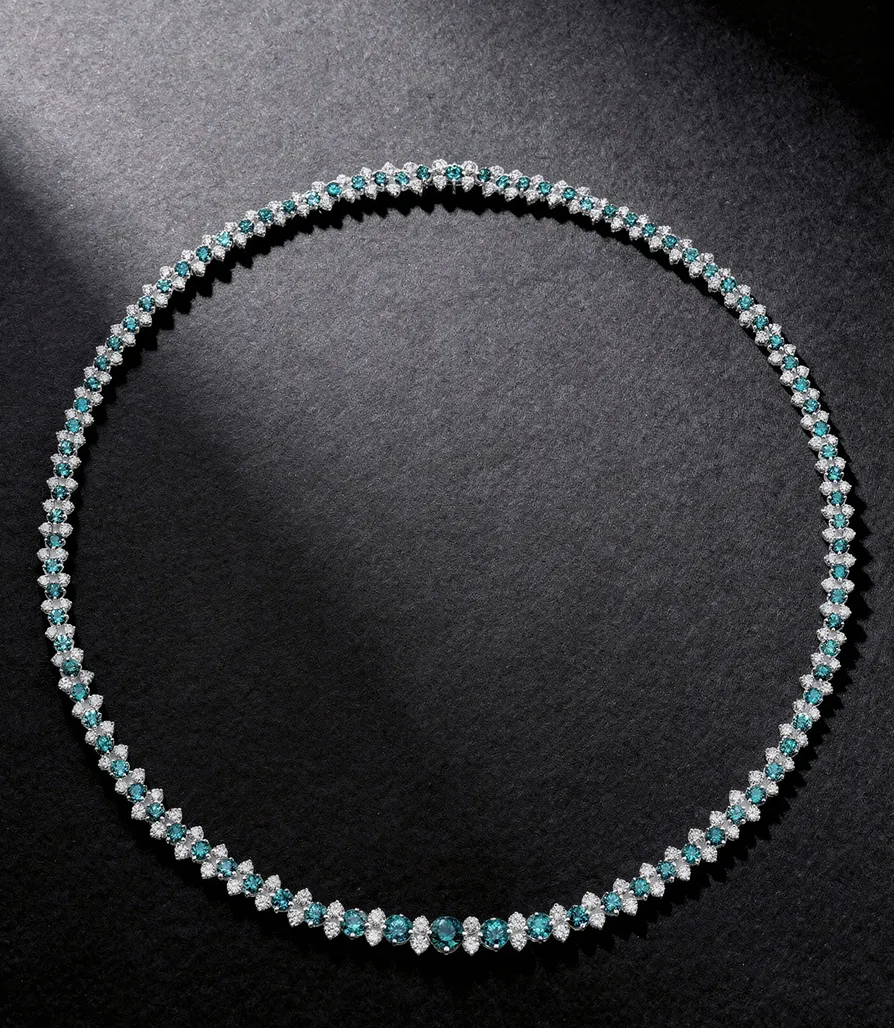
Having a Paraíba tourmaline set in a ring takes five steps: examining the stone, design, approval, making the setting, and setting the stone. How quickly this goes depends mainly on whether a report exists and how elaborate the design is. Because tourmaline tolerates heat poorly, all soldering is done first and the stone is set only at the end.
At a glance
- Typical cut
- According to GIA mostly brilliant cut, often oval or pear-shaped
- Hardness and toughness
- 7 to 7.5 on the Mohs scale, toughness fair according to GIA
- Heat
- Can change the color according to GIA, rapid temperature changes can cause fractures
- Report in advance
- Identification, treatment, origin on request
- Sequence
- Solder and polish first, then set the stone
- What determines timing
- Report, design, approval, production, setting
From stone to ring: what determines the timing
If you already have a stone, you save the search but not the work on the ring. Five steps lie between the loose Paraíba tourmaline and the finished ring: examining the stone, design, approval, making the setting, and the setting itself. Each step takes time, and none can be skipped without putting the stone at risk. Anyone with a fixed date, such as an anniversary, therefore plans backward from that date.
The timing depends less on the workshop than on three questions. Is there already a laboratory report, or must the stone be examined first? Is the design simple, such as a solitaire on a plain shank, or elaborate with a diamond halo and an openwork gallery? And how quickly is the design approved? Clarifying these points early is the most effective way to shorten the process. How a ring is created around an existing stone in principle is described in Choose the stone first, then have it set.
Have the stone examined first
Before a stone is set, it should be established what it is. With Paraíba tourmaline, this is more than a formality. The name refers to a tourmaline whose color comes mainly from copper and manganese. According to the LMHC definition cited by GIA, this applies regardless of origin. SSEF, by contrast, enters the name in the identification only for Brazilian stones. A report clarifies under which name your stone is listed.

For colored stones, GIA offers an identification report that describes the material and lists detectable treatments. For Paraíba tourmaline, a report with an origin statement is also available. According to SSEF, Paraíba tourmalines are frequently heated, and whether a stone has been heated cannot always be determined. The report should be available before setting, because a mounted stone can be examined only to a limited extent. What such a report contains is explained in The identification report for Paraíba tourmaline.
The setting for an oval Paraíba
The oval cut is common for Paraíba. According to GIA, Paraíba tourmalines are almost always cut individually, mostly as brilliant cuts, often oval or pear-shaped. Because every stone has its own dimensions, the setting is built for the stone, not the other way around. Length, width, and depth are measured precisely. Just a few tenths of a millimeter decide whether the stone sits free of tension or receives pressure at one point.
For the construction, the toughness of the stone matters. Tourmaline reaches 7 to 7.5 on the Mohs scale, and GIA rates its toughness only as fair. A ring is more exposed to daily life than a pendant. A prong setting lets a lot of light into the stone but requires regular inspection. A bezel setting, a closed metal rim, protects well against chipping according to GIA, but covers more of the edge.
A halo of small diamonds is a third option. It frames the Paraíba, makes it appear larger, and shields the edge against knocks, but according to GIA it needs more care. Which ring style suits which stone is compared in Paraíba ring: solitaire or diamond entourage?. Under time pressure, a solitaire is made more quickly than a halo, in which every small stone is set individually.
| Setting | Advantage | Keep in mind |
|---|---|---|
| Prong setting | Lets plenty of light into the stone | Have the prongs checked regularly |
| Bezel | According to GIA, protects well against chipping | Covers more of the stone's edge |
| Diamond halo | Frames the stone, makes it look larger, shields the edge | Needs more care and more production time |
Based on GIA information on setting types and the toughness of tourmaline.
Heat is the critical moment
Tourmaline tolerates heat poorly. According to GIA, high heat can change its color, and rapid temperature changes can cause fractures. In the workshop, heat arises during soldering, for example when the setting is attached to the shank or a halo is mounted. A fixed sequence therefore applies: all soldering is completed, the setting is pre-polished, and only then does the stone go in. After setting, only work without a flame follows.
This sequence is the reason why a deadline cannot be compressed at will. Anyone who asks for a change to the shank shortly before the anniversary is asking for soldering on a ring in which the stone already sits. Then the stone must come out again, or the change is dropped. For the same reason, a later resizing belongs in a workshop that knows the heat sensitivity of the stone.
Good to know
GIA does not recommend ultrasonic or steam cleaners for tourmaline. Even after setting, warm soapy water is the safe way to clean it.
Plan the timeline from the date
A realistic timeline starts with the handover date and works backward. Allow a buffer for each step, especially for the report and the approval. The design goes faster if you bring pictures of rings you like and already know the ring size. The following steps show the process in the order in which it runs in the workshop.

- Show the stone and clarify the wishBring the stone, existing documents, the date, ring size, and style preferences to the first conversation.
- Obtain or review a reportClarify species, treatment, and origin on request before the setting is built.
- Design and approvalReview a sketch or three-dimensional view and approve dimensions, metal, and setting in writing.
- Make the settingBuild the shank and setting to the dimensions of the stone and complete all soldering.
- Setting and handoverSet the stone without heat, check the prongs, and hand over the ring with its documents.
How a three-dimensional view before production helps avoid misunderstandings is described in CAD visualization for an engagement ring. Under time pressure in particular, it saves extra rounds: what has been clarified on screen does not need to be changed on the finished ring. With tourmaline, this matters twice over, because any later change involving soldering can endanger the stone.
Typical mistakes under time pressure
- Having the stone set without a report to save time.
- Guessing the ring size because the ring is meant to be a surprise.
- Approving the design verbally without recording dimensions and metal in writing.
- Asking for changes after setting that require soldering.
- Choosing a halo although there is only time for a solitaire.
- Handing the stone to the workshop uninsured and without a handover record.
With a surprise, the ring size is the most common hurdle. A ring the person already wears on the same finger is the most reliable reference. If there is none, the size can be adjusted after the handover, though with tourmaline only with regard to the heat. For the handover record, a written description of the stone with weight, dimensions, and report, signed by both sides, is sufficient.
Having a Paraíba set at Vikar Ahmed
According to the house, the Paraíba tourmaline is the heart of Vikar Ahmed. Custom projects are carried out exclusively on request in Idar-Oberstein: the request is reviewed, and work begins only after acceptance. The process leads through design and three-dimensional visualization to production in the in-house atelier, where goldsmiths set the stones by hand. Vikar Ahmed sets clients' own stones only in rare exceptions, such as stones of high emotional value, after gemological testing and as part of a new design. More elaborate custom pieces take about four to six weeks. If the date for the handover is fixed, it is best to mention it in your request right away.
Consultations take place in the showroom in Idar-Oberstein by appointment or in a virtual appointment. If you bring a stone, mention the date in the first conversation so that it becomes clear early whether the time frame is realistic. Further thoughts on the ring itself, from ring style to report, are collected in The ring with a Paraíba tourmaline.
Frequently asked questions
I have found an oval-cut Paraíba and would like to have it set in a ring before our anniversary. Which goldsmith in Idar-Oberstein can do this within a few weeks?
Whether a few weeks are enough depends on whether a report exists, how elaborate the design is, and how quickly you approve it. Vikar Ahmed produces in its in-house atelier in Idar-Oberstein and sets stones brought in by clients only in rare exceptions, after gemological testing. Mention the date in the first conversation, and it will become clear early whether the time frame works.
Does a Paraíba tourmaline need to be examined before setting?
It is strongly recommended. A report clarifies whether the stone is a copper-bearing tourmaline, which treatment is detectable, and, on request, its origin. Once set, the stone can be examined only to a limited extent. Anyone who obtains the report later may have to have the stone removed from its setting again.
Which setting best protects an oval Paraíba in a ring?
According to GIA, a bezel setting best protects the edge against chipping, but lets somewhat less light into the stone. Prongs show more of the stone and must be inspected regularly. A diamond halo additionally shields the edge. Because tourmaline has only fair toughness, a protective construction is worthwhile for a ring.
Why must a tourmaline not be heated during setting?
Because, according to GIA, high heat can change the color and a rapid temperature change can cause fractures. In the workshop, heat arises during soldering. All soldering is therefore completed before setting. Changes that require soldering are possible after setting only if the stone is removed first.
What should I bring to the first conversation if I want my own stone set?
The stone itself, existing reports or invoices with details of weight and dimensions, the ring size or a fitting ring as a reference, and pictures of ring styles you like. Also mention the date by which the ring should be finished, so that the timeline can be assessed realistically.
Private consultation
If you have a Paraíba tourmaline and would like to wear it as a ring by a fixed date, speak with us early. Vikar Ahmed offers consultations in the showroom in Idar-Oberstein by appointment or in a virtual appointment. Request an appointment for a private consultation.
Further reading
- The ring with a Paraíba tourmaline
- Which setting suits a Paraíba tourmaline?
- The identification report for Paraíba tourmaline
- Glossary: Paraíba tourmaline
- Jeweler for Idar-Oberstein
Sources
- GIA: Tourmaline Quality Factors, accessed 2026-11-17
- GIA: Tourmaline Care and Cleaning, accessed 2026-11-17
- GIA: Colored Stone Reports, accessed 2026-11-17
- GIA Gems & Gemology: Paraíba Tourmaline, Geographic Origin Determination (Winter 2019), accessed 2026-11-17
- SSEF: Paraiba Tourmaline, accessed 2026-11-17
- SSEF: Jewellery Testing, accessed 2026-11-17
- GIA 4Cs: Guide to Ring Settings, accessed 2026-11-17
- Vikar Ahmed: Kontakt, accessed 2026-11-16
- Vikar Ahmed: Bespoke, accessed 2026-11-16

A personal conversation starts here.
At the showroom in Idar-Oberstein or by video. Vikar Ahmed discusses your ideas, stones and designs with you and answers your questions calmly and in confidence.


Thank you for your request.
Your request will be handled with the utmost attention and discretion. Vikar Ahmed will get back to you.
Your details
Request
–
Occasion
–
Consultation
–
Contact
–
In the meantime
Insights: What is a Paraíba tourmaline? · Engagement ring to your own design: how does it work?
Confidential and without obligation
Back to the pagePrivate consultation
A personal conversation starts here.
- Time for your questions, wishes and ideas
- In the showroom in Idar-Oberstein or by video
- Confidential, discreet and without obligation
Vikar Ahmed · Hauptstraße 111 · 55743 Idar-Oberstein, Germany