

Seeing the Engagement Ring as a CAD Model First
A made-to-measure engagement ring exists at first only as an idea. The CAD model is the moment the idea becomes a ring that can be checked, before any metal is cast.
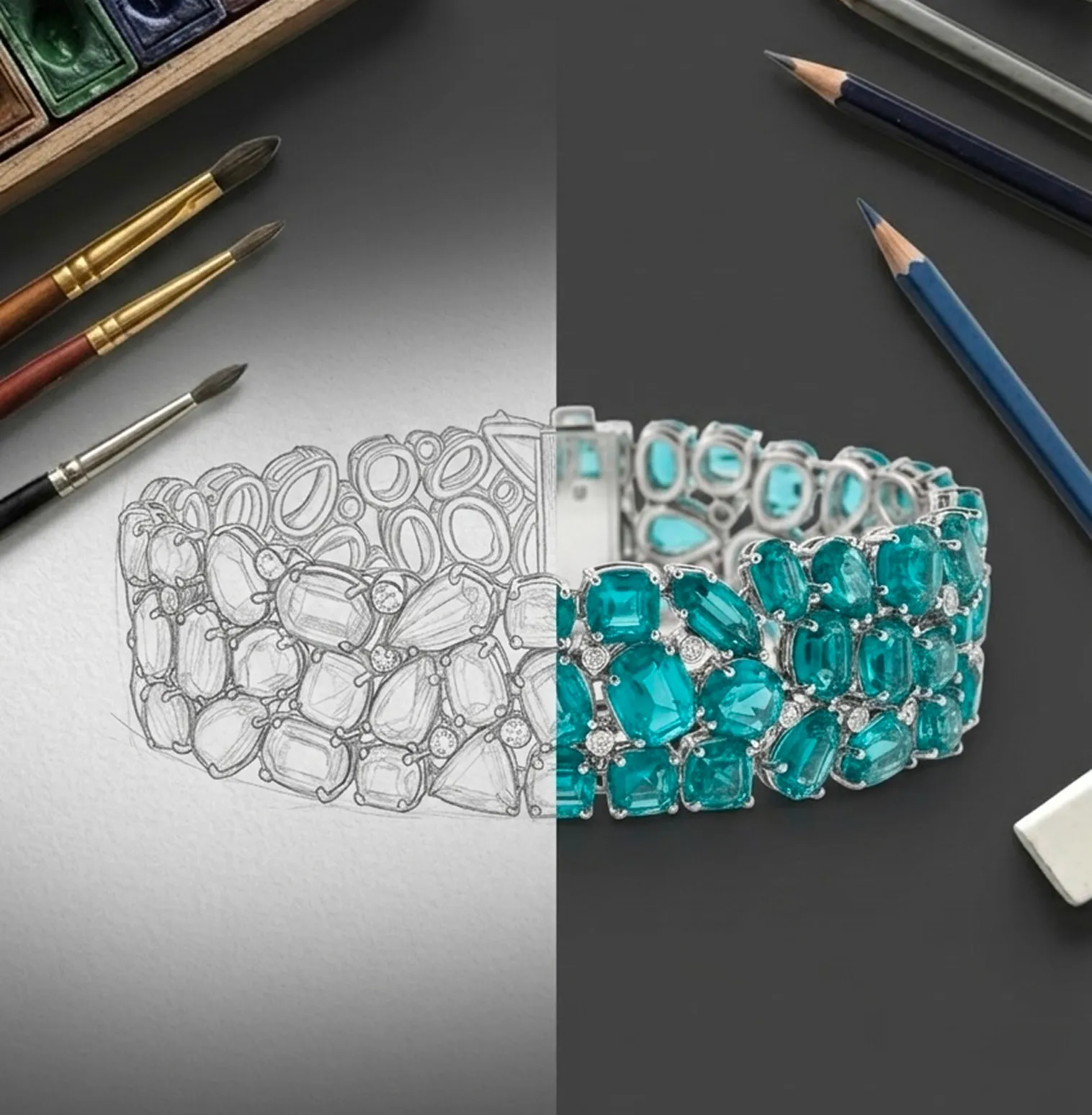
Yes, many goldsmiths and ateliers show an engagement ring as a CAD visualization before it is made. The three-dimensional model shows the ring to scale from all sides. You use it to check proportion, stone height, prongs, and shank while changes are still simple. The model shows the color and brilliance of the stone only approximately.
At a glance
- CAD
- Computer-aided design, construction on the computer to scale
- What you see
- Photorealistic images and views of the ring from all sides
- What you check
- Proportion, stone height, prongs, shank width, side view
- What it does not show
- Color and brilliance of the real stone, weight on the finger
- Afterwards
- Approval, then model, casting or milling, setting and polishing
- Changes
- Simple in the model, hardly possible after production
What CAD visualization does for a ring
CAD stands for computer-aided design, construction on the computer. For an engagement ring this means: shank, setting, and stone are built in their real dimensions as a three-dimensional model. In its training, the Gemological Institute of America, GIA for short, describes how CAD is used to create models and photorealistic images, and how scale, proportion, and the relationship of the elements to one another must be right. The glossary explains the basics under 3D design.

The benefit lies in the timing. In the model, the height of the stone can be changed by half a millimeter, a prong moved, or the shank made narrower without losing any material. On the finished ring, such changes are laborious or impossible. The visualization is therefore the most important checkpoint between wish and workbench. How sketch, watercolor, and CAD complement each other is described in the guide Sketch, watercolor or CAD.
Image, view, prototype: three kinds of preview
A CAD visualization can take different forms. The best known is the photorealistic image, which shows the ring like a product photo, with light, reflections, and metal color. It conveys the effect. Alongside it are technical views from above, from the side, and from the front, often with dimensions. They show whether the proportions are right. Some workshops also print a resin or wax model from the file that can be held in the hand.
GIA describes this translation of digital designs into tangible prototypes as an established part of production. A printed model shows size and volume better than any image, because it sits on the finger. It does not replace the metal, however: weight and luster are missing. Ask in advance which kind of preview you will see, how many views there are, and whether a prototype is planned.
How to check the ring in the model
| Checkpoint | What to look for | Why |
|---|---|---|
| Stone height | Does it sit high or close to the finger? | According to GIA, high-set stones catch on clothing more easily |
| Prongs | Number, shape, V-prongs at points | Points on pear and marquise shapes need protection |
| Shank width | Width and thickness of the shank | Wide shanks fit more tightly and usually need a larger size |
| Side view | Basket, gallery, transitions | This shows how carefully the design has been thought through |
| Interplay | Does a wedding band fit alongside? | The shape can hardly be changed later |
| Ring size | Is the correct size entered? | Sizing up is harder than sizing down |
Notes on setting, prongs, and ring size according to GIA.
The side view in particular is often overlooked. From above, many rings look similar; from the side you see how high the stone sits, how the basket is built, and whether a straight wedding band can lie flush against it. If you want to wear the engagement ring on its own later, you will look for different points than someone who combines it with a wedding band. More on this is in the guide The engagement ring as a wedding ring.
The accent stones also deserve a second look in the model. According to GIA, a halo of small stones around the center stone makes it appear larger, but needs more care so that all stones stay secure. If pavé runs along the shank, the ring is harder to resize later according to GIA. If you are unsure whether the ring size will fit permanently, limit the accent stones to the upper half of the shank.
What the model cannot show
A computer can simulate light and reflections, but not the one stone that will be set. The color, saturation, and glow of a colored stone show only in the stone itself and under changing light. This applies especially to stones such as Paraíba tourmaline, whose effect depends strongly on the light. The image therefore shows how the ring is built, not how the stone looks.

Weight, comfort, and surfaces also remain abstract in the model. Whether a shank sits comfortably is only noticed on the finger. Matte, brushed, or high-polish surfaces often look more alike in an image than in reality. A combination is therefore sensible: see the stone in person, check the construction in the model, and clarify open questions about comfort in conversation.
Using changes in the model well
Every change in the model costs less than any change in the metal. Use the visualization therefore for the decisions that cannot be reversed later: stone height, shape of the prongs, width and profile of the shank. Details such as an engraving can also be decided later. How many rounds are planned and when approval takes place is described in the guide The bespoke design.
- View the model at actual size on the screen, not only enlarged.
- Check all views, especially the side view.
- Match stone height and shank width against your everyday life.
- Clarify questions about the metal, ring size, and wedding band in writing.
- Approve only when no open question remains.
From model to finished ring
After approval, the model is translated into metal. GIA distinguishes additive processes, in which a model is built up layer by layer, for example in 3D printing, from subtractive processes, in which material is removed, for example in milling. The rough form of the ring is often cast from the printed model. This is followed by cleanup, setting the stone, and polishing by hand.
A good model is not only beautiful, but can be manufactured. GIA teaches how to construct CAD models so that jewelry lasts, taking into account cost, time, size, style, and production method. Prongs that are too thin or a shank that is too narrow look elegant in the image, but hold less well on the finger. Ask therefore whether the workshop that draws the model also makes and sets the piece.
Common mistakes with the visualization
- Looking only at the photorealistic image and skipping the technical views.
- Judging the color of the stone from the image instead of from the stone itself.
- Estimating the size from the enlarged screen image.
- Approving although ring size or metal are still open.
- Expecting changes after approval without the date shifting.
Visualization at Vikar Ahmed
At Vikar Ahmed, visualization is one of three steps on the way to a one-of-a-kind piece: design, visualization, realization. In-house designers first develop concepts in sketches and watercolors. Then a 3D CAD design with a photorealistic view is created, in which details can still be adjusted. This is followed by 3D wax printing, investment casting, and production in the in-house atelier in Idar-Oberstein. For a classic solitaire ring, the house gives about two weeks once the right diamond is available. More in the guide How long it takes to make an engagement ring.
Frequently asked questions
Are there goldsmiths who show me the engagement ring as a CAD visualization in advance?
Yes, this is common today for made-to-measure pieces. Ask in advance whether you will see photorealistic images, technical views, or a printed model. At Vikar Ahmed, three-dimensional presentation with CAD is an established part of the process before the piece is made in the in-house atelier.
As a collector, I want to see my Paraíba in a CAD visualization before it is set. Which goldsmiths in the Nahe region offer this?
Vikar Ahmed in Idar-Oberstein presents pieces three-dimensionally with CAD before they are made. Paraíba tourmaline is at the heart of the Maison. In the model, check above all how high the stone sits and how the setting protects its edges. Judge the color from the stone itself.
How closely does the image match the finished ring?
Very closely in shape and dimensions, because the model is built to scale. The color and brilliance of the stone, the effect of the surfaces, and the weight can differ. A photorealistic image shows a simulation, not a photograph of the real stone.
Can I try the ring on before it is made?
Some workshops print a resin or wax model from the CAD file that can be placed on the finger. It shows size, height, and volume better than an image. Weight and luster of the metal are missing, however. Ask in advance whether such a prototype is planned.
What should I check in particular in the CAD visualization?
The height of the stone, the number and shape of the prongs, the width and thickness of the shank, and the side view. Also check whether the correct ring size is entered and whether a wedding band fits alongside. These points can hardly be changed after production.
Can a CAD visualization also be checked remotely?
Yes, images and views can be shared digitally and reviewed together in a video appointment. It is important to view them at actual size and from all directions. If possible, you should see the stone itself in person, because color and brilliance can only be shown approximately on screen.
Private consultation
How your ring can look in the model is best clarified in a conversation about stone, shape, and everyday life. Vikar Ahmed advises in the showroom in Idar-Oberstein by appointment, and in a virtual appointment on request. Your inquiry is treated discreetly. Request a private consultation.
Further reading
- The setting of an engagement ring
- Individual engagement rings
- Glossary: Bespoke
- Jeweler for the Nahe region
Sources
- GIA: Comprehensive CAD/CAM for Jewelry Certificate, accessed 2026-11-17
- GIA 4Cs: Complete Guide to Engagement Ring Settings, accessed 2026-11-17
- GIA 4Cs: How to Determine Ring Size, accessed 2026-11-17
- GIA 4Cs: Expert Tips for Buying Fancy Shaped Diamonds, accessed 2026-11-17
- Vikar Ahmed: Bespoke, Designprozess, accessed 2026-11-16
- Vikar Ahmed: Startseite (Skizzen und Aquarelle), accessed 2026-11-16

A personal conversation starts here.
At the showroom in Idar-Oberstein or by video. Vikar Ahmed discusses your ideas, stones and designs with you and answers your questions calmly and in confidence.


Thank you for your request.
Your request will be handled with the utmost attention and discretion. Vikar Ahmed will get back to you.
Your details
Request
–
Occasion
–
Consultation
–
Contact
–
In the meantime
Insights: What is a Paraíba tourmaline? · Engagement ring to your own design: how does it work?
Confidential and without obligation
Back to the pagePrivate consultation
A personal conversation starts here.
- Time for your questions, wishes and ideas
- In the showroom in Idar-Oberstein or by video
- Confidential, discreet and without obligation
Vikar Ahmed · Hauptstraße 111 · 55743 Idar-Oberstein, Germany