

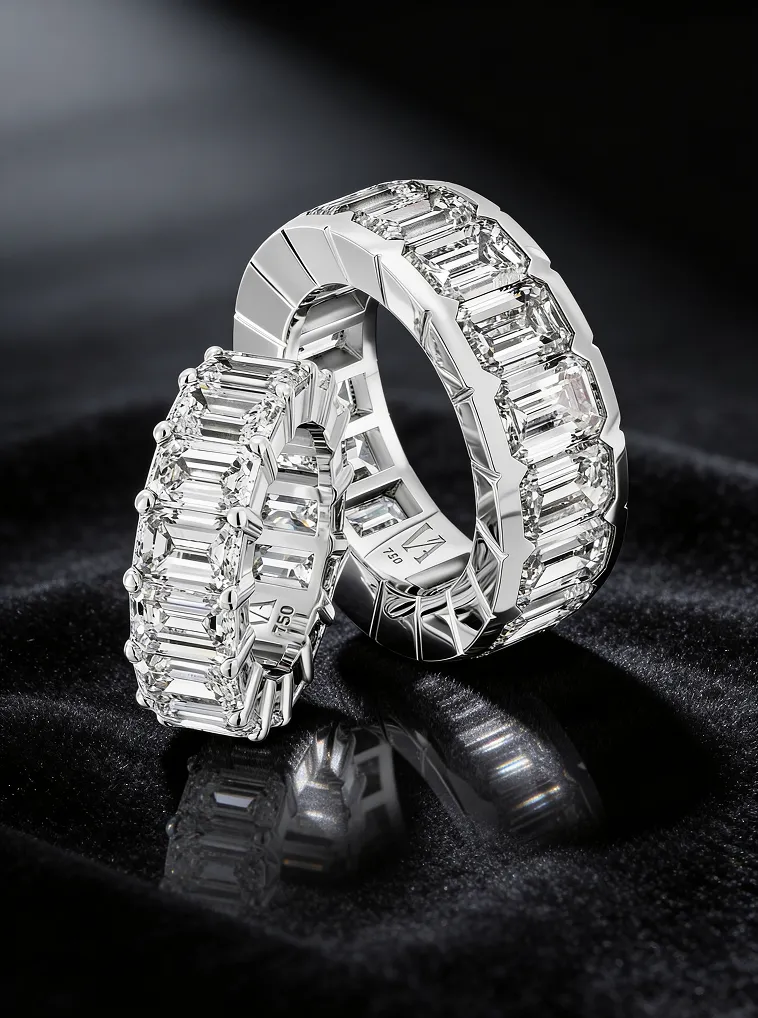
Choosing the stone first makes sense when it plays the leading role: you see exactly the stone that will later sit on the finger, and the setting is built for its shape and dimensions. A finished ring is faster but fixes shape and size. With a stone you bring, a report, a check before setting, and clear agreements are part of the process.
At a glance
- Stone first
- The setting follows the shape, cut, and dimensions of the chosen stone
- Semi-mount
- Everything is set except the center stone; size and shape are limited
- Verify identity
- Match report and stone before setting, for example via a laser inscription
- Risk in setting
- Cleavage, and with certain treatments the heat of the workshop
- Laboratory report
- Describes quality but states no monetary value
- Legal framework
- Contract for work, § 631 German Civil Code (BGB) also covers altering an item
The order decides what adapts
With a finished ring, the stone adapts to the ring: shape, size, and height of the head are fixed. When the stone is chosen first, the reverse is true. According to GIA, the shape and cutting style of the stone determine which type of head, meaning the mounting above the shank, is used. An oval needs different prongs than an emerald cut, and a deep stone a different height than a shallow one.

The advantage is obvious. You decide on exactly the stone that will later sit on the finger, with its hue, its inclusions, and its face-up effect. The ring is then built around it, and the stone is not forced into an existing form. If you have a particular stone in mind, such as a colored gemstone with an unusual cut, this path usually leads to a more harmonious result.
Three paths from stone to ring
Between the finished ring and a free design there is a middle path, the prepared setting, known as a semi-mount. In it, the shank and small accent stones are already set; only the center stone is missing. GIA names as an advantage that a ring is often made faster and at lower cost this way than a fully custom piece. Some of these settings, however, are cast in one piece and limit the size and shape of the center stone.
| Path | What is fixed | Room for the stone | Suits you if |
|---|---|---|---|
| Finished ring | Ring and stone | None | You like a particular piece right away |
| Semi-mount | Shank and accent stones | Limited to a matching shape and size | The stone fits a common setting |
| Free design | Only the stone | Full; the setting follows the stone | The stone is unusual or plays the leading role |
The three paths differ mainly in whether the stone adapts to the ring or the ring to the stone.
How to weigh a finished ring against a custom piece in general is explored in the comparison Custom-made or finished engagement ring. How a design develops from a stone already chosen is described in the guide Designing around a loose stone. Both paths lead to the same goal if it is clear beforehand whether the stone or the ring model is settled first.
Identifying the stone before setting
Before a stone you bring is set, you and the workshop should be certain that it is the stone from the report. With some GIA report types, such as the Diamond Dossier, the report number is laser-inscribed on the stone. This inscription can be read under magnification and compared with the report. The report number also allows you to look up the details in the laboratory's database.
Without an inscription, the details in the report help: weight, dimensions, shape, and for diamonds the plotted inclusions. A report describes the quality of the stone. According to GIA, it does not state a monetary value; that is what an appraisal is for. What a GIA report records in detail and how it differs from other reports is explained in the guide Gemstone report.
Good to know
Before handing the stone over to the workshop, record in writing which stone is being handed over: report number, weight, dimensions, and shape. A photo of the stone next to the report helps if questions arise later.
What can go wrong in setting
Setting is precision work under pressure. Prongs are pressed against the stone, a bezel is closed around it. Diamond is very hard but has cleavage: according to GIA, a hard blow in the direction of its cleavage can split even a cut stone. Stones with inclusions near the surface or with a thin girdle are more vulnerable. An experienced workshop therefore checks the stone beforehand and says openly if it sees a risk.
With treated stones, heat comes into play. GIA points out that in diamonds whose color was produced by irradiation, the color can be damaged by the flame of a soldering torch. Coatings are susceptible to scratches, and filled fractures remain fractures; they are merely less noticeable. The workshop must therefore know whether and how the stone is treated. An overview is given in the guide Gemstone treatment.
Is your own stone less costly in the end?
There is no general answer. With a finished ring, stone, setting, labor, and profit margin are contained in one amount. When setting your own stone, these parts become visible separately. Whether that adds up to less overall depends on what the ring is meant to achieve. A simple semi-mount requires less work than a free design with its own accent stones and hand engraving.

- Metal and weight of the setting, for example 18k (750) gold or platinum
- Design and visualization, if the setting is newly designed
- Number and quality of the accent stones
- Effort of setting, which increases with the shape and sensitivity of the stone
- Examination of the stone before the work and, if necessary, a new report
Legally, setting your own stone is work on someone else's property. Under § 631 of the German Civil Code (BGB), the contract for work expressly includes the alteration of an item. What exactly is owed should therefore be settled beforehand: type of setting, metal, time frame, and the question of who is liable for damage to the stone. A clear agreement protects both sides.
A colored gemstone as center stone
If you choose a colored gemstone first, such as a tourmaline, emerald, or sapphire, you face different questions than with a diamond. Many colored gemstones are softer and less tough, and some react to heat or ultrasound. Their cuts are often more individual, and their dimensions and proportions deviate from common settings. This is exactly where the advantage of building the setting for the stone shows. What matters in the choice is described in Engagement ring with a colored gemstone.
Common mistakes with your own stone
- Handing over the stone without a report and asking about its quality only after setting.
- Concealing treatments, or not knowing them yourself, even though the workshop must work accordingly.
- Choosing a semi-mount whose head does not fit the shape and dimensions of the stone.
- Discussing liability, time frame, and type of setting only verbally.
- Confusing the report with an appraisal and deriving an insurance value from it.
Your own stone at Vikar Ahmed
Vikar Ahmed carries out bespoke jewelry projects exclusively on request in Idar-Oberstein. Each request is reviewed, and work begins only after acceptance. As a rule, the house sets diamonds and gemstones of its own. A stone you bring is taken on only in rare exceptions, for instance one of high emotional value, after a gemological examination and as part of a new design. Mention such a stone right away in your request, therefore. The ring is created in three steps: design, three-dimensional visualization, and execution in the in-house atelier. Directions are available under Jeweler in Idar-Oberstein.
Frequently asked questions
Which goldsmiths set a diamond you bring, and is that usually less costly than a finished ring with a stone?
Whether a workshop sets a diamond you bring is usually decided after examining the stone and agreeing on liability. It is not automatically less costly. It depends on whether a simple semi-mount is enough or a free design with accent stones is created. Ask for a breakdown of all work steps.
Should you choose the stone first for an engagement ring?
If the stone plays the leading role, yes. Then you see exactly the stone that will later sit on the finger, and the setting is built to its shape and dimensions. If, on the other hand, a particular ring model is the priority, it is better for the stone to adapt to the ring.
How can you tell that the set stone is the same as the one in the report?
Most reliably via a laser inscription of the report number, which some GIA reports include and which can be read under magnification. Without an inscription, weight, dimensions, shape, and the inclusion pattern serve for comparison. Record these details in writing when handing the stone over to the workshop.
Can a stone be damaged during setting?
Yes, the risk is small but real. Diamonds have cleavage, and many colored gemstones are softer or more brittle. With some treatments, the heat of the workshop can affect the color. A careful examination before setting and open disclosure of treatments reduce the risk.
Does every stone fit a semi-mount?
No. Semi-mounts are built for particular shapes and sizes, and some are cast in one piece. According to GIA, the shape and cutting style of the stone determine which head is used. For unusual dimensions or cuts, a setting built specifically for the stone is the better solution.
Does the laboratory report state what the stone is worth?
No. A GIA report describes the quality of the stone, such as weight, color, clarity, and cut, but no monetary value. For insurance and a statement of value there is a separate appraisal, for which appraisers often use the report as a basis.
Private consultation
Whether your stone and your idea fit together is best clarified in conversation. Vikar Ahmed offers consultations in the house's showroom in Idar-Oberstein by appointment or in a virtual appointment. Bring any existing reports. Your request is handled discreetly. Request an appointment for a private consultation.
Further reading
- An individual setting for your own gemstone
- Which setting for the engagement ring
- Glossary: prong setting
- Glossary: treatment
- Jeweler for clients from Idar-Oberstein
Sources
- GIA 4Cs: How to Build Your Own Engagement Ring with Semi Mount Rings, accessed 2026-11-17
- GIA: Diamond Grading Services (Diamond Dossier mit Lasergravur), accessed 2026-11-17
- GIA 4Cs: Diamond Grading Report vs. Appraisal, accessed 2026-11-17
- GIA 4Cs: How to Buy a Diamond (Report Check), accessed 2026-11-17
- GIA: Diamond Care and Cleaning Guide, accessed 2026-11-17
- GIA: Gem Treatment, accessed 2026-11-17
- BGB § 631 Vertragstypische Pflichten beim Werkvertrag, accessed 2026-11-17
- Vikar Ahmed: Kontakt und Custom Order, accessed 2026-11-16
- Vikar Ahmed: Bespoke, Designprozess, accessed 2026-11-16

A personal conversation starts here.
At the showroom in Idar-Oberstein or by video. Vikar Ahmed discusses your ideas, stones and designs with you and answers your questions calmly and in confidence.


Thank you for your request.
Your request will be handled with the utmost attention and discretion. Vikar Ahmed will get back to you.
Your details
Request
–
Occasion
–
Consultation
–
Contact
–
In the meantime
Insights: What is a Paraíba tourmaline? · Engagement ring to your own design: how does it work?
Confidential and without obligation
Back to the pagePrivate consultation
A personal conversation starts here.
- Time for your questions, wishes and ideas
- In the showroom in Idar-Oberstein or by video
- Confidential, discreet and without obligation
Vikar Ahmed · Hauptstraße 111 · 55743 Idar-Oberstein, Germany