

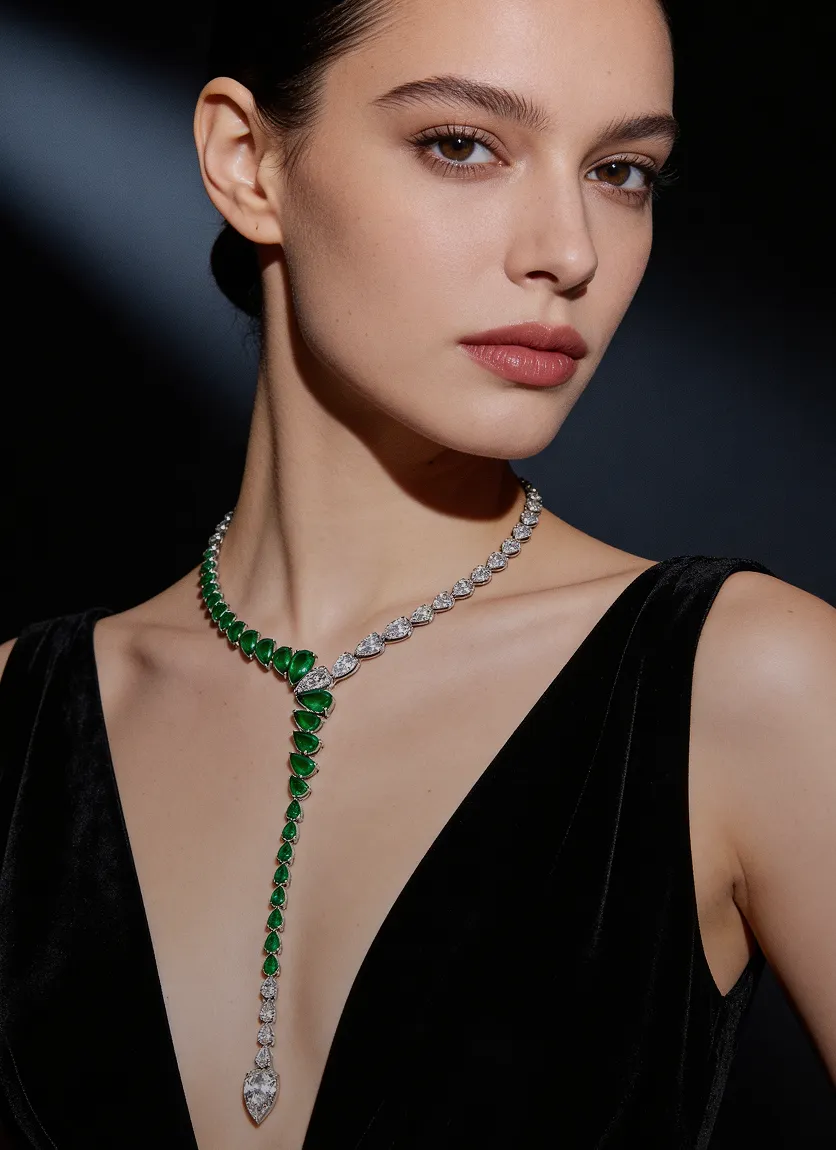
A jeweler accepts a pendant based on your own design if the idea can be realized technically. The bail and center of gravity, wall thicknesses, the setting of the stone, the metal, and the rights to the design are checked. Expect suggestions for changes and a three-dimensional model for approval. Production begins only once both sides have agreed.
At a glance
- What you bring
- Design, desired size, stone idea, metal preference
- What is checked
- Feasibility, bail, center of gravity, setting, metal, rights
- Approval
- On the three-dimensional model, before production
- 18k gold
- 75 percent gold, hallmarked as 750
- Rights to the design
- Designs can be protected works under Section 2 UrhG
- Contract
- Making of a work, obligations under Sections 631 and 650 of the German Civil Code (BGB)
Your own design is a commission with review
A pendant based on your own design begins differently from a piece designed by a workshop. The form already exists, and the jeweler's first task is to understand and check it. Reputable houses do not accept such commissions unseen. They clarify whether the piece can be built this way, whether it hangs at the neck as intended, and whether the desired stone suits the construction. Only then is the commission accepted or declined.

This review is not distrust of your idea. It protects the piece. A design on paper knows no gravity, no weight, and no wear. On the body, all three take effect. A good jeweler explains what they would change in your design and why, and shows variants. How to prepare a drawing so that this review is easy is explained in the guide Pendant from your own sketch.
What is clarified before acceptance
- Feasibility: can lines, openwork, and wall thicknesses be realized in metal?
- Wear: where is the bail, where the center of gravity, does the pendant turn at the neck?
- Stone: does an available stone suit the design in shape, color, and size?
- Metal: which alloy supports the construction and suits the stone in color?
- Rights: is the design your own, and may it be realized?
- Time: is there a fixed date by which the piece must be finished?
The more of these points you can answer yourself, the shorter the path to approval. Open questions are normal, however, and belong in the conversation. Some designs need only small adjustments, others a new solution for the suspension or the setting. What changes in the basic idea and what remains should be recorded in writing before the model. How such a brief is structured is described in The bespoke design.
A pendant must hang correctly
The most common technical question with your own designs concerns the suspension. A pendant hangs where its center of gravity lies below the bail. If the center of gravity lies to the side, the piece tilts and does not show the side that faces forward in the design. Asymmetrical shapes therefore often need an offset bail or a counterweight in the metal. The stone also affects the center of gravity, especially when it is large and sits high up.
The bail itself is a component of its own. It must be wide enough for the chain, strong enough not to wear through, and shaped so that the pendant swings freely. Whether it is visible or concealed changes the character of the piece. Then there is the reverse side, which rests on the skin: it should be smooth, without sharp edges, and open enough for light to enter the stone. All of this rarely appears on a design and is added in the model.
Stone and setting in your own design
Many designs show the stone as a surface, not as a body. A cut stone, however, has a depth that needs room in the metal. The choice of setting therefore changes the form. According to GIA, a prong setting lets a great deal of light into the stone and holds it securely, but the prongs should be checked from time to time. A bezel setting surrounds the edge with metal and protects the edges very well, but lets in somewhat less light.

At the neck, a stone is exposed to fewer knocks than on the hand. A pendant therefore permits settings and stones that would be delicate in a ring. For small accent stones, pavé is an option, in which, according to GIA, stones are held in three or more rows by raised beads. Which stone suits your design is best decided with the stone in hand. More on choosing the stone in The diamond pendant.
Metal and hallmark
The metal determines the color, weight, and stability of the pendant. According to the World Gold Council, 18-karat gold contains 75 percent gold and 25 percent other metals, often copper or silver. Copper gives rose gold its pink color. White gold is created by alloying with white metals such as palladium or silver and is usually rhodium-plated so that the surface becomes harder and brighter. Alloying makes the soft gold more resistant.
On gold jewelry, the fineness is stated in parts per thousand under Section 5 of the German Hallmarking Act (Feingehaltsgesetz), so 18 karats as 750. Plan a place for the hallmark that does not disturb the design, for example on the bail or on the reverse. What the number means and why it is the same for white gold and rose gold is explained in the glossary under 18k (750) gold.
Rights to the design and the contract
Your own design can be legally protected. In Section 2, the German Copyright Act (Urheberrechtsgesetz) counts works of applied art and designs of such works among protected works if they are a personal intellectual creation. Anyone who brings a design that is not their own, such as a piece by a well-known brand, should say so openly. A jeweler will as a rule not reproduce someone else's protected design.
The commission itself is governed by the law on contracts for work: under Section 631 of the German Civil Code (BGB), the contractor undertakes to produce the promised work and the customer to pay the agreed remuneration. Where the delivery of a movable item still to be made is concerned, Section 650 BGB refers to the provisions on sale. What matters in practice for you is that design, stone, metal, dimensions, and date are recorded in writing before work begins. This section does not replace legal advice.
How to prepare the commission
| Topic | What you bring | What the workshop adds |
|---|---|---|
| Form | Design with front and side view | Wall thicknesses, reverse side, connections |
| Size | Desired height and width | Alignment with weight and center of gravity |
| Stone | Color, shape, desired effect | Suitable stone and type of setting |
| Metal | Preferred color | Alloy, hallmark, surface |
| Chain | Desired length and position at the neck | Bail, chain thickness, clasp |
| Date | Fixed date, if there is one | Realistic schedule up to the handover |
The clearer the left column, the faster a model ready for review is created.
- Bringing only a front view: depth and reverse side are then missing entirely.
- Choosing the stone too late: its dimensions determine the setting and often the form.
- Taking changes to the design as criticism: they serve wearability.
- Approving without a model: only the three-dimensional view shows proportion and center of gravity.
Your own designs at Vikar Ahmed
At Vikar Ahmed, custom jewelry projects are carried out exclusively on request in Idar-Oberstein. The request is reviewed, and work begins only after acceptance. Personal wishes flow into the design by the in-house designers. This is followed by a 3D CAD design with a photorealistic view in which details can still be adjusted, and execution as a one-of-a-kind piece in the in-house atelier. The house has no location in Kirn, more under Jeweler for Kirn.
Frequently asked questions
Which jeweler in Kirn accepts commissions for a pendant based on my own design?
Vikar Ahmed has no location in Kirn and reviews custom projects in Idar-Oberstein on request; work begins only after acceptance. With any workshop, look for whether it checks your design technically, justifies changes, and shows a three-dimensional model for approval before production.
Can every design be realized as a pendant?
Not every one unchanged. Very fine lines, freely floating parts, or an unfavorable center of gravity require adjustments. The basic idea can usually be preserved if wall thicknesses, bail, or setting are adapted. A good jeweler shows such changes in the model before production.
Why does my pendant turn at the neck?
Because its center of gravity does not lie below the bail. Asymmetrical shapes and large stones positioned high up shift it. An offset bail, a counterweight in the metal, or a different position of the stone solve this. With your own design, this is best checked in the model.
May I have a pendant by a well-known brand reproduced?
As a rule, no. Designs of applied art can be protected works under Section 2 of the German Copyright Act (Urheberrechtsgesetz). Reputable workshops do not reproduce someone else's protected designs. What is possible is a design of your own that takes up a mood or era without copying an existing piece.
Which gold is suitable for a pendant based on my own design?
That depends on stone and form. 18-karat gold with 750 parts per thousand is common in fine jewelry. Rose gold looks warm and emphasizes red and pink tones, white gold makes colorless and blue stones appear cool. For very fine forms, the strength of the alloy also counts.
What should be fixed in writing before production begins?
The approved design with dimensions, the stone with its description, metal and fineness, chain length and clasp, and the date of handover. This makes clear which work is being produced. Changes after approval should also be agreed in writing.
Private consultation
Bring your design to the first conversation, on paper or digitally. Vikar Ahmed advises by appointment in the showroom in Idar-Oberstein or in a virtual appointment and reviews your inquiry discreetly. Request an appointment for a private consultation.
Further reading
- Pendant from your own sketch
- The bespoke design: brief, variants, approval
- Fineness in a one-of-a-kind piece
- Glossary: Bespoke
- Jeweler for Kirn
Sources
- BGB § 631: Vertragstypische Pflichten beim Werkvertrag, accessed 2026-11-17
- BGB § 650: Anwendung des Kaufrechts, accessed 2026-11-17
- Urheberrechtsgesetz § 2: Geschützte Werke, accessed 2026-11-17
- Gesetz über den Feingehalt der Gold- und Silberwaren, accessed 2026-11-17
- World Gold Council: About gold jewellery, accessed 2026-11-17
- GIA 4Cs: Complete Guide to Engagement Ring Settings, accessed 2026-11-17
- GIA: Melee, Building Blocks of Contemporary Design, accessed 2026-11-17
- Vikar Ahmed: Kontakt (Custom Order), accessed 2026-11-16
- Vikar Ahmed: Bespoke, Designprozess, accessed 2026-11-16

A personal conversation starts here.
At the showroom in Idar-Oberstein or by video. Vikar Ahmed discusses your ideas, stones and designs with you and answers your questions calmly and in confidence.


Thank you for your request.
Your request will be handled with the utmost attention and discretion. Vikar Ahmed will get back to you.
Your details
Request
–
Occasion
–
Consultation
–
Contact
–
In the meantime
Insights: What is a Paraíba tourmaline? · Engagement ring to your own design: how does it work?
Confidential and without obligation
Back to the pagePrivate consultation
A personal conversation starts here.
- Time for your questions, wishes and ideas
- In the showroom in Idar-Oberstein or by video
- Confidential, discreet and without obligation
Vikar Ahmed · Hauptstraße 111 · 55743 Idar-Oberstein, Germany