

The Colored Gemstone Necklace: Stones, Structure, and Choice
A necklace with colored stones shows more color at once than any other piece of jewelry. Therein lies its appeal and, at the same time, its greatest difficulty.
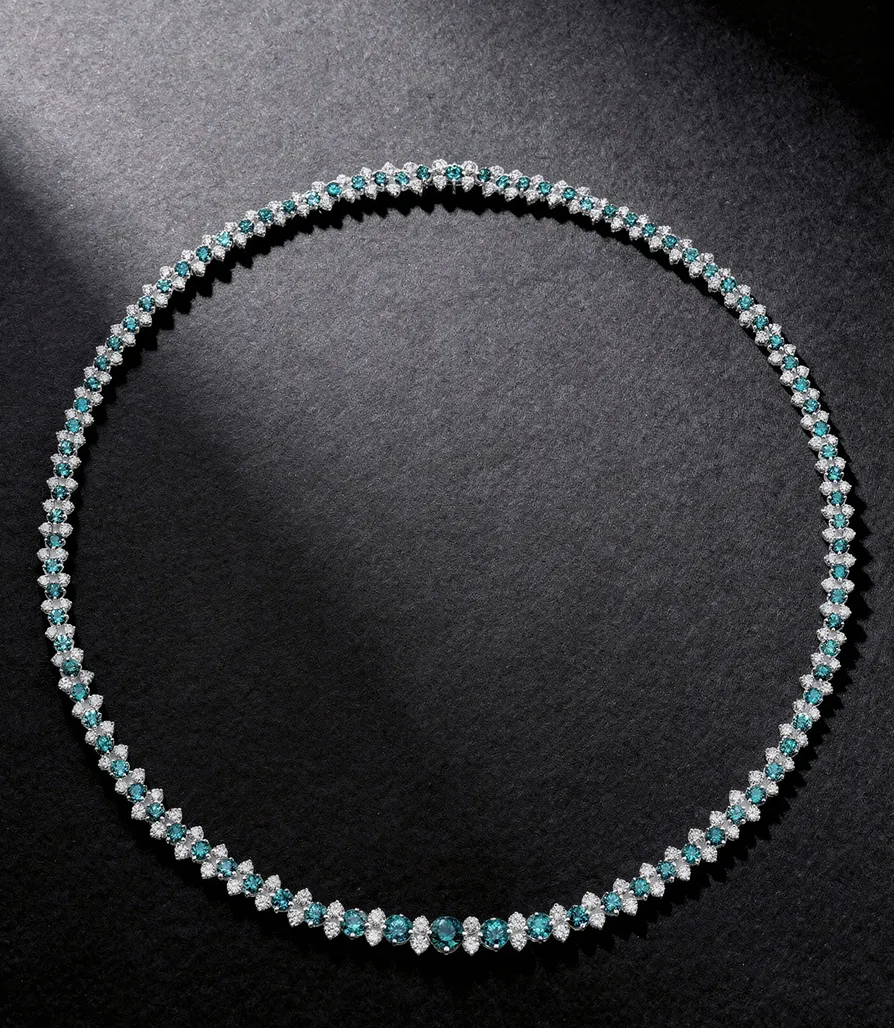
A good colored gemstone necklace can be recognized by stones that match one another in hue and saturation, by a clear structure with principal and accompanying stones, and by a setting that suits the durability of the stones. Emerald without visible inclusions and Paraíba tourmaline in larger sizes are rarer than rubellite. Larger matched lines are difficult to assemble with all three stones.
At a glance
- Most difficult point
- Matching many stones to one another in hue and saturation
- Rubellite
- Tourmaline in pink to red, Mohs hardness 7 to 7.5
- Emerald
- Mohs hardness 7.5 to 8, usually with visible inclusions
- Paraíba tourmaline
- Color from copper, rare above one carat
- Origin report
- At GIA, among others for emerald and Paraíba tourmaline
- Cleaning
- Warm soapy water, no ultrasonic and no steam
A necklace is a color composition
In a diamond necklace, one looks for uniformity of light. In a colored gemstone necklace, one looks for uniformity of color, and that is more difficult. Every colored stone has its own hue, its own saturation and tone. When twenty stones lie side by side, any stone that is warmer, lighter, or darker than its neighbors stands out. A successful necklace therefore looks as if made from a single piece, although it consists of many individual stones.

There are essentially three structures. In a graduated design, the stones become larger toward the center. In a center stone necklace, a large principal stone carries the piece and the remaining stones frame it. In an even line, stones of equal size sit all around. How necklaces are generally structured and named is explained in the glossary under Necklace. The assessment of pure diamond necklaces is covered in the guide Diamond necklaces.
Rubellite, emerald, and Paraíba compared
| Feature | Rubellite | Emerald | Paraíba tourmaline |
|---|---|---|---|
| Color | Pink, red, purplish red | Bluish green to green | Vivid blue to green |
| Mohs hardness | 7 to 7.5 | 7.5 to 8 | 7 to 7.5 |
| Inclusions | Accepted with strong color | Usually visible, eye-clean is rare | Depends on the stone |
| Common treatment | Heat treatment possible | Fracture filling very widespread | Heat treatment possible |
| Larger stones | Comparatively readily available | Price rises sharply with size | Rare above one carat |
Details according to GIA. Paraíba tourmaline is a tourmaline, so its hardness and care correspond to rubellite.
According to the Gemological Institute of America, GIA for short, rubellite is a tourmaline in pink, red, purplish red, orangy red, or brownish red. With strong color, the trade accepts visible inclusions according to GIA. Rubellite is easier to find in larger sizes than the other two stones, which makes it suitable for necklaces with many medium-sized stones. Its warm color looks particularly cohesive in rose gold.
Emerald in a necklace
With emerald, color determines value. GIA names bluish green to pure green stones with vivid saturation and a tone that is not too dark as the most desirable. Visible inclusions are typical of emerald. Eye-clean stones are, according to GIA, so rare that they are particularly valuable. At the same quality, the price can rise sharply with size. A necklace of many equally fine emeralds is therefore a rarity in itself.
Emerald requires consideration in a necklace. According to GIA, by some estimates 90 percent or more of emeralds have their fractures filled, often with oils or resins. Heat can widen existing fractures, and light and chemicals can alter fillings. A necklace is knocked less often than a ring, but it lies on the skin and comes into contact with perfume and cosmetics. That argues for settings that enclose the stones.
Paraíba tourmaline in a necklace
According to GIA, Paraíba tourmaline owes its color to copper, which acts as a coloring agent in no other tourmaline. It was found at the end of the 1980s in the Brazilian state of Paraíba, and copper-bearing tourmalines from Nigeria and Mozambique were added later. Stones above one carat are rare according to GIA. A necklace with many matched Paraíba tourmalines in this typical neon color is therefore difficult to assemble.
This shapes the composition. Often a single Paraíba tourmaline carries the necklace as the center stone, with diamonds framing it and carrying the light further. Equally possible is a line of smaller Paraíbas whose color is matched along the graduation. With the report, it is worth looking at the nomenclature: SSEF names only Brazilian stones Paraiba tourmaline in its report, while stones of other origin with the same color are called tourmaline there, with a note on the trade name.
Length, weight, and clasp
A necklace with many colored stones can become heavy. For it to sit well, the weight must be distributed evenly around the neck. Flexible links between the stones let the necklace follow the neckline without tipping or twisting. A center stone should be set so that it faces forward and does not pull downward. The length follows the neckline with which the necklace is most often worn.

- Clasp with a secondary safety catch, matched to the weight.
- Links flexible but without play, so stones do not knock against each other.
- Open back, so light enters the colored stones from behind.
- Longer necklaces with an extension loop, to adapt them to different necklines.
The metal is also part of the color composition. According to the World Gold Council, 18k (750) gold consists of 75 percent fine gold, and the remainder determines the color of the alloy. Copper gives rose gold its warm tone, which frames rubellite and other red and pink stones calmly. White gold is usually rhodium-plated and frames cool colors such as the green of emerald or the blue of Paraíba tourmaline clearly, without adding warmth to them.
Typical mistakes with a colored gemstone necklace
- Selecting stones individually rather than as a group: color deviations only show in the line.
- Comparing only under artificial light: colored stones often look different in daylight.
- Not asking about the treatment of sensitive stones, such as the filling in emerald.
- Judging emerald by diamond rules and measuring it by inclusions rather than color.
- Planning a heavy necklace without flexible links.
For care, GIA recommends warm soapy water and a soft brush for tourmaline and emerald. Ultrasonic and steam cleaners are not recommended for either. With emerald, steam can drive oil or unhardened resin out of the fractures, and ultrasound can weaken stones that are already fractured. A necklace should be put on last, after perfume and cosmetics, and stored lying flat.
A necklace to your own design
At Vikar Ahmed, jewelry is created as a one-of-a-kind piece in the in-house atelier in Idar-Oberstein, from the design by in-house designers through a three-dimensional visualization to its realization. The house's pieces shown include rubellite, Colombian emerald, and Brazilian Paraíba tourmaline, combined with diamonds in 18k (750) white and rose gold. As a guide, the house gives about 4 to 6 weeks for more elaborate custom pieces and 1 to 3 months for high jewelry projects. If a date is fixed, include it in your inquiry right away. More on the path there under Bespoke necklace.
Frequently asked questions
I collect High Jewelry with colored gemstones and am undecided between a rubellite necklace and an emerald necklace. Which is the rarer choice?
As a rule, the emerald necklace, provided the stones are of good color. Eye-clean emeralds are particularly rare according to GIA, and at the same quality the price rises sharply with size. Rubellite is easier to find in larger sizes. Rarer, however, does not automatically mean more suitable: for a collection, what counts is the color and the matching of the line.
Which ateliers in Idar-Oberstein offer rubellite necklaces with diamonds?
Vikar Ahmed is based in Idar-Oberstein and uses rubellite and diamonds, among other stones, in the house's pieces. Necklaces are created there as one-of-a-kind pieces to design. Independent of the house, what counts with a rubellite necklace is that the stones are matched in color, the diamonds frame the rubellite, and the setting suits its durability.
Is rubellite the same as ruby?
No. Rubellite is a tourmaline in pink to red, ruby is the red variety of the mineral corundum. The names sound similar, but the stones differ in hardness, chemistry, and origin. A laboratory report determines the species beyond doubt. The guide on rubellite and ruby describes the difference in detail.
How many stones does a colored gemstone necklace need?
That depends on the structure. A center stone necklace manages with one principal stone and a few accompanying stones. An even line all around needs many stones of the same size and color. The more stones that have to be matched, the more difficult the selection becomes, especially with emerald and Paraíba tourmaline.
Which metal suits a colored gemstone necklace?
That depends on the color of the stones. Rose gold owes its tone to the copper in the alloy and suits rubellite and other warm colors. White gold, usually rhodium-plated, makes green and blue appear cool and clear and is suitable for emerald and Paraíba tourmaline. What decides is how metal and stones look side by side.
Can Paraíba tourmaline and diamonds be combined in a necklace?
Yes, that is in fact a common arrangement. Diamonds frame the Paraíba tourmaline, intensify the light, and bridge the gaps between the colored stones. Because larger Paraíbas are rare, a single stone often carries the necklace, while diamonds provide length and form. White gold emphasizes the cool color.
Why does a colored gemstone necklace look different under different light?
Colored stones respond to the type of light. Warm artificial light intensifies red and pink tones, while daylight usually shows green and blue stones more clearly. Tourmalines also show different hues depending on the viewing direction. Anyone choosing a necklace should therefore view it under both types of light and from several angles.
Private consultation
Which stones carry a necklace is best decided in direct comparison. Vikar Ahmed offers consultations in the showroom in Idar-Oberstein by appointment, and on request also in a virtual appointment. Your request is treated with discretion. Request an appointment for a private consultation.
Further reading
Sources
- GIA: Tourmaline Quality Factors, accessed 2026-11-17
- GIA: Tourmaline Description, accessed 2026-11-17
- GIA: Emerald Quality Factors, accessed 2026-11-17
- GIA: Emerald Care and Cleaning, accessed 2026-11-17
- GIA: Tourmaline Care and Cleaning, accessed 2026-11-17
- GIA: Gem Treatment, accessed 2026-11-17
- GIA Gems & Gemology: Paraíba Tourmaline Geographic Origin Determination (Winter 2019), accessed 2026-11-17
- SSEF: Paraiba tourmaline, accessed 2026-11-17
- World Gold Council: About gold jewellery, accessed 2026-11-17
- Vikar Ahmed: Collections, accessed 2026-11-16
- Vikar Ahmed: Bespoke, Designprozess, accessed 2026-11-16

A personal conversation starts here.
At the showroom in Idar-Oberstein or by video. Vikar Ahmed discusses your ideas, stones and designs with you and answers your questions calmly and in confidence.


Thank you for your request.
Your request will be handled with the utmost attention and discretion. Vikar Ahmed will get back to you.
Your details
Request
–
Occasion
–
Consultation
–
Contact
–
In the meantime
Insights: What is a Paraíba tourmaline? · Engagement ring to your own design: how does it work?
Confidential and without obligation
Back to the pagePrivate consultation
A personal conversation starts here.
- Time for your questions, wishes and ideas
- In the showroom in Idar-Oberstein or by video
- Confidential, discreet and without obligation
Vikar Ahmed · Hauptstraße 111 · 55743 Idar-Oberstein, Germany