

Rubellite or Ruby?
The names sound related, the stones are not. Rubellite is a tourmaline, ruby a corundum. What this means for a ring, a collection, and the laboratory report.
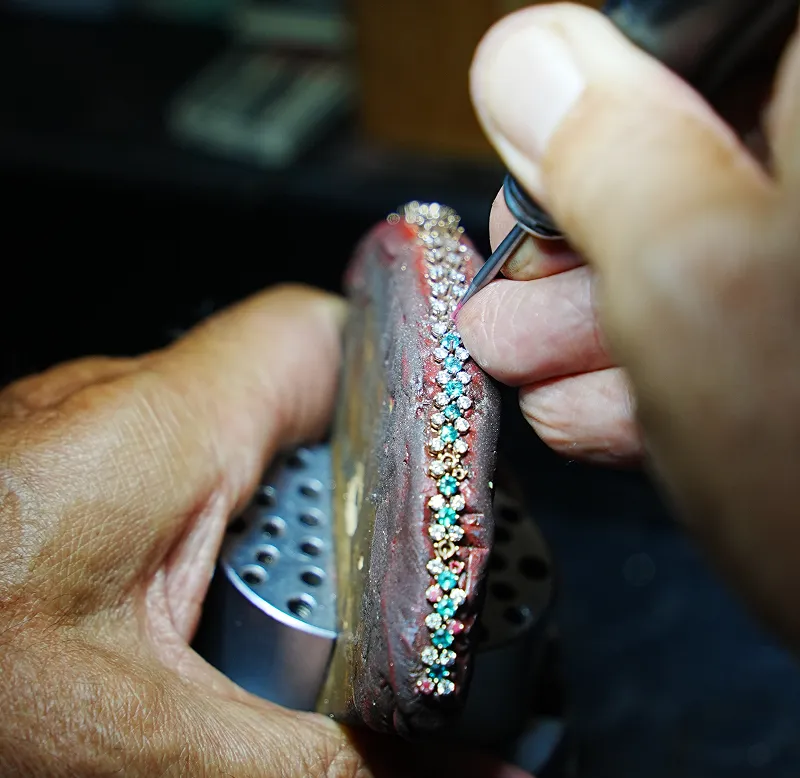
Ruby is red corundum with a hardness of 9 and very good toughness, colored by chromium. Rubellite is red to pink tourmaline with a hardness of 7 to 7.5 and moderate toughness, colored by manganese. For a ring worn every day, ruby is more durable. Rubellite is more accessible in larger sizes and shows nuances from pink to purplish red.
At a glance
- Ruby
- Red corundum, aluminum oxide, colored by chromium
- Rubellite
- Red to pink tourmaline, colored by manganese
- Mohs hardness
- Ruby 9, rubellite 7 to 7.5
- Toughness
- Ruby excellent, rubellite fair (GIA)
- Origin report from GIA
- Available for ruby, not offered for rubellite
- Fine quality over 1 carat
- Very rare in ruby, according to GIA
Two minerals with a similar color
Ruby is a variety of the mineral corundum, to which sapphire also belongs. According to the Gemological Institute of America, GIA for short, its red color comes from the trace element chromium: the more chromium, the stronger the red, which ranges from orangy red to purplish red. Rubellite is the trade name for tourmaline in pink, red, purplish red, orangy red, or brownish red. Its color is due to manganese.
The resemblance is real: according to GIA, tourmaline can approach ruby and pink sapphire in hue and depth of color. Chemically and physically, however, the two stones have little in common. A laboratory distinguishes them reliably, for example by refractive index and density. For the wearer, what matters most are the differences in durability, treatment, and the availability of large stones. More about both stones on the pages on ruby and rubellite.
The comparison by criteria
| Criterion | Ruby | Rubellite |
|---|---|---|
| Mineral | Corundum | Tourmaline |
| Cause of color | Chromium | Manganese |
| Mohs hardness | 9 | 7 to 7.5 |
| Toughness according to GIA | Excellent, no cleavage | Fair |
| Common treatments | Heating, lead glass filling, diffusion | Heating, irradiation, filling possible |
| Origin determination | Possible in the laboratory | Not offered by GIA |
| Heat and ultrasonic | Durable when untreated or heated | No ultrasonic, no steam |
Information according to GIA and SSEF. Treated stones may require different care.
The table shows where the real difference lies: not in the color, but in the material. A ruby withstands more, both in everyday wear and at the workbench. A rubellite requires a protective setting and a little more care when cleaning. In return, it can be found in sizes that hardly occur in ruby of fine quality. Both sides of the decision depend on how the piece is to be worn.
Hardness and toughness in a ring
Hardness describes resistance to scratches, toughness the resistance to knocks, chipping, and breaking. With a hardness of 9, ruby is one of the hardest gemstones after diamond. GIA describes its toughness as excellent and emphasizes that corundum has no cleavage, meaning no tendency to break along a plane. For rings worn every day, this is a very good basis.
At 7 to 7.5, rubellite is still within the range that is well suited to jewelry. GIA, however, rates its toughness as only fair, and heat can harm it: sudden temperature changes can cause a tourmaline to fracture. In a ring, it should therefore be set so that corners and edges are protected. The guide Which setting protects a rubellite? describes how this is achieved.
Inclusions and treatments
According to GIA, rubies entirely without inclusions practically do not exist. Fine rutile needles, called silk, are typical. If they are intact, they show that the stone was not heated at very high temperatures. Heating can remove a purplish tint and make the red purer. In stones of low quality, fractures are filled with lead-bearing glass. Such stones cannot tolerate even mild acids and, according to GIA, should be cleaned only with a damp cloth.
With rubellite, visible inclusions are accepted in the trade as long as the color is strong. Heating and irradiation are the common treatments. According to GIA, changes produced by heating are stable and undetectable, while a color produced by irradiation can fade under heat or strong light. In tourmaline, as in other stones, fractures may be filled with resin or glass. According to GIA, any treatment must be disclosed to the customer. More on this under treatment.
What the laboratory report can provide
For rubies, major laboratories offer reports with information on treatment and, on request, on geographic origin. GIA explicitly lists ruby among the stones for which it issues an origin report. The Swiss laboratory SSEF notes in its report whether or not indications of heating were found. SSEF describes origin determination as an expert opinion, based on microscopy, trace elements, and spectroscopy compared against a reference collection.
For rubellite, GIA offers an identification report. It confirms that the stone is a tourmaline and names detectable treatments. An origin determination is not offered there for rubellite, only for Paraíba tourmaline. For a colored gemstone collection, this means: with ruby, origin can be part of the documentation, while with rubellite the species, treatment, and the color itself are in the foreground. More on statements of origin under origin report.
Size and rarity
According to GIA, rubies of fine quality over one carat are very rare, and the price per carat rises considerably with size. Large, eye-clean rubies with fine color are considered exceptionally rare. According to GIA, ruby can achieve the highest prices of all colored gemstones. For a large red center stone of top quality, ruby is therefore the most demanding choice.
In pegmatites, which are coarse-grained rocks, tourmaline crystals can grow up to one meter long, according to GIA. In tourmaline, too, the price per carat rises with size, according to GIA mainly above five carats. The threshold is therefore considerably higher than for ruby, where fine quality is a rarity even above one carat. Anyone looking for a large, strongly red stone for a necklace or a statement ring is more likely to find it as a rubellite.
Which suits whom
- Ruby: for a ring that is worn every day and must withstand knocks.
- Ruby: for a collection in which origin and absence of treatment are to be documented.
- Rubellite: for a large red or pink stone in a necklace, pendant, or earrings.
- Rubellite: for nuances between pink, raspberry red, and purplish red.
- Both: for a ring of your own design, if the setting suits the stone.
For a ring of your own design, the question is less which stone is better than which suits the design. Vikar Ahmed works with rubellites in the house's pieces and designs jewelry individually: design, three-dimensional visualization, and realization as a one-of-a-kind piece in the in-house atelier. For colored gemstones, the house works with Gübelin, SSEF, GRS, and the DGemG, and for high-quality rubies from 1 carat a report with origin determination is standard. The guide on rubellite in an engagement ring describes how a rubellite looks in an engagement ring.
Frequently asked questions
Rubellite or ruby for a ring of my own design?
For a ring worn every day, ruby is more durable thanks to its hardness of 9 and excellent toughness. Rubellite is suitable if a larger stone or a particular hue is desired and the setting protects corners and edges. In your own design, both can be planned so that the stone sits securely.
Rubellite or ruby: which loose stone fits better into a colored gemstone collection?
That depends on the aim of the collection. A ruby can be documented comprehensively with a report on treatment and origin. A rubellite is described by species, treatment, and color, and GIA does not offer an origin determination for it. Both stones are collected by color, clarity, and size.
Is rubellite an inexpensive ruby?
No. Rubellite is not a ruby of lesser quality, but a mineral in its own right, namely tourmaline. The names only sound similar. Rubellite has its own quality characteristics and its own hues, and it is assessed by its own standards. Anyone who calls it ruby describes the stone incorrectly.
How does a laboratory distinguish rubellite from ruby?
By physical properties. According to GIA, ruby has a refractive index of 1.762 to 1.770 and a density of around 4.00. Tourmaline lies at 1.624 to 1.644 and around 3.06. With the naked eye, by contrast, the stones cannot be reliably distinguished.
Which stone tolerates ultrasonic cleaning?
According to GIA, untreated and heated rubies generally tolerate ultrasonic and steam cleaning. Rubies with lead glass filling or dye, by contrast, tolerate only a damp cloth. For rubellite, GIA generally advises against ultrasonic and steam cleaning. Lukewarm soapy water is the safe choice for both stones.
Private consultation
Whether ruby or rubellite suits your design better becomes clear when color, size, and the way the piece is worn are considered together. Vikar Ahmed advises in the showroom in Idar-Oberstein by appointment or virtually. Request an appointment for a private consultation.
Further reading
- Gemstone: Ruby
- Gemstone: Rubellite
- Ruby in an engagement ring
- Rubellite or pink diamond?
- Glossary: Treatment
Sources
- GIA: Ruby, Quick Facts, accessed 2026-11-17
- GIA: Ruby Description, accessed 2026-11-17
- GIA: Ruby Quality Factors, accessed 2026-11-17
- GIA: Ruby Care and Cleaning, accessed 2026-11-17
- SSEF: Ruby, accessed 2026-11-17
- GIA: Tourmaline, Quick Facts, accessed 2026-11-17
- GIA: Tourmaline Description, accessed 2026-11-17
- GIA: Tourmaline Quality Factors, accessed 2026-11-17
- GIA: Tourmaline Care and Cleaning, accessed 2026-11-17
- GIA: Gem Treatments, accessed 2026-11-17
- GIA: Colored Stone Reports, accessed 2026-11-17
- Vikar Ahmed: Collections, accessed 2026-11-16
A personal conversation starts here.
At the showroom in Idar-Oberstein or by video. Vikar Ahmed discusses your ideas, stones and designs with you and answers your questions calmly and in confidence.





Thank you for your request.
Your request will be handled with the utmost attention and discretion. Vikar Ahmed will get back to you.
Your details
Request
–
Occasion
–
Consultation
–
Contact
–
In the meantime
Insights: What is a Paraíba tourmaline? · Engagement ring to your own design: how does it work?
Confidential and without obligation
Back to the pagePrivate consultation
A personal conversation starts here.
- Time for your questions, wishes and ideas
- In the showroom in Idar-Oberstein or by video
- Confidential, discreet and without obligation
Vikar Ahmed · Hauptstraße 111 · 55743 Idar-Oberstein, Germany