

The Ruby in an Engagement Ring
Ruby combines a strong red with a hardness surpassed only by diamond. Whether it lasts a lifetime in a ring is decided by its treatment and by the setting.
Ruby and sapphire are equally durable, because both are corundum with a hardness of 9 and excellent toughness. Untreated and heated stones withstand daily wear very well. Rubies whose fractures are filled with lead glass are sensitive. So ask first about the treatment, and choose a setting that holds the stone securely.
At a glance
- Mineral
- Corundum, like sapphire. The red color is caused by chromium
- Hardness and toughness
- Hardness 9, excellent toughness, no cleavage
- Finest color
- Pure, vivid red to slightly purplish red
- Clarity
- Rubies free of inclusions practically do not exist
- Critical treatment
- Filling with lead glass, requires considerably more care
- Fine quality over 1 carat
- Very rare according to GIA
Ruby and sapphire are equally durable
Ruby and sapphire are two names for the same mineral. Both belong to the mineral species corundum. Red corundum is called ruby; all other colors are called sapphire. According to the Gemological Institute of America, GIA for short, corundum has a hardness of 9 on the Mohs scale, excellent toughness and no cleavage. It therefore resists scratches and knocks better than any other colored gemstone usually set in rings.
A difference in durability therefore does not arise from the color but from the individual stone. Large fractures, certain treatments and an unprotected setting make corundum more vulnerable. An untreated or only heated ruby is as resilient in daily wear as a sapphire of the same quality. If you prefer a blue stone, you will find more in the guide Engagement rings with sapphire.
What defines the color of a ruby
The red of ruby is caused by chromium. The more chromium, the stronger the red, which according to GIA ranges from orangy red to purplish red. The finest color is considered a pure, vivid red to slightly purplish red. If the tone is too dark, the stone loses brightness. If it is too light, it no longer counts as ruby but as pink sapphire. Hue is therefore the first criterion by which a ruby is judged.

According to GIA, a ruby that formed in marble fluoresces red under ultraviolet light, even in the UV component of sunlight. This intensifies its color in daylight. Rubies from basalt contain more iron, which dampens the fluorescence and often makes the stones look darker. For choosing a ring, this means that seeing a ruby under different light sources tells you more than any photo.
Clarity, cut and size
According to GIA, rubies free of inclusions practically do not exist. Fine, intersecting needles of rutile, which the trade calls silk, are typical. If this silk is intact, it indicates that the stone has not been heated to very high temperatures. Value is reduced above all by inclusions that visibly diminish transparency or brightness. Small, barely visible inclusions are part of the stone.
Rubies are mostly cut as ovals or cushions. Because rough is valuable, many cutters cut shallow to retain weight. A window can then form in the center, a zone you can see through and where the color looks pale. According to GIA, fine rubies over one carat are very rare, and the price per carat rises considerably with size. A smaller stone with a good cut often looks more beautiful than a large, shallow one.
Treatment decides suitability for daily wear
Heating is common in ruby. According to GIA, it can remove a purplish component and make the red purer. Heated rubies are considered just as stable as untreated ones. In its report, the SSEF laboratory states either “indications of heating” or “no indications of heating”. What a treatment is in principle is explained in the glossary.
| Treatment | Effect | In daily wear | Cleaning according to GIA |
|---|---|---|---|
| None | Natural color and clarity | Very stable | Soapy water, usually also ultrasonic |
| Heating | Purer red, less purple | Very stable | Soapy water, usually also ultrasonic |
| Lattice diffusion | Color penetrates the crystal lattice | Color can be polished away if the layer is shallow | Soapy water, usually also ultrasonic |
| Lead glass filling | Fractures become less visible | Considerably more sensitive, even lemon juice attacks it | Damp cloth only |
Data according to GIA. Every treatment must be disclosed when a gemstone is passed on.
In rubies with lead glass filling, fractures that reach the surface are filled with a glass of high lead content. According to SSEF, this treatment has become common for low-quality rough. For an engagement ring that is worn every day and cleaned from time to time, such a stone is the wrong choice. An independent laboratory report rules out this treatment or names it.
Setting and care for a ruby ring
Even a hard stone needs a setting that holds it. According to GIA, prongs let a lot of light into the stone and show it openly, but should be checked from time to time. A bezel setting encloses the edge completely, protects better against knocks and does not catch on fabrics. It suits people who work a lot with their hands. Part of the ruby's edge disappears into the metal. More on this under prong setting.
- Warm soapy water and a soft brush are always safe.
- Avoid acids and chemicals. According to GIA, boric acid powder can even etch untreated rubies.
- Ultrasonic cleaning only for untreated, heated or diffusion-treated stones.
- Clean filled or dyed stones only with a damp cloth.
- Have the prongs checked regularly by a goldsmith.
Reading origin and trade names correctly
According to GIA, famous rubies come from Myanmar, the Himalayas and northern Vietnam, and most of them formed there in marble. According to SSEF, an origin statement in a report is an expert opinion. It is based on inclusions, trace elements and spectra that are compared with a reference collection. It is not a certainty, but a reasoned judgment. More on this in the glossary under origin report.

Terms such as “pigeon blood” are trade names. The SSEF laboratory assigns the designation “pigeon blood red” only to unmounted rubies with a strongly saturated red that meet all of the laboratory's criteria. If such a name appears in a description, it should be supported by the report of a laboratory that assigns the term according to fixed criteria. Without this evidence it is merely a claim.
Common mistakes with a ruby ring
- Not asking about the treatment: a lead glass filling fundamentally changes care and durability.
- Choosing a very dark ruby: it looks almost black in low light.
- Putting size before color: a large, shallow stone often shows a pale window.
- Trusting trade names without a report.
- Putting a filled stone in an ultrasonic cleaner.
A common misconception concerns care: because corundum is so hard, a ruby ring is often treated like a diamond ring. That applies only to untreated, heated or diffusion-treated stones, however. A filled ruby requires different care. If you know the treatment, you also know which cleaning the ring tolerates and when it is better taken off.
A ruby in your own design
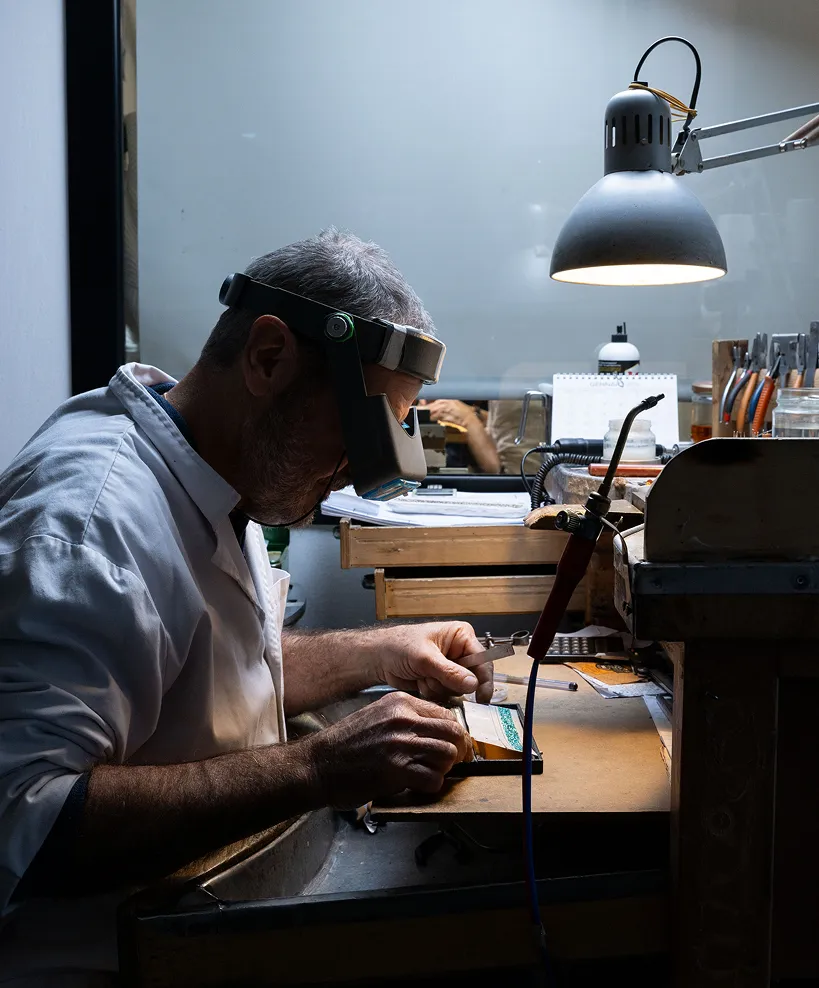
At Vikar Ahmed, engagement rings are designed individually and made in Germany. Every line, every gemstone and every detail can be tailored to your own ideas. The path leads from the design through a three-dimensional visualization to execution in the in-house atelier in Idar-Oberstein. The visualization makes it possible to check how high the ruby sits and whether prongs or a bezel better suit daily life. For high-quality rubies from 1 carat, a report with origin determination is standard at Vikar Ahmed, for example from Gübelin, SSEF, GRS, or the DGemG.
Frequently asked questions
Which engagement rings are more durable, with ruby or with sapphire?
Ruby and sapphire are equally durable, because both are corundum with a hardness of 9 and excellent toughness. The difference lies in the individual stone and the setting. Untreated and heated stones are very stable, while those filled with lead glass are considerably more sensitive. A bezel setting gives additional protection against knocks.
Is there a goldsmith in Morbach who makes bespoke ruby engagement rings?
Vikar Ahmed has no location in Morbach, but advises and creates pieces in its in-house atelier in Idar-Oberstein. Engagement rings are made there individually, from design to execution. With ruby, what matters is a workshop that asks about the treatment and plans a suitable setting. More under Jeweler for Morbach.
Is a heated ruby worse than an untreated one?
Not in terms of durability. GIA describes untreated and heated rubies as very stable. Whether a stone is untreated nevertheless remains an important statement about its nature. What matters is that the heating is disclosed and noted in the report.
How can I recognize a ruby with lead glass filling?
Usually not reliably with the naked eye. A gemological laboratory examines the stone under the microscope and with further methods, and names a filling in the report. If you choose a ruby for an engagement ring, you should therefore insist on an independent report that states the treatment.
How do I clean a ring with a ruby?
According to GIA, warm soapy water and a soft brush are always safe. Ultrasonic cleaning and steam are usually harmless for untreated and heated stones. Filled or dyed rubies may only be cleaned with a damp cloth. You should avoid acids in general.
Is a ruby as hard as a diamond?
No. Diamond has a hardness of 10, ruby a hardness of 9. The Mohs scale is not even; according to GIA, diamond is far harder than corundum. On the other hand, corundum has no cleavage, whereas a diamond can break in certain directions from a hard blow.
Private consultation
Which ruby and which setting suit your daily life becomes clear in conversation and with the stone itself. Vikar Ahmed advises in the showroom in Idar-Oberstein by appointment or in a virtual appointment. Your inquiry is treated discreetly. Request an appointment for a private consultation.
Further reading
- Gemstone: Ruby
- Rubellite or ruby?
- Engagement ring with a colored gemstone
- Clarifying gemstone treatment before production
- The setting of an engagement ring
Sources
- GIA: Ruby Description, accessed 2026-11-17
- GIA: Ruby Quality Factors, accessed 2026-11-17
- GIA: Ruby Care and Cleaning Guide, accessed 2026-11-17
- GIA: Sapphire Care and Cleaning Guide, accessed 2026-11-17
- GIA: Gem Treatment, accessed 2026-11-17
- GIA 4Cs: More Than Mohs, Gem Durability, accessed 2026-11-17
- GIA 4Cs: Complete Guide to Engagement Ring Settings, accessed 2026-11-17
- SSEF: Ruby, accessed 2026-11-17
- Vikar Ahmed: Verlobungsringe, accessed 2026-11-16
- Vikar Ahmed: Bespoke, Designprozess, accessed 2026-11-16
- GIA: Gem Laboratory, accessed 2026-11-17

A personal conversation starts here.
At the showroom in Idar-Oberstein or by video. Vikar Ahmed discusses your ideas, stones and designs with you and answers your questions calmly and in confidence.


Thank you for your request.
Your request will be handled with the utmost attention and discretion. Vikar Ahmed will get back to you.
Your details
Request
–
Occasion
–
Consultation
–
Contact
–
In the meantime
Insights: What is a Paraíba tourmaline? · Engagement ring to your own design: how does it work?
Confidential and without obligation
Back to the pagePrivate consultation
A personal conversation starts here.
- Time for your questions, wishes and ideas
- In the showroom in Idar-Oberstein or by video
- Confidential, discreet and without obligation
Vikar Ahmed · Hauptstraße 111 · 55743 Idar-Oberstein, Germany