

A Sapphire Engagement Ring Instead of a Diamond
After the diamond, the sapphire is the hardest gemstone in jewelry. Why it suits an engagement ring and how to recognize a fine stone.
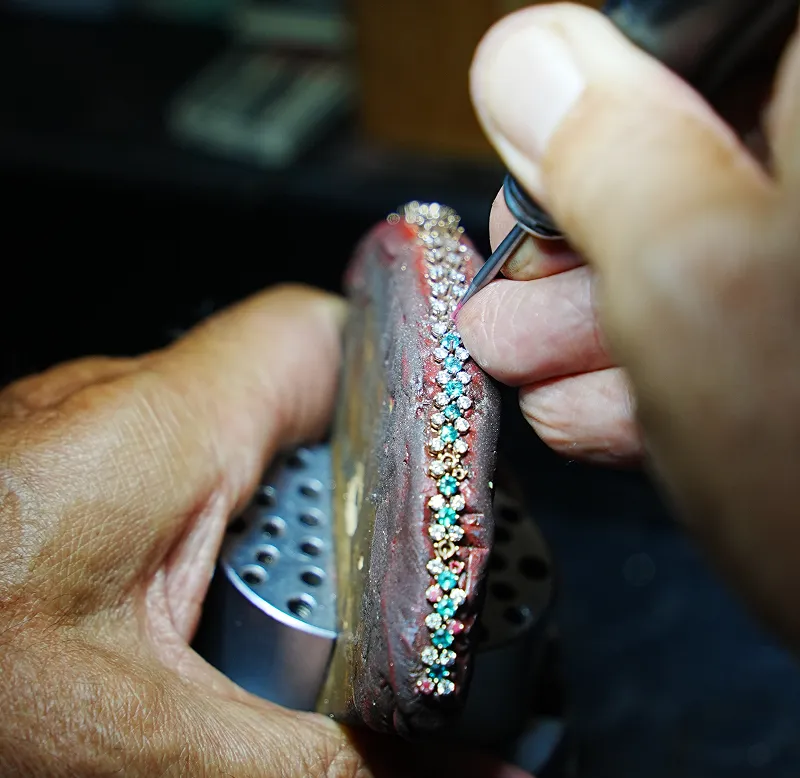
A sapphire is a worthwhile alternative to a diamond if you are looking for color rather than sparkle. With a hardness of 9 and excellent toughness, it can be worn every day without special consideration. Quality is decided first by color. A laboratory report should document whether the stone was heated or treated in another way.
At a glance
- Mineral
- Corundum, like ruby
- Mohs hardness
- 9, only diamond is harder
- Toughness according to GIA
- Excellent, no cleavage
- Colors
- Blue, plus pink, yellow, orange, green, violet, and intermediate hues
- Blue color from
- Iron and titanium
- Common treatment
- Heating, more rarely diffusion or filling
- Most important criterion
- Color: hue, saturation, evenness
Why the sapphire comes closest to the diamond
Anyone who wants a colored stone in an engagement ring without compromising in daily life arrives almost inevitably at the sapphire. The Gemological Institute of America, GIA for short, gives corundum a hardness of 9 on the Mohs scale. Among jewelry stones, only the diamond is harder. Added to this is excellent toughness without cleavage. GIA therefore explicitly calls corundum suitable for rings worn every day.
The sapphire is not a substitute but a decision in its own right. A diamond works through light, that is, through brightness, fire, and sparkle. A sapphire works through its color. It draws the eye into its depth instead of reflecting light back. Choosing it means choosing a ring that appears calm and rich. A halo or side diamonds can combine both effects.
Sapphire and diamond compared
| Criterion | Sapphire | Diamond |
|---|---|---|
| Mohs hardness | 9 | 10, many times harder |
| Toughness according to GIA | Excellent, no cleavage | High, lower along the cleavage planes |
| Effect | Color and depth | Brightness, fire, sparkle |
| Grading | Mainly by color | By the 4Cs, color D to Z |
| Common treatment | Heating | Processes for color or clarity possible |
| Report | Identity, treatment, origin on request | 4Cs with clarity plot |
Data from GIA. Toughness values in the GIA article: corundum 600, diamond over 8,000.
The comparison shows two paths to the same goal. Both stones are hard enough to barely scratch in daily life. A diamond is harder, but it can break along its cleavage planes under a hard blow. The sapphire has no cleavage. Where the diamond has fine gradations in the 4Cs, the grading of a sapphire follows mainly the eye: how beautiful is the blue, and how evenly is it distributed?

Color decides the rank
In blue sapphire, according to GIA, color has the greatest influence on value. Ranking highest are strongly saturated stones in a medium to medium-dark tone with a slight tendency toward violet. If the blue looks gray, too light, or almost black, the rank drops. The more intense and even the color, the more valuable the stone. The blue comes from traces of iron and titanium; more iron makes it darker.
Many sapphires show color zoning, that is, areas of differing color strength, and slightly different hues depending on the viewing direction. The cutter therefore orients the stone so that the color shows best from above. This only becomes apparent in the finished stone. It is best to examine a sapphire in daylight and in warm light to see whether the blue remains stable or shifts in one direction.
Sapphires in other colors
Sapphire is not only blue. GIA names violet, green, yellow, orange, pink, and purple as well as intermediate hues. The padparadscha, a pinkish orange sapphire, is named after the lotus flower. Pink sapphires owe their color to chromium, like ruby. At SSEF, only blue corundum is called sapphire without a qualifier. Other colors receive a color name in front or the designation fancy sapphire. For the ring, the same hardness and toughness apply to all colors.
Inclusions, cut, and size
Blue sapphires usually contain inclusions but, according to GIA, are on average cleaner than rubies. Very clean stones are rare. Inclusions reduce value above all when they endanger durability, for example as a fracture near the surface. Fine inclusions, conversely, can add to a stone's appeal; GIA cites as an example sapphires from Kashmir with their velvety blue.
According to GIA, most blue sapphires in the trade weigh under 5 carats. In fine qualities, size has a greater effect on value than in commercial ones. For the ring, shape counts alongside weight. Elongated shapes such as the oval cut usually show more surface area than a round stone of the same weight and visually lengthen the finger. Carat remains a weight, not a size.
Treatment and laboratory report
According to the Swiss Gemmological Institute SSEF, sapphires are frequently treated. SSEF names heating, heating with flux, more rarely with lead glass, as well as diffusion and the filling of fractures with oil. It discloses all treatments found. In terms of durability, untreated and heated stones are, according to GIA, equally very stable. With diffusion, by contrast, the color may sit only near the surface and be lost when the stone is recut.

- Ask for a report from an independent laboratory such as GIA, SSEF, or Gübelin.
- Read the section on treatment: “indications of heating” means heated, “no indications of heating” means no evidence of it.
- Watch for filling or diffusion. They change care and durability.
- Check whether the dimensions and weight in the report match the stone in the ring.
- According to SSEF, origin is an expert opinion, not a measurement with certainty.
An origin report is available from GIA for sapphires, as well as for ruby and emerald. SSEF bases its origin determination on microscopic features, trace elements, and spectroscopic data, compared with a collection of stones of known origin. The glossary explains under SSEF and Gübelin what a report achieves in detail.
Setting, metal, and accent stones
Because the sapphire is so resistant, it also allows open settings with few prongs that show much of the stone. According to GIA, prongs let in a lot of light and hold the stone securely but should be checked occasionally. A bezel setting protects the edge even better and gives the ring a smooth, modern line. With a sapphire, this is more a question of style than of necessity.
White metal makes the blue appear cool and clear, while rose gold places a warm tone beside it that is especially harmonious with pink or orange sapphires. The sapphire with side diamonds or a halo is popular. According to GIA, a halo of small stones can make the center stone appear larger but requires more care so that all stones stay secure. More on the choice of metal in the guide Rose gold or white gold.
Common mistakes in the choice
- Looking only at size: a large, grayish sapphire looks weaker than a smaller one with strong blue.
- Viewing the stone only under artificial light: some sapphires change their color noticeably depending on the light.
- Not asking about treatment: diffusion or glass filling change care and durability.
- Choosing a very dark stone: on the finger it looks almost black.
- Forgetting the accent stones: diamonds and center stone should match in quality.
At Vikar Ahmed, an engagement ring is designed individually and made in Germany. A classic can be developed further, or an entirely new idea realized. Every line, every diamond, and every gemstone can be tailored. Before production, a three-dimensional CAD visualization shows how stone and setting work together. For high-quality sapphires from 1 carat, a report with origin determination is standard at Vikar Ahmed, for example from Gübelin, SSEF, GRS, or the DGemG. Every treatment is stated in the consultation and in writing on the certificate, expert opinion, and invoice.
Frequently asked questions
Which sapphire engagement rings are worthwhile as an alternative to a diamond?
Rings with a sapphire of strong, even color whose treatment is documented by a laboratory report. Thanks to a hardness of 9 and high toughness, the stone withstands daily life well. An oval cut shows a lot of surface, and side diamonds combine the color of the sapphire with the sparkle of the diamond.
Is a pink sapphire as robust as a blue one?
Yes. Pink, yellow, green, or orange sapphires are corundum like the blue sapphire and have the same hardness of 9 and the same toughness. Differences in durability do not arise from color but from treatments such as glass filling or from fractures in the stone.
What does fancy sapphire mean?
This is the name for sapphires in colors other than blue. SSEF uses the term for corundum in colors such as pink, yellow, or green, provided no color name is placed in front. Red is excluded, because red corundum is called ruby. Without a qualifier, sapphire at SSEF always means blue corundum.
How do I clean a sapphire engagement ring?
With warm soapy water and a soft brush, which according to GIA is always safe. Untreated, heated, and diffusion-treated sapphires usually also tolerate ultrasonic cleaning and steam. For filled or dyed stones, a damp cloth is sufficient. Boric acid powder can etch even untreated stones.
How can I tell whether a sapphire has been heated?
Usually not with the naked eye; only a gemological laboratory can assess this. If it finds evidence of heating, SSEF writes “indications of heating” in the report, and without such a finding “no indications of heating”. Without a report, the question remains open.
Which cut suits a sapphire in an engagement ring?
Any cut is possible, because the sapphire is hard enough for corners and points. Oval and cushion look soft, an emerald cut clear and strict. More important than the shape, according to GIA, is that the cutter orients the stone so that its color shows best from above.
Private consultation
Which sapphire suits you is ultimately decided by the eye. Vikar Ahmed advises in the showroom in Idar-Oberstein by appointment, and virtually on request. Tell us your color, style, and timeframe, and the appointment can be prepared accordingly. Request a consultation appointment.
Further reading
- Gemstone: Sapphire
- Emerald or sapphire in an engagement ring
- Engagement rings with a blue stone
- Engagement ring with a colored gemstone
- Jeweler for clients from Birkenfeld
Sources
- GIA: Sapphire Quality Factors, accessed 2026-11-17
- GIA: Sapphire Description, accessed 2026-11-17
- GIA: Sapphire Care and Cleaning Guide, accessed 2026-11-17
- SSEF: Sapphire, Behandlung, Farbe und Herkunft, accessed 2026-11-17
- GIA: Colored Stone Reports, accessed 2026-11-17
- GIA 4Cs: More Than the Mohs Scale, Gem Durability, accessed 2026-11-17
- GIA 4Cs: Complete Guide to Engagement Ring Settings, accessed 2026-11-17
- GIA 4Cs: Tips for Buying an Engagement Ring, accessed 2026-11-17

A personal conversation starts here.
At the showroom in Idar-Oberstein or by video. Vikar Ahmed discusses your ideas, stones and designs with you and answers your questions calmly and in confidence.


Thank you for your request.
Your request will be handled with the utmost attention and discretion. Vikar Ahmed will get back to you.
Your details
Request
–
Occasion
–
Consultation
–
Contact
–
In the meantime
Insights: What is a Paraíba tourmaline? · Engagement ring to your own design: how does it work?
Confidential and without obligation
Back to the pagePrivate consultation
A personal conversation starts here.
- Time for your questions, wishes and ideas
- In the showroom in Idar-Oberstein or by video
- Confidential, discreet and without obligation
Vikar Ahmed · Hauptstraße 111 · 55743 Idar-Oberstein, Germany