

Rubellite or Pink Diamond?
Both stones bring pink to a ring, but in entirely different ways. A comparison of origin of color, rarity, suitability for daily wear, and documentation.
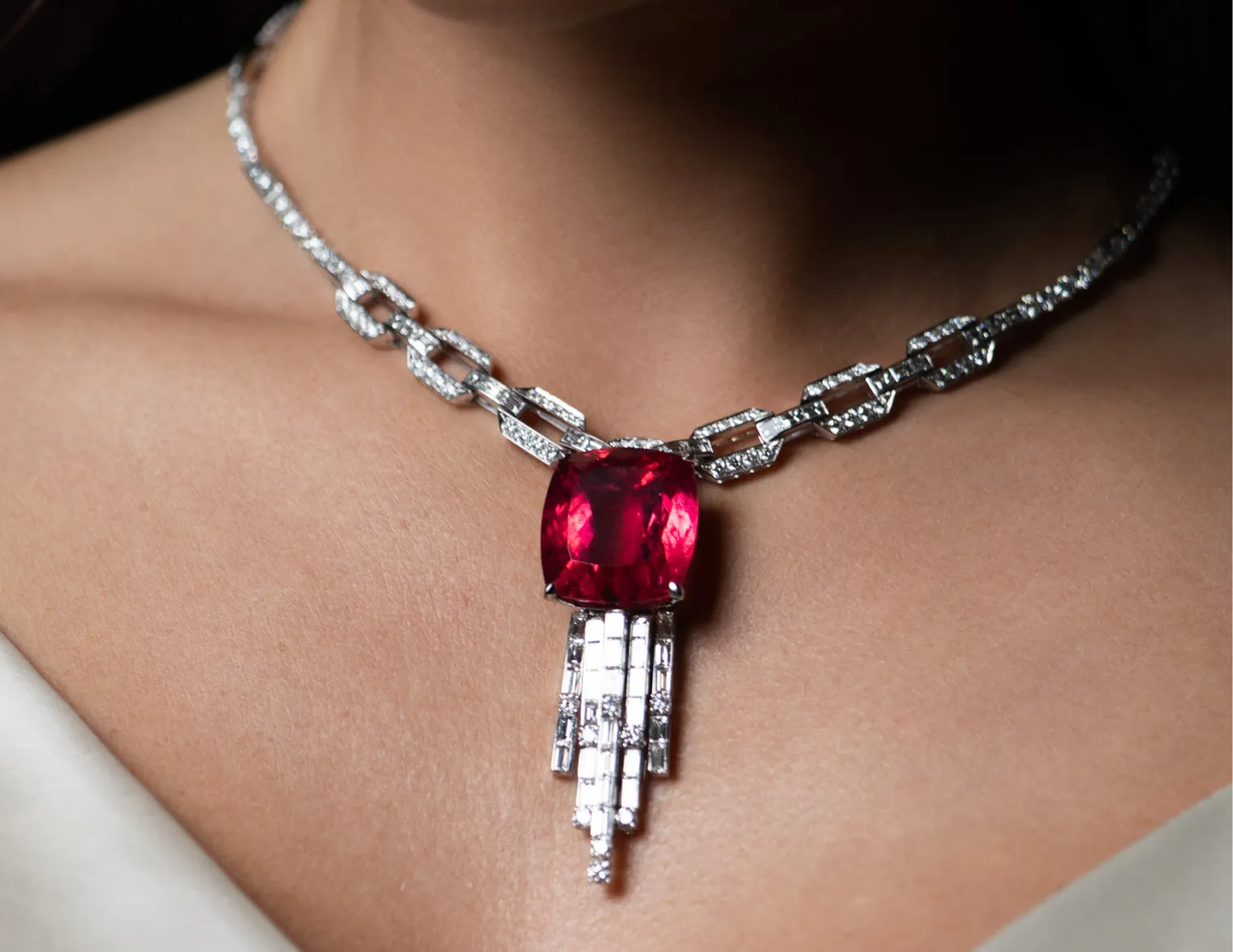
With a hardness of 10, a pink diamond is the more robust and far rarer stone. Its color results from deformation of the crystal lattice, and strong tones are an exception. A rubellite is a tourmaline with a hardness of 7 to 7.5, but it often shows a much more saturated color and larger sizes. For a ring worn every day, more speaks for the diamond.
At a glance
- Pink diamond
- Diamond, color from plastic deformation of the crystal lattice
- Rubellite
- Tourmaline in pink to red, color from manganese
- Mohs hardness
- Diamond 10, rubellite 7 to 7.5
- Typical size
- At GIA, 83 percent of pink diamonds weigh under one carat
- Key value factor
- Color, for both
- Report
- Diamond with a statement on color origin, rubellite with identification
Two paths to pink
In a pink diamond, the color is not caused by a foreign element but by pressure. According to the Gemological Institute of America, GIA for short, the crystal lattice was compressed and slightly twisted deep in the earth, which specialists call plastic deformation. The color often sits in fine parallel bands. In a GIA study, it was due to an absorption band at 550 nanometers in 992 of 1,000 randomly selected pink diamonds.
In rubellite, the cause is chemical. The stone is a tourmaline, and according to GIA the trace element manganese produces its red and pink tones. Rubellite is the trade name for tourmaline in pink, red, purplish red, orangy red, and brownish red. It therefore covers a wider color range than is usual for pink diamonds. How rubellite differs from red corundum is described in the comparison Rubellite or ruby.
The comparison by criteria
| Criterion | Pink diamond | Rubellite |
|---|---|---|
| Mineral | Diamond | Tourmaline |
| Cause of color | Deformation of the crystal lattice | Manganese |
| Mohs hardness | 10 | 7 to 7.5, toughness fair |
| Typical color strength | Mostly delicate, strong very rare | Often saturated, from pink to red |
| Usual sizes | Predominantly under one carat | Also stones over five carats |
| Report | Color grade and color origin | Identification and treatments |
| Cleaning | Robust, provided untreated | No ultrasonic, no steam |
Information according to GIA. The color description of fancy color diamonds follows its own system, not the D to Z scale.
The table shows a fundamental difference: with a pink diamond, one pays above all for rarity, with a rubellite above all for color. A strongly pink diamond is an exception among exceptions. A rubellite with equally strong color is considerably more common. Seeing both stones side by side, one often notices that the tourmaline can appear more saturated, while the diamond sparkles brighter and livelier.

Rarity and value
According to GIA, pink diamonds are among the rarest gemstones on earth. Most are small, delicately colored, or contain inclusions. Of the pink diamonds GIA has examined, 83 percent weighed less than one carat. From the Australian Argyle mine, one of the most important sources, pink stones made up well under 0.1 percent of production according to GIA. Stones with saturated color, high clarity, and notable size are correspondingly scarce.
With rubellite, color determines value, and visible inclusions are accepted when the tone is strong. Larger stones are available, and according to GIA the price per carat rises above all beyond five carats. The gap to a pink diamond of comparable size and color strength is usually very large. Specific amounts depend on the individual stone and are deliberately not stated here. More on the diamond in pink in the guide Fancy pink diamond in an engagement ring.
Color and cut
For pink diamonds, according to GIA the market prefers pure pink over stones with purple, orange, brown, or gray secondary hues. According to GIA, ovals, pears, radiants, and cushions show the color more vividly than the round brilliant because they concentrate the color within the stone. Strongly pink diamonds are therefore rarely cut round. More on the color grades in the glossary under Fancy Color Diamond.
With rubellite, pleochroism plays a role: tourmaline shows a different depth of color depending on the viewing direction. The cutter orients the stone so that it appears neither pale nor too dark. According to GIA, tourmaline can rival ruby and pink sapphire in hue and depth. Which shapes work well for rubellite is described in the guide Which cut suits a rubellite?.
Durability in a ring
A ring is subjected to more stress than any other piece of jewelry. With a hardness of 10, diamond stands at the top of the Mohs scale and is therefore highly resistant to scratches. For an engagement ring worn every day, that is a clear advantage. A pink diamond can therefore be set like a colorless one, and the setting follows mainly the shape.

With a hardness of 7 to 7.5, rubellite is also suitable for rings, but GIA rates its toughness only as fair. Heat and sudden temperature changes can cause it to fracture, and GIA advises against ultrasonic and steam cleaning. In a ring, it needs a setting that encloses edges and corners, and some care during hard manual work. Which setting is suitable is explained in the guide Which setting protects a rubellite?.
Authenticity and report
Pink diamonds are also produced artificially. According to GIA, natural and laboratory-grown diamonds can be colored pink by treatment, which creates different color centers than in naturally pink stones. For the absorption band at 550 nanometers that colors most natural pink diamonds, no method is known to produce it in the laboratory. A report on a fancy color diamond therefore states the origin of the color: natural or treated.
For rubellite, GIA issues an identification report. It confirms the species and lists detectable treatments. According to GIA, heating leaves no detectable traces in tourmaline, and a color change caused by irradiation can fade under heat or strong light. Clarify before deciding whether such a report exists for your stone and which treatments it lists.
Which stone suits whom
- Pink diamond: for an engagement ring worn daily that is meant to last for decades.
- Pink diamond: when rarity and a documented natural color origin come first.
- Rubellite: when a saturated, strong color in a visible size is desired.
- Rubellite: for rings worn on special occasions, or for necklaces and earrings.
- Both: when the setting suits the stone and the design places the color at the center.
A ring does not look timeless because of the stone alone, but because of a calm design that carries the stone. In its pieces, Vikar Ahmed works with natural fancy color diamonds, including pink and purplish pink, as well as rubellites. Engagement rings are designed individually by the house and made in Germany. A three-dimensional visualization makes it possible to check in advance how the respective stone looks in the ring. The house has diamonds graded almost exclusively by GIA and does not work with lab-grown diamonds.
Frequently asked questions
Which is better for a ring, rubellite or pink diamond?
For a ring worn every day, the pink diamond with a hardness of 10 is the more robust choice. The rubellite is suitable when a saturated color in a larger size is desired and the setting protects corners and edges. The better stone is the one whose properties match the way the ring will be worn.
Rubellite or pink diamond as an engagement stone: how large is the price difference?
Usually very large. According to GIA, pink diamonds are among the rarest gemstones, and strong color in a notable size is an exception. Rubellites of the same color strength and size are considerably more common. How large the gap is in an individual case depends on the color, size, and clarity of the two stones.
Rubellite or pink diamond for an individually designed ring: which looks more timeless?
Both can look timeless. The pink diamond appears bright and sparkling and, thanks to its hardness, can be worn for generations. The rubellite appears more saturated and color-focused. A ring becomes timeless above all through a calm design, balanced proportions, and a setting that protects the stone.
Can a pink diamond be distinguished from a treated one with the naked eye?
No. Treated and laboratory-grown pink diamonds look very similar to natural stones. Only a laboratory can determine, from the color centers in the crystal, whether the color formed naturally. A report stating the color origin is therefore essential for pink diamonds.
Does a rubellite fade over time?
Not after heating: according to GIA, this color change is stable. A color produced by irradiation, on the other hand, can fade under heat or strong light. According to GIA, tourmaline is generally stable to light. Information on treatments in the report helps to assess this.
Private consultation
Whether a pink diamond or a rubellite better suits your ring depends on color, size, and how you will wear it. Vikar Ahmed advises in the showroom in Idar-Oberstein by appointment, and virtually on request. Request an appointment for a private consultation.
Further reading
- Ring with a fancy pink diamond
- Rubellite in an engagement ring
- Rubellite or ruby?
- Gemstone: Fancy Color Diamond
- Glossary: Rubellite
Sources
- GIA, Gems & Gemology: Natural-Color Pink, Purple, Red, and Brown Diamonds (Winter 2018), accessed 2026-11-17
- GIA 4Cs: Reasons for a Pink Diamond Engagement Ring, accessed 2026-11-17
- GIA: Fancy Color Diamond Quality Factors, accessed 2026-11-17
- GIA 4Cs: Mohs-Skala der Härte, accessed 2026-11-17
- GIA: Tourmaline Description, accessed 2026-11-17
- GIA: Tourmaline Quality Factors, accessed 2026-11-17
- GIA: Tourmaline Care and Cleaning, accessed 2026-11-17
- GIA, Gems & Gemology: Pleochroism in Faceted Gems, an Introduction (Herbst 2014), accessed 2026-11-17
- Vikar Ahmed: Collections, accessed 2026-11-16
- Vikar Ahmed: Verlobungsringe und Engagement, accessed 2026-11-16

A personal conversation starts here.
At the showroom in Idar-Oberstein or by video. Vikar Ahmed discusses your ideas, stones and designs with you and answers your questions calmly and in confidence.


Thank you for your request.
Your request will be handled with the utmost attention and discretion. Vikar Ahmed will get back to you.
Your details
Request
–
Occasion
–
Consultation
–
Contact
–
In the meantime
Insights: What is a Paraíba tourmaline? · Engagement ring to your own design: how does it work?
Confidential and without obligation
Back to the pagePrivate consultation
A personal conversation starts here.
- Time for your questions, wishes and ideas
- In the showroom in Idar-Oberstein or by video
- Confidential, discreet and without obligation
Vikar Ahmed · Hauptstraße 111 · 55743 Idar-Oberstein, Germany