

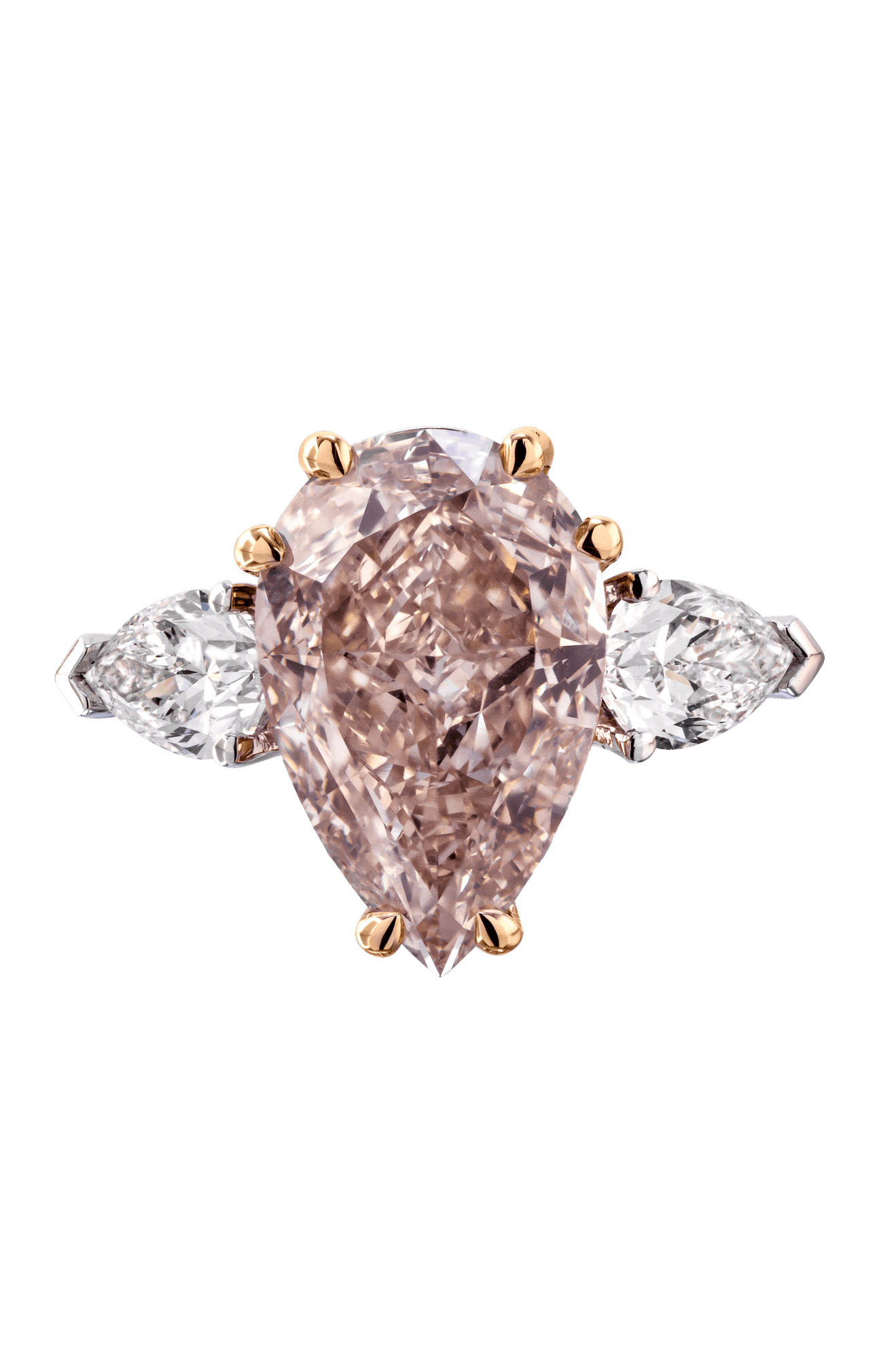
A ring with a fancy pink diamond: rarity, color, making
With a pink diamond, the assessment is reversed: what counts is not the absence of color but its strength. Accordingly, the origin of that color must be documented precisely.

A fancy pink diamond is a diamond whose pink color lies outside the scale for colorless stones and is graded separately. According to GIA, strongly saturated pink diamonds are among the rarest colors of all. What matters are hue, tone, and saturation, along with a laboratory report that confirms the color as natural.
At a glance
- Grading
- By hue, tone, and saturation, not by the D to Z scale
- Color intensity grades
- From Faint through Fancy to Fancy Vivid, plus Fancy Dark and Fancy Deep
- Hue modifier
- For example purplish pink: pink with a share of purple
- Cause of the color
- Mostly plastic deformation of the crystal lattice deep in the earth
- Main value factor
- Color, ahead of clarity and weight
- Check in the report
- Color origin: natural or treated
How the color of a pink diamond is graded
Colorless diamonds are judged by how little color they show. For colored diamonds, the Gemological Institute of America (GIA) assesses the presence of color. Three dimensions describe it: the hue, here pink, the tone, and the saturation, meaning the strength of the color. Tone and saturation together determine the grade that precedes the hue, such as Fancy Light, Fancy, Fancy Intense, or Fancy Vivid.

| Term in the report | Meaning |
|---|---|
| Fancy Light Pink | Light, delicate color |
| Fancy Pink | Clearly recognizable color of medium strength |
| Fancy Intense Pink | Strong color |
| Fancy Vivid Pink | Very strong, saturated color |
| Fancy Deep or Fancy Dark | Strong color in a darker tone |
| Purplish Pink | Pink as the main color with a share of purple |
Terms from the GIA grading system for colored diamonds, explained in simplified form.
The stronger and purer the color, the rarer the stone. According to GIA, Fancy Intense and Fancy Vivid are generally valued most highly. Pure pink is preferred to stones with a purple, orange, brownish, or grayish modifier. A modifier such as purplish pink is therefore not a flaw, but it is a detail worth knowing. The fundamentals are in the glossary under fancy color diamond.
Where the pink color comes from
The color of most pink diamonds is caused not by a foreign element but by deformation. According to GIA research, the crystal lattice was plastically deformed under pressure deep in the earth, which changes the path of light through the stone. The color is often not evenly distributed in the stone but concentrated in fine lines, known as pink graining. They mark the planes along which the crystal was under strain.
This explains the rarity. For decades, the Argyle mine in Western Australia was the most important source of strongly saturated pink diamonds. Even there, according to GIA, pink stones made up well under 0.1 percent of production. Most of the output was brown, a smaller share colorless to yellowish. The mine's final year of operation was planned for 2020, and it has since closed.
Size also plays a role. In an evaluation of more than 90,000 pink diamonds examined by GIA, 83 percent weighed less than one carat. Pure pink was the most common hue at 40 percent, followed by hues between purplish pink and pinkish purple at 28 percent. A large stone in strong, pure pink is therefore the exception within an already rare group.
Pink or colorless: which is rarer?
Both ends are rare, in different ways. Within the D to Z scale, truly colorless diamonds are the rarest. Among colored diamonds, GIA names saturated pink, blue, and green as the rarest colors. A natural pink diamond of strong saturation is thus among the rarest diamonds of all. A pale pink is less rare than a strong one.
For collectors, this means that the color grade weighs more heavily than the carat weight. In colored diamonds, color is the decisive value factor. Even stones with many inclusions can be prized for their color, as long as the inclusions do not compromise durability. Large colored diamonds are rarer than small ones. How this compares with a colorless stone in D Flawless is ultimately a matter of preference.
Natural or treated: the report decides
The color of a diamond can be altered by treatment. This cannot be seen with the naked eye. A laboratory report for colored diamonds therefore states the origin of the color, natural or treated, alongside the color grade. Without this detail, the designation fancy pink is incomplete. For a ring with a pink diamond, the report is not an accessory but the basis of the decision.
GIA describes several ways in which diamonds become pink. Pale brown or very light stones can be irradiated and heated. Brownish pink stones can be treated under high pressure and high temperature, HPHT for short, so that the brown disappears and the pink remains. In addition, there are laboratory-grown pink diamonds. According to GIA, a treated natural stone is worth less than an untreated one. The fundamentals are in the glossary under treatment.
A clear rule applies to the designation. The CIBJO Diamond Book requires that a treated diamond be disclosed, in writing in the documents and verbally before the transaction is concluded. Expressions such as “naturally treated” are expressly not permitted because they can mislead about the origin. For a ring with a pink diamond, the treatment detail therefore belongs in every document, not only in the laboratory report.
Good to know
Read two details in the report first: the color grade with hue and the color origin. Note the report number and verify it in the laboratory's database.
Cut and setting serve the color
Colored diamonds are cut so that the color appears as strong as possible, not so that as much white light as possible returns. The size and depth of the stone influence how far light travels through it, and thus the effect of the color. According to GIA, oval, pear, radiant, and cushion show pink color more strongly than the round shape.
The metal also plays a part, because a diamond reflects its surroundings. According to GIA, strongly saturated pinks are mostly framed in white metal, and yellow gold is rare for them. For light to medium pinks, GIA also names rose and yellow gold, because white metal can make a pale stone look paler still. Colorless diamonds beside the center stone heighten the contrast. More in the guide Rose gold or white gold.
Good to know
A pink diamond is as hard as any diamond, 10 on the Mohs scale. It is sensitive to sudden temperature changes, which according to GIA can enlarge fractures. Warm soapy water is sufficient for cleaning.
Goldsmith or high jewelry atelier
The name of a house says little; its way of working says a great deal. For a ring with a pink diamond, four things matter: experience with colored diamonds, a report on the stone from an independent laboratory, a design you see before production, and making that takes place traceably in one location. You can ask any provider these questions, in Morbach, Kaiserslautern, Birkenfeld, or elsewhere.
Vikar Ahmed is based in Idar-Oberstein, has no location in the towns named, and makes one-of-a-kind pieces in its in-house atelier. The house's pieces include natural fancy color diamonds in pink and purplish pink, set in 18k (750) white gold and rose gold, among other metals. Bespoke projects are carried out exclusively on request. Each request is reviewed, and work begins only after acceptance. With a pink diamond, make sure the report states the natural origin of color. For diamonds, the house works almost exclusively with GIA, in exceptional cases with HRD Antwerp.
Frequently asked questions
Fancy pink diamond or colorless diamond: which is the rarer ring for collectors?
In strong saturation, the ring with a pink diamond. GIA counts saturated pink among the rarest diamond colors. The condition is that the report confirms the color as natural. A pale pink is less rare, and a colorless diamond in D Flawless is also rare in its own way.
For a custom ring with a fancy pink diamond, should I go to a goldsmith in Morbach or to a high jewelry atelier?
What matters is not the name but experience with colored diamonds, an independent report on the stone, and a design you see before production. Vikar Ahmed works with natural fancy color diamonds and makes its pieces in its in-house atelier in Idar-Oberstein.
Is a natural fancy pink diamond a more sensible collector's piece than a ring with rubellite?
If rarity alone is the question, generally yes. According to GIA, natural pink diamonds in strong saturation are among the rarest gemstones of all. Rubellite, a red to pink tourmaline, has a hardness of 7 to 7.5, diamond 10. If a strong color and its effect are what matter, rubellite is an independent choice with its own character.
As a collector, I am looking for a piece with a natural fancy pink diamond and want to see it beforehand. Which ateliers in Birkenfeld are worth comparing?
Worth considering is any atelier that shows you the stone in daylight, presents a report with natural color origin, and makes the design visible before production. Vikar Ahmed has no location in Birkenfeld. The atelier receives clients in Idar-Oberstein by appointment. On request, the house also sends photos or short videos in daylight beforehand.
What does purplish pink mean in a diamond?
Purplish pink describes the hue: pink is the main color, purple a smaller share. The detail appears in the laboratory report after the color grade, for example Fancy Intense Purplish Pink. Pure pink without a modifier is considered more sought after, but the effect on the stone is a matter of taste.
How can I tell whether the color of a pink diamond has been treated?
Not at all with the naked eye. A laboratory separates natural and treated color using spectroscopic methods. The report is what counts: alongside the color grade, it states whether the color is natural or treated. Also check whether the report number is recorded in the laboratory's database.
Private consultation
The color of a pink diamond must be seen with your own eyes, ideally in daylight. Vikar Ahmed receives clients for this by appointment in the house's showroom in Idar-Oberstein and handles your request discreetly. Request a consultation on a ring with a fancy pink diamond.
Further reading
- Jeweler in the region
- Glossary: fancy color diamond
- Gemstone: fancy color diamond
- Engagement ring with a pink diamond
- Consultation in Idar-Oberstein
- Consultation for Bad Kreuznach
Sources
- GIA: Fancy Color Diamond Quality Factors, accessed 2026-11-17
- GIA: Colored Diamonds Buyer's Guide, accessed 2026-11-17
- GIA Gems & Gemology, Winter 2018: Natural-Color Pink, Purple, Red, and Brown Diamonds, accessed 2026-11-17
- GIA 4Cs: Pink Diamond Engagement Ring Buying Guide, accessed 2026-11-17
- GIA: How Metal Affects Diamond Color Appearance, accessed 2026-11-17
- GIA: How does the colored diamond grading system differ from D-to-Z?, accessed 2026-11-16
- CIBJO: The Diamond Book 2024-1 (Offenlegung, Mohs-Härte), accessed 2026-11-17
- Vikar Ahmed: Collections, accessed 2026-11-16
- Vikar Ahmed: Kontakt, accessed 2026-11-16
A personal conversation starts here.
At the showroom in Idar-Oberstein or by video. Vikar Ahmed discusses your ideas, stones and designs with you and answers your questions calmly and in confidence.





Thank you for your request.
Your request will be handled with the utmost attention and discretion. Vikar Ahmed will get back to you.
Your details
Request
–
Occasion
–
Consultation
–
Contact
–
In the meantime
Insights: What is a Paraíba tourmaline? · Engagement ring to your own design: how does it work?
Confidential and without obligation
Back to the pagePrivate consultation
A personal conversation starts here.
- Time for your questions, wishes and ideas
- In the showroom in Idar-Oberstein or by video
- Confidential, discreet and without obligation
Vikar Ahmed · Hauptstraße 111 · 55743 Idar-Oberstein, Germany