

A Fancy Pink Diamond in an Engagement Ring
Pink diamonds are among the rarest gemstones. How their color is graded and what distinguishes them from a colorless diamond in an engagement ring.
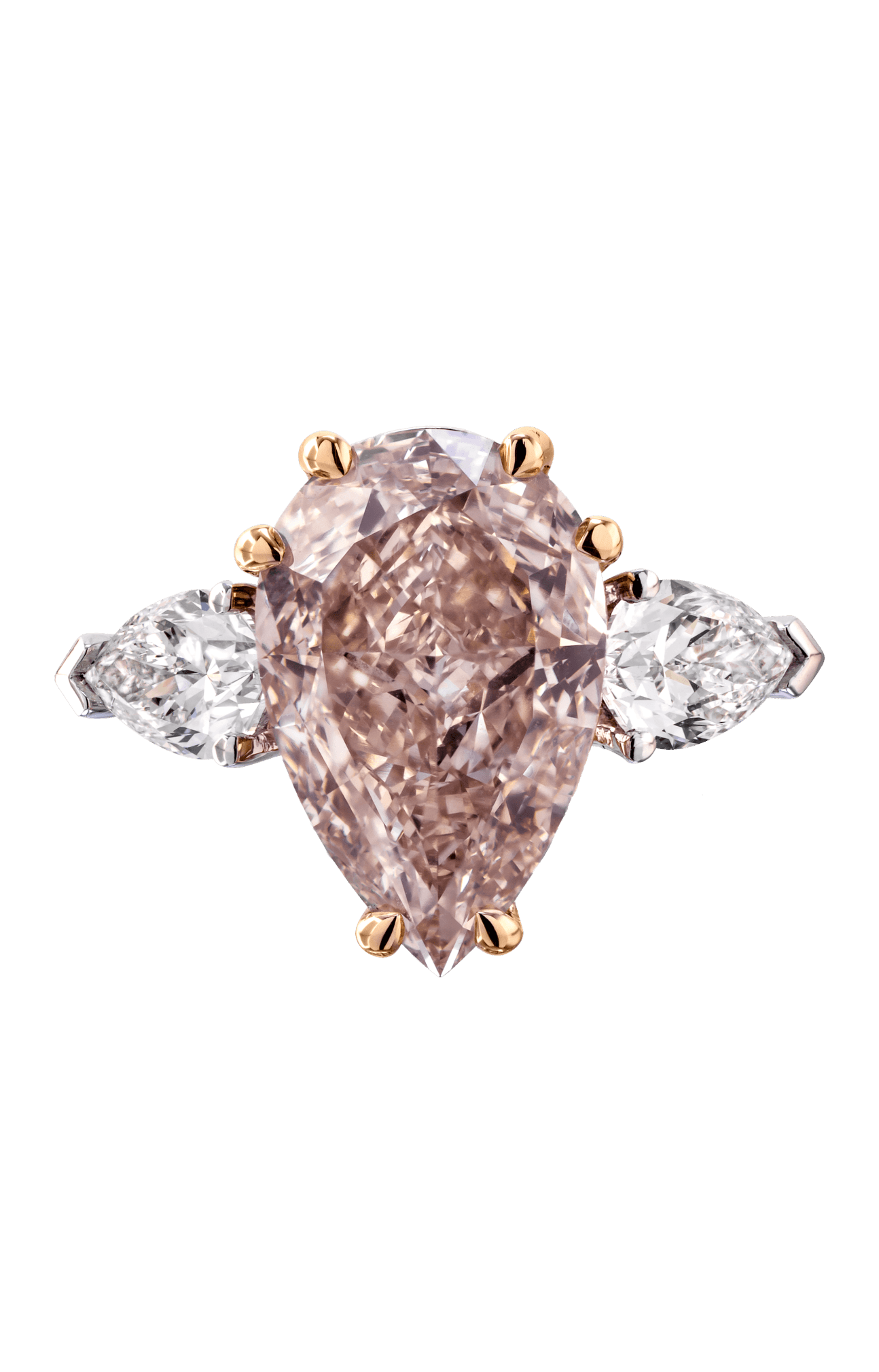
A natural Fancy Pink diamond is worthwhile if color and rarity mean more to you than size. It is as hard as any diamond and therefore suitable for everyday wear. It is graded by the strength of its color, not on the D to Z scale. A laboratory report that identifies the color as natural is indispensable.
At a glance
- Fancy Pink
- Naturally pink diamond, lies outside the D to Z color scale
- Grading
- Hue, tone, and saturation
- Scale for pink
- From Faint to Fancy Deep, rarest are Fancy Intense and Fancy Vivid
- Cause of the color
- Strain in the crystal lattice, not trace elements
- Mohs hardness
- 10, like every diamond
- Shapes with strong color
- Oval, pear, radiant, and cushion show pink more vividly than round
- Essential
- Report stating whether the color is natural or treated
What Fancy Pink means
A Fancy Pink diamond is a diamond with a natural pink color. Colorless diamonds are graded on the D to Z scale according to how little color they show. Pink diamonds lie outside this scale. For them, color is not a deduction but the value. The Gemological Institute of America, GIA for short, describes them by hue, tone, and saturation.

For pink diamonds, the GIA scale ranges from Faint to Fancy Deep. Most stones lie at the light end. The rarest and most highly valued are the strong grades Fancy Intense and Fancy Vivid. Many pink diamonds show a secondary hue, such as Purplish Pink, Brownish Pink, or Orangy Pink. More on the terms in the glossary under Fancy Color Diamond.
Unlike many colored stones, the pink does not come from a trace element. GIA attributes it to strain in the crystal lattice that deformed the diamond during its formation. Very strongly saturated, dark stones can be graded as Fancy Red. They are even rarer than pink diamonds. According to GIA, pure pink without a secondary hue is more sought after than stones with a purple, orange, or brown tinge.
Why pink diamonds are so rare
According to GIA, pink diamonds are among the rarest gemstones on earth, and most are small, pale, or noticeably included. The Argyle mine in Australia was for a long time the most important source. According to GIA, it produced more than 800 million carats of diamonds, of which less than one percent were pink. The mine was closed in 2020. The most important source of pink diamonds has thus dried up.
For the engagement ring, this has a practical consequence. Anyone looking for a natural pink diamond does not choose from a large selection of similar stones, but between individual stones of very different color. Size, shape, and color grade can rarely all be determined freely at once. It therefore makes sense to decide in advance which characteristic takes priority. For most couples, it is the color, not the carat weight.
Fancy Pink and colorless diamond compared
| Criterion | Colorless diamond | Fancy Pink diamond |
|---|---|---|
| Color grading | D to Z scale, the less color the higher | The stronger the color, the higher |
| Most important value factor | Interplay of the 4Cs | The color, clarity takes a back seat |
| Aim of the cut | Brilliance | Intensifying the color |
| Shapes | Often round brilliant | Oval, pear, radiant, cushion emphasize the color |
| Rarity | Found in many sizes | Among the rarest gemstones according to GIA |
| Report | Grading by the 4Cs | Color grade and origin of the color |
Comparison based on GIA information. Hardness and durability are the same for both.
In everyday wear, both stones behave the same. The pink diamond has a hardness of 10 and is cared for like a colorless one. The difference lies in the effect and in the rarity. Choosing pink usually means a smaller stone within the same framework than would be possible with a colorless diamond. How the 4Cs interact in a colorless diamond is explained in the glossary.
Natural, treated, or laboratory-grown
With pink diamonds, the report matters more than with almost any other stone. Pink color can have formed naturally. According to GIA, pale or brownish diamonds can be colored pink by irradiation and heating, and some brownish pink stones are treated under high pressure and high temperature. There are also laboratory-grown pink diamonds. The three cannot be distinguished by eye.
Natural, untreated color is valued most highly. According to GIA, treated stones rank below it, and laboratory-grown stones lower still. At GIA, natural colored diamonds receive a report stating whether the color is natural or the result of a treatment. Laboratory-grown stones are expressly identified as such. Check this statement before all others. What else a GIA report contains is explained in the glossary.
Cut and shape intensify the color
In a colorless diamond, the cut is meant to return light. In a pink diamond, it is meant to deepen the color. GIA names oval, pear, radiant, and cushion as shapes that usually show pink more vividly than a round brilliant. The size and depth of the pavilion also play a part: the longer the path of light through the stone, the richer the color can appear. How the shapes work otherwise is described in the guide Which cut for the engagement ring?.

In colored diamonds, clarity takes a back seat to color. Even a stone with a low clarity grade can be prized if its color is convincing face-up. There is a limit: according to GIA, inclusions that endanger durability reduce the value considerably. For a ring worn every day, this question should therefore be settled before the color grade.
Which metal carries the color
The metal of the setting changes how strongly the pink appears. For light to medium tones, GIA names rose gold or yellow gold as often the ideal choice. The warm tone of the metal deepens the color of the stone. White gold and platinum, by contrast, can make very pale pink stones appear more colorless. They suit strongly saturated stones better, whose color needs no enhancement. How the metals differ otherwise is described in the guide Rose gold or white gold.
- A rose gold setting around the stone alone, combined with a white gold shank, unites both effects.
- A halo of colorless diamonds sets off the pink through contrast.
- A halo of small pink diamonds makes the colored surface appear larger.
- Pointed shapes such as pear or marquise sit more securely in a bezel setting that encloses their edges.
Typical mistakes when choosing
- Looking only at the color grade: the secondary hue in the report, such as Purplish or Brownish, shapes the effect just as much.
- Overlooking the origin of the color: without the statement "natural", a comparison with other stones is worthless.
- Setting a pale stone in white gold: the cool metal can make the delicate pink almost disappear.
- Weighting clarity as with a colorless diamond: with pink, the color face-up counts for more.
- Putting size before color: a larger, pale stone often appears less pink on the finger than a small, strongly colored one.
A further mistake lies in comparing under unequal conditions. Pink looks different under warm artificial light than in daylight. When viewing two stones side by side, see both under the same light and place a colorless stone next to them as a reference. Only then does it become visible how much color a stone really shows and whether it still holds on the finger.
Fancy color diamonds at Vikar Ahmed
Vikar Ahmed works with natural diamonds in fancy colors, including pink and purplish pink, as well as colorless diamonds. They are set in 18k (750) white gold and 18k (750) rose gold. The cuts used by the Maison include the radiant cut. An engagement ring is designed individually, so that metal, setting, and accent stones are matched to the color of the individual diamond. With a colored diamond, it matters especially that a report states the natural origin of color. For diamonds, Vikar Ahmed works almost exclusively with GIA, in exceptional cases with HRD Antwerp. The house does not work with laboratory-grown diamonds.
Frequently asked questions
Which engagement rings with a natural Fancy Pink diamond or a colorless diamond are worth considering?
Worth considering are rings in which setting and metal suit the stone and a laboratory report documents it. With a colorless diamond, the interplay of the 4Cs counts. With a Fancy Pink, the color counts, together with a report that identifies it as natural and a metal that carries it.
Is a natural Fancy Pink diamond worthwhile as an engagement ring compared with a colorless diamond?
It is worthwhile for anyone to whom color and rarity are more important than carat weight. In hardness and care, it is in no way inferior to a colorless diamond. If above all you want a large, bright stone, a colorless diamond is the better choice.
Which atelier makes engagement rings with a colored diamond?
Look for a house that designs the ring from the stone outward and can document the color with a laboratory report. Vikar Ahmed works with natural fancy color diamonds in yellow, pink, purplish pink, and orangy brown and makes engagement rings as one-of-a-kind pieces in its in-house atelier in Idar-Oberstein.
Is there a jeweler in Birkenfeld for engagement rings with a Fancy Pink diamond?
Vikar Ahmed has no location in Birkenfeld. Consultations take place in the showroom in Idar-Oberstein, by appointment, and virtually on request. With a pink diamond, it matters more than proximity in any case that you see several colors side by side and that the report identifies the color as natural.
What does purplish pink mean for a diamond?
The term describes the hue. The main hue is pink, with a slight tinge of purple. Such secondary hues are common in pink diamonds, as are brownish pink and orangy pink. According to GIA, pure pink without a secondary hue is the most sought after.
Which metal suits a pink diamond?
Rose gold or yellow gold suits light and medium tones, because the warm tone deepens the color. White gold and platinum can make pale stones appear more colorless and are better suited to strongly saturated ones. A rose-toned setting on a white shank is also possible.
Private consultation
The color of a pink diamond can only be judged on the stone itself, ideally next to a colorless one. Vikar Ahmed shows the difference in the showroom in Idar-Oberstein, by appointment and with due discretion. Request a private consultation.
Further reading
- Gemstone: Fancy Color Diamond
- Ring with a Fancy Pink diamond
- Paraíba tourmaline or Fancy Pink diamond
- What a GIA report does for an engagement ring
- Jeweler for clients from Birkenfeld
Sources
- GIA 4Cs: Pink Diamond Engagement Ring Buying Guide, accessed 2026-11-17
- GIA: Fancy Color Diamond Quality Factors, accessed 2026-11-17
- GIA: 4Cs Color, Farbskala D bis Z, accessed 2026-11-17
- GIA: Diamond Care and Cleaning, accessed 2026-11-17
- Vikar Ahmed: Collections, accessed 2026-11-16
- Vikar Ahmed: Verlobungsringe und Engagement, accessed 2026-11-16

A personal conversation starts here.
At the showroom in Idar-Oberstein or by video. Vikar Ahmed discusses your ideas, stones and designs with you and answers your questions calmly and in confidence.


Thank you for your request.
Your request will be handled with the utmost attention and discretion. Vikar Ahmed will get back to you.
Your details
Request
–
Occasion
–
Consultation
–
Contact
–
In the meantime
Insights: What is a Paraíba tourmaline? · Engagement ring to your own design: how does it work?
Confidential and without obligation
Back to the pagePrivate consultation
A personal conversation starts here.
- Time for your questions, wishes and ideas
- In the showroom in Idar-Oberstein or by video
- Confidential, discreet and without obligation
Vikar Ahmed · Hauptstraße 111 · 55743 Idar-Oberstein, Germany