

Paraíba Tourmaline or Fancy Pink Diamond?
Two rare colors, two entirely different minerals. What defines a Paraíba tourmaline and a pink diamond as the center stone of a collector's ring.
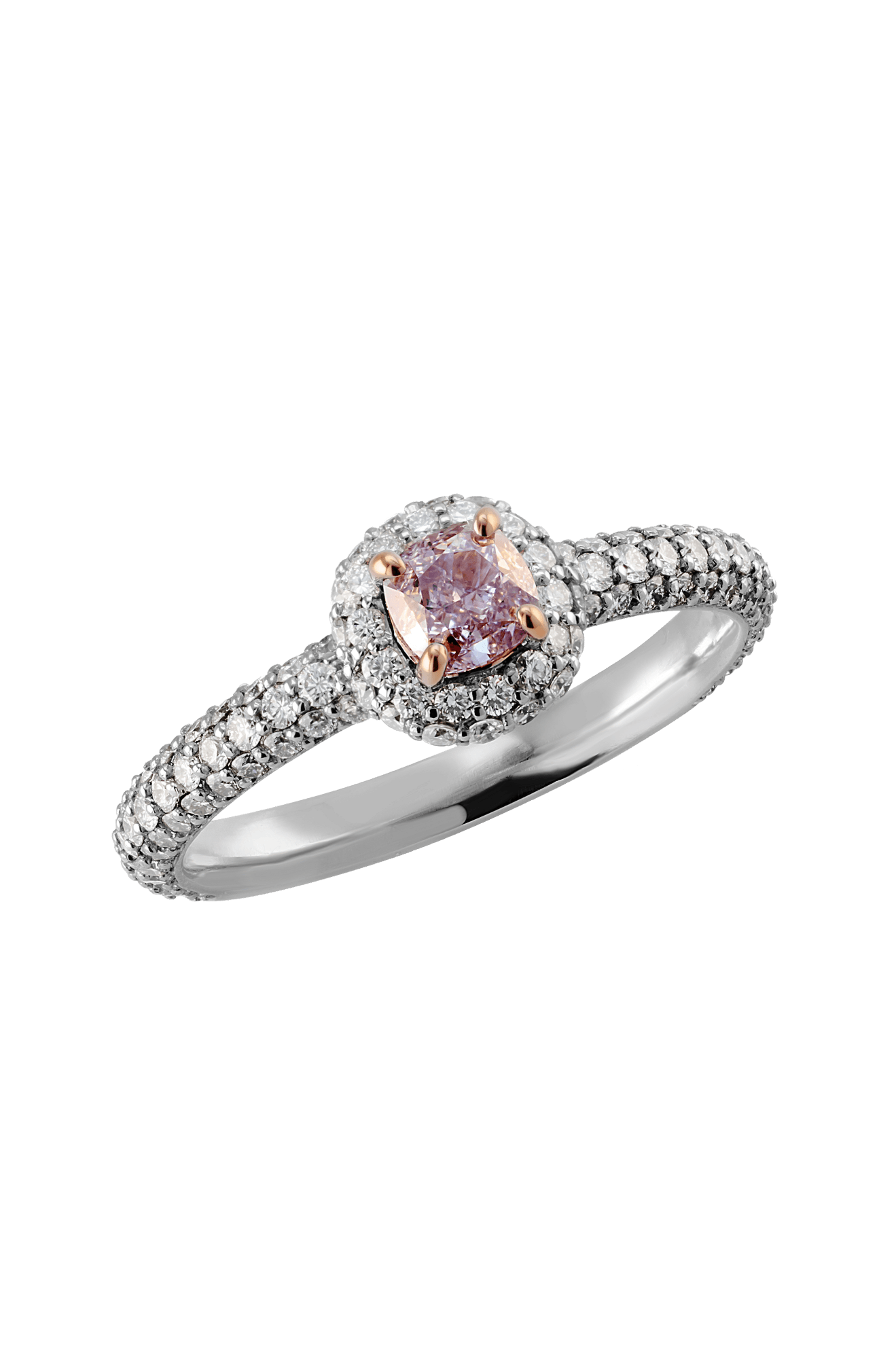
Both are suitable as collector's stones, but for different reasons. With a hardness of 10, the Fancy Pink Diamond is the more robust ring stone, and its rarity depends on the saturation of its color. Paraíba tourmaline offers a vivid blue to green caused by copper, but with a hardness of 7 to 7.5 it is more delicate and needs a protective setting in a ring.
At a glance
- Mineral
- Paraíba: copper-bearing tourmaline. Fancy Pink: diamond made of carbon
- Cause of color
- Paraíba: copper and manganese. Pink diamond: according to GIA probably distortion of the crystal lattice
- Mohs hardness
- Paraíba tourmaline 7 to 7.5, diamond 10
- Color grades
- For pink diamonds per GIA from Faint to Fancy Deep, most sought after Fancy Intense and Fancy Vivid
- Size
- Paraíba over one carat rare according to GIA. Pink diamonds mostly small or pale
- Treatment
- Paraíba frequently heated. Pink diamonds sometimes irradiated, heated or HPHT treated
Two collector's stones of opposite character
A collector's stone is sought for a property that is rare. With Paraíba tourmaline it is the color: a blue, bluish green or green that, according to SSEF, is caused mainly by copper and manganese and seems to glow from within. With the pink diamond it is also the color, but in a material that is already regarded as the hardest gemstone. What links the two stones is therefore color as the carrier of value, not mineralogy.
This leads to two different ways of thinking about a ring. A pink diamond stands for permanence and a color that rarely occurs in strong saturation. A Paraíba tourmaline stands for a color effect that no other stone shows in the same way, but in return it requires more care when worn. Which of these properties matters more to you will in the end be more decisive than any market consideration.
Both stones by the same criteria
| Criterion | Paraíba tourmaline | Fancy Pink Diamond |
|---|---|---|
| Color | Blue, violet, bluish green to green, caused by copper | Pink in many gradations, often with purple or brown |
| Value-determining | Color before size, according to GIA | Saturation of color, Fancy Intense and Vivid highest |
| Mohs hardness | 7 to 7.5, toughness fair according to GIA | 10, but cleavage in certain directions |
| Usual treatment | Heating common, sometimes filling of fissures | Irradiation and heating or HPHT in some stones |
| Origin | Brazil, Nigeria, Mozambique | Argyle in Australia until 2020, also Brazil, South Africa, Russia |
| Report | Identification, origin on request | Colored diamond report stating the origin of color |
Comparison based on information from GIA and SSEF. The assessment of an individual stone depends on its report and its color.
The table shows that both stones are assessed similarly on color but differ greatly in durability and treatment. For diamonds, GIA grades color by hue, tone and saturation and assigns grades such as Fancy Intense or Fancy Vivid. For tourmaline there is no such scale. There, a laboratory describes the color in words, and SSEF explicitly avoids trade terms such as neon.

What makes the pink diamond rare
According to GIA, most pink diamonds are small, only weakly colored or noticeably included. Stones with strong color, high clarity and good size are very rare. An important source was the Argyle mine in Western Australia, which closed in 2020. According to GIA, pink stones made up less than one percent of the more than 800 million carats mined there. Since the closure, supply has become even scarcer.
According to current knowledge, the color of pink diamonds is probably caused by a distortion of the crystal lattice that specialists call plastic deformation. Some stones show pink graining inside as a result. GIA grades the color from Faint to Fancy Deep. Most sought after are Fancy Intense and Fancy Vivid. If the saturation is very high and the tone deep enough, the grade is Fancy Red, an even rarer color. More on classification under Colored Diamonds.
What makes Paraíba tourmaline rare
With Paraíba tourmaline, rarity lies in the combination of copper and size. GIA writes that it is seen only rarely in sizes over one carat and emphasizes that with Paraíba, color determines value, not size. Because the rough material is so valuable, the stones are almost always cut individually according to the crystal, mostly as pear or oval. According to GIA, blue and violet are most in demand.
The stone was discovered in the late 1980s in the Brazilian state of Paraíba. Later came finds in the neighboring state of Rio Grande do Norte, and at the beginning of the 21st century also in Nigeria and Mozambique. For a collector, origin therefore often counts as well. The laboratories assign the name differently: according to the harmonization body LMHC, a matching copper-bearing tourmaline is called Paraíba regardless of the source country, while SSEF uses the name in its report only for Brazilian stones.
Hardness and everyday life in a ring
A ring is the most heavily stressed piece of jewelry. With a hardness of 10, the diamond stands at the top of the Mohs scale and practically does not scratch in everyday life. It is nevertheless not indestructible: according to GIA, a hard blow along its cleavage directions can split it, including during setting. Tourmaline lies at 7 to 7.5, and GIA rates its toughness as fair. The steps of the Mohs scale are unequal in size, so the gap to diamond is considerable.

For Paraíba tourmaline in a ring, this means that a setting enclosing edges and points with metal is more than a stylistic device. The ring should be taken off during sports and rough work. Heat is a further factor. High heat can alter the color of tourmaline, and a rapid change in temperature can cause fractures. For repairs, the workshop must know this. Which settings have proven themselves is described in the guide on Setting Paraíba Tourmaline.
Treatment and report
For both stones, an independent report belongs with a collector's stone. At GIA, the pink diamond receives a colored diamond report that grades the color and states whether it is natural. This matters because some pale or brownish diamonds are irradiated and heated to look pink, and some brownish pink stones are lightened by HPHT, meaning high pressure and high temperature. According to GIA, treated stones are worth less than untreated ones. At Vikar Ahmed, every diamond center stone from 0.50 carat comes with an independent original certificate, and diamonds are graded there almost exclusively by GIA.
In Paraíba tourmaline, heating is common according to SSEF and LMHC and cannot always be detected. In such cases SSEF states explicitly that heating currently cannot be determined. Fissures are sometimes filled with resin, which must be disclosed under the rules of the World Jewellery Confederation (CIBJO). An identification report names detectable treatments, an origin report additionally the country. Whether a tourmaline is untreated, however, a report cannot reliably confirm.
Color, metal and cut in the ring
Both stones respond to the metal around them. For pink diamonds, GIA names warm metals such as rose or yellow gold for pale to medium tones and white metals for strongly saturated stones. A halo of colorless diamonds can make the pink look lighter. According to GIA, oval, pear, radiant and cushion cuts show the color more strongly than the round brilliant, because they retain more color in the stone.
With Paraíba tourmaline, the metal serves above all the blue. White gold and platinum keep the color cool and clear, and colorless diamonds frame it without competing with it. Because tourmaline is strongly pleochroic, meaning it shows different colors depending on the viewing direction, the cutter deliberately orients the table to the crystal axis. How cut and color effect come together in Paraíba is shown in the guide Paraíba Cut.
Which suits whom
The Fancy Pink Diamond suits collectors who wear a ring every day and are looking for a stone that will last for generations. Its rarity is tied to clear color grades and is easy to trace through a report. Anyone choosing this path should pay attention to the statement of natural color. A detailed look at the pink diamond in a ring is offered by the guide Fancy Pink Diamond Ring.
Paraíba tourmaline suits collectors who are looking for a color that is instantly recognizable and who are prepared to wear the ring with care. It is particularly suited to a ring for special occasions or to a piece in which a protective setting is part of the design. Anyone torn between Paraíba and a colorless diamond will find a separate comparison under Paraíba Tourmaline or Diamond in an Engagement Ring.
Frequently asked questions
Paraíba tourmaline or Fancy Pink Diamond as a collector's stone for a ring?
Both are possible, and the choice depends on how the ring will be worn. With a hardness of 10, the pink diamond is the more robust ring stone and can be clearly classified through color grades. Paraíba tourmaline shows a color no other stone has, but with a hardness of 7 to 7.5 it needs a protective setting and more care in everyday life.
Where does the color of a pink diamond come from?
According to GIA, it is probably caused by a plastic deformation of the crystal lattice that influences how light passes through the stone. Some pink diamonds show fine pink graining inside as a result. Unlike in yellow diamonds, the cause is therefore not a foreign element such as nitrogen.
What color grades are there for pink diamonds?
GIA grades pink diamonds on a scale from Faint to Fancy Deep. The rarest and most sought after are Fancy Intense and Fancy Vivid. If the saturation is very high and the tone deep enough, the stone is graded Fancy Red, which occurs even more rarely.
Can a laboratory prove that a Paraíba tourmaline was not heated?
Not always. Heating is common in Paraíba tourmaline, and according to GIA the changes in tourmaline are stable and undetectable. In its report, SSEF notes whether there are indications of heating, no indications, or whether this currently cannot be determined.
Why has the supply of pink diamonds become scarcer?
Because the Argyle mine in Western Australia, an important source, closed in 2020. Even there, according to GIA, pink stones made up less than one percent of production. Pink diamonds also come from countries such as Brazil, South Africa and Russia, but stones with strong color and good size remain an exception.
Which of the two stones is more delicate in a ring?
Paraíba tourmaline. It has a hardness of 7 to 7.5 and fair toughness, so it scratches more easily and withstands blows less well. Heat and rapid temperature changes can also harm it. Diamond is harder, but it too can break along its cleavage directions from a hard blow.
Private consultation
Whether a pink diamond or a Paraíba tourmaline should form the center of your ring is best decided with both colors before your eyes. Vikar Ahmed advises in the showroom in Idar-Oberstein by appointment or in a virtual appointment, and Paraíba tourmaline is the heart of the Maison. Request a private consultation.
Further reading
- Guide: Fancy Pink Diamond Ring
- Guide: Colored diamonds
- Paraíba tourmaline or Fancy Yellow Diamond
- Glossary: Fancy Color Diamond
- Gemstone: Paraíba tourmaline
Sources
- GIA 4Cs: Pink Diamond Engagement Ring Buying Guide, accessed 2026-11-17
- GIA: Fancy Color Diamond Quality Factors, accessed 2026-11-17
- GIA 4Cs: Yellow Diamond Buying Guide, accessed 2026-11-17
- GIA Gems & Gemology: Natural-Color Pink, Purple, Red, and Brown Diamonds, accessed 2026-11-17
- GIA: Tourmaline Quality Factors, accessed 2026-11-17
- GIA: Tourmaline Care and Cleaning, accessed 2026-11-17
- GIA: Diamond Care and Cleaning, accessed 2026-11-17
- SSEF: Paraiba Tourmaline, accessed 2026-11-17
- SSEF: Fissure-filling in Paraiba Tourmaline, accessed 2026-11-17
- LMHC Information Sheet 6: Paraiba Tourmaline, accessed 2026-11-17
- GIA Gems & Gemology: Paraíba Tourmaline Geographic Origin Determination, accessed 2026-11-17

A personal conversation starts here.
At the showroom in Idar-Oberstein or by video. Vikar Ahmed discusses your ideas, stones and designs with you and answers your questions calmly and in confidence.


Thank you for your request.
Your request will be handled with the utmost attention and discretion. Vikar Ahmed will get back to you.
Your details
Request
–
Occasion
–
Consultation
–
Contact
–
In the meantime
Insights: What is a Paraíba tourmaline? · Engagement ring to your own design: how does it work?
Confidential and without obligation
Back to the pagePrivate consultation
A personal conversation starts here.
- Time for your questions, wishes and ideas
- In the showroom in Idar-Oberstein or by video
- Confidential, discreet and without obligation
Vikar Ahmed · Hauptstraße 111 · 55743 Idar-Oberstein, Germany