

Which Setting Protects a Rubellite?
A rubellite is hard enough for jewelry, but not insensitive. How the setting protects it and which metal suits it determine how well it lasts in a ring.

A rubellite is best protected by a setting that encloses its edges and corners: a bezel, a half bezel, or V-shaped prongs at the points. The stone has a hardness of 7 to 7.5, but its toughness is rated only as fair. 18k (750) white gold and platinum are both suitable. Platinum wears more slowly, white gold occasionally needs new rhodium plating.
At a glance
- Mohs hardness
- 7 to 7.5, like all tourmalines
- Toughness
- Rated as fair by GIA
- Best edge protection
- Bezel or half bezel, V-shaped prongs at points
- Heat
- Can damage the stone, sudden temperature changes can cause it to crack
- Cleaning
- Warm soapy water, no ultrasonic, no steam
- Metal
- 18k (750) white gold with rhodium plating or platinum without coating
What the setting has to achieve for a rubellite
A rubellite is a red to pink tourmaline. At 7 to 7.5 on the Mohs scale, it is harder than quartz and therefore largely resistant to everyday dust. Hardness, however, describes only resistance to scratches. Against knocks, toughness is what counts, and the Gemological Institute of America, GIA for short, rates the toughness of tourmaline only as fair. A hard blow to an edge can chip the stone.
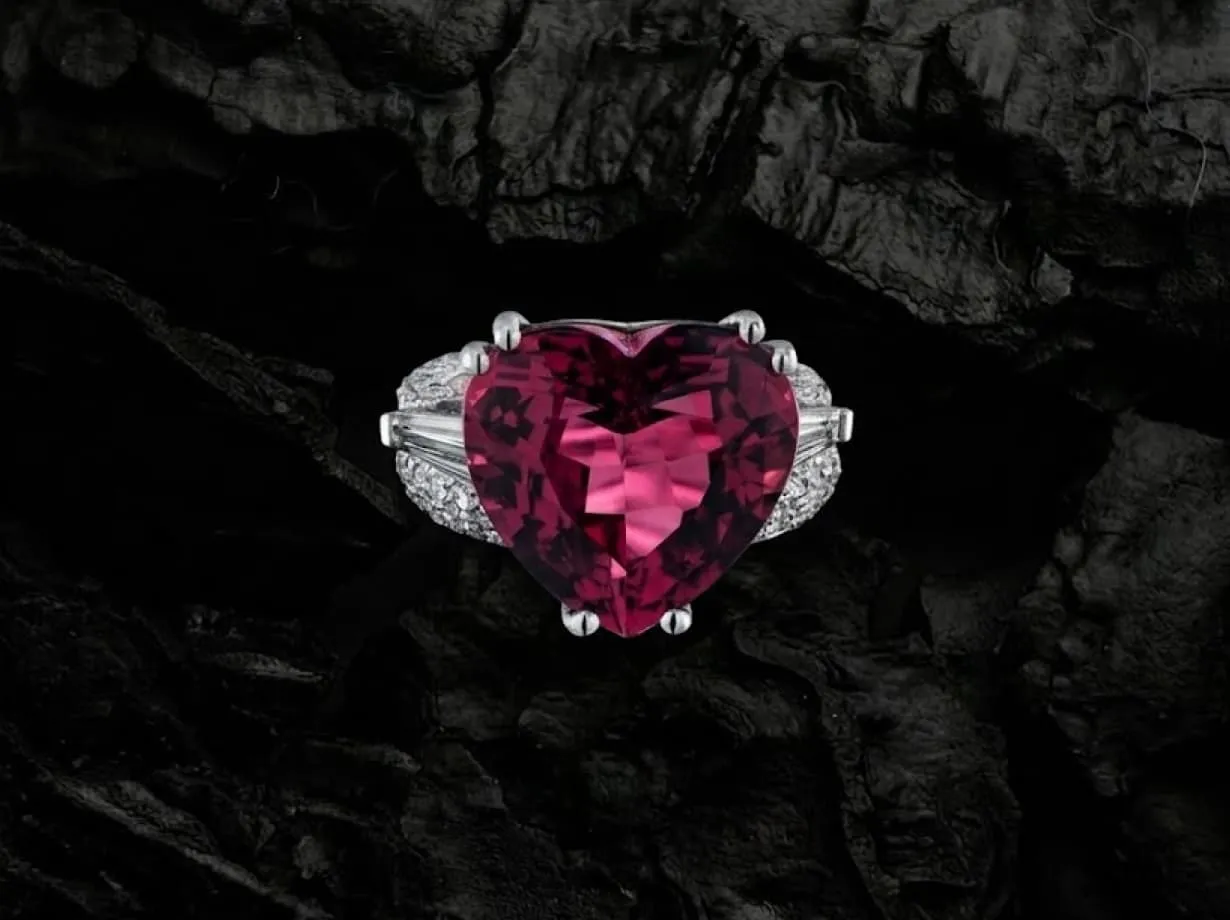
This defines the task of the setting. It should hold the stone securely, cover the vulnerable areas and still leave enough of it open for its color to show. The most vulnerable parts are the girdle, meaning the edge between the upper and lower part, as well as corners and points. According to GIA, thin girdles and pointed ends, as in pear shapes and marquises, are particularly susceptible. How strong the protection must be depends on where the piece is worn.
A ring is most at risk, because the hand constantly knocks against table edges, doors and bags. According to GIA, earrings and necklaces carry a lower risk of such blows. A rubellite in a pendant may therefore be set more openly than the same stone in a ring. Anyone who wishes to wear a ring every day plans the setting for protection first and for appearance second.
Bezel, half bezel or prongs compared
The bezel is a closed metal rim that surrounds the stone on all sides. GIA describes it as a setting with very good protection for the edges that rarely catches on clothing. It lets somewhat less light into the stone than a prong setting. With a strongly colored rubellite, this matters less than with a light stone, whose liveliness depends more on incoming light.
The half bezel protects only two opposite sides and leaves the others open. It is a compromise between protection and light. The prong setting holds the stone with individual metal claws and shows the most of it. For rubellites with corners or points, GIA recommends V-shaped prongs that enclose the vulnerable points. A basket with horizontal connections additionally supports the prongs and prevents them from bending open over the years.
| Setting | Edge protection | Light | Suited to |
|---|---|---|---|
| Bezel | Very good, closed all around | Somewhat lower | Rings for daily wear |
| Half bezel | Good on two sides | Medium | Oval and elongated stones in rings |
| Prongs with V-tips | Good at corners and points | High | Emerald cut, pear, marquise |
| Round prongs | Lower, edges are exposed | High | Pendants, earrings, necklaces |
| Tension setting | Low, stone is exposed | High | According to GIA, better suited to hard stones such as diamond |
Classification based on GIA information on ring settings. The details of the execution also determine how well a setting protects.
18k white gold or platinum
Both metals are suitable for a rubellite, but they age differently. 18k (750) gold consists of 75 percent fine gold. According to the World Gold Council, white gold is created when gold is alloyed with white metals such as palladium or silver. As a rule, it receives rhodium plating, a thin layer of rhodium that makes the surface harder and brighter. This layer wears off and, according to GIA, must be renewed every few years.
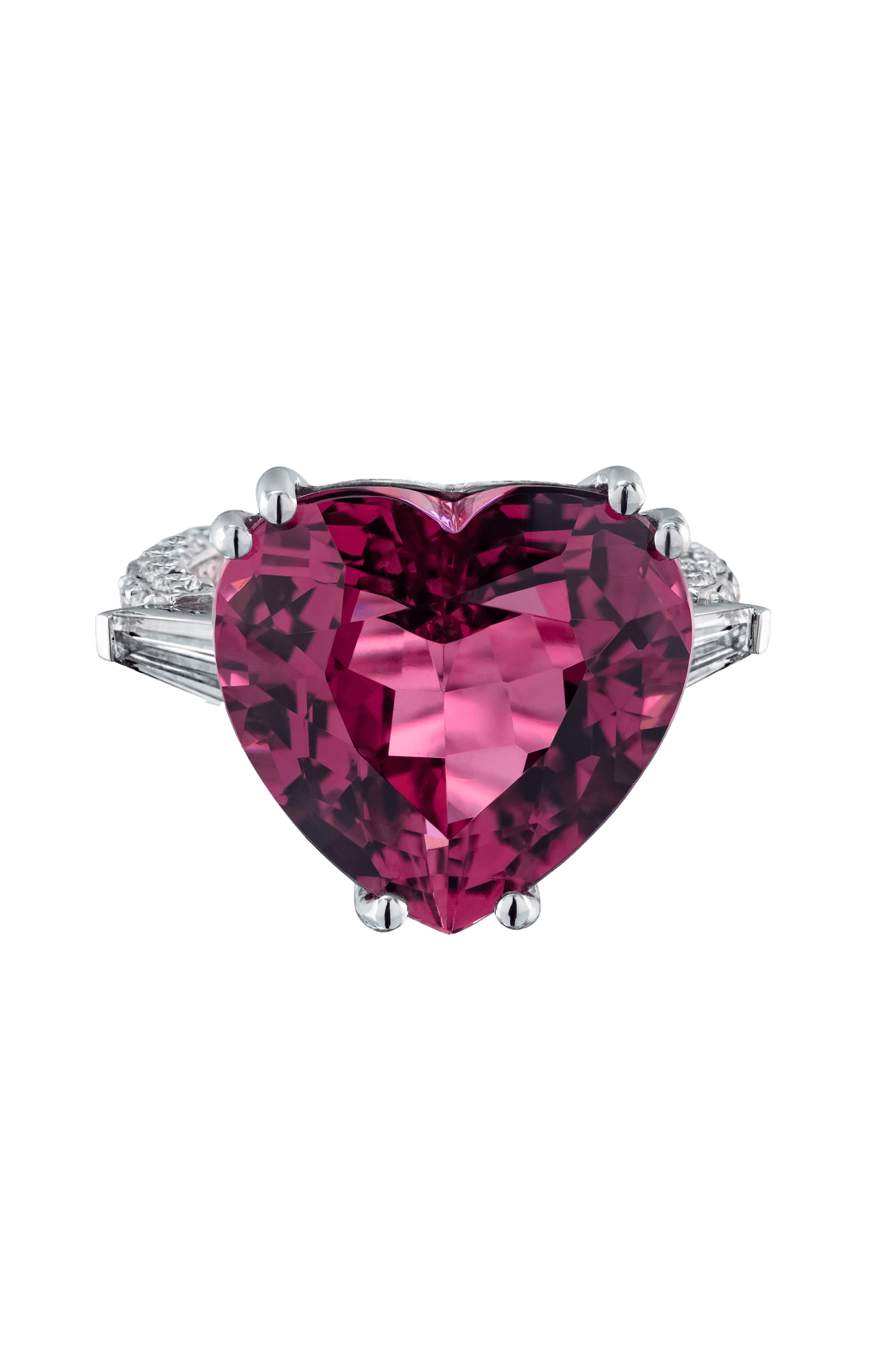
Platinum is naturally white and needs no coating. GIA describes it as very resistant to wear: over decades it loses hardly any shape or substance. Over time, a matte patina forms, which can be polished away if desired. For prongs that are to hold a stone over many years, this stability of form is an argument. It is not an argument against white gold, as long as the setting is checked regularly.
Besides durability, the effect matters. A white metal makes red and pink appear cool and clear. Rose gold blends with warm pink tones and makes the ring appear softer overall. There is no fixed rule, and the decision is best made with the stone in hand. In Germany, a stamped fineness on jewelry must be stated in parts per thousand, and under the German Hallmarking Act (Feingehaltsgesetz) the seller is liable for its accuracy.
Heat, ultrasonic cleaning and work at the bench
Tourmaline tolerates light and chemicals well, but not heat. GIA points out that heat can damage a tourmaline and change its color, and that sudden temperature changes can lead to cracks. For the workshop, this means that soldering near the stone is done before setting wherever possible. If a set rubellite has to be soldered later, for instance when resizing the ring, it is usually removed from the setting beforehand.
Care is also needed when cleaning. GIA does not recommend ultrasonic and steam cleaners, routine in many workshops, for tourmaline. Warm soapy water with a soft brush is best. For stones whose color has been altered by irradiation, there is a further point: according to GIA, such colors can fade under heat or strong light. Whether a stone is treated is clarified by a laboratory report, more on this under treatment.
Good to know
If you take a ring with a rubellite in for resizing or refurbishment, name the stone explicitly. A rubellite resembles a ruby, but at the bench it requires different handling.
Cut and orientation also determine the setting
Tourmalines grow in long crystals. According to GIA, cutters often form long rectangles from them in order to lose little material. Many stones therefore have no standard dimensions. A prefabricated setting from a catalog rarely fits exactly. With a rubellite, the setting is usually built around the individual stone so that every prong or bezel sits snugly. Gaps between metal and stone are places where a knock arrives unchecked.
Tourmaline is also strongly pleochroic: it shows different color tones depending on the viewing direction. Cutters orient the table so that the desired depth of color appears. The setting should respect this orientation and hold the stone as it was cut. Placing a rubellite crosswise rather than lengthwise on the ring shank changes not only the shape on the finger, but also which side of the stone is most often exposed to knocks.
Inclusions also play a part. According to GIA, visible inclusions in red tourmalines are accepted if the color is strong. If they reach the surface, however, they weaken that spot. A good workshop checks where such features lie before the design and does not place prongs directly on them. You can read more about assessing inclusions under Clarity in rubellite.
Typical mistakes when setting a rubellite
- Looking only at hardness: it is the setting, not the hardness, that protects against knocks.
- Leaving points and corners exposed: pear, marquise and emerald cut need V-prongs or a bezel there.
- Using a standard setting that does not sit snugly against the stone.
- Having the ring soldered with the stone set, without telling the workshop about the tourmaline.
- Cleaning in an ultrasonic bath because it is common for diamond rings.
- Not having prongs checked for years: bent prongs expose the edges.
Almost all of these mistakes arise because a rubellite is treated like a diamond. Diamond has a hardness of 10 and is more forgiving in cleaning and setting. How the two red stones otherwise differ is shown in the comparison Rubellite or pink diamond. General principles for large colored gemstones can be found in the guide Setting large colored gemstones correctly.
Rubellite in the in-house atelier of Vikar Ahmed
Rubellite is among the stones Vikar Ahmed works with in the pieces it shows, alongside Paraíba tourmaline, Lagoon tourmaline, Namibian tourmaline and Colombian emerald. The house works with 18k (750) gold in white, rose, and yellow as well as platinum 950, and Vikar Ahmed decides on metal and alloy together with you in the consultation. With rubellite, Vikar Ahmed accepts fine inclusions as long as they do not dull the brilliance of the color. The design follows three steps: design, three-dimensional visualization with CAD, and realization as a one-of-a-kind piece in the in-house atelier.
In the visualization, it is possible to check before production how a bezel or prong encloses the stone and how high it sits above the hand. The setting of the stones and the hand polishing are carried out by goldsmiths from Idar-Oberstein with decades of experience. How the path from design to finished ring unfolds is described on the Bespoke page. There is a separate guide on rubellite in engagement rings: Rubellite in an engagement ring.
Frequently asked questions
Which ateliers offer rubellite rings with a protective setting in 18k white gold or platinum?
What matters is an atelier that builds the setting around the individual stone and protects its edges with a bezel or V-prongs. Vikar Ahmed works with rubellite and crafts in 18k (750) white gold as one-of-a-kind pieces in its in-house atelier in Idar-Oberstein. Besides 18k (750) gold in white, rose, and yellow, the house also works with platinum 950.
Is a rubellite hard enough for a ring worn every day?
Yes, with the right setting. At 7 to 7.5 on the Mohs scale, it resists scratches from dust. Its toughness, however, is only fair, and a hard blow can chip its edges. A bezel or half bezel, and taking the ring off for rough work, significantly reduce this risk.
Does platinum hold a rubellite more securely than white gold?
Platinum retains its shape particularly well over decades, and prongs wear more slowly. Both metals hold securely, however, if the setting is well made and checked regularly. White gold additionally needs new rhodium plating from time to time to stay bright.
May a ring with a rubellite be cleaned in an ultrasonic bath?
No. GIA advises against ultrasonic and steam cleaners for tourmaline. The gentlest method is warm soapy water with a soft brush, then rinsing with clear water and drying with a lint-free cloth. For professional cleaning, you should explicitly identify the stone as a tourmaline.
What happens to a rubellite when the ring is enlarged?
Resizing a ring usually involves soldering. Heat can damage a tourmaline or change its color, and a sudden temperature change can cause it to crack. The stone is therefore usually removed from the setting before such work and reset afterwards. Ask in advance how the workshop proceeds.
Which setting suits an emerald-cut rubellite?
A setting that protects the four beveled corners: V-shaped prongs at each corner or a bezel all around. The emerald cut is a step cut with a large table that shows the color openly. That is precisely why it is worth securing the corners well as the most sensitive points.
Private consultation
Which setting suits your rubellite and your everyday life is best clarified with the stone at hand. Vikar Ahmed advises in the showroom in Idar-Oberstein by appointment, and on request also in a virtual appointment. Request an appointment for a private consultation.
Further reading
- Gemstone: Rubellite
- Glossary: Prong setting
- Setting large colored gemstones correctly
- Having an existing rubellite set
- Rubellite in an engagement ring
Sources
- GIA: Tourmaline Care and Cleaning Guide, accessed 2026-11-17
- GIA: Tourmaline Description, accessed 2026-11-17
- GIA: Tourmaline Quality Factors, accessed 2026-11-17
- GIA 4Cs: Gem Durability, more than the Mohs Scale, accessed 2026-11-17
- GIA 4Cs: Complete Guide to Engagement Ring Settings, accessed 2026-11-17
- GIA 4Cs: Best Ring Material for Everyday Wear, accessed 2026-11-17
- World Gold Council: Gold Jewellery, Colour, Carat and Purity, accessed 2026-11-17
- Gesetz über den Feingehalt der Gold- und Silberwaren, accessed 2026-11-17
- Vikar Ahmed: Collections, accessed 2026-11-16
- Vikar Ahmed: Bespoke, Designprozess, accessed 2026-11-16
A personal conversation starts here.
At the showroom in Idar-Oberstein or by video. Vikar Ahmed discusses your ideas, stones and designs with you and answers your questions calmly and in confidence.





Thank you for your request.
Your request will be handled with the utmost attention and discretion. Vikar Ahmed will get back to you.
Your details
Request
–
Occasion
–
Consultation
–
Contact
–
In the meantime
Insights: What is a Paraíba tourmaline? · Engagement ring to your own design: how does it work?
Confidential and without obligation
Back to the pagePrivate consultation
A personal conversation starts here.
- Time for your questions, wishes and ideas
- In the showroom in Idar-Oberstein or by video
- Confidential, discreet and without obligation
Vikar Ahmed · Hauptstraße 111 · 55743 Idar-Oberstein, Germany