

How Important Is Clarity in Rubellite?
Rubellites are among the tourmalines in which inclusions are almost always part of the picture. Which of them are harmless and which weaken the stone.
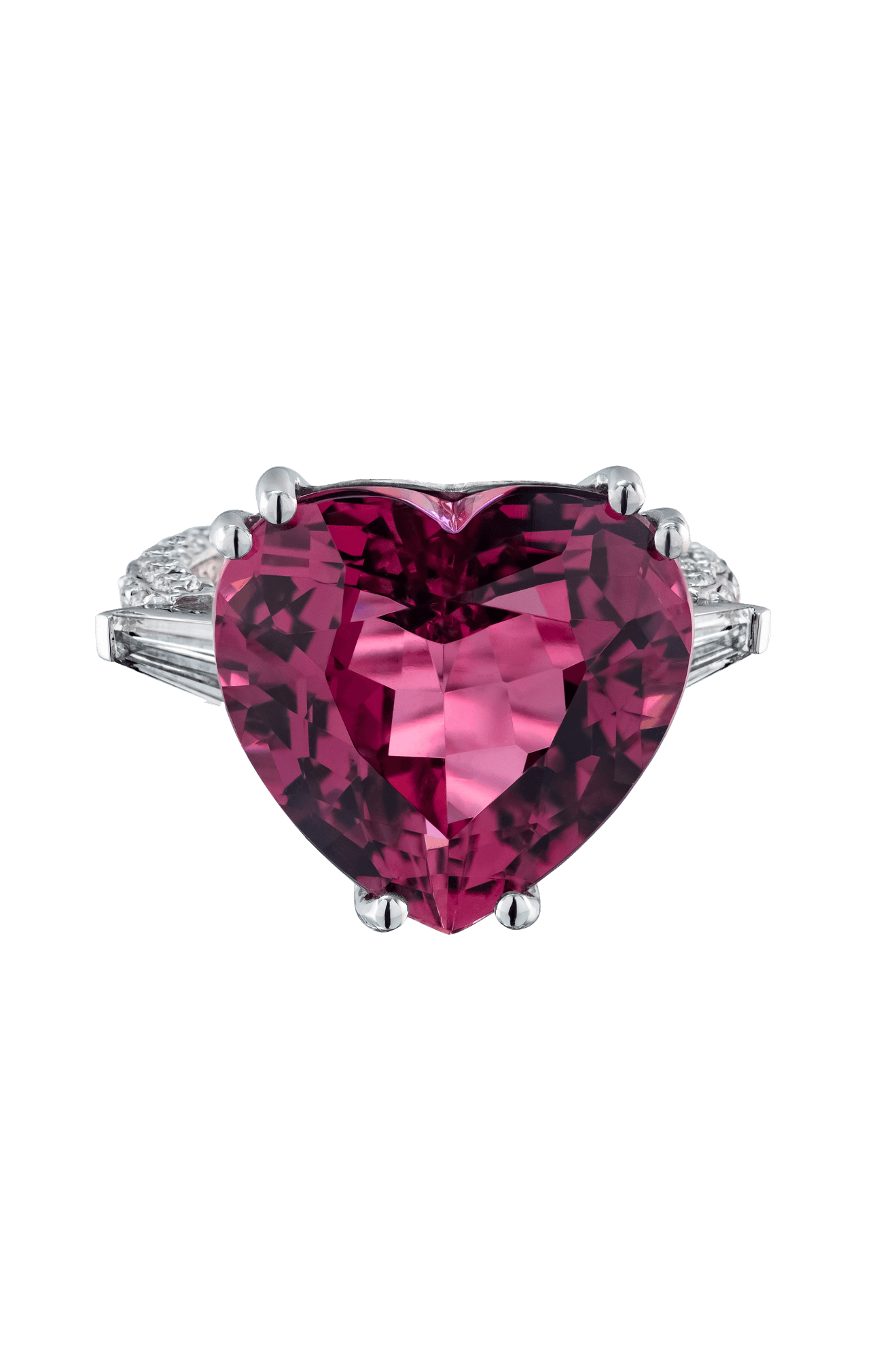
In rubellite, color determines the value, and clarity comes second. Inclusions visible to the naked eye are accepted in the trade when the color is strong. Whitish, conspicuous inclusions and fractures that reach the surface are critical. There is no clarity grade as for diamonds, so the assessment is made on the stone itself.
At a glance
- Most important value factor
- Color, not clarity
- Visible inclusions
- Accepted in the trade when color is strong (GIA)
- Typical inclusions
- Thread-like cavities parallel to the long axis of the crystal
- Critical
- Whitish, conspicuous inclusions and fractures reaching the surface
- Clarity grade in the report
- None, GIA describes tourmaline but does not grade it
- Toughness
- Rated as fair by GIA, hardness 7 to 7.5
In rubellite, color comes first
Rubellite is the trade name for tourmaline in pink, red, purplish red, orangy red, or brownish red. As with most colored gemstones, color determines the value. The Gemological Institute of America, GIA for short, describes a clear position in the trade: red tourmalines with some visible inclusions are accepted as long as the color is strong and beautiful. An almost clean stone with a pale or overly dark color ranks behind it.
For green tourmalines, by contrast, the trade expects stones without visible inclusions. The trade therefore applies different standards to the two colors. A requirement that is taken for granted with green tourmaline does not apply to rubellite. Anyone who transfers the clarity standards of diamonds to a rubellite is therefore looking for a stone that exists only in exceptional cases. More about the stone itself can be found in the glossary under rubellite.
Which inclusions are typical
According to GIA, the most common inclusions in tourmaline are thread-like cavities that run parallel to the long axis of the crystal. They form when liquid is trapped during growth. In a faceted rubellite they appear as fine lines or veil-like areas. If they lie at the side and are fine, they hardly disturb the color. If they lie just beneath the table, the large facet on top, they are immediately noticeable.

Not every inclusion should be assessed the same way. GIA names two types that clearly lower the value: inclusions that reach the surface, because they impair luster and polish, and conspicuous whitish inclusions, which make a stone unattractive regardless of its color. As a general rule, the more visible the inclusions, the more the value falls. A rubellite without visible inclusions is more valuable than one with inclusions of the same color.
A rough classification for practice
- Harmless: fine, thread-like inclusions at the edge that can only be found with a loupe.
- Acceptable: individual inclusions that are barely noticeable from a normal distance.
- Value-reducing: whitish areas that lighten the color or make the stone look cloudy.
- Risky: fractures that reach the surface, especially at corners and points.
Why the report does not state a clarity grade
For diamonds, there is a clarity scale with fixed grades from Flawless to I3. For tourmaline, nothing of the kind exists in the laboratory report. GIA states explicitly that it evaluates tourmaline but does not grade it. An identification report confirms that the stone is tourmaline, describes it, and names detectable treatments. It contains no statement on whether the clarity is good or moderate.
The report is nevertheless important for clarity, namely because of treatments. According to GIA, resins and glasses can be used in any durable gemstone with fractures reaching the surface to make them less visible. Tourmaline is explicitly named. A rubellite that looks surprisingly clean should therefore have a report that rules out or discloses such a filling. The guide on untreated rubellite explains more about treatments.
Weighing size against clarity
The choice between a large rubellite with visible inclusions and a smaller, cleaner stone cannot be decided across the board. What is clear: according to GIA, the price per carat of larger cut tourmalines rises considerably, especially above five carats. A large stone is therefore more expensive not only in total but also per carat. Inclusions lower this value again, depending on how visible they are and where they lie.
It helps to ask how the piece will be worn. In a ring, the stone is seen at close range and from above, and inclusions beneath the table are noticeable there. On a necklace or earring, the stone is seen from a distance, and smaller inclusions recede. More important than the mere number of inclusions is whether one of them endangers durability. A fracture at a corner weighs more heavily than three fine threads in the center.
| Criterion | Larger with inclusions | Smaller and cleaner |
|---|---|---|
| Effect from a distance | Strong, color carries far | More restrained |
| Effect at close range | Inclusions may be noticeable | Clear and calm |
| Durability | Depends on position and type of inclusions | Generally fewer weak points |
| Suitable for | Necklace, pendant, earrings | Ring, pieces worn daily |
| What to look for | No fractures at corners, no whitish areas | Do not sacrifice color for clarity |
Rough orientation. With the same color, the individual stone always decides.
Inclusions and durability
Tourmaline has a hardness of 7 to 7.5 on the Mohs scale, which makes it scratch-resistant enough for jewelry. GIA, however, rates its toughness, meaning its resistance to knocks, as only fair. Inclusions can increase this weakness when they lie in the stone as lines of stress. Heat is another risk: according to GIA, sudden temperature changes can cause a tourmaline to fracture.

For everyday wear, this means: do not clean a rubellite with many inclusions in an ultrasonic or steam device, since GIA advises against both for tourmaline. Lukewarm soapy water and a soft brush are sufficient. In the setting, corners and points should be protected, especially if an inclusion lies there. The guide Which setting protects a rubellite? describes suitable settings.
How to assess clarity yourself
- First look at the stone from normal wearing distance, not straight away under the loupe.
- Check under daylight and warm artificial light whether inclusions lighten the color.
- Use a 10x loupe to locate the inclusions: center, edge, corners.
- Examine the surface in raking light: fractures show up there as fine lines.
- Read the report: species, treatments, indications of fillings.
The order is deliberate. Anyone who starts with the loupe sees inclusions that no one notices when the piece is worn, and underestimates the color in the process. Anyone who only looks from a distance overlooks a fracture at the edge. Only the combination produces a judgment. It helps to place two stones side by side: the difference in color is then often greater than the difference in clarity.
Typical mistakes regarding clarity
The most common mistake is to assess a rubellite like a diamond and sacrifice color for clarity. A pale, very clean stone looks weaker in jewelry than a strongly colored stone with fine inclusions. A second mistake is the opposite: ignoring inclusions entirely because they are considered normal in rubellite. Whitish areas and fractures at the surface are a real flaw in rubellite as well.
A third mistake concerns stones that look unusually clean and strongly colored for their size. They are possible, but rare. Without a report, it cannot be ruled out that fractures have been filled. Finally, the position in the piece of jewelry is often forgotten: the same stone can look flawless in a necklace and distracting in a ring. The guide on the rubellite necklace describes how stones are shown to advantage in a necklace.
Considering clarity in the design
Rubellites are among the stones that Vikar Ahmed works with in the house's pieces. A piece of jewelry is created at the house from the design through a three-dimensional visualization to realization as a one-of-a-kind piece in the in-house atelier. Where a stone has inclusions can already be taken into account in the design: the setting can protect a corner, the cut can be positioned differently in the ring. Vikar Ahmed accepts fine inclusions in rubellite as long as they do not dull the brilliance of the color. The house discloses every treatment openly, in the consultation and in writing on the certificate and invoice.
Frequently asked questions
A large rubellite with visible inclusions or a smaller one with better clarity: which is the wiser choice?
That depends on color and use. With an equally beautiful color, the larger stone is often the better choice for a necklace or earrings, as long as there are no whitish areas or fractures at the surface. For a ring that is seen at close range, the cleaner stone is usually more convincing.
Is there a clarity scale for rubellites as there is for diamonds?
No. Laboratory reports for tourmaline do not state a clarity grade. GIA evaluates tourmaline but does not classify it into grades. The report confirms the species and names detectable treatments. Clarity is assessed on the stone itself, with the naked eye and under the loupe.
Is a rubellite without visible inclusions rare?
It is the exception. The trade accepts visible inclusions in red tourmaline, while it does not accept them in green tourmaline. According to GIA, a rubellite without visible inclusions and with strong color is more valuable than one with inclusions. With a conspicuously clean stone, it is worth looking at the report.
Which inclusions make a rubellite delicate?
Above all, fractures that reach the surface, and inclusions at corners or points. They can spread further with a knock or sudden heat. Fine, thread-like inclusions in the interior are generally harmless. A protective setting reduces the risk at exposed spots.
Can inclusions in rubellite be filled?
Yes, that is possible. According to GIA, resins and glasses can be used in tourmaline to make fractures reaching the surface less visible. Such a filling must be disclosed. An identification report names the detectable treatments.
May a rubellite with inclusions be cleaned in an ultrasonic bath?
No. GIA generally advises against ultrasonic and steam cleaners for tourmaline. In stones with inclusions, the risk of a fracture is greater. Lukewarm soapy water and a soft brush are sufficient for care. Afterward, rinse with clear water and dry.
Private consultation
How much clarity a rubellite needs for your piece is best clarified with the stone in hand and with a view to the design. Vikar Ahmed advises in the showroom in Idar-Oberstein by appointment, and virtually on request. Your inquiry is treated discreetly. Request an appointment for a private consultation.
Further reading
- Glossary: Rubellite
- Gemstone: Rubellite
- Untreated rubellite: what can be documented
- Which setting protects a rubellite?
- Which cut suits rubellite?
Sources
- GIA: Tourmaline Quality Factors, accessed 2026-11-17
- GIA: Tourmaline Description, accessed 2026-11-17
- GIA: Tourmaline Buyer's Guide, accessed 2026-11-17
- GIA: Tourmaline Care and Cleaning, accessed 2026-11-17
- GIA: Gem Treatments, accessed 2026-11-17
- GIA: Tourmaline, Quick Facts, accessed 2026-11-17
- Vikar Ahmed: Collections, accessed 2026-11-16
- CIBJO: Introduction to the Blue Books, accessed 2026-11-17

A personal conversation starts here.
At the showroom in Idar-Oberstein or by video. Vikar Ahmed discusses your ideas, stones and designs with you and answers your questions calmly and in confidence.


Thank you for your request.
Your request will be handled with the utmost attention and discretion. Vikar Ahmed will get back to you.
Your details
Request
–
Occasion
–
Consultation
–
Contact
–
In the meantime
Insights: What is a Paraíba tourmaline? · Engagement ring to your own design: how does it work?
Confidential and without obligation
Back to the pagePrivate consultation
A personal conversation starts here.
- Time for your questions, wishes and ideas
- In the showroom in Idar-Oberstein or by video
- Confidential, discreet and without obligation
Vikar Ahmed · Hauptstraße 111 · 55743 Idar-Oberstein, Germany