

Having an Inherited Rubellite Set as a One-of-a-Kind Piece
An inherited stone carries a story. For it to last as a ring or pendant, it is first identified and examined, then given a design that fits its dimensions.
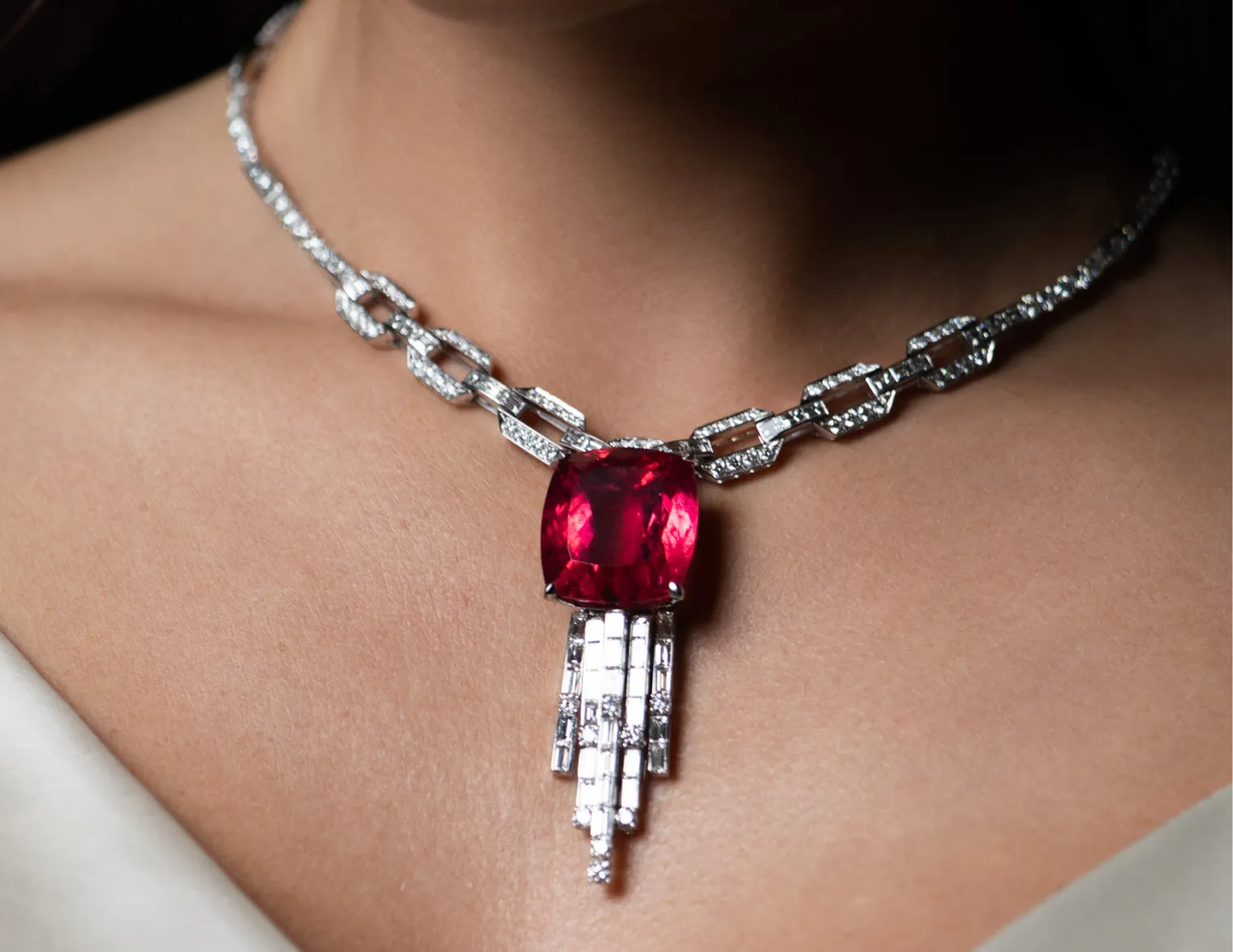
An existing rubellite can be set well as a one-of-a-kind piece. First it is clarified whether it really is a rubellite and what condition it is in, most reliably with a laboratory report. Then a design is created that is built around the exact dimensions of the stone. Because tourmaline tolerates heat poorly, the workshop plans soldering work before setting.
At a glance
- First step
- Have the gemstone type identified, rubellite is easily confused with ruby
- Laboratory report
- GIA identification report for loose and mounted polished stones
- Origin report
- Not offered by GIA for rubellite
- Mohs hardness
- 7 to 7.5
- Sensitive to
- Heat, sudden temperature changes, hard knocks
- Setting
- Usually constructed around the individual stone
An inherited stone becomes a piece of your own
A loose stone from an estate is a good starting point for a one-of-a-kind piece. Unlike with a new design, the most important part is already there, and the design follows it. That is an advantage, because a standard setting rarely fits tourmalines anyway. The work, however, begins not with the sketch but with two questions: what exactly is this stone, and what condition is it in?

Such a stone is often called a rubellite in the family without ever having been examined. Red stones look alike, and a ruby, a spinel or glass can also hide behind the name. For the design this is decisive, because hardness, toughness and sensitivity to heat depend on the gemstone type. What distinguishes a rubellite as a tourmaline is described in detail on the gemstone page.
First clarify what the stone is
Certainty about the gemstone type is provided by a report from an independent laboratory. The Gemological Institute of America, GIA for short, determines the material in its identification report for colored gemstones and lists detectable treatments. The report is possible for polished stones, loose or mounted. A loose stone is the most favorable moment for the examination, because it is accessible from all sides and the report later belongs to the finished piece.
There are two limits you should know. GIA offers a statement of the country of origin only for certain stones, such as ruby, sapphire, emerald and Paraíba tourmaline, not for rubellite. And not every treatment can be detected. According to GIA, heating in tourmaline is stable and not detectable. Irradiation, by contrast, can fade under heat or strong light. More on this in the guide Untreated rubellite.
Good to know
A laboratory report describes the stone and states no monetary value. Anyone who wishes to record the value for insurance or an estate additionally needs an appraisal. GIA explicitly distinguishes between the two documents.
| Question | Who answers it | Why it matters |
|---|---|---|
| Which species? | Identification report from an independent laboratory | Hardness, toughness, and heat sensitivity depend on it |
| Treated? | Laboratory report, as far as the treatment is detectable | Heating is undetectable in tourmaline, and irradiation can fade |
| Origin? | At GIA only for certain stones, not for rubellite | A missing origin statement is normal for rubellite |
| Condition? | Goldsmith or gem cutter | Cracks and chips determine the position in the setting |
| Value? | Appraisal | A laboratory report states no monetary value |
What should be clarified before the design, based on GIA information.
Examining the condition of the stone
A stone that has lain for decades in a drawer or an old ring can show traces. Typical are small chips on the girdle, meaning the edge running around the stone, abraded facet edges or fine fractures. For the new design, what counts is where these spots lie. A setting can cover a chipped edge. A fracture that reaches the surface, on the other hand, weakens the stone permanently and therefore belongs under the protective side of the setting.
Inclusions also play a role. According to GIA, the trade accepts visible inclusions in red tourmalines if the color is strong. Whitish, conspicuous inclusions reduce the effect regardless of color. Inclusions reaching the surface impair the luster. How inclusions in rubellite are classified is explained in the guide Clarity in rubellite.
If the surface is heavily scratched, a gemstone cutter can judge whether repolishing is worthwhile. Every treatment of the surface costs some material and may change the proportions. With an heirloom, this is a conscious decision between preservation and effect. According to GIA, agates and other gemstones have been cut and polished in Idar-Oberstein for more than 500 years. More about the town in the glossary under Idar-Oberstein.
The design follows the dimensions of the stone
According to GIA, tourmalines are often cut into long, narrow shapes in order to retain as much weight as possible from the crystal. Many stones therefore have unusual dimensions. An older rubellite may also be cut to proportions that are rare today. The setting is therefore constructed for the individual stone. In a three-dimensional visualization, it is possible to check beforehand how high the stone sits and how it looks from the side.

Where the piece is worn determines the type of setting. A ring is exposed to the most knocks and needs a setting that encloses edges and corners. According to GIA, a pendant or earring carries a lower risk and may be set more openly. If the stone is already chipped, a pendant can be the gentler choice. The guide Which setting protects a rubellite? compares the setting types in detail.
Tourmaline shows different color tones depending on the viewing direction. GIA describes how cutters deliberately orient the table to achieve the desired depth of color. The design should adopt this orientation so that the stone looks the way it was cut. With an heirloom, it is worth looking at the stone in different lighting conditions before its position in the ring is fixed.
Heat is the delicate moment in the workshop
Rubellite tolerates light and chemicals well, but heat poorly. GIA warns that heat can damage tourmaline and change its color, and that rapid temperature changes can trigger fractures. When a piece of jewelry is newly built, this is easily resolved: all soldering work on setting and shank is completed before the stone is inserted. Only at the very end is the stone set and the piece polished by hand.
It becomes more delicate when the stone sits in an old piece of jewelry whose metal is to be reused. Then it must first be removed from the setting before anything is melted or soldered. Care is also needed for later maintenance: GIA does not recommend ultrasonic and steam cleaning for tourmaline. With every later repair, mention that the stone is a tourmaline.
The process from request to one-of-a-kind piece
- Request with photosDescribe the stone, any existing documents and your idea, ideally with pictures from several angles.
- Examination of the stoneDetermine gemstone type, condition and dimensions, and obtain a laboratory report if needed.
- DesignSketches based on the dimensions, with the choice of jewelry type, setting and metal.
- VisualizationThree-dimensional rendering in which proportion and seat of the stone are checked.
- Production and settingMetalwork first, then setting of the stone and hand polishing.
At Vikar Ahmed, custom jewelry projects are realized exclusively on request in Idar-Oberstein. The request is reviewed, and work begins only after acceptance. Vikar Ahmed sets stones brought in by clients only in rare exceptions, for example when they carry high emotional value as an heirloom does, after gemological testing and as part of a new design. In-house designers create the design, a visualization with CAD shows the piece before production, and goldsmiths from Idar-Oberstein make it in the in-house atelier. As a guide, more elaborate custom pieces take about four to six weeks. If there is an occasion with a date, mention it right away in your inquiry.
Typical mistakes when setting an heirloom
- Treating the stone as a rubellite without examination, although the gemstone type was never determined.
- Choosing an off-the-shelf setting that does not sit snugly against the dimensions of the stone.
- Setting a chipped stone openly in a ring instead of protecting the damaged spot.
- Having the old piece of jewelry melted down or soldered with the stone still in place.
- Confusing laboratory report and appraisal and ending up with neither.
Frequently asked questions
I have inherited a loose rubellite and would like to have a ring made from it. Which goldsmith in Bad Kreuznach realizes something like this as a one-of-a-kind piece?
What matters is a workshop that identifies the stone beforehand and builds the setting around its dimensions. Vikar Ahmed has no location in Bad Kreuznach and sets stones brought in by clients in Idar-Oberstein only in rare exceptions, such as an heirloom, after gemological testing and as a new design. More on this under Jeweler for Bad Kreuznach.
Paraíba tourmaline or rubellite as a loose collector's stone?
Both are tourmalines with a hardness of 7 to 7.5. Paraíba tourmaline owes its blue to green color to copper and is considerably rarer, and GIA offers an origin report for it. Rubellite is easier to find. With both, color counts above all, and with rubellite visible inclusions are more readily accepted.
Does an inherited stone have to go to a laboratory before setting?
It is not mandatory, but sensible. An identification report clarifies whether the stone really is a rubellite and whether detectable treatments are present. This determines how the workshop handles it. A stone is best examined loose, and the report later accompanies the finished piece.
Can a rubellite from an old ring be transferred to a new one?
Yes. The stone is carefully removed from its setting, examined and then set in a new setting. It is important that it does not remain in the old metal when this is soldered or melted. Tourmaline tolerates heat poorly and can crack with rapid temperature changes.
Is it worth having a damaged rubellite recut?
That depends on the position and size of the damaged spot. Small chips can often be hidden under the setting without losing material. Repolishing or recutting improves the effect, but costs weight and can change the proportions. A gemstone cutter should assess the stone beforehand.
Which type of jewelry is best suited to an inherited rubellite?
That depends on the condition and on your everyday life. A ring shows the stone most often but is exposed to the most knocks and needs a protective setting. A pendant or earring is less at risk and is particularly suitable for stones that already show small traces.
Private consultation
If you would like to have an inherited rubellite set, bring the stone and any existing documents to the appointment. Vikar Ahmed advises in the showroom in Idar-Oberstein by appointment, and an initial exchange is also possible virtually. Request an appointment for a private consultation.
Further reading
- Which setting protects a rubellite?
- Gemstone: Rubellite
- Rubellite or ruby
- Glossary: Bespoke
- Jeweler for Bad Kreuznach
Sources
- GIA: Colored Stone Reports, accessed 2026-11-17
- GIA: Country of Origin Reports, FAQ, accessed 2026-11-17
- GIA: Tourmaline Care and Cleaning Guide, accessed 2026-11-17
- GIA: Tourmaline Quality Factors, accessed 2026-11-17
- GIA 4Cs: Gem Durability, more than the Mohs Scale, accessed 2026-11-17
- GIA 4Cs: Difference between a Diamond Grading Report and an Appraisal, accessed 2026-11-17
- GIA: Tourmaline Description, accessed 2026-11-17
- GIA: The Lapidary Tradition of Idar-Oberstein, accessed 2026-11-17
- Vikar Ahmed: Kontakt, accessed 2026-11-16
- Vikar Ahmed: Bespoke, Designprozess, accessed 2026-11-16

A personal conversation starts here.
At the showroom in Idar-Oberstein or by video. Vikar Ahmed discusses your ideas, stones and designs with you and answers your questions calmly and in confidence.


Thank you for your request.
Your request will be handled with the utmost attention and discretion. Vikar Ahmed will get back to you.
Your details
Request
–
Occasion
–
Consultation
–
Contact
–
In the meantime
Insights: What is a Paraíba tourmaline? · Engagement ring to your own design: how does it work?
Confidential and without obligation
Back to the pagePrivate consultation
A personal conversation starts here.
- Time for your questions, wishes and ideas
- In the showroom in Idar-Oberstein or by video
- Confidential, discreet and without obligation
Vikar Ahmed · Hauptstraße 111 · 55743 Idar-Oberstein, Germany