

Untreated Paraíba Tourmaline: What Can Be Proven
For Paraíba tourmaline, untreated is a statement with gaps. Those who understand it can read reports correctly and decide deliberately.
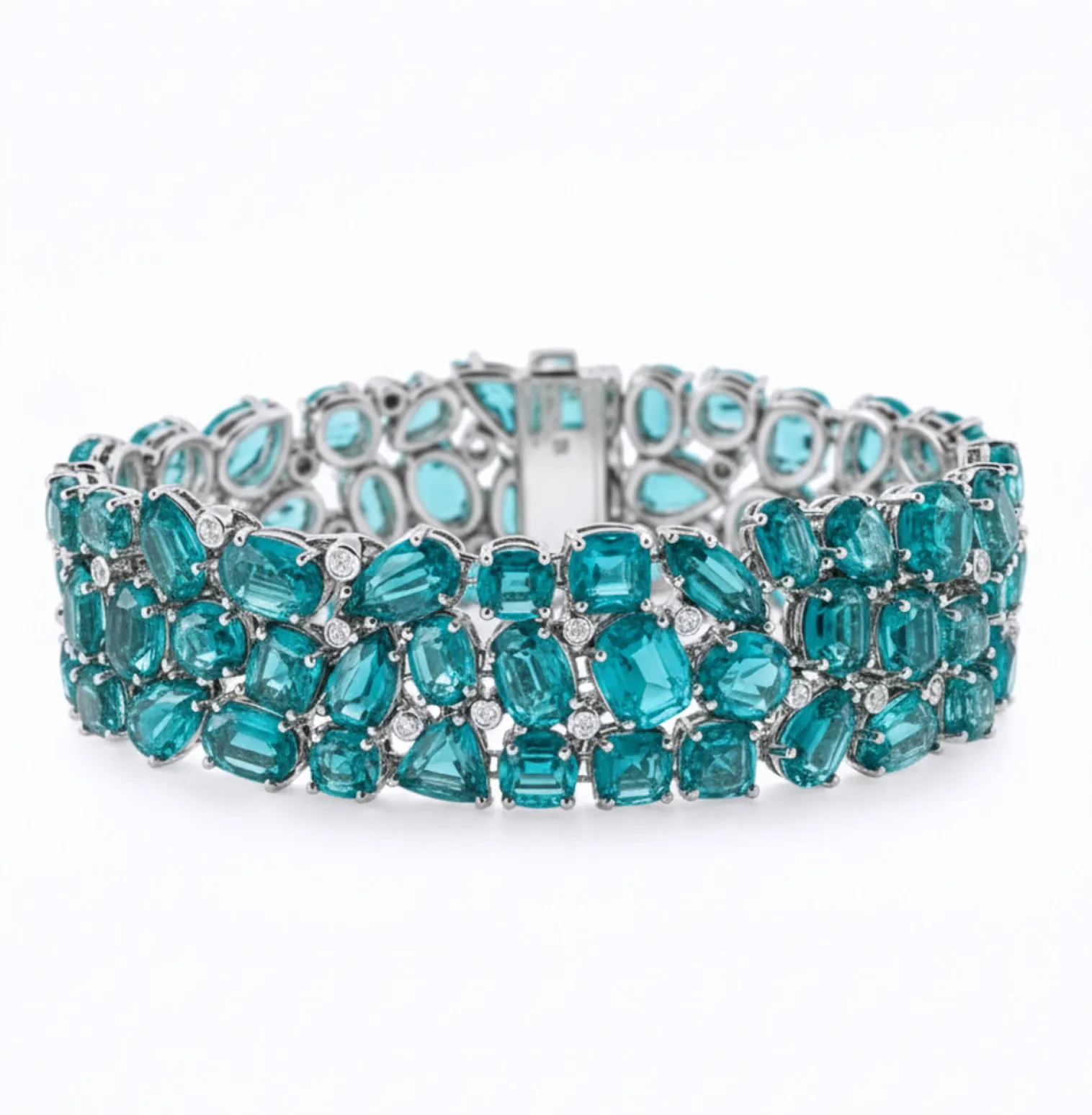
An untreated Paraíba tourmaline has been neither heated nor filled with resin. This can only partly be proven with certainty: heating is not always detectable in Paraíba, and laboratories then write that the color may have been enhanced. For a collection, the difference is worthwhile when a report states no indications of heating. An openly disclosed, stable stone remains a good choice.
At a glance
- Common treatment
- Heating, according to SSEF usually at 400 to 450 °C
- Effect of heating
- Can remove pink and violet components; the blue appears purer
- Detection
- According to GIA not always possible
- Filling
- Fine fissures are sometimes filled with artificial resin; must be disclosed
- SSEF report
- No indications, indications of heating, or explicitly undeterminable
- Durability
- According to GIA, heating is considered permanent under normal handling
Untreated means two things for Paraíba
For Paraíba tourmaline, the question of treatment mainly concerns two interventions. The first is heating, which changes the color. The second is filling fine fissures with a colorless substance, usually artificial resin, which makes the stone appear clearer. An untreated stone has undergone neither. After mining, it was only cut and polished. What the term means in general is explained in the glossary under untreated.
The two interventions differ greatly in how well they can be detected. Fillings can usually be recognized under the microscope and with spectroscopic methods. Heating is different. In a study on the origin of Paraíba tourmalines, GIA explicitly writes that heating is not always detectable. For Paraíba, the term untreated is therefore a statement whose certainty depends on the individual stone.
Why Paraíba tourmalines are heated
The color of Paraíba tourmaline is caused mainly by copper and manganese. According to GIA, heating can change the state of the manganese and thus remove violet and pink tones. What remains is a purer blue or green, which is usually in greater demand in the trade. SSEF cites temperatures of 400 to 450 °C as customary for heating Paraíba tourmalines.

According to GIA, heating is considered permanent under normal handling. The color of a heated stone therefore remains stable, and SSEF also describes it as stable in its reports. GIA points out, however, that strong heating can make a stone somewhat more brittle. With Paraíba, heat can also create new fissures and widen existing ones. This is one reason why heating and filling occur together in the same stone.
How laboratories word the finding
SSEF uses three wordings in its Paraíba reports. If it can be confirmed that the stone has not been heated, the comment states that there are no indications of heating. If heating is detected, the report states indications of heating. If it cannot be clarified, it says the color may have been enhanced or modified by heating and that it is currently not determinable whether the stone has been heated. The color is then considered stable.
| Wording in the report | Meaning | For the collection |
|---|---|---|
| No indications of heating | Laboratory confirms an unheated stone | The strongest statement on untreated |
| Indications of heating | Heating is proven | Treated stone, openly disclosed |
| Heating not determinable | Finding remains open | Assess as a possibly heated stone |
| Filling minor, moderate, significant | Amount of fissure filling | The more filling, the more caution |
Wordings based on SSEF's explanations of its Paraíba report. Other laboratories use their own wording.
Good to know
SSEF does not state very small amounts of filling in the report, in line with the guidelines of the laboratory association LMHC. A report without a filling note therefore means no significant filling, not necessarily none at all.
How laboratories recognize an unheated stone
One characteristic is fine channels in the stone around which a violet halo has formed. According to SSEF, this halo develops over geological time through natural radiation and is considered proof that the stone has not been heated, because heat would remove it. Certain minerals in the channels also help. Goethite, for example, is according to SSEF stable only up to about 350 °C, which is below the customary heating temperatures.
Other characteristics are less conclusive. Pink-colored areas around inclusions were long read as a sign of an unheated stone. GIA writes, however, that such characteristics can also persist in heated stones. Its conclusion is clear: the color of a Paraíba tourmaline should always be considered as possibly modified by heating unless otherwise proven. A single characteristic therefore does not replace examination by an experienced laboratory.
When characteristics are faked
Because unheated stones are sought after, there are attempts to imitate their characteristics. SSEF examined a light blue, copper-bearing tourmaline of 14 carats from Mozambique. Some channels reaching the surface were partly filled with a violet-blue substance. At first glance, this resembled the natural halo of an unheated stone. The analysis showed that the stone had been heated. SSEF considers deliberate deception likely.

The difference lay in the detail. In the natural characteristic, the coloration surrounds the channel; in the examined stone, the substance sat inside the channel. In addition, an absorption band associated with manganese was missing from the spectrum, and under the microscope typical tension fissures appeared around fluid inclusions. For collectors, this means: the statement untreated should come from a laboratory familiar with such cases, not from a mere glance through the loupe.
Untreated or openly disclosed: what suits the collection
For a collection, an unheated Paraíba tourmaline is of interest when a report states no indications of heating and the stone convinces in color. It is rarer than a heated stone, and the statement can be passed on with the report. A report that leaves heating open does not carry this distinction. Anyone who spends more for it pays for a possibility, not for a finding.
A heated stone with openly disclosed treatment, by contrast, is no makeshift solution. Its color is stable, the treatment is known, and the stone can be superior to an unheated one in color and clarity. More important than the label is that the report is complete and conceals no significant filling. How sellers should disclose treatments for Paraíba is covered in the guide Disclosing treatment of Paraíba.
- Request a report from a laboratory experienced with Paraíba tourmalines.
- Read the wording on heating: no indication, indication, or undeterminable.
- Check the comment on filling and note the grading.
- Assess the color on the stone, in daylight and in artificial light.
- Decide whether the finding or the color is decisive for the collection.
Clarifying treatment details before the design
Paraíba tourmaline is at the heart of the house, and Vikar Ahmed uses it to create one-of-a-kind pieces in 18k gold, platinum, and diamonds. If you are specifically looking for an unheated stone, say so early and ask for the treatment to be stated in writing, as CIBJO disclosure rules require. Vikar Ahmed works with heated and unheated Paraíbas and states the treatment in the consultation and in writing on the certificate, expert report, and invoice. A finding such as “no indications of heating” is only reliable in a report from an independent laboratory. A general overview of treatments is given in the guide Gemstone treatment.
Frequently asked questions
Is there a jeweler in Kirn with untreated Paraíba tourmalines?
Vikar Ahmed has no location in Kirn; consultations take place in Idar-Oberstein, more under Jeweler for clients from Kirn. Regardless of location: ask for a laboratory report that states no indications of heating. A verbal assurance of untreated is not enough for Paraíba, because heating is not always detectable.
What is more worthwhile for my collection, an untreated Paraíba tourmaline or a treated stone with disclosed treatment?
The untreated stone is worthwhile when a laboratory report records the absence of indications of heating and the color convinces. Without this finding, a heated stone with complete disclosure offers more clarity. Its color is stable, and you know exactly what you are adding to your collection.
Is an untreated stone in Paraíba jewelry worthwhile despite the higher price?
Only if the added value is proven. A report without indications of heating makes the rarity verifiable and transferable. If heating remains undeterminable in the report, this basis is missing. In jewelry, the effect also counts: a heated stone with a more beautiful color can make the more harmonious piece.
Can a laboratory always determine whether a Paraíba tourmaline has been heated?
No. GIA writes that heating is not always detectable in Paraíba tourmaline. In such cases, SSEF notes that the color may have been enhanced by heating and that this is currently not determinable. The finding only becomes unambiguous when the stone shows clear characteristics in one direction or the other.
Does the color of a heated Paraíba tourmaline fade?
According to GIA, heating is considered permanent under normal handling, and SSEF also describes the color as stable. Resin fissure fillings are different. They can react sensitively to heat, pressure changes, and chemicals, which is why filled stones should be cleaned gently.
Does a report without a filling note mean the stone was never filled?
Not necessarily. SSEF does not state very small amounts of filling, in line with the guidelines of the laboratory association LMHC. Only from a detectable amount is the filling noted as minor, moderate, or significant. Without a note, therefore, no significant filling is present.
Private consultation
What role the treatment of a Paraíba tourmaline plays for your piece or your collection is best clarified in conversation and at the stone. Vikar Ahmed advises in the showroom in Idar-Oberstein by appointment or in a virtual appointment. Your inquiry is handled discreetly. Request an appointment for a private consultation.
Further reading
- Untreated colored gemstones and the premium
- Glossary: Treatment
- What makes a Paraíba masterpiece
- Gemstone: Paraíba tourmaline
- Origin of Paraíba tourmaline
Sources
- GIA Gems & Gemology: Paraíba Tourmaline Geographic Origin Determination (Winter 2019), accessed 2026-11-17
- GIA: Gem Treatment, accessed 2026-11-17
- SSEF: Paraiba Tourmaline Report, Formulierungen zu Erhitzen und Füllung, accessed 2026-11-17
- SSEF: Purple substance in hollow tubes to mimic unheated Paraiba tourmaline, accessed 2026-11-17
- SSEF: Fissure-filling in Paraiba Tourmaline, accessed 2026-11-17
- Vikar Ahmed: Paraíba, accessed 2026-11-16
- Vikar Ahmed: Startseite, accessed 2026-11-16
- CIBJO: Introduction to the Blue Books, accessed 2026-11-17

A personal conversation starts here.
At the showroom in Idar-Oberstein or by video. Vikar Ahmed discusses your ideas, stones and designs with you and answers your questions calmly and in confidence.


Thank you for your request.
Your request will be handled with the utmost attention and discretion. Vikar Ahmed will get back to you.
Your details
Request
–
Occasion
–
Consultation
–
Contact
–
In the meantime
Insights: What is a Paraíba tourmaline? · Engagement ring to your own design: how does it work?
Confidential and without obligation
Back to the pagePrivate consultation
A personal conversation starts here.
- Time for your questions, wishes and ideas
- In the showroom in Idar-Oberstein or by video
- Confidential, discreet and without obligation
Vikar Ahmed · Hauptstraße 111 · 55743 Idar-Oberstein, Germany