

What Makes a Paraíba Masterpiece
The word masterpiece promises a great deal and is defined nowhere. What stands behind a Paraíba piece can nevertheless be examined.
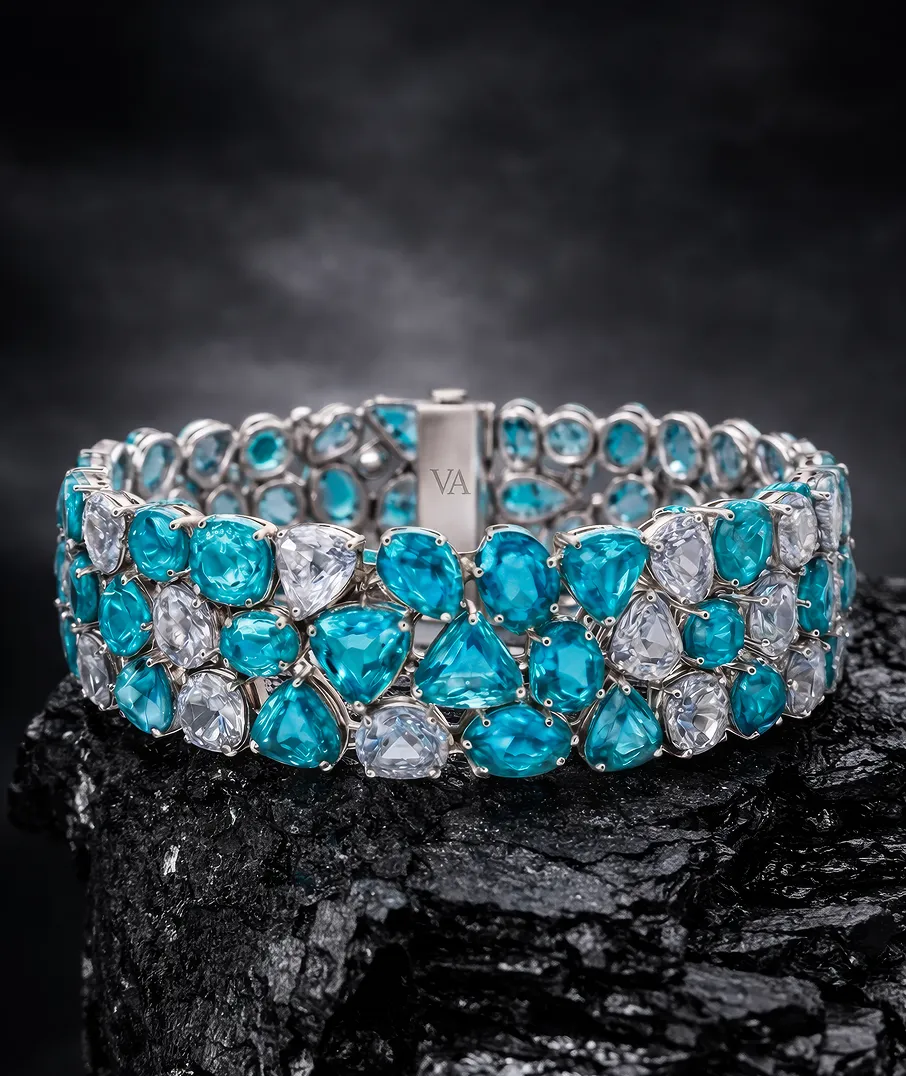
A Paraíba masterpiece is not a standardized term. It is sensibly measured by three things: a stone that qualifies as Paraíba tourmaline under the laboratory definition and convinces in color; documents that record identity, treatment and, where possible, origin; and a setting designed as a one-of-a-kind piece for exactly this stone and executed by hand.
At a glance
- Masterpiece
- Not a laboratory or quality grade; in German trade law the examination piece is called a master examination project
- Paraíba tourmaline
- Blue to green tourmaline, color mainly from copper and manganese
- Main value factor
- According to GIA, color, not size
- Size
- According to GIA, rarely over one carat
- Origin report
- Available for Paraíba tourmaline at GIA and SSEF, not always determinable
- Craftsmanship
- One-of-a-kind piece, designed for the stone, setting and polishing by hand
Masterpiece is an aspiration, not a grade
No laboratory awards the designation masterpiece, and no standard defines when a jewel may be called one. In German trade law, the word has a different background. The ordinance on the master craftsman examination in the gold and silversmithing trade speaks of the master examination project: a jewel with or without stones, or an object made of precious metal, that corresponds to a client commission. Design, workshop drawing, costing and work plan are assessed, as well as the finished piece.
In the jewelry trade, the word is used more freely. It is meant to say that a piece goes beyond ordinary goods. Whether that is true cannot be tested on the word, only on the piece. For a Paraíba jewel, three test questions suggest themselves: what kind of stone it is, what the documents prove, and how the piece is made. The following chapters go through these questions in turn.
The stone: when a tourmaline is called Paraíba
Under the definition reproduced by GIA and SSEF, a Paraíba tourmaline is a blue to green tourmaline whose color is based mainly on copper and manganese, regardless of the country. This material was discovered in the late 1980s in the Brazilian state of Paraíba, and later also in Nigeria and Mozambique. Copper alone is not enough. SSEF describes a very light, copper-bearing stone whose saturation was too low under its color standard to be called Paraíba.

For a piece of aspiration, color therefore counts first. GIA calls it the decisive factor for Paraíba tourmaline, more important than size. The hues range from greenish blue through bluish green and green to blue and violet, with blue and violet the most highly valued. According to GIA, stones over one carat are rare. How closely color, clarity, and size are connected is explored in the guide Color or clarity in Paraíba.
The cut also belongs to the stone. GIA writes that Paraíba tourmalines are almost always custom cut because of the high value of the rough, often as brilliant cuts in pear or oval shapes. A custom-cut stone often has no standard dimensions. For the setting, this means it must adapt to the stone, not the other way around. This is where the difference between a one-of-a-kind piece and a piece made from prefabricated parts begins.
The documents: what should be proven
For a Paraíba tourmaline, the name on the invoice is not enough. Whether a stone meets the definition is shown by a laboratory's chemical analysis. GIA offers a report for Paraíba tourmaline with identification and geographic origin. SSEF issues its own Paraíba report. Stones that meet the color and chemistry requirements but do not come from Brazil are called tourmaline in the SSEF report, with a note that they may be called Paraíba tourmaline in the trade.
| Statement | What it clarifies | Limit |
|---|---|---|
| Identification | Tourmaline, copper as cause of color | Says nothing about the workmanship |
| Treatment | Detectable interventions such as fillings | Heating is not always detectable |
| Origin | Country of origin as the laboratory's assessment | May remain without a result |
| Dimensions and weight | Matching report and stone | Only partially measurable in a set stone |
A report is strongest when it was produced before setting, because the stone can then be examined completely.
The origin of a Paraíba tourmaline cannot be determined with standard tests. GIA bases it mainly on trace elements, measured by laser ablation, and compares them with reference stones. Some stones fall between the ranges, and then the result is undetermined. How much an origin report means for a collector's piece is covered in the guide Origin of Paraíba tourmaline. With a masterpiece, clarify before deciding whether a report exists and whether it covers treatment and origin as well as identity.
Treatment belongs openly on the table
According to SSEF, Paraíba tourmalines are frequently heated. Heating can remove pink and violet components and make the blue appear purer. Not every heating can be detected. SSEF then writes in the report that the color may have been enhanced by heating and that this cannot currently be determined. A piece of aspiration does not conceal this uncertainty but states it. The details are explained in the guide untreated Paraíba tourmaline.
Fillings are added to this. Paraíba tourmalines often have fine fissures that heating can widen. Some are filled with colorless artificial resin to make the stone appear clearer. SSEF notes such a filling in the report and grades it as minor, moderate, or significant. Under the CIBJO rules to which SSEF refers, it must be disclosed through to the end customer. A filled stone can be beautiful, but it requires different care.
The craftsmanship: how to recognize a one-of-a-kind piece
A masterpiece in the true sense is created for a specific stone. The design starts from the shape, color, and dimensions of the stone and determines how it is held, protected, and set in the light. With a custom-cut Paraíba tourmaline, this is more than a question of style. Setting, prongs, and bezel must fit exactly so that the stone is held securely and its color is not obscured by metal.

- A design that starts from the stone and is made visible before production.
- A setting worked to the dimensions of the stone, not made from standard parts.
- Clean transitions, evenly placed prongs, no tool marks in visible areas.
- Accent stones whose color and size suit the main stone.
- Documents that belong to the stone and are passed on with the piece.
Series jewelry follows the reverse path: the setting is fixed, and a matching stone is sought. That makes sense for common dimensions but is a limitation for a rare Paraíba tourmaline. How a setting protects the stone and which forms have proven themselves is explained in the guide Setting for Paraíba tourmaline. Anyone looking for a piece for a collection should examine the setting as closely as the stone.
Common mistakes in assessment
- Reading the word masterpiece as proof of quality.
- Taking a blue-green tourmaline without a laboratory finding for a Paraíba tourmaline.
- Placing size above color, although color is decisive for Paraíba.
- Expecting an origin report where the laboratory could not determine a result.
- Checking the report and overlooking the workmanship of the setting.
A common error concerns pairs. SSEF received two tourmalines that were submitted as a pair of Paraíba tourmalines and looked identical. Only one contained copper; the other was an iron-colored indicolite. For earrings or a necklace with several stones, the rule is therefore: every stone described as Paraíba needs its own determination. A report for one stone proves nothing about the second.
Paraíba one-of-a-kind pieces at Vikar Ahmed
Paraíba tourmaline is at the heart of the house. Vikar Ahmed creates Paraíba High Jewelry as one-of-a-kind pieces, set in 18k gold, platinum, and diamonds. The path to a piece leads through three steps: a design by in-house designers, a three-dimensional visualization with CAD, and execution in the in-house atelier in Idar-Oberstein, where goldsmiths set the stones under the microscope and polish them by hand. The house works with heated and unheated Paraíbas and discloses every treatment openly, in the consultation and in writing on the certificate, expert report, and invoice.
Frequently asked questions
Where can I inquire about a Paraíba masterpiece in Kirn?
Vikar Ahmed has no location in Kirn. Consultations take place in the showroom in Idar-Oberstein by appointment or in a virtual appointment; more under Jeweler for clients from Kirn. Custom pieces are created there exclusively on request. The request is reviewed, and work only begins after acceptance.
Is masterpiece a protected quality designation for jewelry?
No. No laboratory awards this designation, and it does not describe a defined grade. In German trade law, the examination piece for the master craftsman examination is called the master examination project. In the trade, masterpiece is the maker's claim, which you should test on the stone, the documents, and the workmanship.
How can I tell that a Paraíba tourmaline is genuine?
Reliably only by a laboratory finding. A Paraíba tourmaline is a tourmaline whose blue to green color is based mainly on copper and manganese. Similar-looking tourmalines can owe their color to iron. Only chemical analysis reveals the difference, not the eye.
Does a Paraíba jewel need an origin report?
It is not mandatory, but often valuable for collectors. GIA and SSEF offer reports with origin for Paraíba tourmaline. The result is the laboratory's assessment and may remain undetermined. The report should ideally be produced before setting, when the stone can be examined unmounted.
Why does color count more than size for Paraíba tourmaline?
Because the luminosity of the color defines the stone. GIA calls color the decisive factor for Paraíba tourmaline. A smaller stone with saturated blue can therefore be more significant than a larger one with pale color. According to GIA, stones over one carat are rare in any case.
Is a Paraíba tourmaline from Africa considered a genuine Paraíba?
Yes, if color and cause of color match. Under the definition reproduced by GIA and SSEF, the name applies regardless of the country of origin. SSEF calls such stones tourmaline in the report and notes that they may be called Paraíba tourmaline in the trade. The country of origin itself requires an origin finding.
Private consultation
Whether a Paraíba tourmaline is suitable for a one-of-a-kind piece and which documents should accompany it is clarified in conversation. Vikar Ahmed advises in the showroom in Idar-Oberstein by appointment or in a virtual appointment. Inquiries are handled discreetly. Request an appointment for a private consultation.
Further reading
- Glossary: Paraíba tourmaline
- Gemstone: Paraíba tourmaline
- How do you recognize a genuine Paraíba tourmaline?
- Paraíba as a collector's piece
- Bespoke: from design to one-of-a-kind piece
Sources
- GIA: Tourmaline Quality Factors, Paraíba-Turmalin, accessed 2026-11-17
- GIA Gems & Gemology: Paraíba Tourmaline Geographic Origin Determination (Winter 2019), accessed 2026-11-17
- GIA: Colored Stone Identification & Origin Report, accessed 2026-11-17
- SSEF: Paraiba Tourmaline Report, accessed 2026-11-17
- SSEF: Saturation too low for Paraiba tourmaline, accessed 2026-11-17
- SSEF: Fissure-filling in Paraiba Tourmaline, accessed 2026-11-17
- SSEF: A perfect match, Paraiba tourmaline and Indicolite tourmaline, accessed 2026-11-17
- Gold- und Silberschmiedemeisterverordnung (GoldSilberschmiedMstrV), accessed 2026-11-17
- Vikar Ahmed: Paraíba, accessed 2026-11-16
- Vikar Ahmed: Bespoke, accessed 2026-11-16
- CIBJO: Introduction to the Blue Books, accessed 2026-11-17

A personal conversation starts here.
At the showroom in Idar-Oberstein or by video. Vikar Ahmed discusses your ideas, stones and designs with you and answers your questions calmly and in confidence.


Thank you for your request.
Your request will be handled with the utmost attention and discretion. Vikar Ahmed will get back to you.
Your details
Request
–
Occasion
–
Consultation
–
Contact
–
In the meantime
Insights: What is a Paraíba tourmaline? · Engagement ring to your own design: how does it work?
Confidential and without obligation
Back to the pagePrivate consultation
A personal conversation starts here.
- Time for your questions, wishes and ideas
- In the showroom in Idar-Oberstein or by video
- Confidential, discreet and without obligation
Vikar Ahmed · Hauptstraße 111 · 55743 Idar-Oberstein, Germany