

Paraíba Tourmaline from Batalha
The story of Paraíba tourmaline began in a small mine in northeastern Brazil. What the name Batalha means today and how far it can be substantiated.
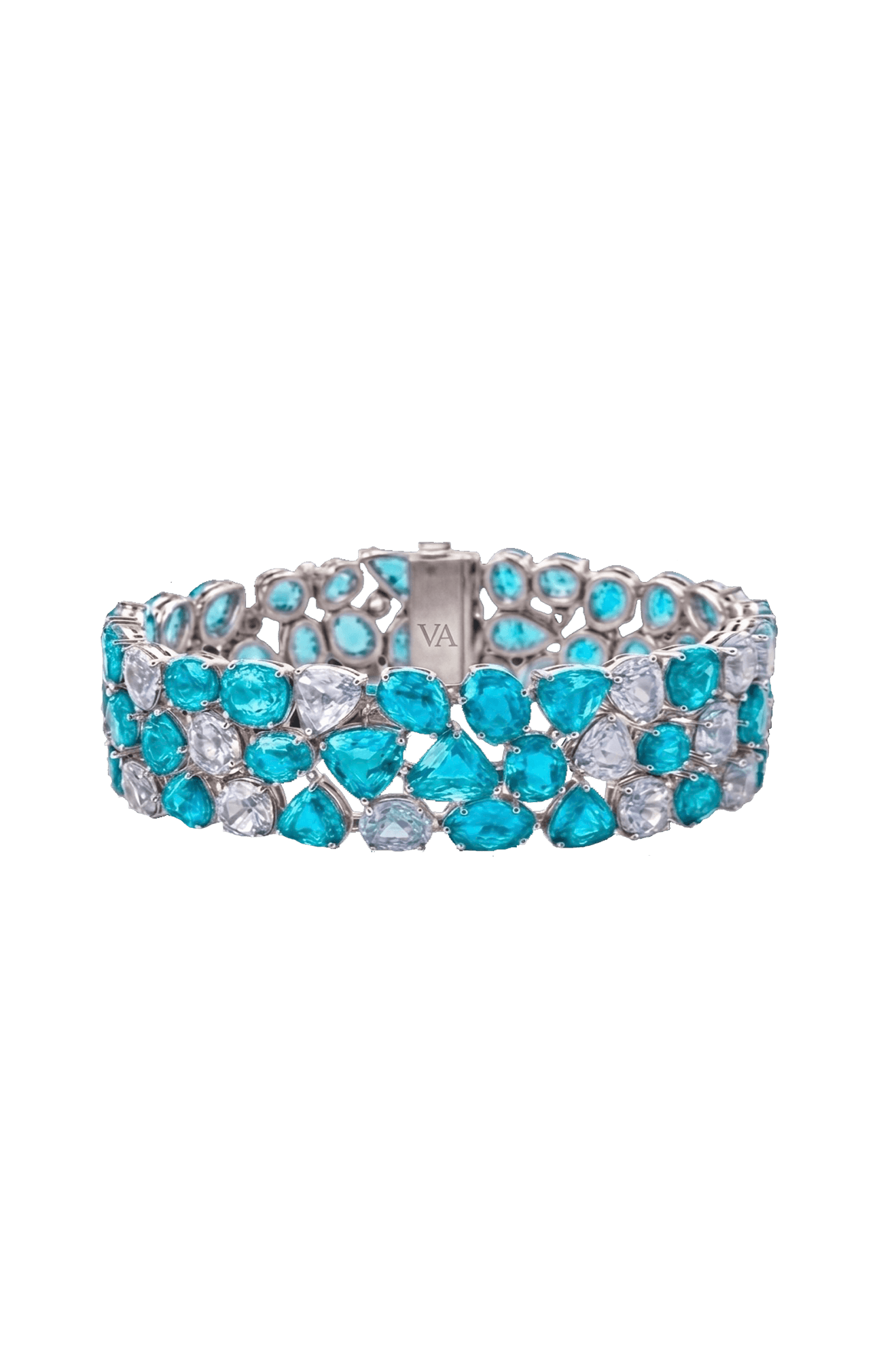
Batalha is the mine in the Brazilian state of Paraíba where Paraíba tourmaline was first found. This origin cannot be seen in the stone itself. Through trace elements, a laboratory can determine the country, that is Brazil, but not the individual mine. The attribution Batalha therefore rests on documentation of the supply chain and should be verifiably supported.
At a glance
- Mine
- Mina da Batalha on the Serra da Frade, state of Paraíba, Brazil
- Location
- 4.5 km northeast of Salgadinho, near São José da Batalha
- First blue stones
- August 1987, on the international market from 1989
- Cause of color
- Copper, partly together with manganese
- Copper content
- 0.37 to 2.38 weight percent CuO in the 1990 samples
- Origin in the report
- As a country, such as Brazil, not as an individual mine
- Treatment
- Frequently heated, not detectable in every case
Batalha is the origin of Paraíba tourmaline
Paraíba tourmaline bears the name of a state, but its story begins in a single place. The mine is called Mina da Batalha. According to a 1990 article by the Gemological Institute of America, GIA for short, it lies on the upper slope of the Serra da Frade, 4.5 kilometers northeast of the town of Salgadinho and near the village of São José da Batalha.

The search began in 1982. Heitor Dimas Barbosa, who had previously mined tourmaline in Minas Gerais, noticed colored fragments in samples of pegmatite, a coarse-grained vein rock. With a team of around 15 garimpeiros, that is, independent prospectors, he dug shafts up to 50 meters deep. From 1985 to 1987 they found green tourmalines. Only in August 1987 did they come upon the glowing blue stones that made the site famous.
From discovery to a term
The stones appeared on the international market in 1989. The trade described their colors with words such as neon, electric or fluorescent, and some shades of blue had hardly been seen in tourmaline before. In a 2023 obituary, GIA writes that Barbosa and his team recovered 10 to 15 kilograms of tourmaline in the two years after the discovery, with simple hand tools and by candlelight. After that, production declined considerably.
Later, copper-bearing tourmalines were also found in the neighboring state of Rio Grande do Norte and, in the early 2000s, in Nigeria and Mozambique. The name Paraíba traveled with them. Today, by the laboratories' definition, it denotes a type of tourmaline, not a locality. Batalha is therefore two things: the historical origin and an origin statement that claims more than the name alone. The page on Paraíba tourmaline describes what characterizes the stone in general.
What distinguishes the stones from Batalha
What is special about the stones from Batalha is their copper. GIA's 1990 study found 0.37 to 2.38 weight percent copper oxide in the samples. This was well above anything previously measured in natural elbaites, the type of tourmaline to which these stones belong. The colors are due to divalent copper, partly together with trivalent manganese. The inclusions, by contrast, are typical of tourmaline, such as liquid veils and fine growth tubes.
In later measurements too, copper remains a characteristic of Brazil. A 2019 GIA study reports an average of around 11,400 ppmw copper for Brazilian samples, that is, parts per million by weight, and less than 2,000 for African ones. Zinc above 1,000 ppm was found only in Brazilian samples. These values apply to Brazil as a whole, not only to Batalha. They are the basis on which laboratories determine origin.
Origin cannot be seen in the stone
Anyone who places a stone from Batalha beside one from Mozambique cannot reliably tell the difference with the naked eye. GIA writes that, although top-quality Brazilian stones often show a stronger color, the color ranges of all localities overlap considerably. According to GIA, the usual gemological tests do not reliably separate the countries of origin either, nor does a qualitative chemical analysis. A glowing color is therefore no proof of origin.

A laboratory determines origin through trace elements. For this, GIA uses laser ablation and mass spectrometry to measure copper, zinc, gallium, strontium, tin and lead, among others. According to GIA, origin can thus be determined unambiguously for the great majority of stones, while a small number remain unclear. The Swiss laboratory SSEF explicitly describes origin determination as an opinion based on microscopy, trace elements and spectroscopy, compared against its reference collection.
What a report can say about Batalha
The major laboratories have harmonized their report wording in the Laboratory Manual Harmonisation Committee, LMHC for short. For origin, this wording provides for Brazil, Nigeria, Mozambique, another country or the note that origin was not determined. An individual mine does not appear. A report can therefore confirm that a stone comes from Brazil. Whether it comes from Batalha or from a mine in Rio Grande do Norte, it does not state in this form.
The attribution Batalha therefore rests on the history of the stone: who mined, cut and passed it on, and when. Such documents are valuable, but they are not a laboratory finding. Anyone offered a stone with this attribution should ask what it is based on and set the laboratory report on the country beside it. The guide to origin statements for colored stones explains the basics. A reliable origin statement is always a laboratory's opinion and appears in the report.
| Statement | Who substantiates it | How reliable |
|---|---|---|
| Paraíba tourmaline | Laboratory, via copper and manganese | High, based on a harmonized definition |
| Country of origin Brazil | Laboratory, via trace elements | High, undeterminable in rare cases |
| Batalha mine | Supply chain documentation | As good as the documents behind it |
| Unheated | Laboratory, only if unambiguous | Often not determinable |
Which statement about a Paraíba tourmaline can be substantiated by whom. According to LMHC, GIA and SSEF.
Treatment: what heat changes in the color
As early as 1990 it was known that some of the stones from Batalha had been heated. For its study, GIA heated samples to 550 degrees Celsius. In the process, the violet component, which is due to trivalent manganese, disappeared, while the copper-related color remained unchanged. The authors observed an emerald-like green only in heated stones. According to their study, however, most colors also occurred untreated.
For the report, this means a limit. According to the LMHC, Paraíba tourmalines are frequently heated, and in some cases this cannot currently be established. In such cases SSEF writes that the color may have been improved by heat, that a determination is not possible and that the color is considered stable. A stone from Batalha is therefore not automatically untreated. Vikar Ahmed, whose specialty is original Brazilian Paraíbas, states the treatment of every stone in writing on the certificate, the expert report, and the invoice. More under Treatment.
When a Batalha origin affects value
Origin carries weight, but not on its own. According to GIA, Brazilian Paraíba tourmalines are generally valued more highly than African ones, and prices are based in part on origin. For Batalha, its history as the first locality is added. At the same time, color remains the most important factor. A pale stone does not become more beautiful through a famous name. The guide to Paraíba as a collector's piece shows how collectors judge beyond that.
- Assess the color first, in daylight and under artificial light.
- Read the laboratory report: is the stone identified as Paraíba tourmaline and is Brazil named as the country?
- Ask what the attribution Batalha is based on and whether the chain of previous owners can be traced.
- Check the statement on treatment, including the case in which it remains undetermined.
- Weigh the attribution Batalha only if all other points are convincing.
Frequently asked questions
Batalha Paraíba or Paraíba from another Brazilian locality, does the origin make a real difference for a loose stone?
Gemologically hardly, historically yes. Stones from Batalha and from Rio Grande do Norte are both Brazilian Paraíba tourmalines, and a laboratory report names Brazil as the country for both. Batalha stands for the first locality. Whether that matters to you is a question of your collection, and the color of the individual stone remains more important.
Paraíba tourmaline from Batalha or from other localities, can you see the difference?
No, not reliably. According to GIA, the colors of stones from Brazil, Nigeria and Mozambique overlap considerably. Even the usual gemological tests are not sufficient to separate them. Only the laboratory measurement of trace elements such as copper, zinc or gallium allows a statement, and even then only about the country.
Is a Paraíba tourmaline with Batalha origin worth the premium?
If the origin is documented and the stone is convincing even without the name, it can add value for collectors. According to GIA, Brazilian stones are generally valued more highly. Check the color and laboratory report first, then the documents on the mine. An unsubstantiated attribution does not justify a premium.
Can a laboratory name the Batalha mine in its report?
The harmonized report wording of the major laboratories does not provide for this. It names a country as origin, such as Brazil, or notes that origin was not determined. Attribution to a mine rests on supply chain documentation and is therefore a statement by the seller, not a laboratory finding.
Is the Batalha mine still being worked today?
According to GIA's 2023 obituary of Heitor Barbosa, production declined considerably after the first years. Barbosa continued to work in the mine, and according to GIA it is now run by his son Sergio. GIA does not state how much is still found there today.
Who discovered Paraíba tourmaline?
Heitor Dimas Barbosa. He began searching in 1982 in an old pegmatite mine in the state of Paraíba and worked for years with a few helpers and simple tools. According to the 1990 GIA report, his team found the first glowing blue stones in August 1987. Barbosa died in 2023 at the age of 90.
Private consultation
What an origin statement means for a particular stone is best clarified with the report and the stone on the table. Vikar Ahmed advises by appointment in the house's showroom in Idar-Oberstein or in a virtual appointment. Request an appointment for a private consultation.
Further reading
- Origin of Paraíba tourmaline
- How to recognize a genuine Paraíba tourmaline
- Glossary: Origin report
- Glossary: SSEF and Gübelin
- Understanding and assessing Paraíba jewelry
Sources
- Fritsch et al.: Gem-Quality Cuprian-Elbaite Tourmalines from São José da Batalha, Paraíba, Brazil. Gems & Gemology, Herbst 1990, accessed 2026-11-17
- GIA: In Memoriam Heitor Barbosa, Gems & Gemology, Winter 2023, accessed 2026-11-17
- GIA: Paraíba Tourmaline Geographic Origin Determination, Gems & Gemology, Winter 2019, accessed 2026-11-17
- LMHC Information Sheet 6: Paraiba Tourmaline (Version 8, 2023), accessed 2026-11-17
- SSEF: Paraiba Tourmaline, accessed 2026-11-17
- GIA: Tourmaline Quality Factors, accessed 2026-11-17

A personal conversation starts here.
At the showroom in Idar-Oberstein or by video. Vikar Ahmed discusses your ideas, stones and designs with you and answers your questions calmly and in confidence.


Thank you for your request.
Your request will be handled with the utmost attention and discretion. Vikar Ahmed will get back to you.
Your details
Request
–
Occasion
–
Consultation
–
Contact
–
In the meantime
Insights: What is a Paraíba tourmaline? · Engagement ring to your own design: how does it work?
Confidential and without obligation
Back to the pagePrivate consultation
A personal conversation starts here.
- Time for your questions, wishes and ideas
- In the showroom in Idar-Oberstein or by video
- Confidential, discreet and without obligation
Vikar Ahmed · Hauptstraße 111 · 55743 Idar-Oberstein, Germany