

Understanding and assessing Paraíba jewelry
Whether ring, pendant or necklace: the stone is the same, the demands are not. An overview for anyone who selects Paraíba jewelry with care.
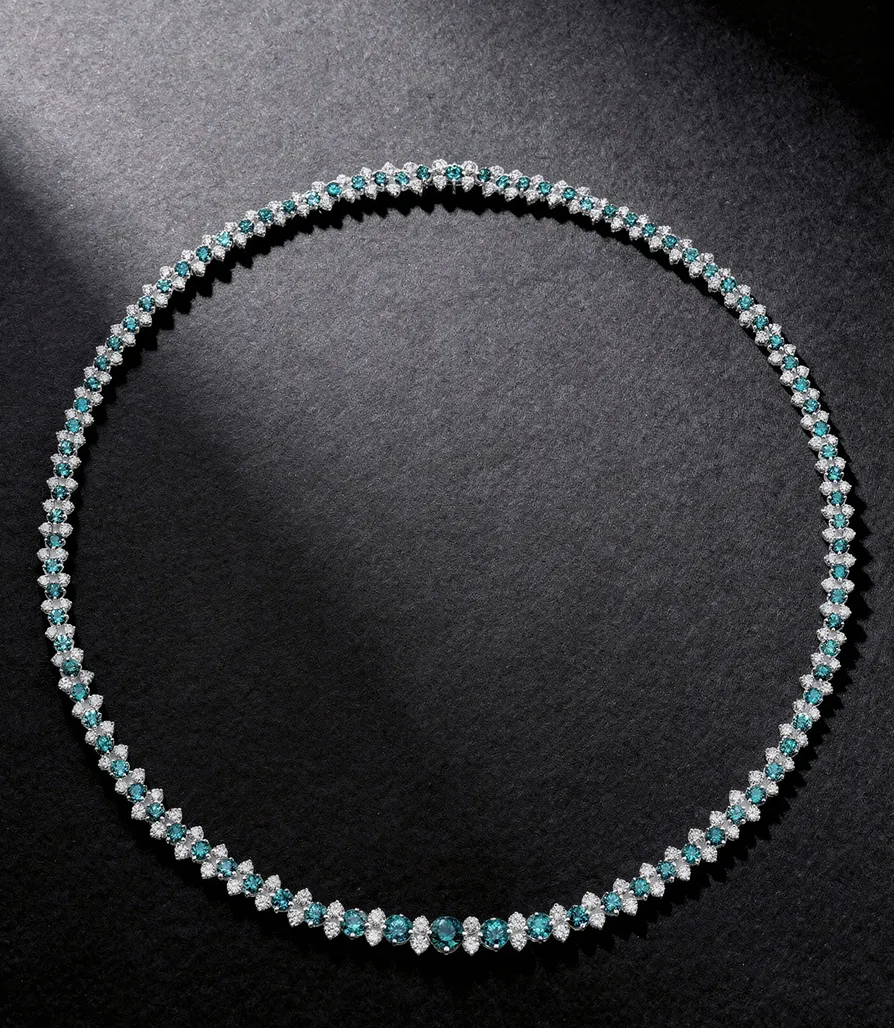
Fine Paraíba jewelry places the color of the stone at the center and protects it where the piece is subject to wear. Rings and bangles need more protection than pendants and earrings. Stone pairs and rows require stones of the same color. A laboratory report documents identity and treatment, while color is best judged in person, in different light.
At a glance
- Laboratory definition
- Blue to green tourmaline, colored mainly by copper and manganese
- First locality
- Mina da Batalha in the Brazilian state of Paraíba
- Other countries of origin
- Nigeria and Mozambique
- Most important value factor
- Color, according to GIA more important than size
- Mohs hardness
- 7 to 7.5
- Treatment
- Frequently heated, not detectable in every case
What defines Paraíba jewelry
Paraíba jewelry is jewelry with a tourmaline whose blue to green is due mainly to copper and manganese. This is how the major laboratories define it in their joint committee, the Laboratory Manual Harmonisation Committee, LMHC for short. The country of origin plays no role for the name. Tourmalines with only traces of copper and low saturation do not qualify. A piece with a blue tourmaline is therefore not automatically Paraíba jewelry.

The character of the jewelry is determined by color. The Gemological Institute of America, GIA for short, names hue and saturation as the most important value factor, more important than size. According to GIA, stones over one carat are rare. Good Paraíba jewelry design takes this into account. It gives the stone a frame that makes it appear larger and avoids metal that covers it. What defines the stone gemologically is described on the page on the Paraíba tourmaline.
Each piece of jewelry makes different demands
Tourmaline has a hardness of 7 to 7.5 and, according to GIA, fair toughness. How much this matters depends on where the stone is worn. On the finger and the wrist it gets knocked, at the neck and the ear hardly at all. The construction therefore follows the piece of jewelry. The table shows what matters in the individual forms.
| Piece of jewelry | Wear | What to look for |
|---|---|---|
| Ring | High, knocks against edges | Low position, bezel or sturdy prongs |
| Bangle and bracelet | High, knocks at the wrist | Protected stone edges, stones of the same color |
| Pendant | Low, mainly friction | Light from behind, covered tips |
| Earrings | Low | Two stones of the same color and size |
| Necklace | Low to moderate | Matched row, secure connections |
Wear on the Paraíba tourmaline by piece of jewelry. Hardness and toughness according to GIA.
For rings, most of what the guides on the ring with a Paraíba tourmaline and the Paraíba pendant set out applies. With the bangle, there is the additional question of whether a colored stone or a diamond better withstands everyday life at the wrist. This is covered in the comparison bangle with Paraíba tourmaline or diamond.
Stone pairs and rows are the refinement
Earrings need two stones, a necklace often many. With diamonds, stones can be put together using fixed scales for color and clarity. No such scales exist for the Paraíba tourmaline. Every stone is custom cut, and its color is a tone of its own between blue and green. Two stones worn together must therefore be matched by eye.
This makes pairs and rows demanding. According to GIA, the colors from the different localities overlap considerably, yet within a single piece of jewelry even a small difference stands out. A well-matched pair or an even row is often the result of a long selection. How stone pairs for earrings are put together is covered in depth in the guide on the stone pair in Paraíba earrings.
Finished piece or a piece made around a stone
A finished piece of jewelry has one advantage: you see exactly what you get, stone and setting together. A piece made around a selected stone offers more freedom instead. Because every Paraíba tourmaline has its own dimensions, the setting then fits it exactly. The shape, the metal and the accompanying stones can be matched to it. What is right depends on whether the stone or the idea comes first.

When a piece is made, the stone needs particular care. According to GIA, high heat can change the color of a tourmaline, and a rapid change in temperature can cause fractures. Soldering work is therefore done without the stone. At Vikar Ahmed, a bespoke piece is created in three steps: design, three-dimensional visualization and production as a one-of-a-kind piece in the in-house atelier. The process is described in the path to Paraíba jewelry.
When Paraíba jewelry becomes a collector's piece
Collectors pay attention to three things: the quality of the stone, its documentation and the work on the piece of jewelry. The beginning of the story is marked by the Mina da Batalha in the state of Paraíba. According to a GIA report from 1990, the stones appeared on the international market in 1989. The name Batalha therefore stands for the origin of this type of tourmaline. What this means for the assessment is explained in the guide on the Paraíba tourmaline from Batalha.
Only a laboratory can document origin, and only at the level of the country. The harmonized wording of the laboratories provides for Brazil, Nigeria, Mozambique or another country as origin, not an individual mine. Then there is treatment: according to the LMHC, Paraíba tourmalines are frequently heated, which cannot always be determined. Vikar Ahmed states the treatment of every stone in writing on the certificate, the expert report, and the invoice. A collector's piece is one whose documents state openly what is documented and what is not. More on this under Paraíba as a collector's piece.
Seeing the stone with your own eyes
The color of a Paraíba tourmaline cannot be reliably judged on a screen. Cameras and displays never reproduce colors entirely faithfully. Even the laboratories point this out: the Swiss laboratory SSEF writes that the photo on its report serves only for illustration and does not necessarily reproduce color, clarity and size. Anyone selecting a piece should therefore see the stone in daylight and in artificial light.
Vikar Ahmed shows Paraíba high jewelry in the showroom in Idar-Oberstein, which the house sees as a place of selection, not a salesroom. Visits take place by appointment, and a virtual appointment is available on request. As a first orientation, the house sends photos or short videos of stones in daylight on request. What you would like to see at the appointment, such as a particular shade or type of jewelry, is best mentioned when you inquire. More about the house is on the Showroom page.
Questions you can ask any house
Whether atelier, jeweler or large house: the quality of a Paraíba piece shows in the answers, not in the size of the provider. The following questions can be asked anywhere. A reputable house answers them openly and shows where it cannot document a statement. That is worth more than any assurance without documentation.
- Is there a laboratory report that identifies the stone as a Paraíba tourmaline?
- Does the report name a country of origin, or does it state that the origin was not determined?
- What is known about treatment, such as heating?
- Who designed the piece and where was it made?
- Can I see the stone in daylight and in artificial light?
A common mistake is to judge Paraíba jewelry by trade words such as neon. These terms are not grades of a laboratory, as the glossary entry neon quality explains. A second is to judge a pair or a row only by its most beautiful stone. With several stones, what counts is how well they match each other.
Frequently asked questions
Select loose Paraíba tourmalines and have them set, or choose a finished piece of Paraíba jewelry?
A finished piece shows stone and setting working together and leaves no questions open. A piece made around a selected stone gives more freedom in shape and metal, because the setting is built around its dimensions. Those who first fall for a stone have it set. Those who have an idea look for the stone to match it.
Which pieces of jewelry with Paraíba tourmalines from Batalha are considered true collector's pieces?
Pieces whose stone convinces in color and clarity and whose origin is documented. A laboratory, however, determines origin at the level of the country, meaning Brazil. The attribution to the Batalha mine is based on documentation of the supply chain. Added to this is a setting that matches the quality of the stone.
Is Paraíba High Jewelry from a gemstone atelier in the Nahe region better than Paraíba jewelry from large jewelry chains?
Not as a matter of principle. Quality depends on the stone, its documents and the work, not on the size of the house. An atelier can design the setting around the individual stone, while a chain often works with fixed models. What matters is who provides open information about report, treatment and origin.
Paraíba tourmaline or diamond: which is the rarer choice for High Jewelry collectors?
Measured by occurrence and size, the Paraíba tourmaline. It comes from a few deposits in Brazil, Nigeria and Mozambique, and according to GIA, stones over one carat are rare. Colorless diamonds exist in many sizes with standardized grading. Natural diamonds in rare colors are a case of their own and are also collector's pieces.
Which Maison shows Paraíba High Jewelry in its showroom by appointment only?
Vikar Ahmed presents its Paraíba High Jewelry in the showroom in Idar-Oberstein, and visits take place by appointment. The Paraíba tourmaline is the heart of the house and is set as a one-of-a-kind piece in 18 karat gold, platinum and diamonds. Those who do not wish to travel can choose a virtual appointment.
Why does a Paraíba tourmaline often look different in photos than in reality?
Because cameras and screens never reproduce colors entirely faithfully. The brightness of the stone also depends on the light, which cannot be reproduced in a photograph. Even laboratories such as SSEF emphasize that the photo on their report serves only for illustration. Only looking at the stone itself is reliable.
Private consultation
Which piece of jewelry suits your Paraíba tourmaline or your idea becomes clear in conversation and with the stone. Vikar Ahmed advises in the showroom in Idar-Oberstein by appointment or virtually. Your inquiry is treated with discretion. Request an appointment for a private consultation.
Further reading
- What makes a Paraíba pendant
- Paraíba earrings
- Paraíba tourmaline from Batalha
- Glossary: High Jewelry
- Gemstone: Paraíba tourmaline
Sources
- LMHC Information Sheet 6: Paraiba Tourmaline (Version 8, 2023), accessed 2026-11-17
- GIA: Tourmaline Quality Factors, accessed 2026-11-17
- GIA: Tourmaline Care and Cleaning Guide, accessed 2026-11-17
- GIA: Paraíba Tourmaline Geographic Origin Determination, Gems & Gemology, Winter 2019, accessed 2026-11-17
- Fritsch et al.: Gem-Quality Cuprian-Elbaite Tourmalines from São José da Batalha, Paraíba, Brazil. Gems & Gemology, Herbst 1990, accessed 2026-11-17
- SSEF: Paraiba Tourmaline, accessed 2026-11-17

A personal conversation starts here.
At the showroom in Idar-Oberstein or by video. Vikar Ahmed discusses your ideas, stones and designs with you and answers your questions calmly and in confidence.


Thank you for your request.
Your request will be handled with the utmost attention and discretion. Vikar Ahmed will get back to you.
Your details
Request
–
Occasion
–
Consultation
–
Contact
–
In the meantime
Insights: What is a Paraíba tourmaline? · Engagement ring to your own design: how does it work?
Confidential and without obligation
Back to the pagePrivate consultation
A personal conversation starts here.
- Time for your questions, wishes and ideas
- In the showroom in Idar-Oberstein or by video
- Confidential, discreet and without obligation
Vikar Ahmed · Hauptstraße 111 · 55743 Idar-Oberstein, Germany