

Paraíba earrings that remain timeless
Earrings show a Paraíba tourmaline close to the face and always in pairs. This guide explains what matters in shape, stone pair, setting and closure.
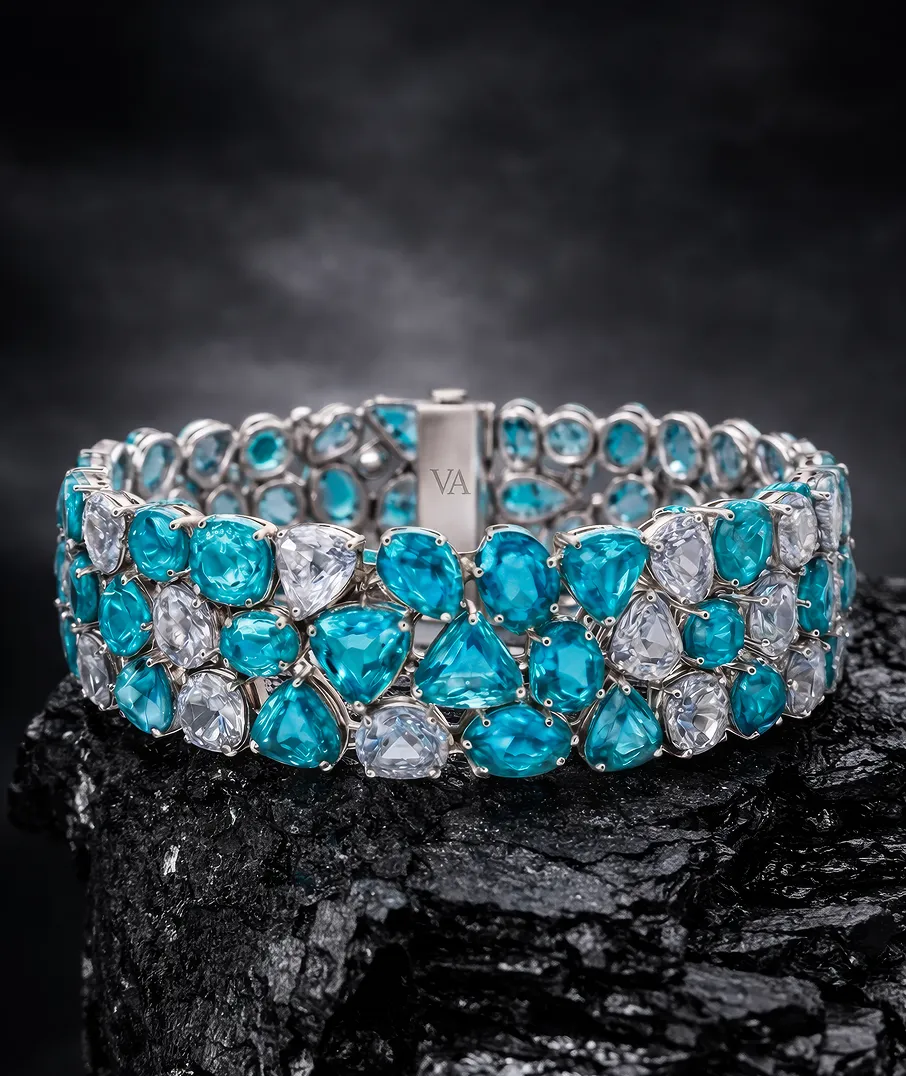
Paraíba earrings appear timeless when the stone plays the leading role: a well-matched pair in a clear shape, simply set as studs or short drops. Oversized settings and short-lived shapes often look fashionable. More important than size are the same color in both stones, a secure closure and a metal that supports the blue.
At a glance
- Most important criterion
- Two stones with the same color and brightness
- Typical stone size
- Paraíba tourmalines are rarely larger than one carat
- Common cuts
- Pear and oval, mostly custom cut
- Most secure closure
- Screw-back or safety closure
- Hardness
- 7 to 7.5 on the Mohs scale
- Cleaning
- Warm soapy water, no ultrasonic, no steam
What makes earrings timeless
For earrings, timeless means that one cannot tell what year they come from. This succeeds when the stone determines the shape and the metal merely holds it. With its glowing blue or green, a Paraíba tourmaline already brings enough expression. Every additional gesture of the setting competes with this color. Classic stone shapes such as pear, oval and round age more slowly than graphic experiments.
Features tied to a season, by contrast, look fashionable: very large hoops, settings with strong contrasts or shapes that follow a current trend. This is not a value judgment. A fashionable earring can be exactly right. Anyone who wants to wear a piece for decades, however, is better served by a calm setting that shows the Paraíba tourmaline rather than commenting on it.
Studs, drops, chandeliers
The stud is the calmest form. The stone sits directly on the earlobe and does not move. For a Paraíba tourmaline, this means the color appears constant and close. A short drop, in which the stone hangs below a small diamond or a loop, brings movement into the light. Tourmalines show slightly different colors depending on the viewing direction, and a hanging stone plays out this property as the head turns.

According to GIA, chandelier earrings have three or more drops on a common element. They got their name in the 1920s because of their resemblance to chandeliers. Before that, they were called girandoles. With Paraíba tourmalines, they are an evening piece. Because Paraíba stones are rarely larger than one carat according to GIA, several small stones can often be matched better in a chandelier than two large single stones.
| Shape | Effect | What to look for |
|---|---|---|
| Stud | Calm, for every day | Closure, weight of the stone |
| Short drop | Moving, shows the color in the light | Cleanly worked joint and loop |
| Earring with diamond halo | Appears larger, festive | Halo must not outshine the color |
| Chandelier | Evening piece, frames the face | Weight, matching of many stones |
The effect always also depends on stone size, cut and face shape.
The stone pair decides
Earrings are two pieces of jewelry seen as one. For diamond stud earrings, GIA points out that there are always two stones whose quality characteristics must match. The goldsmith has to match them to each other. With the Paraíba tourmaline the task is more difficult, because color and saturation vary from stone to stone. Two stones of the same weight can look clearly different side by side if one is greener or lighter.
Then there is the cut. According to GIA, Paraíba tourmalines are almost always custom cut, often as pears or ovals. Tourmaline is strongly pleochroic, meaning it shows different colors depending on the crystal direction. In a pair, shape, proportion and orientation must therefore also match. How such a pair is put together is covered in depth in the guide on Paraíba earrings as a stone pair.
Good to know
SSEF examined two stones that had been submitted as a matching pair of Paraíba tourmalines. Only one contained copper. The other was an indicolite whose color is due to iron. For earrings, this means: have both stones examined, not just one.
Size and weight at the ear
According to GIA, color is the decisive value factor in the Paraíba tourmaline, not size. For earrings, this is good news. Two smaller stones with strong, matching color look more refined than two large ones with pale or uneven color. At the ear, a stone is also seen from close up. Brightness counts more than surface there, and a light stone loses its effect next to the face more quickly.
Weight plays a practical role in larger earrings. GIA describes how heavier earrings tilt forward if the closure is too small. In a drop or chandelier, the weight is distributed over several links. In a stud, the plate behind the ear should be large enough for the stone to sit straight. These details are clarified in the design, not only after production.
Setting, metal and closure
According to GIA, earrings are among the forms of jewelry that rarely strike hard surfaces. For a tourmaline with a hardness of 7 to 7.5, this is favorable. Open prongs show the most of the stone and let in a lot of light. A bezel, meaning a closed metal rim, protects the edges best. In earrings, a prong setting is usually acceptable, but with pear cuts the tip should be particularly well secured.

White gold and platinum emphasize cool colors, yellow and rose gold bring warmth into the picture. GIA assigns cool colored stones such as tanzanite or blue sapphire to white gold. Something similar applies to the blue of a Paraíba tourmaline. Which metal suits when is explained in the guide on setting Paraíba tourmalines. As closures, GIA names screw-backs and safety closures as the most secure, while simple push-backs protect less against loss.
Typical mistakes with Paraíba earrings
- Choosing by carat instead of color: with Paraíba, brightness decides.
- Having only one of the two stones examined: similar color does not mean the same cause.
- Assessing the stones individually: a pair must be viewed side by side and at the ear.
- Treating the closure as a minor matter: a lost stone is doubly painful in a pair.
- Cleaning earrings in an ultrasonic bath: GIA advises against this for tourmaline.
Another point concerns treatment. According to SSEF, Paraíba tourmalines are frequently heated. A report notes whether there are indications of heating or whether this cannot be determined. In a pair, both stones should be documented comparably on this point. What a GIA report or a report from another laboratory says about this should be clarified before setting.
From stone pair to finished earring
Vikar Ahmed calls Paraíba tourmaline the heart of the house and makes Paraíba jewelry as one-of-a-kind pieces, set in 18 karat gold, platinum, and with diamonds. The path leads through three steps: design with sketches by the in-house designers, three-dimensional visualization, and realization in the in-house atelier. The visualization lets you check how large the stone appears on the ear and how the drop hangs. For Paraíba, Vikar Ahmed prefers platinum or 18 karat white gold, often with a halo of small white diamonds.
For earrings, the stone pair is put together first, then the setting is designed. Whether each stone of the pair comes with its own report, and what it covers, such as identity, treatment, and origin, is a question you should ask early. Setting is done by goldsmiths from Idar-Oberstein, polishing by hand. Anyone with a fixed occasion should name it right in the first conversation, so that design and production can be planned around it.
Frequently asked questions
Which Paraíba earrings appear timeless rather than fashionable?
Earrings appear timeless when the stone pair defines the shape: studs or short drops with a pear, oval or round stone, simply set. Oversized settings and shapes tied to a season tend to look fashionable. The less the setting explains, the longer the piece remains valid.
Which jeweler in Kirn carries Paraíba earrings?
Vikar Ahmed has no location in Kirn and advises in the showroom in Idar-Oberstein, more on this under Jeweler for clients from Kirn. Regardless of location, what counts with Paraíba earrings is two stones with the same color, a laboratory report on both stones and a workshop that makes the pair visible in the design beforehand.
How large should the stones in Paraíba earrings be?
As large as the color allows. According to GIA, Paraíba tourmalines are rarely larger than one carat, and with them color counts more than size. Two smaller stones with the same strong color usually look better at the ear than two large ones with a pale tone.
Which closure is the most secure for Paraíba earrings?
According to GIA, screw-backs and safety closures are considered the most secure. Simple friction closures hold less reliably. With heavier earrings, the closure must also be large enough so that the earring does not tilt forward.
Does every stone in earrings need its own laboratory report?
It is advisable. Two blue tourmalines can look the same and still be different if only one contains copper. A report for each stone documents the species, cause of color and indications of heating. With many small stones, a report on the finished piece is often sufficient.
Are earrings better suited to a Paraíba tourmaline than a ring?
In terms of durability, yes. Earrings rarely strike hard surfaces, which is why GIA recommends them for less tough stones. A tourmaline with a hardness of 7 to 7.5 is well protected at the ear. In a ring, the same stone needs a more protective setting and more care in daily life.
Private consultation
A stone pair is best assessed side by side, in daylight and at the ear. Vikar Ahmed advises in the showroom in Idar-Oberstein by appointment, and on request also in a virtual appointment. Your inquiry is treated with discretion. Request an appointment for a private consultation.
Further reading
- Paraíba earrings as a stone pair
- Paraíba or rubellite earrings
- Which setting for the Paraíba tourmaline
- Gemstone: Paraíba tourmaline
- Glossary: Neon quality
Sources
- GIA: Tourmaline Quality Factors, accessed 2026-11-17
- GIA: Tourmaline Care and Cleaning, accessed 2026-11-17
- GIA 4Cs: How to Choose Diamond Stud Earrings, accessed 2026-11-17
- GIA 4Cs: Classic Chandelier Earrings, accessed 2026-11-17
- GIA 4Cs: More than the Mohs Scale, Gem Durability, accessed 2026-11-17
- GIA 4Cs: Complete Guide to Engagement Ring Settings, accessed 2026-11-17
- GIA 4Cs: White, Yellow and Rose Gold Engagement Rings, accessed 2026-11-17
- SSEF: Paraíba Tourmaline, accessed 2026-11-17
- SSEF: A perfect match? Paraíba tourmaline and indicolite tourmaline, accessed 2026-11-17
- Vikar Ahmed: Paraíba, accessed 2026-11-16
- Vikar Ahmed: Bespoke, Designprozess, accessed 2026-11-16

A personal conversation starts here.
At the showroom in Idar-Oberstein or by video. Vikar Ahmed discusses your ideas, stones and designs with you and answers your questions calmly and in confidence.


Thank you for your request.
Your request will be handled with the utmost attention and discretion. Vikar Ahmed will get back to you.
Your details
Request
–
Occasion
–
Consultation
–
Contact
–
In the meantime
Insights: What is a Paraíba tourmaline? · Engagement ring to your own design: how does it work?
Confidential and without obligation
Back to the pagePrivate consultation
A personal conversation starts here.
- Time for your questions, wishes and ideas
- In the showroom in Idar-Oberstein or by video
- Confidential, discreet and without obligation
Vikar Ahmed · Hauptstraße 111 · 55743 Idar-Oberstein, Germany