

Paraíba or rubellite earrings?
Paraíba tourmaline and rubellite are both tourmalines and yet opposites: cool, glowing blue against deep red. A comparison for earrings that are worn for a long time.
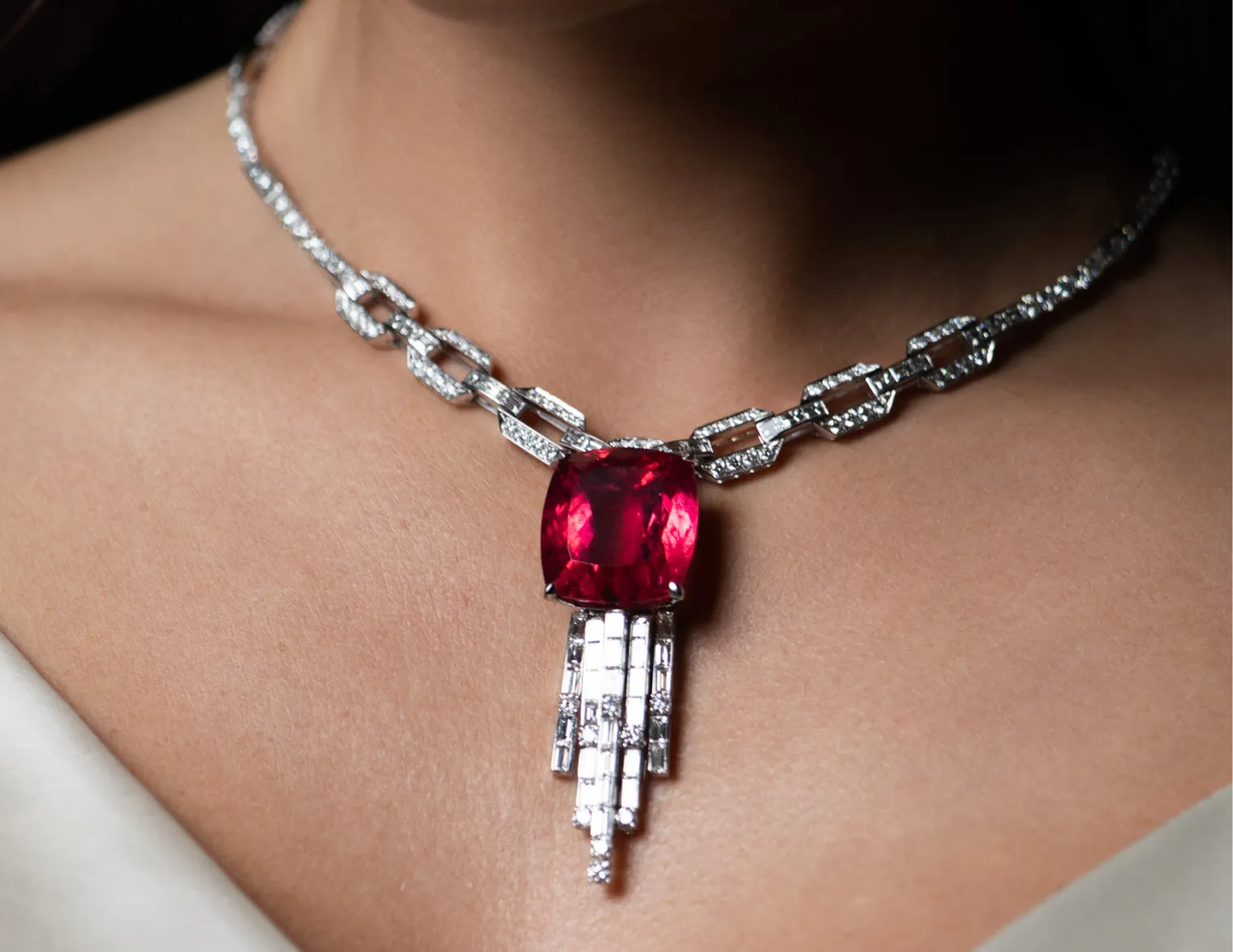
Both are timeless over the long term if the color is strong and the pair is well matched. Rubellite earrings stand in the tradition of red gemstones and appear classic. Paraíba earrings appear more modern and striking, because their color has only been known since the late 1980s. What makes a piece timeless is above all a calm setting, not the color of the stone.
At a glance
- In common
- Both are tourmalines, hardness 7 to 7.5
- Paraíba color
- Blue to green, mainly due to copper and manganese
- Rubellite color
- Pink to red, red and pink are caused by manganese
- Clarity
- With strong red, visible inclusions are more readily accepted
- Size
- Paraíba rarely over one carat, rubellite also larger
- Common treatments
- Heating for both, irradiation also used for tourmaline
Two tourmalines with opposite colors
Paraíba tourmaline and rubellite belong to the same mineral group. The difference lies in the trace elements. According to SSEF, the color of the Paraíba tourmaline is caused mainly by copper and manganese. According to GIA, red and pink in tourmaline are caused by manganese. GIA lists rubellite as a trade name for pink, red, purplish red, orangy red or brownish red tourmalines. Part of the trade wants to use the name only for the red tones.

At the ear, this chemistry leads to two different expressions. Paraíba blue appears cool, bright and almost electric, and it stands out even from a distance. A rubellite appears warm and dense, depending on the tone more like a ruby or like a strong pink. GIA writes that the hue and depth of tourmaline can rival ruby and pink sapphire. Both stones have a strong effect close to the face, but in opposite ways.
The direct comparison
| Criterion | Paraíba earrings | Rubellite earrings |
|---|---|---|
| Color effect | Cool, glowing, modern | Warm, deep, classic |
| Cause of color | Copper and manganese | Manganese |
| Typical stone size | Rarely over one carat | Larger stones more common |
| Clarity | Brightness counts before clarity | Inclusions more readily accepted with strong color |
| Suitable metal | White gold and platinum emphasize the blue | Yellow and rose gold emphasize the warmth |
| Hardness and care | 7 to 7.5, no ultrasonic | 7 to 7.5, no ultrasonic |
Information on cause of color, size, clarity and care according to GIA and SSEF. The choice of metal is a recommendation, not a rule.
What appears timeless over the long term
Red gemstones have accompanied jewelry for centuries. A rubellite earring ties in with this visual language and is therefore rarely read as fashionable. The Paraíba tourmaline, by contrast, is young: according to GIA, the area in Brazil has only been known for these colors since the late 1980s. Its color still carries the freshness of a discovery. This does not make it fashionable, but more striking, and what is striking is more quickly associated with a point in time.
More important than the color of the stone is the design. A rubellite in a playful trend setting ages faster than a Paraíba tourmaline in a simple stud. Clear stone shapes such as pear and oval appear timeless, as do a setting that shows the stone and a size that suits the face. Anyone torn between the two colors should therefore first decide on the shape and then check which color appears calmer in it.
Clarity, size and pairing
Expectations differ when it comes to clarity. According to GIA, pink and red tourmalines are often accepted even with visible inclusions if the color is strong. With the Paraíba tourmaline, brightness is in the foreground, and according to GIA, color is the decisive factor there, not size. Paraíba stones are rarely larger than one carat. Rubellites also come in larger stones, and according to GIA, the price per carat of tourmalines rises from about five carats.

For earrings, this means that a rubellite pair can more readily be assembled in a substantial size, a Paraíba pair more in a fine and glowing one. For both, what counts is that the two stones match in hue, lightness and cut. Tourmalines are strongly pleochroic and show different colors depending on the direction in the crystal. A cleanly matched pair therefore does not result from any two stones of the same weight.
Treatment and durability
According to GIA, tourmalines are mainly heated and irradiated. Changes from heating are stable, color changes from irradiation can fade under heat or strong light. According to GIA, some pink tourmalines owe their color to color centers created by natural or artificial radiation. According to SSEF, Paraíba tourmalines are frequently heated, and according to GIA, heating cannot always be detected. A report should be available for both stones of a pair.
In daily life, both stones behave the same way. According to GIA, tourmaline reaches 7 to 7.5 on the Mohs scale, is largely stable to light and chemicals, but is sensitive to heat and sudden temperature changes. Earrings are a favorable form of jewelry for this, because they are rarely knocked. Cleaning is done with warm soapy water, not in an ultrasonic bath. What laboratory reports say about treatment should be clarified before setting.
Metal and skin tone
GIA tends to assign cool colored stones to white gold and warm colored stones to yellow and rose gold. A Paraíba tourmaline appears clear and cool in white gold or platinum, softer in rose gold. A rubellite gains warmth in yellow or rose gold, while in white gold it appears cooler and more graphic. According to GIA, rose gold is created by copper and silver in the alloy. More on this choice can be found in the guide on setting the Paraíba tourmaline.
Earrings sit directly next to the skin. A stone that convinces in the hand can appear different at the ear, depending on skin tone, hair color and the colors one often wears. Those who mostly wear cool colors often find a continuation in Paraíba blue, those who like warm tones in rubellite. There is no fixed rule. The decision is made most reliably when both stones are viewed at the ear one after the other.
Which suits whom
- Paraíba earrings: for anyone looking for a glowing, modern color who tends to wear fine stones.
- Rubellite earrings: for a classic, warm expression, also with larger stones.
- For every day: studs in both variants, simply set, with a secure closure.
- For evenings: drops with rubellite or Paraíba, complemented by colorless diamonds.
- For collectors: a Paraíba pair with a report on both stones.
The pieces shown by Vikar Ahmed include both Brazilian Paraíba tourmalines and rubellites, set in 18k (750) white and rose gold. For rubellite, what counts for Vikar Ahmed is the radiance of the color and a precise cut, and he accepts fine inclusions as long as they do not cloud the color. For Paraíba, he looks for a glowing blue that seems to shine from within. Earrings are created there as one-of-a-kind pieces through design, three-dimensional visualization, and realization in the in-house atelier. If you would like to see both colors side by side, it is best to mention this when you inquire.
Frequently asked questions
Paraíba earrings or rubellite earrings: which appear more timeless over the long term?
Rubellite earrings often appear more classic, because red stones have a long tradition in jewelry. Paraíba earrings appear more modern and striking. What decides longevity, however, is above all the design: a simple setting with a clear stone shape ages more slowly with both stones than a trend setting.
Is rubellite a tourmaline?
Yes. Rubellite is a trade name for pink to red tourmalines. According to GIA, their color is caused by manganese. Mineralogically, rubellite and Paraíba tourmaline belong to the same group and have the same hardness. They differ in their trace elements and therefore in their color.
Which of the two stones is more delicate?
Neither. Both are tourmalines with 7 to 7.5 on the Mohs scale and react the same way to heat and temperature changes. Differences arise from the inclusions and treatments of the individual stone. At the ear, both are well protected, because earrings rarely strike hard surfaces.
Can the color of a rubellite fade?
In stones whose color was altered by irradiation, according to GIA this is possible under heat or strong light. Heated tourmalines are considered color-stable. A laboratory report gives indications of treatments. That is why the report is worthwhile for a rubellite too, not only for the Paraíba tourmaline.
Can Paraíba and rubellite be combined in one pair of earrings?
Yes, as a deliberate contrast. Cool blue and warm red meet in a drop or in an asymmetrical pair. For the result to appear calm, both stones should be similarly light and similar in size. A metal in between, such as rose gold, connects both tones.
Private consultation
Whether blue or red suits you better is revealed at the ear, not on a screen. Vikar Ahmed advises in the showroom in Idar-Oberstein by appointment, and on request also virtually. Your inquiry is treated with discretion. Request an appointment for a private consultation.
Further reading
- Paraíba earrings that remain timeless
- Paraíba earrings as a stone pair
- Gemstone: Rubellite
- Gemstone: Paraíba tourmaline
- Glossary: Paraíba tourmaline
Sources
- GIA: Tourmaline Description, accessed 2026-11-17
- GIA: Tourmaline Quality Factors, accessed 2026-11-17
- GIA: Tourmaline Care and Cleaning, accessed 2026-11-17
- GIA: Tourmaline History and Lore, accessed 2026-11-17
- GIA Gems & Gemology: Paraíba Tourmaline Geographic Origin Determination, accessed 2026-11-17
- GIA 4Cs: White, Yellow and Rose Gold Engagement Rings, accessed 2026-11-17
- SSEF: Paraíba Tourmaline, accessed 2026-11-17
- Vikar Ahmed: Collections, accessed 2026-11-16

A personal conversation starts here.
At the showroom in Idar-Oberstein or by video. Vikar Ahmed discusses your ideas, stones and designs with you and answers your questions calmly and in confidence.


Thank you for your request.
Your request will be handled with the utmost attention and discretion. Vikar Ahmed will get back to you.
Your details
Request
–
Occasion
–
Consultation
–
Contact
–
In the meantime
Insights: What is a Paraíba tourmaline? · Engagement ring to your own design: how does it work?
Confidential and without obligation
Back to the pagePrivate consultation
A personal conversation starts here.
- Time for your questions, wishes and ideas
- In the showroom in Idar-Oberstein or by video
- Confidential, discreet and without obligation
Vikar Ahmed · Hauptstraße 111 · 55743 Idar-Oberstein, Germany