

The Matched Pair of Stones for Paraíba Earrings
Two Paraíba tourmalines that appear as one stone at the ear are rarer than a single beautiful stone. What makes a good pair and how to assess it.
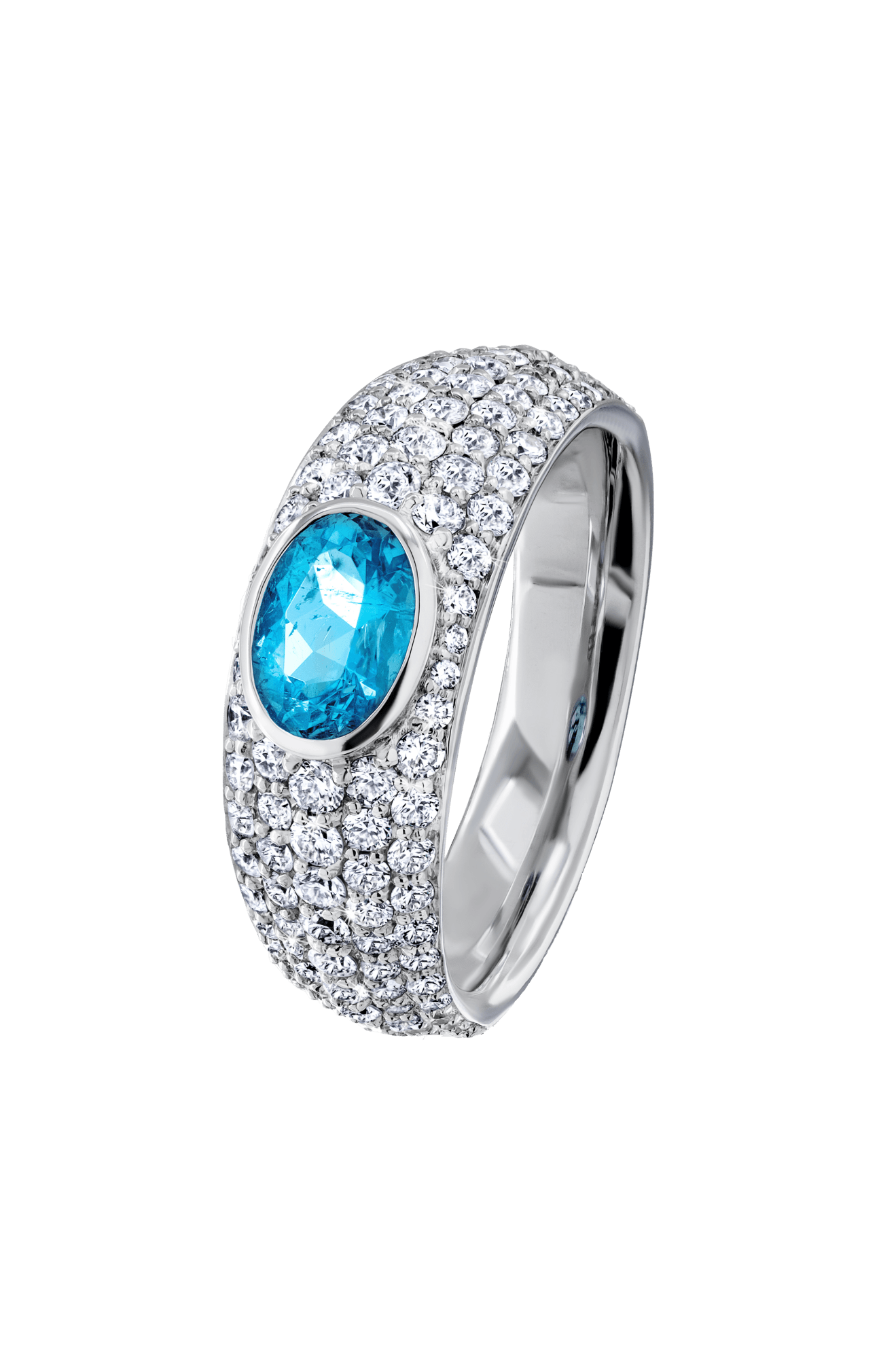
Yes, if the earrings are meant to read as a pair and the difference would be visible. Paraíba tourmalines are usually cut individually, show different colors depending on the viewing direction, and are rare above one carat. Finding two stones of the same tone, the same saturation, and a similar size takes time and selection. With small stones and drop earrings, a slight deviation is less noticeable.
At a glance
- Matched means
- Same hue, same saturation and tone, similar size and shape
- Cut
- According to GIA almost always individual, usually as a pear or oval
- Pleochroism
- Tourmaline shows different colors depending on the viewing direction, one usually considerably darker
- Size
- Paraíba tourmalines over one carat are rare, according to GIA
- Confusion
- An indicolite can resemble a Paraíba, only the laboratory separates them reliably
- Documents
- One report per stone, each with its own number
When a matched pair is worthwhile
A matched pair is worthwhile above all where the eye sees both stones at once. With stud earrings, the stones sit at the same height close to the face, and a difference in tone is noticed immediately. With longer drop earrings, the stones move, the light changes, and a small deviation recedes. The larger and more saturated the stones are, the more readily one sees whether two stones belong together or are merely similar.
The greater effort does not arise from the setting, but from the search. A single beautiful Paraíba tourmaline is already a selection from little material. A second one that matches it in color, size, and shape is a selection from even less. Even for diamond stud earrings, GIA recommends budgeting for two stones and comparing the quality characteristics of both stones. With Paraíba, the matching is considerably more difficult, because there is no fixed color scale.
Why two identical Paraíba tourmalines are rare
Three properties of Paraíba tourmaline make identical pairs rare. First, size: according to GIA, stones over one carat are seen only rarely. Second, the cut: because the rough material is so valuable, Paraíba tourmalines are almost always cut individually to preserve weight and color. Standard dimensions, which would make a pair easier, are therefore the exception. Third, the color, which can vary even within a single crystal.

According to GIA, tourmaline is strongly pleochroic. It shows different colors depending on the viewing direction, and one of them is usually considerably darker. How a stone appears face-up therefore depends on how the cutter oriented it relative to the crystal axis. Two stones from different crystals, or oriented differently, can therefore appear a different blue despite similar chemistry. Stones that come from the same rough and were cut with the same orientation are the most likely to match.
How to recognize a good pair
A good pair can only be recognized in direct comparison. Place both stones side by side with the table facing up and look at them from a normal reading distance. The hue should be the same, meaning both blue, both greenish blue, or both green. Saturation and tone should be so close that you cannot say which stone is more vivid. Then come shape, outline, and face-up size.
| Characteristic | Good pair | Typical deviation |
|---|---|---|
| Hue | Both stones in the same blue or green | One stone more bluish, one more greenish |
| Saturation | Same vividness side by side | One stone appears paler or grayer |
| Tone | Equally light, even in dark surroundings | One stone darkens more under artificial light |
| Shape and outline | Mirror-image or identical | Different length or shoulder |
| Face-up size | Same visible diameter | Same weight, but different depth |
| Clarity | Comparable inclusions | One stone with visible needles or fractures |
Characteristics for assessing a pair of Paraíba stones for earrings. What counts is the impression side by side, not the individual stone.
Pay particular attention to face-up size. Two stones of the same weight can appear different in size if one is cut deeper. For clarity, GIA names thread-like cavities and growth tubes in particular as typical inclusions in tourmaline. A single visible inclusion in only one stone is more disturbing at the ear than two stones with comparable inclusions.
Light and distance: the test at the ear
A pair that looks identical in the tweezers can look different at the ear. On the head, light falls from the side and from above, and the stones are rarely viewed head-on. A stone cut slightly deeper or shallower then shows more or less color than its counterpart. A comparison in the intended setting, or at least at the height at which the stones will later sit, is therefore sensible.
The type of light also counts. Examine the pair in daylight at a window, under warm artificial light, and in shade. Paraíba tourmalines appear more or less lively in different light, and two stones do not always change in step. If they remain the same in all three situations, the pair is well matched. If one deviates only under artificial light, the deciding question is when the earrings will mostly be worn.
Two stones, two reports
With a pair, the identity of both stones cannot be taken for granted. SSEF describes a case in which a client submitted two stones as a matching Paraíba pair. In the laboratory, one proved to be a copper-bearing Paraíba tourmaline, the other an iron-bearing indicolite without copper. The two were almost indistinguishable in shape, size, and color. A pair should therefore be tested stone by stone, not just one on behalf of both.

Every SSEF report carries its own number. An identification report determines the material and names detectable treatments, and on request also the origin. The laboratories do not agree on the name: according to the LMHC committee, a matching copper-bearing tourmaline is called Paraíba regardless of the country of origin, while SSEF uses the name in its report only for Brazilian stones. At Vikar Ahmed, every high-quality Paraíba is accompanied by an independent original certificate, from 1 carat with origin determination. More on this in the guide to the identification report.
Good to know
Heating is common with Paraíba tourmaline and, according to GIA, not detectable in tourmaline. A report may therefore note for both stones of a pair that heating cannot currently be determined.
Setting and clasp for the pair
The setting can support a good pair or compensate for small differences. A bezel setting, a metal rim around the stone, frames both stones identically and protects the edges. Prongs show more of the stone and let in more light, but make differences in outline more visible. A halo of colorless diamonds draws the eye to the shape and makes a slight deviation in tone less noticeable. More on the forms in the guide Paraíba tourmaline setting.
For the clasp, GIA names screw backs and safety backs as the most secure solutions, while simple push backs offer less protection against loss. Earrings that tip forward are usually too heavy for their backs. With a valuable pair, the clasp is therefore no minor matter: if one stone is lost, a matching replacement is hardly to be found. Tourmaline also has a hardness of only 7 to 7.5 and fair toughness.
Typical mistakes with Paraíba pairs
- Matching only the weight: the same carat weight does not mean the same face-up size.
- Assessing the stones individually instead of side by side, under only one type of light.
- Having one stone tested and tacitly treating the other as identical.
- Choosing prongs even though the outlines visibly differ.
- Using a simple push back for heavy or valuable stones.
- Cleaning in an ultrasonic bath, which GIA does not recommend for tourmaline.
The most common mistake is a compromise at the outset. If you take two stones that are merely similar, you will see the difference later every time you look in the mirror. If no second stone of equal quality can be found, there are alternatives: drop earrings, in which the stones do not appear directly side by side, or a single large stone in a pendant. What timeless earrings with Paraíba can look like is shown in the guide Paraíba earrings.
Frequently asked questions
Are Paraíba earrings with precisely color-matched stones worth the extra cost?
For studs and larger stones, usually yes, because both stones sit side by side close to the face and every deviation is visible. The extra cost arises from the elaborate search for a second stone of the same color and size. With small stones or moving drop earrings, a slight difference is less noticeable.
How can you tell whether two Paraíba tourmalines truly match?
By comparing them side by side in daylight, artificial light, and shade. Hue, saturation, and tone should be so alike that neither stone appears more vivid. After that, outline and face-up size count. The same weight alone says little, because a deeper-cut stone appears smaller.
Why do two Paraíba tourmalines of the same origin look different?
Because tourmaline shows different colors depending on the viewing direction. How a stone appears depends on how the cutter oriented it relative to the crystal axis. Since Paraíba tourmalines are almost always cut individually, two stones of the same origin can end up a visibly different blue.
Does each stone of a Paraíba pair need its own report?
It is advisable. Two stones can look alike and still be different tourmalines, as a pair of a Paraíba and an indicolite examined at SSEF shows. One report per stone documents the identity and detectable treatments of both stones, and each carries its own number.
Which clasp is suitable for Paraíba stud earrings?
A screw back or a safety back. GIA names these two as the most secure solutions against loss. Simple push backs hold less firmly. With a matched pair this counts twice, because an equivalent replacement for a lost stone is hardly to be found.
Is a slightly unequal pair a problem in drop earrings?
Less so than with studs. Drop earrings move, the light falls differently all the time, and the stones are rarely seen directly side by side. A small deviation in tone is hardly noticeable there. Clear differences in shape or size, however, remain visible in drop earrings as well.
Private consultation
Whether two Paraíba tourmalines truly form a pair only becomes clear when you see them side by side. Vikar Ahmed advises in the house's showroom in Idar-Oberstein by appointment or in a virtual appointment and creates earrings as a one-of-a-kind piece in its in-house atelier. Request a private consultation.
Further reading
- Guide: Paraíba earrings that remain timeless
- Paraíba or rubellite earrings
- Guide: Earrings as a one-of-a-kind piece
- Glossary: Neon quality
- Gemstone: Paraíba tourmaline
Sources
- GIA: Tourmaline Quality Factors, accessed 2026-11-17
- GIA: Tourmaline Care and Cleaning, accessed 2026-11-17
- GIA 4Cs: How to Choose Diamond Stud Earrings, accessed 2026-11-17
- SSEF: A perfect match? Paraiba tourmaline and indicolite tourmaline, accessed 2026-11-17
- SSEF: Paraiba Tourmaline, accessed 2026-11-17
- GIA: Colored Stone Reports, accessed 2026-11-17
- LMHC Information Sheet 6: Paraiba Tourmaline, accessed 2026-11-17

A personal conversation starts here.
At the showroom in Idar-Oberstein or by video. Vikar Ahmed discusses your ideas, stones and designs with you and answers your questions calmly and in confidence.


Thank you for your request.
Your request will be handled with the utmost attention and discretion. Vikar Ahmed will get back to you.
Your details
Request
–
Occasion
–
Consultation
–
Contact
–
In the meantime
Insights: What is a Paraíba tourmaline? · Engagement ring to your own design: how does it work?
Confidential and without obligation
Back to the pagePrivate consultation
A personal conversation starts here.
- Time for your questions, wishes and ideas
- In the showroom in Idar-Oberstein or by video
- Confidential, discreet and without obligation
Vikar Ahmed · Hauptstraße 111 · 55743 Idar-Oberstein, Germany