

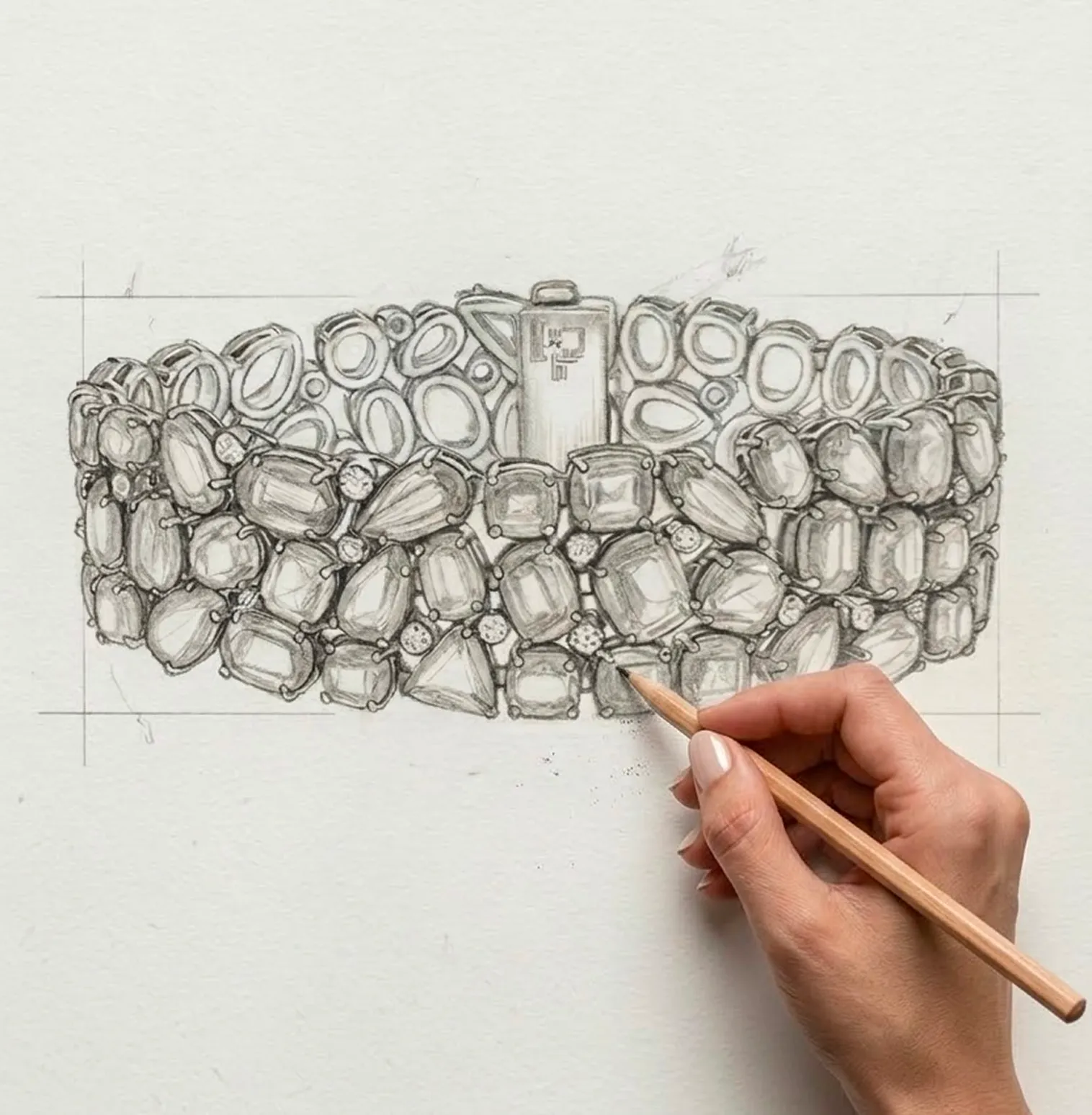
One-of-a-kind earrings arise from three decisions: the form on the ear, from stud to drop; the pair of stones that match in color, size, and cut; and the back that holds the weight securely. Because a pair consists of two pieces, the design usually begins with the search for two matching stones, not with the drawing.
At a glance
- Basic forms
- Stud, hoop, drop, chandelier
- Chandelier
- According to GIA, three or more drops on a common element
- Most secure backs
- According to GIA, screw backs and locking backs
- Stone pair
- Both stones matched in color, size, cut, and clarity
- Setting
- Prongs for light, bezel for the best protection
- Delicate stones
- According to GIA, better protected in an earring than in a ring
A pair means precision twice over
A ring needs one stone, a pair of earrings two that look the same side by side. For diamond studs, GIA writes that the 4Cs of both stones must match. With colored stones, hue, saturation, and tone are added. Because face and hair lie between the two stones, they are never seen directly side by side. Differences are noticeable all the same, especially in photos and in the changing light of an evening.

With a one-of-a-kind piece, mirroring is added. An asymmetrical motif must be built mirrored for the left ear, otherwise both earrings point in the same direction. The orientation of the stones is mirrored as well, for example the point of a pear shape. This must be settled in the design, because the two pieces differ in many details in the workshop, even though they are meant to appear identical as a pair.
Which form suits the ear
The form determines how the earring is worn and what it can carry. Studs sit directly on the earlobe and show a single stone. Hoops encircle the earlobe as a ring. Drops move with the wearer, a chandelier branches out. According to GIA, this form received its name in the 1920s because it was reminiscent of chandeliers; earlier it was called a girandole. More on the form is described in What makes good chandelier earrings.
| Form | Effect | Suited to | What to watch for |
|---|---|---|---|
| Stud | Calm, the stone at the center | A single stone, everyday wear | Size of the back relative to the stone |
| Hoop | Clear, graphic | Rows of stones, pavé | Hinge and closing mechanism |
| Drop | Moving, draws the eye to the neck | Pear shapes, ovals, colored stones | Length and weight |
| Chandelier | Festive, expansive | Several stones, evening | Weight, loops of the drops |
The effect always also depends on size, choice of stones, and the posture of the head.
Back and weight
The back decides whether an earring is lost. GIA names screw backs and locking backs as the two most secure solutions. Simple push backs that hold only through friction offer less protection against loss. Screw posts are thicker than normal posts, which some wearers find uncomfortable. With a one-of-a-kind piece, the back can be chosen according to the ear, the weight, and personal habit.
Weight is the second factor. Larger earrings are heavier, and GIA advises that the back must be large enough to support the stud so that it does not tip forward. For chandeliers, GIA notes that designers use lighter materials and smaller stones to achieve a strong effect nonetheless. A three-dimensional visualization and a printed model show before production how much volume a design has.
Setting in the earring
For sparkle, GIA recommends as little metal on the stone as possible for studs, for example a setting with three or four prongs. Prongs cover the least of the surface and make the stone appear larger. According to GIA, the best protection is offered by the bezel setting, a metal rim that encloses the stone. It lets in somewhat less light, but protects the edge well against chipping and does not catch on clothing or hair.

In an earring, the bezel setting is often a better choice than one might think. Earrings are touched when pulling sweaters on and off, when telephoning, and when combing. Prongs can catch on threads in the process. For a colored stone that needs light from behind, a bezel with an open back can be built. How settings generally differ is explained under prong setting in the glossary.
Which stones are suitable
Earrings are a good place for stones that would be too delicate on the finger. GIA writes that earrings and necklaces are the better choice for less resistant stones, because they knock against hard surfaces less often. Tourmaline reaches 7 to 7.5 on the Mohs scale, and according to GIA its toughness is considered fair. It is therefore well placed in an earring, for example as rubellite or as Paraíba tourmaline.
With diamonds in an earring, matching is what counts above all. The color, clarity, and cut of both stones should be identical or very close according to the report. With colored stones, care is an issue: according to GIA, tourmalines are cleaned with warm soapy water; ultrasonic and steam are not recommended. How to choose colored stones for earrings in general is shown in Choosing colored stone earrings, timeless forms with Paraíba in Paraíba earrings that remain timeless.
Asymmetry and single earrings
A one-of-a-kind piece does not have to be a mirror image. Some pairs are deliberately built unequal: one long and one short earring, two different stones from one color family, a motif that continues across both ears. Such designs need a clear idea that connects both pieces, such as the same metal, the same type of setting, or a shared line. Without this bracket, they look like two earrings from different pairs.
A single earring can also be a one-of-a-kind piece, for example as a counterpart to a plain stud on the other side. The weight should then be planned deliberately, because only one ear bears the load. For all these variants: the decision is made in the design, not in the workshop. A visualization from the front and in profile shows whether the idea works on the head.
Typical mistakes with made-to-measure earrings
- Drawing the design before the stone pair is settled.
- Not mirroring an asymmetrical motif for the second ear.
- Combining a heavy earring with a small friction back.
- Neglecting the back of the piece, which rests against the neck and hair.
- Checking the length only from the front, not in profile and in motion.
One-of-a-kind earrings at Vikar Ahmed
At Vikar Ahmed, one-of-a-kind pieces are created in three steps: design, visualization, realization. In-house designers draw sketches and watercolors, and a three-dimensional representation in CAD shows the piece before production. Gemstone setting and hand polishing are among the atelier's working steps. Among its bespoke projects, the website names a project called Earrings Four. If you are looking for a particular pair of stones, it is best to describe color and size in your inquiry. On request, Vikar Ahmed sends photos or short videos of stones in daylight in advance.
Consultations take place in the showroom in Idar-Oberstein by appointment or virtually. The house has no location in Trier; the details for clients from there are at Jeweler for Trier. From Trier it is around 60 kilometers (about 40 miles), a little over an hour by car without traffic. A project made to the client's wishes begins after the inquiry has been reviewed and accepted.
Frequently asked questions
How long does it take to find two matching stones for earrings?
That depends on the stone. Diamonds in common sizes can be matched well using reports. With rare colored stones such as Paraíba tourmaline, the search for a pair can take considerably longer than the design itself. If there is a fixed occasion, plan the search for the stones as a separate step.
Which back is the most secure for heavy earrings?
According to GIA, screw backs and locking backs offer the best protection against loss. For heavy pieces, the back should also be large enough to support the earring so that it does not tip forward. Pure friction backs are better suited to light studs.
Do both earrings of a pair have to be exactly the same?
No, but they must be recognizable as a pair. Classic pairs are mirror images with matched stones. Deliberately asymmetrical pairs are connected by a shared idea, such as metal, setting, or a motif that runs across both ears. Unintended differences in color or size, by contrast, look like a mistake.
Can delicate gemstones be worn in earrings?
Yes, earrings are among the gentlest places for delicate stones. They knock against hard surfaces less often than rings or bracelets. A bezel setting additionally protects the edge. Such stones are generally cleaned with warm soapy water instead of in an ultrasonic bath.
Stud or drop: which is better for everyday wear?
Studs sit firmly on the earlobe, hardly ever catch, and suit almost any occasion. Drops move with the wearer, draw the eye to the neck, and look more festive, but they are heavier and touch clothing and hair. Anyone looking for a pair for every day usually starts with the stud.
Can existing earrings be reworked into a new one-of-a-kind piece?
Often yes, especially the stones. Before reworking, the species, treatment, and condition of the stones should be examined, because older stones may have fractures. Depending on its fineness, the metal is melted down or replaced. A pair of studs can thus become, for example, a pair of drops with a new design.
Private consultation
A pair of earrings to your own design begins with the question of form, occasion, and stones. Vikar Ahmed advises in the showroom in Idar-Oberstein by appointment or in a virtual appointment. Your inquiry is treated with discretion. Request an appointment for a private consultation.
Further reading
- How to recognize high-quality diamond earrings
- Rubellite earrings
- Tourmaline earrings
- Glossary: Pavé
- Bespoke at Vikar Ahmed
Sources
- GIA 4Cs: How to Choose Diamond Stud Earrings, accessed 2026-11-17
- GIA 4Cs: The Classic Chandelier Earring Gets a Modern Makeover, accessed 2026-11-17
- GIA 4Cs: Guide to Ring Settings, accessed 2026-11-17
- GIA 4Cs: More than Mohs, Gem Durability, accessed 2026-11-17
- GIA: Tourmaline Care and Cleaning, accessed 2026-11-17
- Vikar Ahmed: Bespoke, Designprozess, accessed 2026-11-16
- Vikar Ahmed: Kontakt, accessed 2026-11-16
- OpenStreetMap Routenplaner (OSRM), accessed 2026-11-17

A personal conversation starts here.
At the showroom in Idar-Oberstein or by video. Vikar Ahmed discusses your ideas, stones and designs with you and answers your questions calmly and in confidence.


Thank you for your request.
Your request will be handled with the utmost attention and discretion. Vikar Ahmed will get back to you.
Your details
Request
–
Occasion
–
Consultation
–
Contact
–
In the meantime
Insights: What is a Paraíba tourmaline? · Engagement ring to your own design: how does it work?
Confidential and without obligation
Back to the pagePrivate consultation
A personal conversation starts here.
- Time for your questions, wishes and ideas
- In the showroom in Idar-Oberstein or by video
- Confidential, discreet and without obligation
Vikar Ahmed · Hauptstraße 111 · 55743 Idar-Oberstein, Germany