

What makes a Paraíba pendant
At the neck, a stone is seen from conversational distance. What this means for the color, setting and report of a pendant with a Paraíba tourmaline.
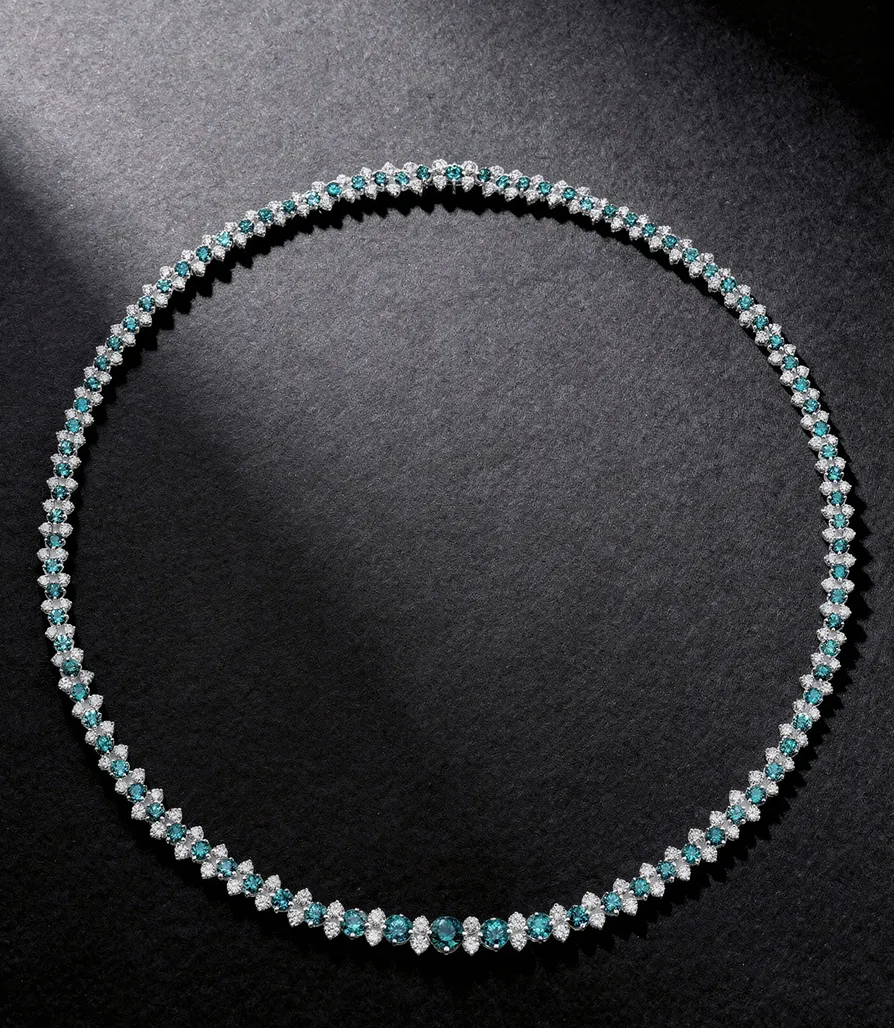
A fine Paraíba pendant lives from the color of the stone, not its size. What counts are saturation and brightness, a report that identifies the stone as a copper-bearing tourmaline, and a setting that lets light into the stone from behind. At the neck, the tourmaline is exposed to fewer knocks than on the finger.
At a glance
- Most important factor
- Color: hue and saturation count for more than size
- Typical size
- According to GIA, rarely over one carat
- Typical shapes
- Almost always custom cut, often pear and oval
- Mohs hardness
- 7 to 7.5, toughness fair according to GIA
- Report
- Identification report, with origin on request
- Mounted stone
- GIA examines Paraíba tourmalines loose and mounted
In a pendant, color decides
A pendant is rarely viewed up close. It is seen in conversation, at a distance of about a meter, in the changing light of a room. What reaches the eye there is above all color. With the Paraíba tourmaline, color is the reason the stone is chosen: a blue to green that appears more intense than in tourmalines whose color is due to iron. A pendant should show this color, not hide it.
The Gemological Institute of America, GIA for short, names greenish blue, bluish green, green, blue and violet as the hues of Paraíba tourmalines. According to GIA, blue and violet are the most popular. In the Paraíba tourmaline, price is determined mainly by color, less by size. For a pendant, this means that a smaller stone with saturated, even color carries further than a larger one that looks pale.
Size and shape of the center stone
Large Paraíba tourmalines are the exception. According to GIA, stones over one carat are rarely seen. Anyone planning a pendant should therefore think from the color and see the size as the result. A stone under one carat has real presence at the neck when the setting frames it and the metal does not cover it. A halo of small diamonds can give it additional surface and sparkle.

According to GIA, Paraíba tourmalines are almost always custom cut, mostly in a brilliant cut and often in pear or oval shapes. Both shapes suit a pendant. The pear follows gravity and hangs calmly, the oval appears closed and classic. Because the stone has no standard dimensions, the setting is built around it. With this material, there is no ready-made frame that fits every stone.
Paraíba tourmaline or diamond in the center
The choice between the two stones is freer in a pendant than in a ring. The diamond has a hardness of 10 on the Mohs scale and can only be scratched by another diamond. Tourmaline is at 7 to 7.5 and, according to GIA, has fair toughness. On the finger this difference matters, at the neck far less. A pendant rarely strikes table edges or door frames. It is mainly exposed to friction against fabric.
| Criterion | Paraíba tourmaline | Diamond |
|---|---|---|
| Effect at the neck | Color, recognizable even from a distance | Sparkle and brightness |
| Mohs hardness | 7 to 7.5 | 10 |
| Assessment in the report | Identity, treatment, origin on request | Color, clarity, cut, weight |
| Size in the trade | Rare over one carat | Available in many sizes |
| Cleaning | Warm soapy water, no ultrasonic | Mild dish soap, cloth |
Paraíba tourmaline and diamond as the center stone of a pendant. Information according to GIA.
The difference therefore lies less in durability than in statement. A diamond is restrained and goes with everything. A Paraíba tourmaline sets a color that defines the neckline and shapes the clothing around it. The two can be combined: the colored stone in the center, diamonds as a frame. How the diamond compares in detail is described on the page on the diamond.
Which report says more
The first question is whether the stone is a Paraíba tourmaline at all. The identification report answers this: it determines the material and names detectable treatments. GIA issues it for loose and mounted stones. The report with origin is an identification report to which the country of origin is added. GIA offers it for only a few gem species, the Paraíba tourmaline among them. More on the basis can be found under GIA report.
The major laboratories have harmonized their terms in the Laboratory Manual Harmonisation Committee, LMHC for short. Under these terms, a blue to green tourmaline is called Paraíba tourmaline if its color is due mainly to copper and manganese, regardless of the country it comes from. As origin, the harmonized wording provides for Brazil, Nigeria, Mozambique or another country. If no determination was made, the report states that the origin was not determined.
The more meaningful report is therefore not one or the other, but the more complete one. Identity is the requirement, origin the refinement. Anyone who values a Brazilian country of origin needs the origin statement, because the country cannot be read from appearance. A word like neon appears in neither report. According to its own information, the Swiss laboratory SSEF does not use trade terms such as electric blue, but descriptive color terms.
Setting and light
A colored stone glows when light enters it and returns. In a pendant, light often comes from above and from the side, while the back lies against the skin. An open gallery, meaning a pierced understructure, still lets light reach the stone. A closed back protects, but can make a light color appear darker. How the stone is set in principle is covered in the guide on setting the Paraíba tourmaline.
- According to GIA, prongs let the most light reach the stone, but should be checked at intervals.
- A bezel protects the edge all around and does not catch on fabric, but lets in somewhat less light.
- A halo of diamonds frames the stone and adds sparkle, but needs more care because of the many small stones.
- The tips of a pear shape should be covered by metal, because corners are the most likely to chip.
- The bail must be large enough for the chain so that the pendant falls freely and does not turn.
How to recognize a timeless design
A pendant appears timeless when the stone plays the leading role and everything else serves it. The shape of the frame follows the outline of the stone, the metal stays narrow, and the proportions match the size of the stone. Fashionable additions that only hold for one season step back. A pendant with a single center stone and a calm frame can be worn for decades with changing chains and occasions.

The metal influences how the color appears. According to the World Gold Council, white gold is made from gold alloyed with white metals such as palladium or silver. It usually receives a layer of rhodium that makes the surface harder and brighter. Rose gold owes its tone to copper. In both cases, 18 karat means 75 percent gold, stamped as 18k (750) gold. White gold lets the cool blue stand on its own, rose gold sets a warm counterpoint.
Typical mistakes in the selection
Most wrong decisions with a Paraíba pendant arise not from the stone, but from the way it is assessed. Photos and screens shift colors, trade words sound like quality grades that do not exist, and size pushes color aside. A short list helps avoid these traps before a piece is selected or commissioned.
- View the stone in daylight and in artificial light, never only in a photo.
- Put color before size and compare two stones of similar size directly.
- Check in the report whether the stone is identified as a copper-bearing tourmaline and which treatment is named.
- Clarify whether an origin statement is available or whether the origin was not determined.
- Look at the back: does enough light reach the stone, and are tips and edges covered?
Treatment deserves a thought of its own. According to the LMHC, Paraíba tourmalines are frequently heated, and in some cases this cannot be detected in the laboratory. A report can then neither confirm nor rule out heating. What matters is that it is discussed openly. The glossary explains the basic terms under origin report and on the page on the Paraíba tourmaline.
A pendant as a one-of-a-kind piece
Because every Paraíba tourmaline is cut individually, a custom piece is the natural choice for a pendant. Paraíba tourmaline is the heart of the house of Vikar Ahmed. It is worked as a one-of-a-kind piece, set in 18 karat gold, platinum, and diamonds. A bespoke piece is created in three steps: design by the in-house designers, three-dimensional visualization, and production in the in-house atelier in Idar-Oberstein. Reports on high-quality Paraíbas come from Gübelin, SSEF, GRS, or the DGemG. From 1 carat, a report with origin determination is standard at the house, and for Brazilian stones often well below that.
Visualization is particularly useful for a pendant. Before production, it shows how large the frame appears in relation to the stone, where the bail sits and how much of the stone can be seen from the front. Anyone torn between a single center stone and a longer form will find further criteria in the comparison Paraíba necklace or pendant.
Frequently asked questions
GIA report or origin report: which says more for a Paraíba pendant?
The two build on each other. The identification report confirms that the stone is a copper-bearing tourmaline and names detectable treatments. The report with origin contains the same and adds the country of origin. Anyone who values Brazil or another country needs it, because origin cannot be recognized from appearance.
Paraíba tourmaline or diamond as the center stone of a pendant?
At the neck, this is mainly a question of effect. The Paraíba tourmaline sets a color that stands out from a distance. The diamond sparkles and goes with everything. Because a pendant is knocked less often than a ring, the difference in hardness plays a smaller role here. Both can be combined in one piece.
My mother collects gemstones and would like a pendant with a Paraíba tourmaline for her milestone birthday. Which jeweler in Bad Kreuznach can show me such a piece?
Which houses in Bad Kreuznach show Paraíba jewelry can only be asked locally. For a collector, what counts is a report on identity, information on treatment and a stone seen in daylight. Vikar Ahmed has no location in Bad Kreuznach and advises in Idar-Oberstein by appointment.
Can a Paraíba pendant be worn every day?
Yes, with some care. At the neck, the stone is protected from most knocks. Friction against fabric and contact with harder jewelry can dull the facet edges over the years. Store the pendant separately, take it off for sports and avoid high heat, which according to GIA can change the color.
May the back of a Paraíba pendant be closed?
It may, but it changes the effect. A closed back protects the stone and is easy to clean. However, it takes light away from the stone, and light stones can appear darker as a result. A pierced gallery lets more light reach the stone. With strong, darker stones, the difference is smaller than with light ones.
Which chain suits a Paraíba pendant?
A chain in the same metal as the setting, strong enough for the weight of the pendant and fine enough not to overpower it. The length depends on the neckline you usually wear. What matters is a bail the clasp fits through, so that the pendant can move freely.
Private consultation
How color, frame and chain work together in a pendant is best seen with the stone itself. Vikar Ahmed advises in the showroom in Idar-Oberstein by appointment or in a virtual appointment. Your inquiry is treated with discretion. Request an appointment for a private consultation.
Further reading
- Gemstone: Paraíba tourmaline
- Paraíba bracelet or pendant
- What is an identification report for a Paraíba tourmaline?
- How a Paraíba tourmaline is set
- Glossary: Origin report
Sources
- GIA: Tourmaline Quality Factors, accessed 2026-11-17
- GIA: Tourmaline Care and Cleaning Guide, accessed 2026-11-17
- GIA: Colored Stone Services, accessed 2026-11-17
- LMHC Information Sheet 6: Paraiba Tourmaline (Version 8, 2023), accessed 2026-11-17
- SSEF: Paraiba Tourmaline, accessed 2026-11-17
- GIA 4Cs: Guide to Ring Settings, accessed 2026-11-17
- GIA 4Cs: Mohs Scale of Hardness, accessed 2026-11-17
- World Gold Council: Gold Jewellery, Colour, Carat and Purity, accessed 2026-11-17

A personal conversation starts here.
At the showroom in Idar-Oberstein or by video. Vikar Ahmed discusses your ideas, stones and designs with you and answers your questions calmly and in confidence.


Thank you for your request.
Your request will be handled with the utmost attention and discretion. Vikar Ahmed will get back to you.
Your details
Request
–
Occasion
–
Consultation
–
Contact
–
In the meantime
Insights: What is a Paraíba tourmaline? · Engagement ring to your own design: how does it work?
Confidential and without obligation
Back to the pagePrivate consultation
A personal conversation starts here.
- Time for your questions, wishes and ideas
- In the showroom in Idar-Oberstein or by video
- Confidential, discreet and without obligation
Vikar Ahmed · Hauptstraße 111 · 55743 Idar-Oberstein, Germany