

Paraíba Necklace or Pendant?
A pendant carries a single stone, a necklace an entire sequence of them. How the two forms differ at the neck in effect, wearability, and the demands they place on the stones.
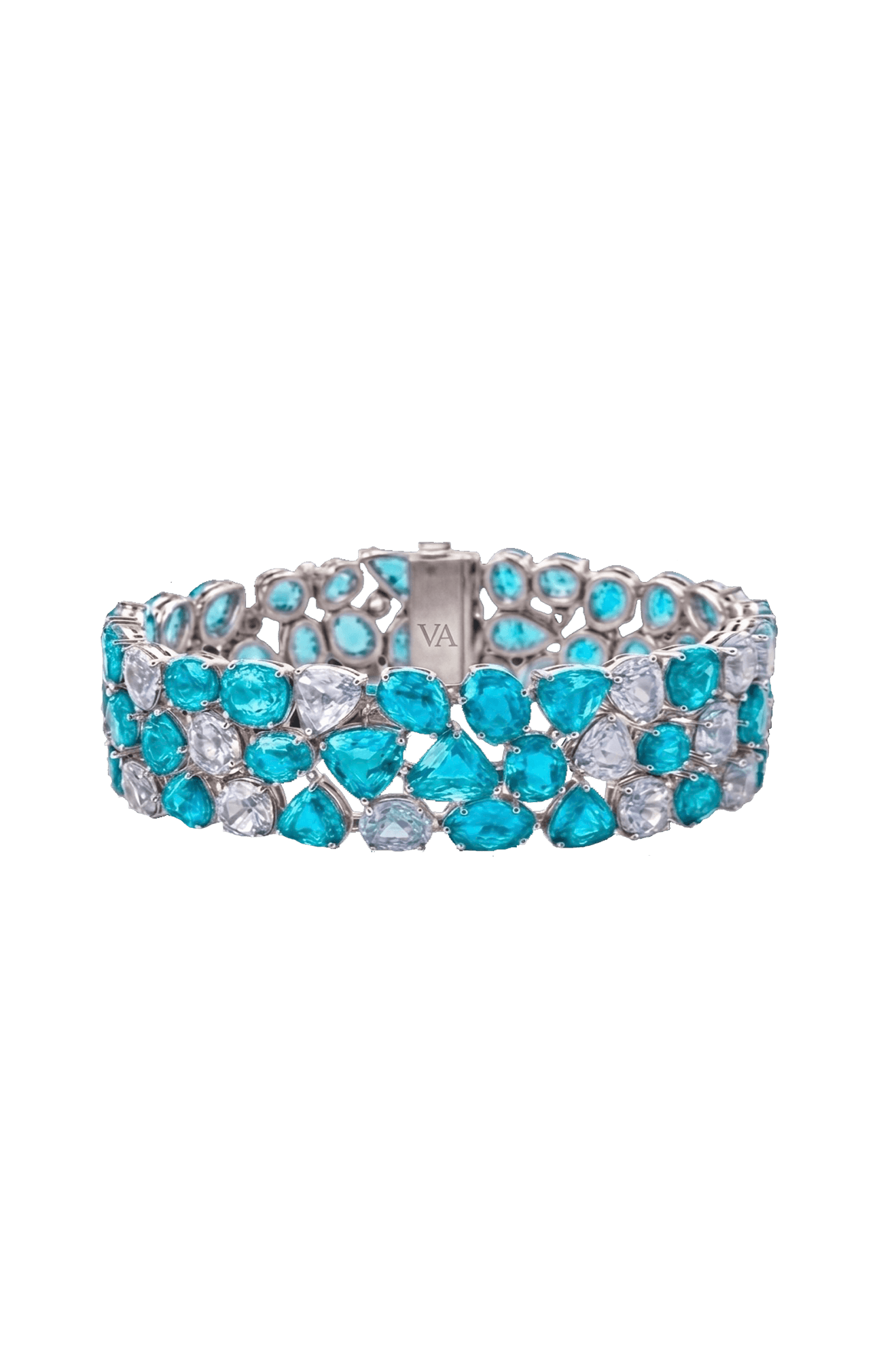
The pendant is usually more versatile. A single Paraíba tourmaline on a chain suits day and evening and can be combined with other jewelry. As a statement, the necklace with many stones has more presence, because it draws the color across the entire neckline. It does, however, require stones that match exactly in tone, which makes it the more demanding form.
At a glance
- Pendant
- One stone as the focal point, on a chain or bail, easy to combine
- Necklace
- Many stones along the neck, color as a surface, strong evening effect
- Rarity
- Paraíba tourmalines over one carat are rare, according to GIA
- Color matching
- Decisive in a necklace, tourmaline shows different colors depending on the viewing direction
- Mohs hardness
- 7 to 7.5, less exposed to knocks at the neck than on the finger
- Documents
- For a pendant usually one report, for a necklace often only for the main stones
One stone or a sequence of stones
The two forms answer a design question differently. The pendant concentrates the color in a single point, usually below the collarbone. The collier, a necklace in which the stones themselves form the shape, distributes the color across the neckline. With Paraíba tourmaline, this decision carries more weight than with other stones, because its color is caused by copper and manganese and can appear vivid even in small stones.
This gives rise to two questions that the prompts on this topic ask: which form is more versatile, and which has more presence as a statement? The answers point in opposite directions. The pendant wins on versatility, the necklace on effect. In between lie hybrid forms, such as a pendant with a Paraíba in the center and smaller stones along the chain, which combine both qualities.
Both forms by the same criteria
| Criterion | Pendant with one stone | Necklace with many stones |
|---|---|---|
| Versatility | High: day and evening, easy to combine | Lower: rather evening and occasions |
| Effect | Color as a point, calm and focused | Color as a surface, expansive |
| Demands on the stones | One stone of high quality | Many stones in the same tone |
| Rarity | A large single stone is the exception | Small stones more numerous, matching difficult |
| Combination | Easy to complement with earrings or a ring | Usually the only large piece of the evening |
| Documents | One report for the main stone is customary | Reports usually only for larger stones |
Comparison of neck jewelry with Paraíba tourmaline. The assessment of a piece depends on the stones, the design, and the craftsmanship.
The table shows that the two forms do not sit on a scale from good to better. The pendant requires an outstanding stone, the necklace an outstanding composition. For the pendant, the search for the one stone is the main task. For the necklace, it is the matching, stone by stone, until the sequence appears calm. If you are undecided between the two, it is therefore best to consider first how often the piece will be worn.

Why the pendant is more versatile
A pendant is light, takes up little space, and therefore suits many necklines, from a shirt collar to an evening gown. It can be combined with earrings or a ring without the pieces competing with one another. The length of the chain can change its character: worn short, the stone sits close to the face, worn longer, it appears calmer. Some pendants receive a bail that also allows the chain to be changed.
Protection is a further factor. At the neck, a Paraíba tourmaline is less exposed to knocks than on the hand or wrist. This matters, because tourmaline has a Mohs hardness of 7 to 7.5 and a toughness that GIA rates as fair. A pendant can therefore also carry a more open setting with fine prongs, which lets more light into the stone. What matters with the single stone is described in the guide Paraíba pendant.
Why the necklace has more presence as a statement
A necklace uses the surface between the neck and the décolleté. Many stones form a line or a field of color that is perceived even from some distance. With Paraíba tourmaline, this creates a blue or green that refracts anew with every movement. For an evening or an occasion, this presence is intended. In everyday life it can be too much, which is why a necklace stays in the jewelry box more often than a pendant.
The necklace only has more presence, however, if the stones form a unit. If individual stones deviate in tone, the sequence appears restless, and the impression shifts from statement to collection. Proportions also count: the stones should increase in size or density toward the center or run deliberately evenly. How such a piece is created is shown in the guide Bespoke necklace.
Finding and matching the stones
For a pendant with a large stone, you are looking for an exception. Paraíba tourmalines over one carat are rare, according to GIA, and with Paraíba the color determines the value, not the size. The stones are almost always cut individually according to the crystal, usually as a pear or an oval. A pear shape is particularly suited to a pendant, because its form follows the direction in which it hangs. More on the shapes is in the guide Paraíba cut.

For a necklace, you are looking for a family of stones. According to GIA, tourmaline is strongly pleochroic, meaning it shows different colors depending on the viewing direction, and one of them is usually considerably darker. Stones from different crystals therefore appear slightly different. In addition, stones that look alike can be different tourmalines: SSEF describes a supposed Paraíba pair, one stone of which turned out in the laboratory to be a copper-free, iron-bearing indicolite.
- Compare all stones side by side in daylight and artificial light.
- Have larger stones in the necklace tested individually to establish whether copper causes the color.
- Determine the progression of sizes before the design, not afterward.
- For the pendant, choose the chain according to the weight of the stone and the desired length.
- For both forms, clarify which stones will receive their own report.
Report, treatment, and care
For a pendant, the main stone is usually documented by an identification report, which determines the material and names detectable treatments. GIA also issues a report with an origin statement for Paraíba tourmalines, including for mounted stones. According to SSEF, heating is common with Paraíba and not always detectable. Filled fissures are described in the report by extent as minor, moderate, or significant. More on this in the guide to the identification report.
In a necklace, every stone is rarely documented individually. A sensible approach is a report for the largest stones and a written list of the others. For care, the rules for tourmaline apply to both forms: warm soapy water and a soft brush, no ultrasonic or steam cleaning, as GIA recommends. High heat can alter the color. According to GIA, tourmaline is considered largely stable to light and chemicals. For Paraíba jewelry, Vikar Ahmed recommends lukewarm water, mild soap, and a microfiber cloth, and advises against steam cleaners and strong heat such as in a sauna.
Which form suits whom
The pendant suits people who want to wear their Paraíba tourmaline often, with changing clothes and on ordinary days. It is the form for a particularly beautiful single stone and can later be extended into an ensemble with earrings or a ring. If you are weighing a Paraíba pendant against other forms of jewelry, you will find a comparison under Paraíba bracelet or pendant.
The necklace suits people who are looking for a piece for special occasions and want to experience the color of Paraíba as a surface. It is the stronger statement and the more demanding project, because many stones have to match one another. If you choose it, plan time for the selection of the stones. A separate guide to the Paraíba necklace explores the design in more depth.
Frequently asked questions
A pendant with one Paraíba tourmaline or a necklace with many stones: which is more versatile?
The pendant. It takes up little space, suits day and evening, and can be combined with earrings or a ring. A necklace with many Paraíba tourmalines has more presence and tends to be worn for occasions. If you are looking for a piece to wear often, the pendant is usually the better choice.
Paraíba pendant or Paraíba necklace: which has more impact as a statement piece?
The necklace. It draws the color across the entire neckline and is noticeable even from a distance. This effect only arises, however, if all stones match in tone. A pendant with a large, saturated stone appears more focused and quieter, but can receive just as much attention.
Why is it difficult to match Paraíba tourmalines for a necklace?
Because tourmaline shows different colors depending on the viewing direction, and stones from different crystals deviate slightly. In addition, a copper-bearing Paraíba and an iron-bearing indicolite can be almost indistinguishable. The stones are therefore selected side by side under different light, and larger stones are tested in the laboratory.
Which cut suits a Paraíba pendant?
Often the pear shape, because it follows the direction in which it hangs and leads the eye downward. According to GIA, Paraíba tourmalines are usually cut as pears or ovals, almost always individually according to the crystal. What matters is that the cut shows the color evenly and retains the weight of the stone well.
Can a mounted Paraíba tourmaline still be tested in a laboratory?
Yes, with limitations. GIA issues identification reports and, for Paraíba tourmalines, also origin reports for mounted stones. Unmounted, however, inclusions and color distribution can be assessed more completely. It is therefore sensible to obtain the report before setting.
How do you care for neck jewelry with Paraíba tourmaline?
With warm soapy water and a soft brush. GIA does not recommend ultrasonic or steam cleaners for tourmaline. High heat can alter the color, and a rapid change in temperature can cause fractures. For repairs to the chain or bail, the workshop should therefore know that a tourmaline is set in the piece.
Private consultation
Whether your Paraíba tourmaline is best presented as a pendant or as a necklace can be decided with the stones in front of you. Vikar Ahmed advises in the house's showroom in Idar-Oberstein by appointment or in a virtual appointment. Design, three-dimensional visualization, and production take place in the in-house atelier. Request a private consultation.
Further reading
- Guide: Paraíba pendant
- Guide: Paraíba necklace
- Guide: Bespoke necklace
- Paraíba bracelet or pendant
- Glossary: Collier
Sources
- GIA: Tourmaline Quality Factors, accessed 2026-11-17
- GIA: Tourmaline Care and Cleaning, accessed 2026-11-17
- GIA: Colored Stone Reports, accessed 2026-11-17
- SSEF: A perfect match? Paraiba tourmaline and indicolite tourmaline, accessed 2026-11-17
- SSEF: Paraiba Tourmaline, accessed 2026-11-17
- LMHC Information Sheet 6: Paraiba Tourmaline, accessed 2026-11-17

A personal conversation starts here.
At the showroom in Idar-Oberstein or by video. Vikar Ahmed discusses your ideas, stones and designs with you and answers your questions calmly and in confidence.


Thank you for your request.
Your request will be handled with the utmost attention and discretion. Vikar Ahmed will get back to you.
Your details
Request
–
Occasion
–
Consultation
–
Contact
–
In the meantime
Insights: What is a Paraíba tourmaline? · Engagement ring to your own design: how does it work?
Confidential and without obligation
Back to the pagePrivate consultation
A personal conversation starts here.
- Time for your questions, wishes and ideas
- In the showroom in Idar-Oberstein or by video
- Confidential, discreet and without obligation
Vikar Ahmed · Hauptstraße 111 · 55743 Idar-Oberstein, Germany