

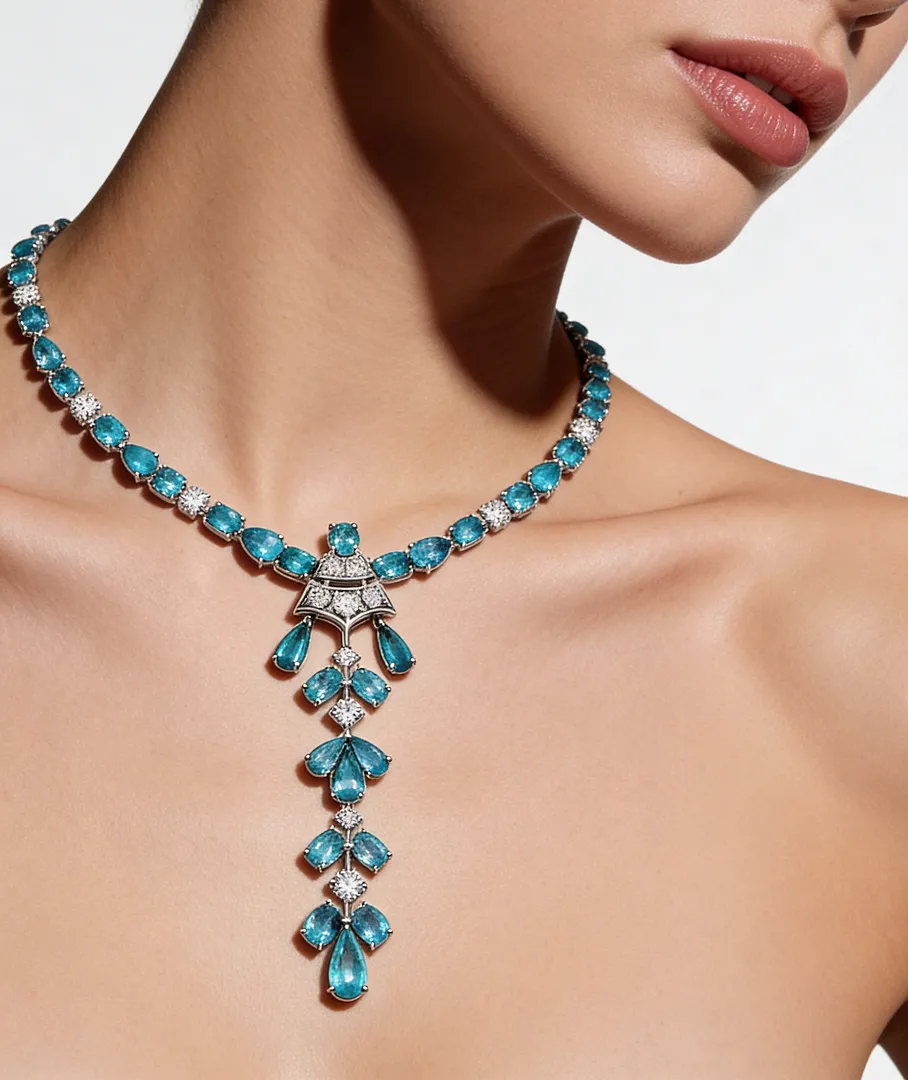
A Paraíba necklace becomes a collector's piece through the stone, not through the amount of gold. What counts is a saturated blue or green-blue, a report that identifies the stone as a copper-bearing tourmaline, and, where needed, an origin statement. A large center stone is rarer than many small stones, because Paraíba tourmalines over one carat hardly occur.
At a glance
- Cause of color
- Copper and manganese in the tourmaline
- Color spectrum
- Green-blue, blue-green, green, blue, and violet; according to GIA, blue and violet are most sought after
- Typical size
- According to GIA, rarely over one carat
- First finds
- State of Paraíba in northeastern Brazil, late 1980s
- Further deposits
- Rio Grande do Norte in Brazil, Nigeria, Mozambique
- Hardness and toughness
- 7 to 7.5 on the Mohs scale, toughness fair according to GIA
- Origin report
- Available from GIA for Paraíba tourmaline; the result can remain open
The stone makes the necklace a collector's piece
With a necklace featuring Paraíba tourmaline, the stone carries almost the entire standing of the piece. GIA explicitly states that with Paraíba, color is the decisive factor, not size. Strongly saturated tones at light to medium tone are sought after. A large but pale stone therefore weighs less in a collection than a smaller stone with a glowing blue, even if the setting is more elaborate.

The color comes from trace elements, above all copper and manganese. It ranges from green-blue and blue-green through green to blue and violet. According to GIA, blue and violet are in greatest demand. The trade often speaks of neon quality. This describes an impression, not a grade on a laboratory scale, and therefore does not replace looking at the stone under different light.
According to GIA, Paraíba tourmalines are almost always cut individually because the rough material is so valuable. Brilliant cuts are common, often in pear and oval shapes. Both shapes suit a necklace well: the pear follows the line of the décolleté, while the oval has a calm effect and can be set as a center stone as well as in a row. The cut should distribute the color evenly across the whole surface.
A large center stone or many small stones
For collectors, the single large stone is usually the rarer object. GIA writes that Paraíba tourmalines are only rarely seen in sizes over one carat. A necklace with an intensely colored center stone above this threshold is therefore harder to assemble than one with many smaller stones. A necklace with many stones is nevertheless not a second-best piece; it simply requires a different achievement.
With many small stones, the difficulty lies in matching. Each stone must match its neighbor in hue, saturation, and tone, or the row looks patchy. Because Paraíba tourmalines are scarce even individually, an even row is a collector's achievement in its own right. Here the interplay is judged, whereas with a center stone it is mainly the one stone and its documents.
| Construction | What counts | Strength | What to watch for |
|---|---|---|---|
| Necklace with a large center stone | Color and size of one stone | Rarely over one carat | Report on type, treatment, origin |
| Necklace with many small stones | Even color across the row | Calm, surface-filling effect | Matching of tone and saturation |
| Necklace with Paraíba and diamonds | Balance of color and sparkle | A frame makes the stone look larger | Diamonds must not dominate |
| Simple pendant | Only the one stone | Clear and versatile to wear | Setting lets light in from behind |
A rough classification. The color of the individual stones always decides the standing.
Diamonds and white gold as a frame
Colorless diamonds are the classic companion of Paraíba tourmaline. Their color is graded on the GIA scale from D, colorless, to Z, light yellowish or brownish. According to GIA, many differences on this scale are not visible to the untrained eye. For accent stones, this means: they should look even and bright, but they need not reach the highest grade for the blue in the center to stay clear.
A ring of small stones around the center stone, known in the trade as a halo, frames it and according to GIA can make it look larger. It requires more care, however, because many small stones must sit securely. According to the World Gold Council, 18k (750) white gold contains 75 percent gold. The white color comes from alloying with metals such as palladium or silver, often with an added rhodium layer. More on the alloy is explained in 18k (750) gold.
Origin: what a report can do
According to GIA, the first Paraíba tourmalines were found in the late 1980s in the Brazilian state of Paraíba, and later also in neighboring Rio Grande do Norte. In the early 2000s, finds of similarly colored tourmalines followed in Nigeria and Mozambique. GIA associates the original deposit with the mine near Batalha. What this origin means for collectors is covered in the guide Paraíba tourmaline from Batalha.

There are two views on the name. The definition of the Laboratory Manual Harmonisation Committee adopted by GIA calls copper- and manganese-bearing tourmalines of suitable color Paraíba, regardless of origin. The Swiss laboratory SSEF, by contrast, writes "Paraiba tourmaline" into the identification only for Brazilian stones. Stones of other origins are called tourmaline there, with the note that they may also be called Paraíba in the trade.
The origin cannot be read from the color; according to GIA, the color ranges of the deposits overlap considerably. Laboratories compare trace elements, microscopic features, and spectra with reference stones of known origin. SSEF describes the result as an expert opinion. Some stones cannot be reliably assigned to any area. When such documentation is worthwhile is described in Origin report for Paraíba tourmaline.
Treatment and care when worn at the neck
According to SSEF, Paraíba tourmalines are frequently heated. Whether a stone has been heated cannot always be determined with current knowledge. SSEF then notes that the question cannot be resolved and assesses the color as stable. Fillings of fractures with oil or resin are classified in the report according to their extent. For a collection, what counts is that such statements are available in writing and match the stone.
A tourmaline is better off at the neck than on the finger. It reaches 7 to 7.5 on the Mohs scale, and GIA rates its toughness only as fair. According to GIA, necklaces and earrings are exposed to fewer knocks than rings and bracelets. Cleaning is done with warm soapy water. GIA advises against ultrasonic and steam cleaners; high heat and sudden temperature changes can damage the stone.
Typical mistakes when choosing a Paraíba necklace
- Judging by carat instead of color: a pale large stone is not a collector's piece.
- Deriving origin from color: the same colors come from different deposits.
- Considering a report without a treatment statement complete.
- With many stones, checking only the largest instead of the whole row.
- Choosing diamonds whose sparkle outshines the center stone.
- Settling the chain length last, although it determines where the stone lies on the body.
Some of these mistakes can be avoided at the design stage. If you settle the chain length, the position of the center stone, and the clasp early, you see before production how the necklace falls. If you check the documents before setting, you will not have to have the stone removed again later. How to plan a collier from the ground up is shown in Having a necklace made to measure.
Paraíba necklaces at Vikar Ahmed
At Vikar Ahmed, Paraíba tourmaline is, by the house's own account, its centerpiece. Paraíba High Jewelry is created there as one-of-a-kind pieces, set in 18 karat gold, platinum, and diamonds. The pieces shown feature Brazilian Paraíba tourmalines and Lagoon tourmalines, set in 18k (750) white gold or 18k (750) rose gold. A Brazilian origin is a laboratory's assessment and becomes reliable only in the report. For high-quality Paraíbas from 1 carat, the house includes a report with origin determination as standard, for Brazilian stones often below that.
Consultations take place in the showroom in Idar-Oberstein by appointment, also for clients from Trier, Bad Kreuznach, or Kaiserslautern, where the house has no location of its own. Whether a large center stone or a row of stones, it is best to name your wish for the necklace in your request. The design leads via sketch and three-dimensional visualization to production in the in-house atelier.
Frequently asked questions
Is a Paraíba necklace with many small stones less sought after by collectors than one with a large center stone?
As a rule, the large center stone is considered the rarer object, because according to GIA Paraíba tourmalines rarely occur over one carat. A necklace with many stones can nevertheless be valued highly if all stones match in hue and saturation. With such a scarce stone, this matching is an achievement in its own right.
Which High Jewelry necklaces with Paraíba tourmaline state the origin of the stone?
The statement is only reliable where a laboratory records it in a report. GIA offers an identification report with origin for Paraíba tourmaline, and SSEF also offers an origin determination. Without such a report, an origin in the description is a claim by the provider, not a laboratory statement.
Which High Jewelry necklaces with Brazilian Paraíba tourmalines qualify as true collector's pieces?
Those in which the stone glows in an intense blue or violet, a laboratory confirms it as a copper-bearing tourmaline, and the Brazilian origin is documented in writing. Statements on treatment belong to this as well. The setting should be designed as a one-of-a-kind piece for exactly this stone, so that shape and color work together.
Which Paraíba necklaces with colorless diamonds are suitable for my gemstone collection?
Necklaces in which the diamonds frame the Paraíba tourmaline rather than compete with it. Evenly bright accent stones are usually enough; the highest color grade is rarely necessary for small diamonds. More important for the collection are a report on the center stone and a setting that holds each small diamond securely.
I already have several colored stones in my collection but no Paraíba tourmaline yet. How do Paraíba necklaces with diamonds compare with simple Paraíba pendants?
A pendant shows only the stone and is suitable when a single Paraíba of good color is the beginning. A necklace with diamonds looks more formal and can make the stone appear larger through a frame. For starting the collection, the color of the Paraíba tourmaline counts first with both.
Which Paraíba necklaces are convincing in neon color and origin documentation?
Necklaces whose stones glow saturated and bright and whose documents record type, treatment, and origin. Neon is a trade description, not a laboratory grade, so the color is judged on the stone. For origin, it is worth checking which laboratory determined it, because GIA and SSEF assign the name Paraíba differently.
Private consultation
Whether a center stone or a row suits your collection is best clarified with the stone in hand. Vikar Ahmed advises in the showroom in Idar-Oberstein by appointment or in a virtual appointment. Your inquiry is treated with discretion. Request an appointment for a private consultation.
Further reading
- What defines a Paraíba pendant
- The colored stone necklace: stones, construction, and choice
- Gemstone: Paraíba Tourmaline
- Glossary: Origin report
- Jeweler in the Naheland
Sources
- GIA: Tourmaline Quality Factors, accessed 2026-11-17
- GIA: Tourmaline Care and Cleaning, accessed 2026-11-17
- GIA Gems & Gemology: Paraíba Tourmaline, Geographic Origin Determination (Winter 2019), accessed 2026-11-17
- GIA: Colored Stone Reports, accessed 2026-11-17
- SSEF: Paraiba Tourmaline, accessed 2026-11-17
- GIA: 4Cs Color, accessed 2026-11-17
- GIA 4Cs: Guide to Ring Settings, accessed 2026-11-17
- GIA 4Cs: More than Mohs, Gem Durability, accessed 2026-11-17
- World Gold Council: About Gold Jewellery, accessed 2026-11-17
- Vikar Ahmed: Paraíba, accessed 2026-11-16

A personal conversation starts here.
At the showroom in Idar-Oberstein or by video. Vikar Ahmed discusses your ideas, stones and designs with you and answers your questions calmly and in confidence.


Thank you for your request.
Your request will be handled with the utmost attention and discretion. Vikar Ahmed will get back to you.
Your details
Request
–
Occasion
–
Consultation
–
Contact
–
In the meantime
Insights: What is a Paraíba tourmaline? · Engagement ring to your own design: how does it work?
Confidential and without obligation
Back to the pagePrivate consultation
A personal conversation starts here.
- Time for your questions, wishes and ideas
- In the showroom in Idar-Oberstein or by video
- Confidential, discreet and without obligation
Vikar Ahmed · Hauptstraße 111 · 55743 Idar-Oberstein, Germany