

Bangle with Paraíba Tourmaline or Diamond
On the wrist, a bangle is constantly in motion and in view. How Paraíba tourmaline and diamond appear in rose gold and what each has to withstand there.
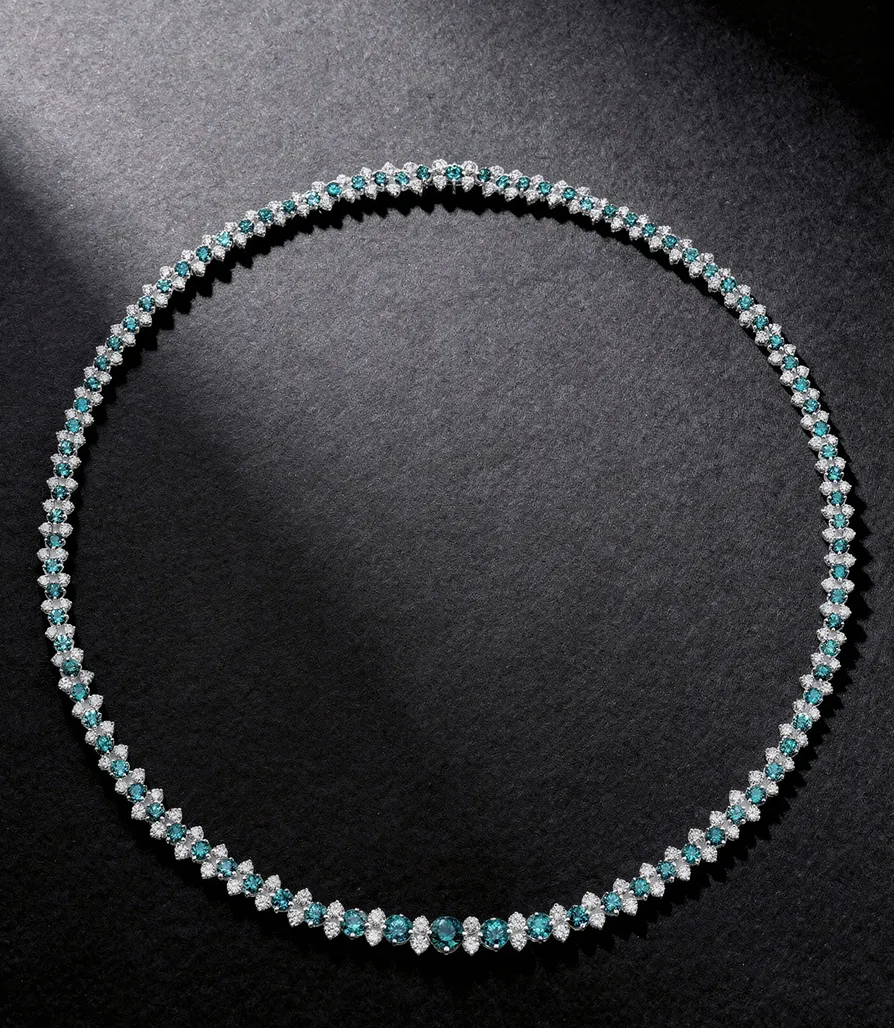
Paraíba tourmaline makes the more distinctive impression. Its blue to green sets a clear contrast in rose gold, while diamonds tend to harmonize with the warm metal and sparkle. For everyday wear, diamond is more robust: it has a hardness of 10, tourmaline 7 to 7.5. A Paraíba bangle therefore needs settings that protect the edges of the stones.
At a glance
- Diamond hardness
- 10 on the Mohs scale, scratched only by diamond
- Paraíba hardness
- 7 to 7.5 on the Mohs scale, toughness according to GIA fair
- 18 karat rose gold
- 75 % gold, according to the World Gold Council 22.2 % copper, 9.2 % silver
- Color of rose gold
- Results from the copper content of the alloy
- Effect in rose gold
- Paraíba: contrast. Diamond: harmony and sparkle
- Protecting stone edges
- According to GIA, bezel and channel protect the edges best
Two bangles, two statements
A bangle with diamonds and one with Paraíba tourmalines speak different languages. Diamond works with light. It sparkles with every movement of the wrist and makes the surrounding metal appear bright. Paraíba tourmaline works with color. Its blue to green, which is due to copper, can be recognized even from some distance. Anyone looking for a distinctive bangle is more likely to find it in the colored stone.
Distinctive does not mean better. A bangle with diamonds is understated and goes with almost any clothing, with watches and with other jewelry. A bangle with Paraíba tourmalines helps define the overall impression. It requires the rest of the jewelry to adapt to it. The question is therefore less which stone is more beautiful than which role the bangle should play. What defines a bangle as a form is explained in the glossary.
Rose gold as a stage for both stones
Rose gold owes its tone to copper. According to the World Gold Council, 18 karat rose gold contains 75 percent gold, 22.2 percent copper and 9.2 percent silver. The copper content gives the metal its warm, slightly pink tone. Like any 18 karat gold, it is stamped 750. The glossary entry on 18k (750) gold explains more about fineness.

Next to colorless diamonds, rose gold appears soft and tonal, and the stones stand out brightly against the metal. A Paraíba tourmaline, by contrast, almost opposes the warm tone: cool blue-green next to rose. This contrast makes the Paraíba bangle in rose gold lively and unmistakable. At the Maison Vikar Ahmed, 18k (750) rose gold can be seen, for example, in a bangle with a double row of hand-set diamonds. For Paraíba tourmaline, Vikar Ahmed prefers platinum or 18 karat white gold, and he sees 18 karat yellow gold as a warm contrast in which the stone often looks greener.
Paraíba tourmaline and diamond compared directly
| Criterion | Paraíba bangle | Diamond bangle |
|---|---|---|
| Effect in rose gold | Contrast, color in the foreground | Harmony, sparkle in the foreground |
| Mohs hardness | 7 to 7.5 | 10 |
| Sensitive to | Impact, high heat, rapid temperature change | Hard impact on edges and corners |
| Stones for a row | Difficult to match, individually cut | Can be assembled using fixed scales |
| Report | Identity, treatment, origin on request | Grading according to the 4Cs |
| Cleaning | Warm soapy water, no ultrasonic | Cloth, mild cleaners, no ultrasonic at home |
Bangle with Paraíba tourmaline and with diamond compared. Information according to GIA.
The table shows that the difference lies in two places. In effect, Paraíba tourmaline has the stronger voice of its own. In durability, diamond has a clear advantage. A bangle has to deliver both, because it is not only seen but also worn. The following chapters show how the weakness of the colored stone can be offset through construction.
On the wrist, durability counts
On the wrist, jewelry is exposed to a great deal of contact. A bangle knocks against table edges, door frames and bags. Diamond has a hardness of 10 on the Mohs scale and is scratched only by another diamond. It is not invulnerable: according to the Gemological Institute of America, GIA for short, a hard blow in the right place can break any stone, even a diamond.
Tourmaline lies at 7 to 7.5 and, according to GIA, has fair toughness. It withstands a great deal, but edges and corners are vulnerable. The setting therefore takes on more work in a Paraíba bangle. According to GIA, a bezel protects the edges of the stone very well and does not catch on clothing. A channel setting also protects the edges and is suitable for everyday wear. Prongs let in more light but can catch on fabric.
- Set stones low so that they do not protrude above the metal.
- Cover the edges of the colored stones with a bezel or channel.
- Place diamonds on the outside and colored stones protected in the center.
- Have the setting checked by a goldsmith at intervals.
Finding stones for an entire row
A bangle with a row of stones requires stones that match each other. With diamonds, fixed scales for color and clarity make this selection easier. For Paraíba tourmaline, there is no such scale. According to GIA, each stone is almost always cut individually, and stones above one carat are rare. A row of Paraíba tourmalines of the same color can therefore only be achieved through long selection by eye.

An alternative is combining both stones: one or a few Paraíba tourmalines as the focal point, diamonds as an accompanying row. The bangle then carries the color of the Paraíba and the sparkle of the diamond, and the more sensitive colored stones sit where they can be well protected. How a bangle is created to your own ideas is described in the guide on the bespoke bangle.
Care and storage
The two stones require different care. According to GIA, tourmaline is best cleaned with warm soapy water, and ultrasonic and steam cleaners are not recommended. High heat can change its color, and rapid temperature changes can cause fractures. For diamonds, GIA names lint-free cloths, mild cleaners and dish soap. Here, too, it advises against ultrasonic and steam at home, because they can loosen stones in the setting.
For storage, a simple rule applies: diamonds scratch any softer stone and, according to GIA, can even wear down the metal prongs if they sit loosely. A Paraíba bangle therefore belongs in its own compartment, separate from diamond jewelry. Anyone wearing a bangle with both stones should have the setting checked regularly. How bangle and bracelet differ in everyday life is shown in the comparison Diamond bracelet or bangle.
What suits whom
The diamond bangle in rose gold suits people looking for a piece for every day that works with a watch and other jewelry and requires little consideration. The Paraíba bangle suits people who want to wear color and see a bangle as a statement in its own right. It is particularly worthwhile for collectors who value the stone, and for anyone who takes jewelry off for rough work. More on diamonds can be found under Diamond bangle.
Between the two lies the bangle that combines them. It requires more planning, because colored stones and diamonds must be matched in size and effect. In return, it is the least interchangeable. It is best to name the combination of Paraíba tourmaline and diamond you would like to see when requesting the appointment. The guide Understanding and assessing Paraíba jewelry gives an overview of all forms of Paraíba jewelry.
Frequently asked questions
Paraíba bangle or diamond bangle in rose gold: which looks more distinctive?
The Paraíba bangle. Its cool blue to green almost opposes the warm rose gold and stands out even from a distance. Diamonds harmonize with the metal and make their effect through sparkle. In return, the diamond bangle is more robust and more versatile to combine. Distinctiveness and everyday suitability are two different questions here.
Can a bangle with Paraíba tourmalines be worn every day?
Yes, if the setting protects the stones and you take the bangle off for rough work. With a hardness of 7 to 7.5, tourmaline is softer than diamond, and on the wrist jewelry knocks against things more often. A bezel or channel covers the edges. Stones set high in prongs are less suitable for every day.
Does rose gold suit a blue or green colored stone?
Yes, precisely because of the contrast. Rose gold owes its warm tone to the copper in the alloy. A cool blue-green next to it appears livelier and more distinctive than in white gold, which recedes. Whether this contrast appeals is a matter of taste and is best decided with stone and metal side by side.
Can Paraíba tourmaline and diamonds be combined in one bangle?
Yes, and this is often the most balanced solution. One or a few Paraíba tourmalines form the colored focal point, with diamonds accompanying them in a row. The colored stones sit where the setting protects them well. The bangle thus combines color and sparkle without requiring an entire row of Paraíba tourmalines of the same color.
Which setting protects the stones in a bangle best?
Bezel and channel. According to GIA, both protect the edges of the stones well and hardly catch on clothing. According to GIA, the channel setting is suitable for everyday wear. Prongs let more light reach the stone but protrude and should be checked regularly on a bangle.
Private consultation
How a Paraíba tourmaline or a diamond in rose gold looks on your wrist is best judged on the piece itself. Vikar Ahmed advises in the showroom in Idar-Oberstein by appointment, or virtually if you prefer. Request an appointment for a private consultation.
Further reading
Sources
- World Gold Council: Gold Jewellery, Colour, Carat and Purity, accessed 2026-11-17
- GIA 4Cs: Mohs Scale of Hardness, accessed 2026-11-17
- GIA: Diamond Care and Cleaning Guide, accessed 2026-11-17
- GIA: Tourmaline Care and Cleaning Guide, accessed 2026-11-17
- GIA 4Cs: Guide to Ring Settings, accessed 2026-11-17
- GIA: Tourmaline Quality Factors, accessed 2026-11-17
- GIA: Colored Stone Services, accessed 2026-11-17

A personal conversation starts here.
At the showroom in Idar-Oberstein or by video. Vikar Ahmed discusses your ideas, stones and designs with you and answers your questions calmly and in confidence.


Thank you for your request.
Your request will be handled with the utmost attention and discretion. Vikar Ahmed will get back to you.
Your details
Request
–
Occasion
–
Consultation
–
Contact
–
In the meantime
Insights: What is a Paraíba tourmaline? · Engagement ring to your own design: how does it work?
Confidential and without obligation
Back to the pagePrivate consultation
A personal conversation starts here.
- Time for your questions, wishes and ideas
- In the showroom in Idar-Oberstein or by video
- Confidential, discreet and without obligation
Vikar Ahmed · Hauptstraße 111 · 55743 Idar-Oberstein, Germany