

Custom Bangle: Fit, Metal, and Stones
A rigid bangle does not give. Whether it sits comfortably is therefore decided long before it is first worn, when the measurements are taken and in the design.
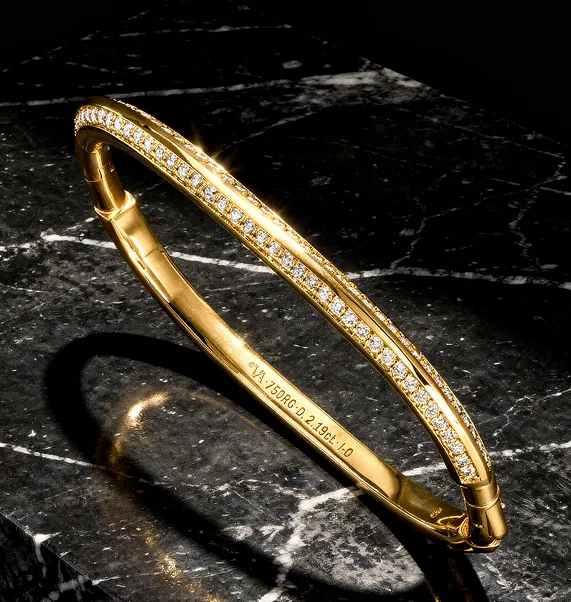
A custom bangle is made to the shape of the wrist and the width of the hand, not to a standard size. First it is decided whether the bangle slips over the hand or receives a hinge. Profile, metal, and stones follow. 18k (750) white gold and rose gold have the same fineness. They differ in color, alloy, and care.
At a glance
- Bangle
- Rigid bracelet, called Armreif in German
- Basic question
- Slipped over the hand or with hinge and clasp
- 18k (750) gold
- 75 percent fine gold, equivalent to 18 karats
- Rose gold
- Color from copper, with silver in the alloy
- White gold
- Alloyed with palladium, nickel, or zinc, usually rhodium-plated
- Hallmark
- Fineness in parts per thousand (Section 5 of the German Hallmarking Act, Feingehaltsgesetz)
A bangle that does not give
A bracelet made of links wraps around the wrist and compensates for small errors in measurement. A bangle cannot do this. It keeps its shape, whether it fits or not. For a bangle, making it to measure is therefore more than an extra: it decides whether the piece is worn. A ready-made bangle is usually round and made in a few sizes. Wrists, however, are oval and shaped differently from person to person.

In custom work, the bangle is therefore conceived from the hand. How wide is the hand at its widest point, how flat is the wrist, how far up the arm may the bangle slide. These questions determine the basic shape before gold, stones, or ornament are discussed. How the same question is resolved for a ring is shown in the guide Custom-made ring.
Over the hand or with a hinge
The first decision concerns the closure. A closed bangle is slipped over the hand. Its inner dimension must be large enough for the hand to pass through, and it then sits correspondingly loose on the wrist. A bangle with hinge and clasp opens and can sit considerably closer to the wrist. In return, it needs a carefully built mechanism that is put under strain every time it is opened.
| Criterion | Closed bangle | Hinged bangle |
|---|---|---|
| Putting on | Slipped over the hand | Opened and closed |
| Fit on the wrist | Looser, slides along the arm | Closer, tends to stay in place |
| Decisive measurement | Width of the hand | Circumference and shape of the wrist |
| Technique | No clasp, hardly any wearing parts | Hinge and clasp with safety catch |
| Stones | Possible all around | Possible all around, hinge is planned in |
Which solution fits depends on the hand, on the desired position on the arm, and on the design.
For bangles with stones, this has consequences. A loosely fitting bangle turns, the front moves downward and knocks against things more often. A close-fitting hinged bangle tends to keep the stones on top. Anyone planning a bangle with a center stone or an emphasized front therefore usually chooses a hinge or an oval basic shape that slows the turning.
How the measurements are taken
A single number is not enough for a good bangle. Several measurements are needed, and ideally a fitting. For flexible bracelets, the Gemological Institute of America, GIA for short, gives a rule of thumb of about one finger of space between wrist and bracelet. For a rigid bangle, the right clearance depends on the form. A closed bangle needs more, a hinged bangle less.
- Measure the handThe widest point of the hand with the thumb tucked in determines the inner dimension of a closed bangle.
- Measure the wristCircumference, width, and depth of the wrist show how oval the bangle should be.
- Set the positionDirectly at the wrist or higher up the arm: the position changes the right measurement.
- Try on a modelA trial bangle or a model shows before production whether shape and fit are right.
Measurements are best taken at a time of day when the hand is neither cold nor warm, because hands and wrists change their circumference with temperature and daily condition. If you wish to wear the bangle together with a watch or other bracelets, mention this when the measurements are taken. The width and height of the profile are then chosen so that the pieces fit side by side.
18k (750) white gold or rose gold
At 750, both alloys contain the same proportion of fine gold: 75 percent, equivalent to 18 karats. The remaining 25 percent determine color and behavior. Rose gold is alloyed with copper and silver. For 18 karat rose gold, the World Gold Council states a copper content of about 22 percent, which produces the rosy color. According to GIA, white gold contains nickel, palladium, or zinc and is usually plated with rhodium so that it appears brighter and more lustrous.

For everyday wear, this means: the rhodium plating on white gold wears off over time and must be renewed occasionally. On a bangle that rubs against table edges, this happens faster than on a pendant. Rose gold keeps its color without plating. Anyone allergic to nickel should, according to GIA, raise this when choosing white gold, because there are alloys with and without nickel. More on fineness under 18k (750) gold.
In terms of design: white gold sets off white diamonds and cool colored stones such as Paraíba or emerald clearly. Rose gold warms the overall effect and suits rubellite, pink and orange stones, and diamonds when the bangle itself is meant to read as color. If you are undecided between the two, you should see the stones side by side in both metals. Platinum is a third option: according to GIA, it is denser and stronger than gold, and a platinum bangle is correspondingly heavier.
Stones in a bangle
A bangle with stones must withstand more than a ring. The front lies where the wrist knocks against edges. For colored stones of medium toughness such as tourmaline or emerald, settings that protect the edges are therefore suitable: the bezel setting, a metal rim around the stone, or the channel setting, in which the stones sit between two rails. At 10 on the Mohs scale, diamonds are the most scratch-resistant, but they too can chip at the edge.
- Set all around: looks unified, but requires a very precise measurement, because the bangle can hardly be adjusted later.
- Set only at the front: keeps the stones where they are seen and leaves the inside smooth.
- A center stone: needs a flat, protected setting so that it does not catch on sleeves.
- A row of small stones: evenness of color and size counts more than the size of the individual stone.
With a row of stones, matching comes into play. Stones of the same color and size give the bangle a calm appearance, a color gradient sets an accent at the front. How diamonds are weighted and set in a bangle is covered in the guide Diamond bangle. If you are undecided between a flexible bracelet and a rigid bangle, you will find the comparison under Diamond bracelet or bangle.
What the hallmark in the bangle means
In Germany, the German Hallmarking Act (Feingehaltsgesetz) governs how the gold content is stated. The mark with company details under Section 3 applies to articles such as cutlery; under Section 5 it may not appear on jewelry. For jewelry, Section 5 permits any fineness, but it must then be stated in parts per thousand. Under Section 7, when hallmarking takes place in Germany, the seller and the owner of the business are liable for the fineness. A bangle in 18 karat gold therefore bears the hallmark 750.
Common mistakes with a custom bangle
- Measuring only the circumference of the wrist: for a closed bangle, the width of the hand is decisive.
- Choosing a round bangle for a flat wrist: it stands away from the arm and turns.
- Making a bangle set all around without a fitting: later it can hardly be altered.
- Choosing the metal without the stones: white gold and rose gold change the color effect considerably.
- Planning the bangle without regard to a watch and other pieces: space on the wrist quickly runs out.
A bangle as a one-of-a-kind piece
Vikar Ahmed makes jewelry as one-of-a-kind pieces in its in-house atelier in Idar-Oberstein and works with 18k (750) gold in white, rose, and yellow as well as platinum 950. The pieces shown include a Signature Bangle in rose gold with a double row of hand-set diamonds. A bangle made to measure is created there in three steps: design, three-dimensional visualization with CAD, and realization. As a guide, the house gives about 4 to 6 weeks for more elaborate custom pieces, so a fixed date belongs in your inquiry right away. The guide Signature bangle gives background on the house.
Frequently asked questions
Where can I have a custom bangle made in the Naheland region?
At a workshop that takes measurements, shows a model for fitting, and produces the piece itself. Vikar Ahmed creates one-of-a-kind pieces in its in-house atelier in Idar-Oberstein and advises there in the showroom by appointment. There is no other location in the Naheland region. More under Jeweler in the Naheland region.
18k (750) white gold or rose gold for a custom bangle?
Both contain 75 percent fine gold. Rose gold keeps its warm color without plating and suits red and pink stones. White gold is usually rhodium-plated and emphasizes cool stones and diamonds, but occasionally needs a new rhodium layer. The stones and the wearer's skin tip the balance.
Which jeweler in Morbach makes a rose gold bangle to my design?
What matters is a workshop that makes your own design visible as a model before production and works rose gold itself. Vikar Ahmed has no location in Morbach, but creates pieces in 18k (750) rose gold to design in Idar-Oberstein. More under Jeweler for Morbach.
How is the size of a rigid bangle determined?
For a closed bangle, the widest point of the hand sets the inner dimension; for a hinged bangle, the circumference and shape of the wrist. Because wrists are oval, width and depth are measured. A fitting with a model is the most reliable method.
Can a bangle be resized later?
Only to a limited extent. A plain bangle without stones can be adjusted more easily than one set all around, where any deformation puts strain on the settings. For a bangle with stones, a fitting before production is therefore worthwhile more than for almost any other piece of jewelry.
Is a platinum bangle better than a gold one?
Not better, but different. Platinum is denser and stronger than gold and is considered skin-friendly, and a bangle made from it is noticeably heavier. 18k (750) gold is lighter to wear and possible in several colors. Which choice fits depends on weight, color, and stones.
Private consultation
A custom bangle begins with the measurements of your hand and the question of how the bangle should sit. Vikar Ahmed advises in the house's showroom in Idar-Oberstein by appointment, and virtually for an initial exchange. Request an appointment for a private consultation.
Further reading
- Glossary: Bangle
- Diamond bangle
- Tourmaline bracelet
- Fineness in a one-of-a-kind piece
- Bespoke: the path to a one-of-a-kind piece
Sources
- World Gold Council: About gold jewellery, accessed 2026-11-17
- Gesetz über den Feingehalt der Gold- und Silberwaren (FeinGehG), accessed 2026-11-17
- GIA 4Cs: White, Yellow and Rose Gold Engagement Rings, accessed 2026-11-17
- GIA 4Cs: Picking the Right White Metal, accessed 2026-11-17
- GIA 4Cs: Tennis Bracelet Buying Guide, accessed 2026-11-17
- GIA 4Cs: The Mohs Scale, accessed 2026-11-17
- Vikar Ahmed: Collections, accessed 2026-11-16
- Vikar Ahmed: Bespoke, Designprozess, accessed 2026-11-16

A personal conversation starts here.
At the showroom in Idar-Oberstein or by video. Vikar Ahmed discusses your ideas, stones and designs with you and answers your questions calmly and in confidence.


Thank you for your request.
Your request will be handled with the utmost attention and discretion. Vikar Ahmed will get back to you.
Your details
Request
–
Occasion
–
Consultation
–
Contact
–
In the meantime
Insights: What is a Paraíba tourmaline? · Engagement ring to your own design: how does it work?
Confidential and without obligation
Back to the pagePrivate consultation
A personal conversation starts here.
- Time for your questions, wishes and ideas
- In the showroom in Idar-Oberstein or by video
- Confidential, discreet and without obligation
Vikar Ahmed · Hauptstraße 111 · 55743 Idar-Oberstein, Germany