

Diamond Bangle: Metal, Setting, and Design
A bangle with diamonds is often worn daily and knocks against things more often than a ring. Metal, setting, and form decide whether it still looks after years as it did on the first day.
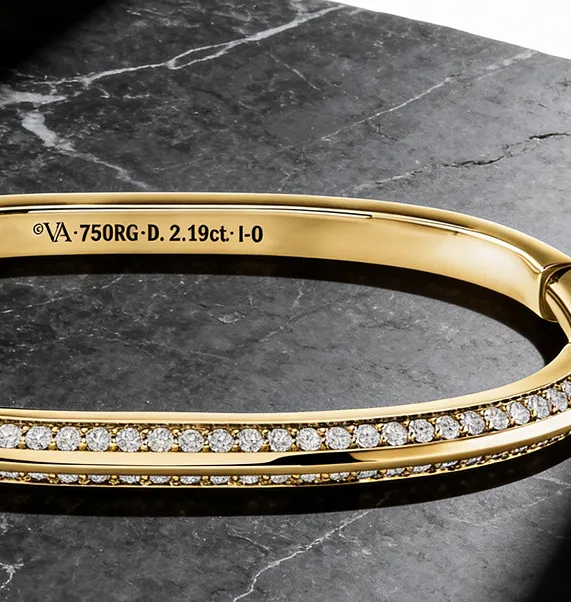
A good diamond bangle is recognized by a setting that holds every stone securely, by evenly matched diamonds, and by a form that suits the wrist. Rose gold looks warm and makes colorless diamonds stand out clearly; white gold emphasizes their colorlessness. For daily wear, protective settings and a simple basic form are the most durable.
At a glance
- Bangle
- Rigid bracelet, as distinct from a flexible bracelet of links
- 18k (750) gold
- 75 percent fine gold, the remainder determines color and hardness
- Rose gold
- Rosy tone from copper in the alloy
- White gold
- Usually rhodium-plated, the layer wears off over time
- Durable settings
- Channel and bezel protect the edges of the stones
- Diamond hardness
- 10 on the Mohs scale, but can cleave from a hard blow
What makes a good diamond bangle
A bangle is rigid and keeps its shape. Unlike a bracelet of flexible links, it does not distribute knocks but absorbs them directly. The diamonds often sit precisely on the outer edge, which knocks against tabletops and door frames during wear. A good bangle therefore combines effect and protection: the stones should take in light freely and still sit securely.

Three levels decide the quality. The first is the diamonds themselves, which must match each other in color and clarity so that the row looks even. The second is the setting work, meaning how each stone is held. The third is the form of the bangle, with cross-section, inner size, and clasp. How bangle and bracelet differ in principle is explained in the comparison Diamond bracelet or bangle.
Rose gold or white gold: the effect of the metals
In 18k (750) gold, 75 percent is fine gold; the remaining 25 percent determine the color. According to the World Gold Council, the rosy tone of rose gold comes from the copper in the alloy. White gold is created with white metals such as palladium and, according to GIA, is usually rhodium-plated, meaning coated with a thin layer of rhodium. This layer makes it whiter and more lustrous, but wears off and must be renewed occasionally.
Diamonds reflect what surrounds them. GIA describes that white gold creates colorless reflections and underscores the colorlessness of stones in color grades D to J. Against rose gold, diamonds of grades D to L stand out clearly; stones further down the scale look softer in it. Rose gold therefore looks warmer and richer in contrast, white gold cooler and more uniform. This is not a question of quality, but of the effect against your own skin tone.
| Criterion | 18k (750) rose gold | 18k (750) white gold |
|---|---|---|
| Color effect | Warm, rosy, sets contrast | Cool, bright, looks uniform with the stones |
| Diamonds appear | Clearly set off against the warm tone | Especially colorless, the metal recedes |
| Care | Occasional polishing | Renew the rhodium layer from time to time |
| Style | Personal, distinctive | Classic, understated |
Both alloys contain the same amount of gold. The difference lies in color and care.
Settings that withstand everyday wear
At grade 10 on the Mohs scale, diamond is the hardest material in jewelry. Hard, however, does not mean unbreakable. GIA points out that a hard blow in the direction of the cleavage planes can cleave a diamond and that corners and points are therefore often protected by prongs. A loose diamond can also wear down a prong over time, because it is harder than the metal.
- Channel setting: the stones sit between two metal walls, their edges are protected.
- Bezel setting: a metal rim encloses the stone completely and hardly catches on fabric.
- Prong setting: lets in a lot of light, but the prongs can catch on fabric.
- Pavé: many small stones forming a surface, needs occasional checking of the setting.
For a bangle worn daily, channel and bezel are the more robust solutions. A prong setting makes the diamonds appear brighter, but requires regular checking. The same applies to a pavé surface. A good workshop aligns the setting with how the piece is worn, not only with its effect in the display window.
One row, two rows, or a tennis bracelet
A bangle with one row of diamonds looks understated and combines well with other jewelry. A double row doubles the area of light and gives the bangle more presence. It requires particularly precise matching, because two rows side by side make every difference in color or size visible. A tennis bracelet, by contrast, is flexible: each diamond sits in its own link, and the bracelet hugs the wrist.

Which form looks more refined is decided by style. The rigid bangle with a double row has a graphic, clear line and acts as a statement. The tennis bracelet flows and sparkles in motion. For everyday wear: the bangle has no links that can loosen; the bracelet has a clasp that can open. How to assess diamond bracelets is shown in the guide Diamond bracelets.
Timeless forms for daily wear
Bangles whose form rests on a few clear lines look timeless: an even cross-section, a continuous row of stones of equal size, an unobtrusive clasp. Fashionable details such as conspicuous ornaments or unusual stone shapes shape a piece more strongly, but age faster. If you wish to wear a bangle every day, you will tend to choose a form that harmonizes with clothing, watch, and other jewelry. How a piece with its own signature is created is explained in the guide Signature bangle.
Fit also counts toward longevity. A rigid bangle that is too tight presses; one that is too wide slides over the hand and knocks against things. An oval bangle shape follows the wrist better than a perfectly round one. A hinge with clasp allows a narrower size than a bangle slipped over the hand. The measurements should therefore be taken on your own wrist and not according to a standard size.
Common mistakes and care
- Paying attention only to the area of light and overlooking the security of the setting.
- Overlooking diamonds of different color in one row, which become noticeable in daylight.
- Choosing a bangle whose size does not suit the wrist.
- Cleaning the bangle in an ultrasonic bath, which can loosen stones in the setting.
- Not having the rhodium layer on white gold renewed when it becomes thin.
For care at home, GIA recommends a lint-free cloth, commercial jewelry cleaners, or mild household detergents. Ultrasonic and steam cleaners do not belong in the household, because they can loosen stones. Before such cleaning, a workshop checks whether all stones are firmly seated. If you wear the bangle daily, have the settings checked at regular intervals. How checks, cleaning and any later adjustment will be handled is best clarified before the handover.
A bangle to your own design
A custom bangle is designed around the wrist and the way it is worn. At Vikar Ahmed, this begins with a design by the in-house designers, followed by a three-dimensional visualization before the piece is made as a one-of-a-kind piece in the in-house atelier. The house works with 18k (750) gold in white, rose, and yellow as well as platinum 950. Stones are set under the microscope, most often with prongs, a bezel or half bezel, and as pavé or micro-pavé. The path from design to finished bangle is described in the guide Custom bangle.
Frequently asked questions
18k (750) white gold or rose gold for a bangle with diamonds: which is the more beautiful choice?
Both are equally fine, because both contain 75 percent gold. Rose gold sets a warm contrast against which colorless diamonds stand out clearly. White gold makes the stones appear especially colorless and itself recedes. The more beautiful choice is whatever suits your skin tone, your watch, and the other jewelry you often wear.
Diamond bangle with a double row of diamonds or a classic tennis bracelet: which looks more refined?
Both look refined, only in different ways. The rigid bangle with a double row shows a clear, graphic line and a large area of light. The tennis bracelet is flexible, lies softly on the wrist, and sparkles with every movement. If you are looking for a distinctive appearance, you will tend toward the bangle; if you value restraint, toward the bracelet.
I wear my bangle almost every day and want it to still look modern in twenty years. Which diamond bangle designs have proven timeless?
Simple basic forms have proven themselves: an even bangle with a continuous row of diamonds of equal size, in channel or bezel setting, with an unobtrusive clasp. Such pieces follow no short-lived detail. For daily wear, a protective setting is added so that the stones remain firmly seated even after many years.
Which setting holds up on a diamond bangle worn every day?
For daily wear, a careful workshop will usually suggest a channel or bezel setting, because both protect the edges of the diamonds. Prongs let in more light, but can catch on fabric. Ask in conversation how the setting suits your everyday life. Vikar Ahmed recommends having settings checked about every two years.
Which is more impressive as a collector's piece, a radiant cut diamond bracelet or a rose gold bangle with hand-set diamonds?
That depends on the emphasis. A radiant cut bracelet lives from the stones themselves; their evenness and quality are in the foreground. A rose gold bangle with hand-set diamonds lives more from design and setting work. For collectors, documented stone quality, execution, and an independent design count in both cases.
I have a bold style and want to wear a bangle as a personal signature. Which rose gold bangle with diamonds has enough character for that?
Character arises from a clear decision in the design: for example a wider bangle, a double row of diamonds, or a strong cross-section that brings out the warm rose gold. What matters is that the bangle suits the size of the wrist and fits well. A piece to your own design can take up exactly this signature.
Private consultation
Rose gold or white gold, one row or two: in a personal appointment in Idar-Oberstein or virtually, you discuss the form, setting, and stones of your bangle with Vikar Ahmed. You submit your inquiry via the Contact page; it is treated discreetly.
Further reading
- Diamond bracelet or bangle
- Custom bangle
- Assessing diamond bracelets properly
- Signature bangle
- Glossary: Bangle
Sources
- GIA: Guide to White, Yellow, and Rose Gold Engagement Rings, accessed 2026-11-17
- World Gold Council: About gold jewellery, accessed 2026-11-17
- GIA 4Cs: Complete Guide to Engagement Ring Settings, accessed 2026-11-17
- GIA: Diamond Care and Cleaning, accessed 2026-11-17
- GIA 4Cs: Best Ring Material for Everyday Wear, accessed 2026-11-17
- Vikar Ahmed: Bespoke, accessed 2026-11-17
- Vikar Ahmed: Collections, accessed 2026-11-17

A personal conversation starts here.
At the showroom in Idar-Oberstein or by video. Vikar Ahmed discusses your ideas, stones and designs with you and answers your questions calmly and in confidence.


Thank you for your request.
Your request will be handled with the utmost attention and discretion. Vikar Ahmed will get back to you.
Your details
Request
–
Occasion
–
Consultation
–
Contact
–
In the meantime
Insights: What is a Paraíba tourmaline? · Engagement ring to your own design: how does it work?
Confidential and without obligation
Back to the pagePrivate consultation
A personal conversation starts here.
- Time for your questions, wishes and ideas
- In the showroom in Idar-Oberstein or by video
- Confidential, discreet and without obligation
Vikar Ahmed · Hauptstraße 111 · 55743 Idar-Oberstein, Germany