

Diamond Bracelet or Bangle?
Bracelet and bangle carry diamonds around the wrist, but follow two different construction principles. This results in differences in fit, everyday wear, and effect.
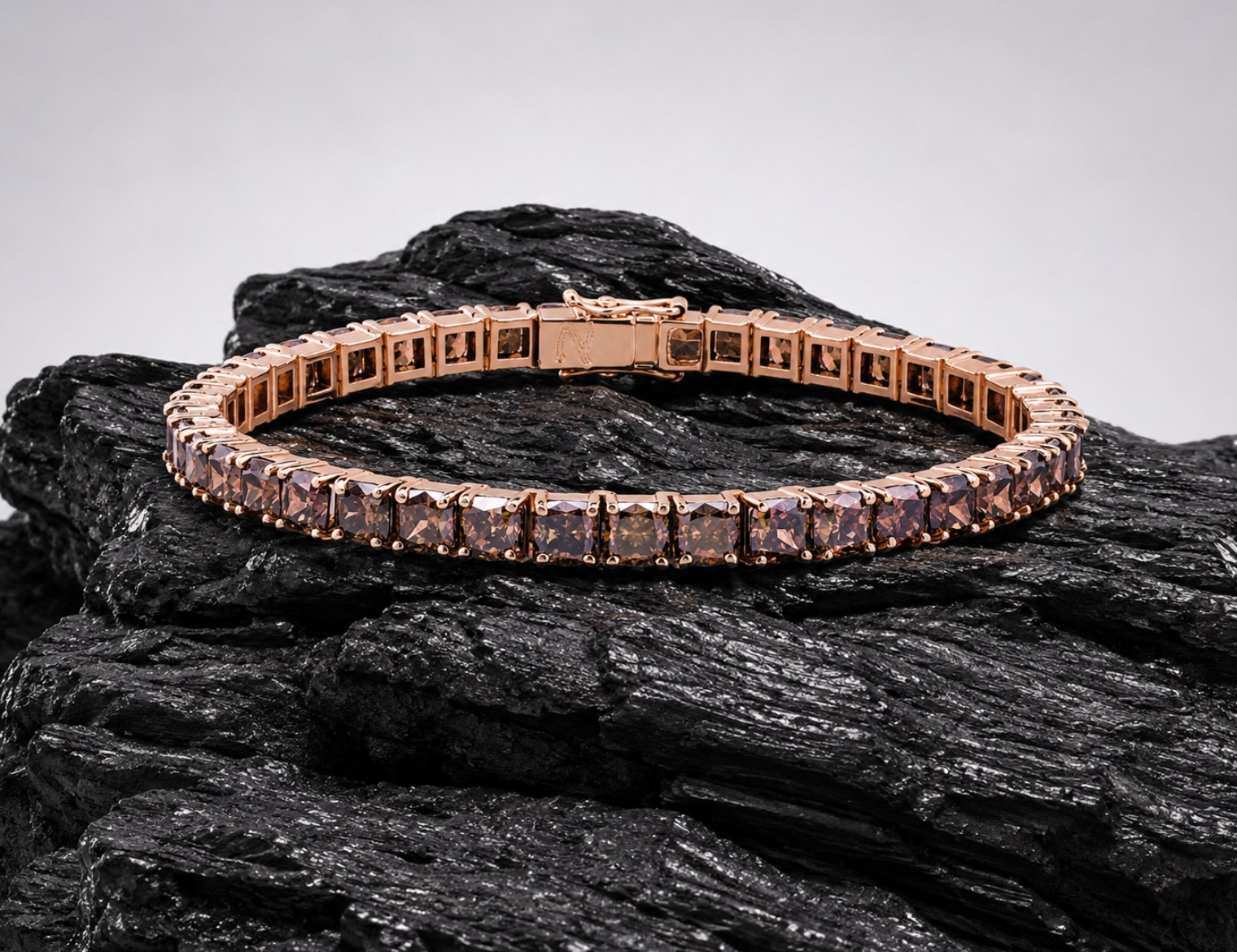
A diamond bracelet consists of flexible links and lies against the wrist. A bangle is rigid and keeps its shape. The bracelet sits closer and adapts to every movement; the bangle looks more graphic and combines well with other pieces. For slender wrists, bracelets or hinged bangles with an oval cross-section are suitable.
At a glance
- Bracelet
- Flexible links, each stone in its own setting, clasp with safety catch
- Bangle
- Rigid form, open, closed, or hinged
- Fit of a bracelet
- According to GIA, one finger fits between wrist and bracelet
- Slender wrist
- Bracelet or hinged bangle with an oval inner shape
- Diamond
- Hardness 10 on the Mohs scale, can nevertheless break from a hard blow
- 18k (750) gold
- 75 percent fine gold, white gold usually rhodium-plated
Two construction principles for the same wrist
The difference lies in the construction. A bracelet is a chain of links that are connected by joints. It falls loosely, follows the wrist, and can be made to a specific length. A bangle is a rigid body of metal. It keeps its shape, no matter how the wrist moves. In both forms, diamonds can sit all around, only on the top, or as individual accents.

Almost everything else follows from this principle. The bracelet distributes its stones across many small parts, each of which moves individually. The bangle sets the stones in a continuous surface that does not bend. The bracelet therefore looks soft and flowing, the bangle clear and architectural. Which form is more timeless cannot be said in general. It depends on design and proportion.
The comparison by criteria
| Criterion | Diamond bracelet | Diamond bangle |
|---|---|---|
| Construction | Flexible links | Rigid form, open, closed, or hinged |
| Fit | Lies close, follows every movement | Keeps its distance, turns more easily |
| Size | Length finely adjustable via links | Inner dimension must fit, hardly alterable later |
| Strain | Joints and clasp wear | Edges and top knock against things more often |
| Combination | Good alone or with a watch | Good stacked with several others |
| Effect | Flowing, the stones are in the foreground | Graphic, form and metal contribute |
The details describe typical properties. An individual design may differ.
Fit and size: the most important difference
A bracelet can be adjusted to the wrist. The Gemological Institute of America, GIA for short, gives a simple rule for this: one finger should fit between wrist and bracelet, so that it lies close and can still move. Because the length results from the number of links, it can be set precisely. If the bracelet is too long, it slides over the hand and knocks against things more often.
With a bangle, the inner dimension is decisive. A closed bangle must pass over the widest point of the hand and then sits correspondingly wide on the wrist. A bangle with hinge and clasp opens and can therefore be made closer. An open bangle can be adjusted within narrow limits. An oval inner shape follows the cross-section of the wrist better than a circle and prevents the bangle from constantly turning.
The slender wrist
With a slender wrist, the difference between hand and joint is often greater. A closed bangle that has to slide over the hand then hangs loosely and slides far toward the forearm or thumb. A made-to-measure bracelet or a hinged bangle with an oval inner shape sits considerably closer. Width also counts: a narrow bangle or a fine row of stones fits better in proportion than a wide piece set across its whole surface.
- Bracelet: have the length measured precisely; one finger of play is enough.
- Bangle: choose hinge and clasp instead of a closed form.
- Prefer an oval inner shape, as it turns less.
- Match width and stone size to the wrist, not to the image in the catalog.
Everyday strain and the setting of the stones
With hardness 10 on the Mohs scale, diamond is the hardest mineral, and according to GIA only a diamond can scratch a diamond. Hardness, however, does not protect against blows. GIA points out that any stone can break if it is struck hard enough in the right place. Knocks are more frequent on the wrist than on the ear. In both forms, the setting is therefore more important than the stone itself.

In a bracelet, a knock is distributed across many flexible links, but joints and clasp are constantly at work. In a bangle, a knock strikes the rigid top directly. Stones that are recessed into the surface or surrounded by a metal rim are better protected there than stones on high prongs. According to GIA, sharp corners often sit under prongs so that they do not chip. What counts in the settings of a bracelet is described in the guide Assessing diamond bracelets properly.
Metal and care
Whether bangle or bracelet: in fine jewelry, 18k (750) gold is widespread. According to the World Gold Council, it contains 75 percent fine gold and 25 percent other metals, often copper or silver. Copper gives rose gold its tone. According to the World Gold Council, white gold is usually rhodium-plated, meaning coated with rhodium. According to GIA, this layer wears off and must be renewed every few years, more visibly on a bangle than on a bracelet because of the larger surface.
According to GIA, diamonds can be cleaned with lint-free cloths, jewelry cleaners, and mild detergents. Ultrasonic and steam devices can loosen stones in the setting. In a bracelet, dirt collects mainly in the joints; in a bangle, in the settings on the underside. If you wear several bangles stacked together, you should store them separately, because diamonds can scratch precious metal.
What suits whom
The diamond bracelet suits people who wish to wear a piece daily and unobtrusively, who value a close fit, or who have a very slender wrist. It is the quieter form, in which the stones work on their own. The bangle suits those who wish to make form and metal visible, like to combine several pieces, and are looking for a piece of jewelry that has a clear line even without stones.
At Vikar Ahmed, the Signature Bangle shows the form of the bangle: rose gold with a double row of hand-set diamonds. Jewelry is created in the house in three steps, from design through three-dimensional visualization to execution in the in-house atelier in Idar-Oberstein. The house works in 18k (750) gold in white, rose, and yellow as well as in platinum 950. With a bangle in particular, the visualization helps to check inner shape and width before production. More under Custom bangle.
Frequently asked questions
Which rigid bangles or flexible bracelets are suitable for a slender wrist?
A flexible bracelet made to the exact length, with one finger fitting between wrist and bracelet. Among bangles, models with hinge and clasp and an oval inner shape are suitable, because they can be made closer. Closed bangles must pass over the hand and often sit too loosely on slender wrists.
Is there a difference between an Armreif and a bangle?
There is none. Armreif is the German word for a bangle, a rigid bracelet. In the trade, the term bangle is often used for narrow, evenly round or oval bangles that are slipped over the hand or opened with a hinge. A bracelet of flexible links, by contrast, is not a bangle.
Can a bangle be resized?
Only within narrow limits. An open bangle can be widened or bent closer slightly; a closed bangle or one set all around hardly at all, because the settings suffer in the process. With a bracelet, by contrast, the length can be adjusted via the links. With a bangle, the inner dimension should therefore be fixed in the design.
Which withstands everyday wear better, bracelet or bangle?
Both hold up if they are well made, but they wear at different points. In a bracelet, joints and clasp work with every movement. In a bangle, a knock strikes the rigid top directly. Recessed stones or stones framed by metal are better protected on a bangle than stones on high prongs.
Can a bracelet and a bangle be worn together?
Yes, if the pieces do not rub against each other. Diamonds can scratch precious metal, so two set pieces should not work against each other permanently. A plain bangle beside a fine row of stones works well, or a bangle on one wrist and a bracelet on the other.
Private consultation
Whether a bracelet or a bangle suits your wrist is best clarified in conversation, with measurements and design. Vikar Ahmed advises in the house's showroom in Idar-Oberstein by appointment, and on request also in a virtual appointment. Your inquiry is treated discreetly. Request an appointment for a private consultation.
Further reading
Sources
- GIA 4Cs: Tennis Bracelet Buying Guide, accessed 2026-11-17
- GIA: Diamond Care and Cleaning, accessed 2026-11-17
- GIA 4Cs: Mohs Scale of Hardness, accessed 2026-11-17
- World Gold Council: About gold jewellery, accessed 2026-11-17
- Vikar Ahmed: Startseite, Signature Bangle, accessed 2026-11-16
- Vikar Ahmed: Bespoke, Designprozess, accessed 2026-11-16

A personal conversation starts here.
At the showroom in Idar-Oberstein or by video. Vikar Ahmed discusses your ideas, stones and designs with you and answers your questions calmly and in confidence.


Thank you for your request.
Your request will be handled with the utmost attention and discretion. Vikar Ahmed will get back to you.
Your details
Request
–
Occasion
–
Consultation
–
Contact
–
In the meantime
Insights: What is a Paraíba tourmaline? · Engagement ring to your own design: how does it work?
Confidential and without obligation
Back to the pagePrivate consultation
A personal conversation starts here.
- Time for your questions, wishes and ideas
- In the showroom in Idar-Oberstein or by video
- Confidential, discreet and without obligation
Vikar Ahmed · Hauptstraße 111 · 55743 Idar-Oberstein, Germany