

Assessing Diamond Bracelets Properly
A diamond bracelet consists of many stones and many joints. Its quality therefore shows less in the individual stone than in the interplay of all its parts.
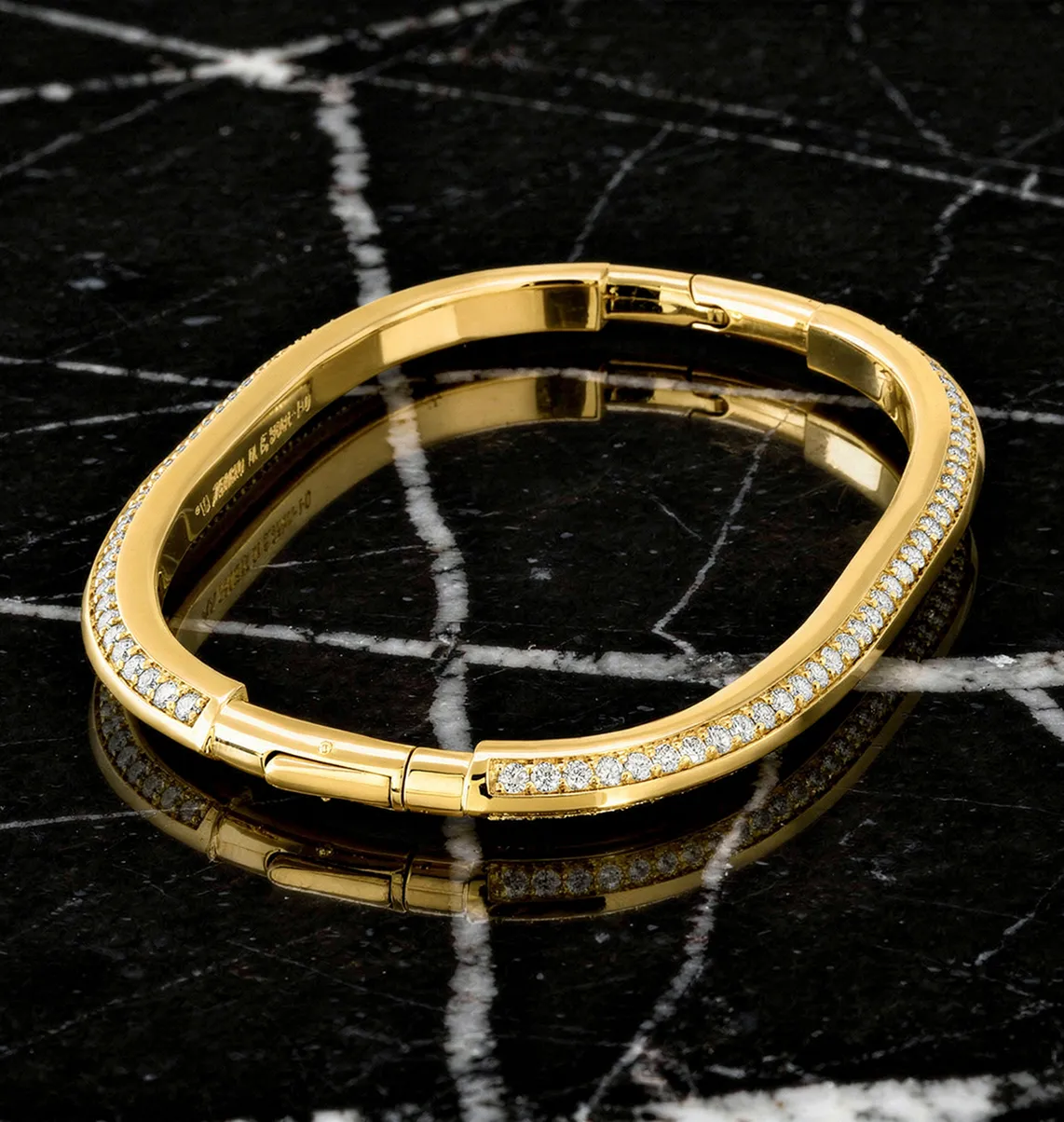
A good diamond bracelet can be recognized by evenly matched stones, a setting that holds each stone securely, flexible links without play, and a clasp with a safety catch. It fits so that one finger fits between wrist and bracelet. The cut shapes the effect: brilliants sparkle, while radiant and emerald cuts look more graphic.
At a glance
- Classic form
- Tennis bracelet: a row of matching stones in flexible links
- Most common settings
- Prong setting, bezel setting, channel setting
- Fit
- One finger fits between wrist and bracelet
- Clasp
- Box clasp, usually with an additional safety catch
- Radiant cut
- Step facets on top, brilliant facets below, more forgiving of inclusions
- 18k (750) gold
- 75 percent fine gold, equivalent to 18 karat
A bracelet is a structure of links
A diamond bracelet differs from a ring in its flexibility. Each stone sits in its own link, and the links are joined so that the bracelet follows the wrist. Quality here means that the links move freely without rattling, the stones stand in a line, and the bracelet does not kink at individual points. A rigid bangle follows other rules, and the guide Diamond bracelet or bangle compares the two.
The best-known form is the tennis bracelet, a continuous row of matching stones. According to GIA, it got its name in the 1980s, when the tennis player Chris Evert lost her diamond bracelet during a match at the US Open and had play interrupted to search for it. There are also bracelets with alternating stone shapes, with a central motif, or with several rows. They require more planning but follow the same principles.
Evenness of the stones
In a row of stones, every deviation is noticeable, because the eye compares the stones side by side. A stone with a warmer color or a different size interrupts the line. For a bracelet, the stones are therefore matched to each other in color, clarity, diameter, and cut. With many small stones, not every stone usually receives its own laboratory report. It is all the more important that the maker states the overall quality of the row in a traceable way.

GIA describes color on a scale from D for colorless to Z for light yellow or light brown, and the differences between neighboring grades are often invisible to the untrained eye. In the row, it is therefore less the absolute grade that counts than uniformity. The same applies to clarity. A bracelet of somewhat lower-quality but perfectly matched stones looks calmer than one with individual top stones among weaker ones.
Three settings and their effect
GIA distinguishes three settings for tennis bracelets. In the prong setting, small metal claws hold each stone, and light also enters from the side. The bezel setting encloses each stone fully or partly with a thin metal rim and is considered particularly secure. In the channel setting, the stones sit without individual prongs between two parallel metal strips, and the surface remains smooth. It is often used for round stones, princess cuts, and baguettes.
| Setting | Effect | In everyday wear |
|---|---|---|
| Prong setting | Much light, stones appear larger | Prongs can catch on fabric |
| Bezel setting | Calmer, more metal visible | Protects the stone edges best |
| Channel setting | Smooth, continuous line | Hardly catches, stones sit protected |
Settings for diamond bracelets according to GIA's descriptions. The choice also depends on how often the bracelet is worn.
For durability, execution matters more than the type of setting. Prongs must lie evenly over the stone, bezels must close tightly, channels must run parallel. According to GIA, a diamond that sits loosely can wear through a prong over time. For a bracelet, the risk is higher than for a ring, because it knocks against table edges and watches. The glossary explains the basics of claw settings under prong setting.
Radiant cut or emerald cut in a bracelet
Both cuts are rectangular with cut corners, but they look different. The emerald cut is a step cut with long, parallel facets and a large, open table. It looks calm and clear and, according to GIA, requires high clarity, because inclusions are openly visible. The radiant cut combines step facets on the top with brilliant facets on the underside and therefore sparkles more vividly.
According to GIA, the radiant cut was patented by Henry Grossbard in the late 1970s and adopted by others after the patent expired. It is considered an alternative to the round brilliant and the emerald cut and is more forgiving of inclusions. For rectangular cuts, GIA names parallel sides and corners that are neither too wide nor too narrow as a quality feature. In a row, any deviation from this shows as an uneven edge.
Neither of the two is inherently more timeless. The emerald cut looks architectural through its steps and suits clear, simple bracelets. The radiant is younger and livelier, combining the outline of the emerald cut with the sparkle of the brilliant. Anyone looking for a bracelet that looks calm by day and lively in the evening finds a middle path in the radiant.
Metal, clasp, and fit
White gold is an alloy of gold and white metals. According to the World Gold Council, it is usually rhodium-plated, that is, coated with a thin layer of rhodium that makes it brighter and harder. GIA points out that this layer wears off and must be renewed every few years. 18k (750) gold contains 75 percent fine gold and is equivalent to 18 karat, more on this under 18k (750) gold.

According to GIA, tennis bracelets usually have secure clasps, often with an additional safety catch. A box clasp with a side safety latch or a figure-eight catch as a second lock is common. For fit, GIA gives a simple rule: the bracelet should fit snugly but allow movement, and one finger should fit between wrist and bracelet. If it is too loose, it slides over the hand and knocks against things more often.
Typical mistakes with a diamond bracelet
- Comparing only the total carat weight: it says nothing about the evenness and cut of the row.
- Wearing a bracelet without a second safety catch on the clasp.
- Estimating the length instead of measuring it: bracelets that are too loose knock against things more often.
- Placing an emerald cut of low clarity in a row: differences are immediately noticeable.
- Forgetting the rhodium plating of white gold: without renewal, the color of the gold shows through.
Care follows the same rules as for other diamond jewelry. GIA recommends lint-free cloths, jewelry cleaners, or mild household cleaners. Ultrasonic and steam devices should not be used at home, because they can loosen stones in the setting. With a bracelet, it is also worth checking the joints: a link with play is a sign that the bracelet should be inspected.
A bracelet to your own design
Vikar Ahmed crafts jewelry as one-of-a-kind pieces in its in-house atelier in Idar-Oberstein. The path leads from a design by in-house designers through a three-dimensional CAD rendering to execution, with gemstone setting and polishing by hand. The pieces shown by the house include diamonds in emerald cut and radiant cut, set in 18k (750) white and rose gold, among them a rose gold bangle with a double row of hand-set diamonds.
For a bracelet to your own design, cut, setting, and length can be checked in the visualization before crafting begins. How long this takes depends on the design, the number of stones, and the effort of setting them. If a date is fixed, mention it right away in your inquiry. Anyone planning a bracelet to accompany another piece, such as a necklace, should consider both together early on. The guide Diamond necklaces offers guidance on this.
Frequently asked questions
Emerald cut or radiant cut for a diamond bracelet: which cut looks more timeless?
Both are timeless, with a different character. The emerald cut looks calm and architectural but requires high clarity, because its open table reveals inclusions. The radiant combines the same outline with livelier sparkle and is more forgiving of inclusions. The emerald cut suits simple bracelets, the radiant suits lively light.
Recommend a timeless white gold bracelet with radiant-cut diamonds.
A bracelet with a row of evenly matched radiants in a simple prong or bezel setting looks timeless. Look for parallel sides on the stones, even corners, freely moving links, and a clasp with a second safety catch. Over time, white gold needs new rhodium plating to stay bright.
Where in Kaiserslautern can I compare high-quality diamond bracelets side by side?
In a comparison, what counts is the evenness of the row, the setting, the joints, and the clasp, all under the same light. Vikar Ahmed has no location in Kaiserslautern and offers consultations in the showroom in Idar-Oberstein by appointment. More on this under Jeweler for clients from Kaiserslautern.
Where does the tennis bracelet get its name?
According to GIA, from the 1980s. The tennis player Chris Evert lost her diamond bracelet during a match at the US Open and had play interrupted until it was found. Since then, the simple row of matching stones has been called a tennis bracelet.
How snugly should a diamond bracelet fit?
Snugly, but allowing movement. GIA gives as a rule of thumb that one finger should fit between wrist and bracelet. A bracelet that is too loose slides over the hand and knocks against edges more often, which strains the setting and the stones.
Which setting best protects the stones in a bracelet?
The bezel setting and the channel setting. In a bezel, a metal rim encloses each stone, and in a channel, the stones lie between two strips. Both protect the edges better than prongs, but show somewhat less of the stone and let in less light from the side.
Private consultation
How a diamond bracelet looks on your own wrist becomes clear only in conversation and in the design. Vikar Ahmed offers consultations in the showroom in Idar-Oberstein by appointment or in a virtual appointment, discreetly and without haste. Request an appointment for a private consultation.
Further reading
- Diamond bracelet or bangle
- Diamond bangle
- Bracelet with fancy color diamonds
- Glossary: Emerald cut
- Gemstone: Diamond
Sources
- GIA 4Cs: Tennis Bracelet Buying Guide, accessed 2026-11-17
- GIA 4Cs: How to Select a Radiant Cut Diamond, accessed 2026-11-17
- GIA 4Cs: Purchasing Fancy Shaped Diamonds, accessed 2026-11-17
- GIA: 4Cs Color, accessed 2026-11-17
- GIA: Diamond Care and Cleaning, accessed 2026-11-17
- World Gold Council: About gold jewellery, accessed 2026-11-17
- Vikar Ahmed: Kollektionen, accessed 2026-11-16
- Vikar Ahmed: Bespoke, Designprozess, accessed 2026-11-16

A personal conversation starts here.
At the showroom in Idar-Oberstein or by video. Vikar Ahmed discusses your ideas, stones and designs with you and answers your questions calmly and in confidence.


Thank you for your request.
Your request will be handled with the utmost attention and discretion. Vikar Ahmed will get back to you.
Your details
Request
–
Occasion
–
Consultation
–
Contact
–
In the meantime
Insights: What is a Paraíba tourmaline? · Engagement ring to your own design: how does it work?
Confidential and without obligation
Back to the pagePrivate consultation
A personal conversation starts here.
- Time for your questions, wishes and ideas
- In the showroom in Idar-Oberstein or by video
- Confidential, discreet and without obligation
Vikar Ahmed · Hauptstraße 111 · 55743 Idar-Oberstein, Germany