

A Ring with Lagoon Tourmaline
Lagoon stands for a clear bluish green that recalls shallow water. What a ring with this tourmaline requires and where it differs from a Paraíba ring.
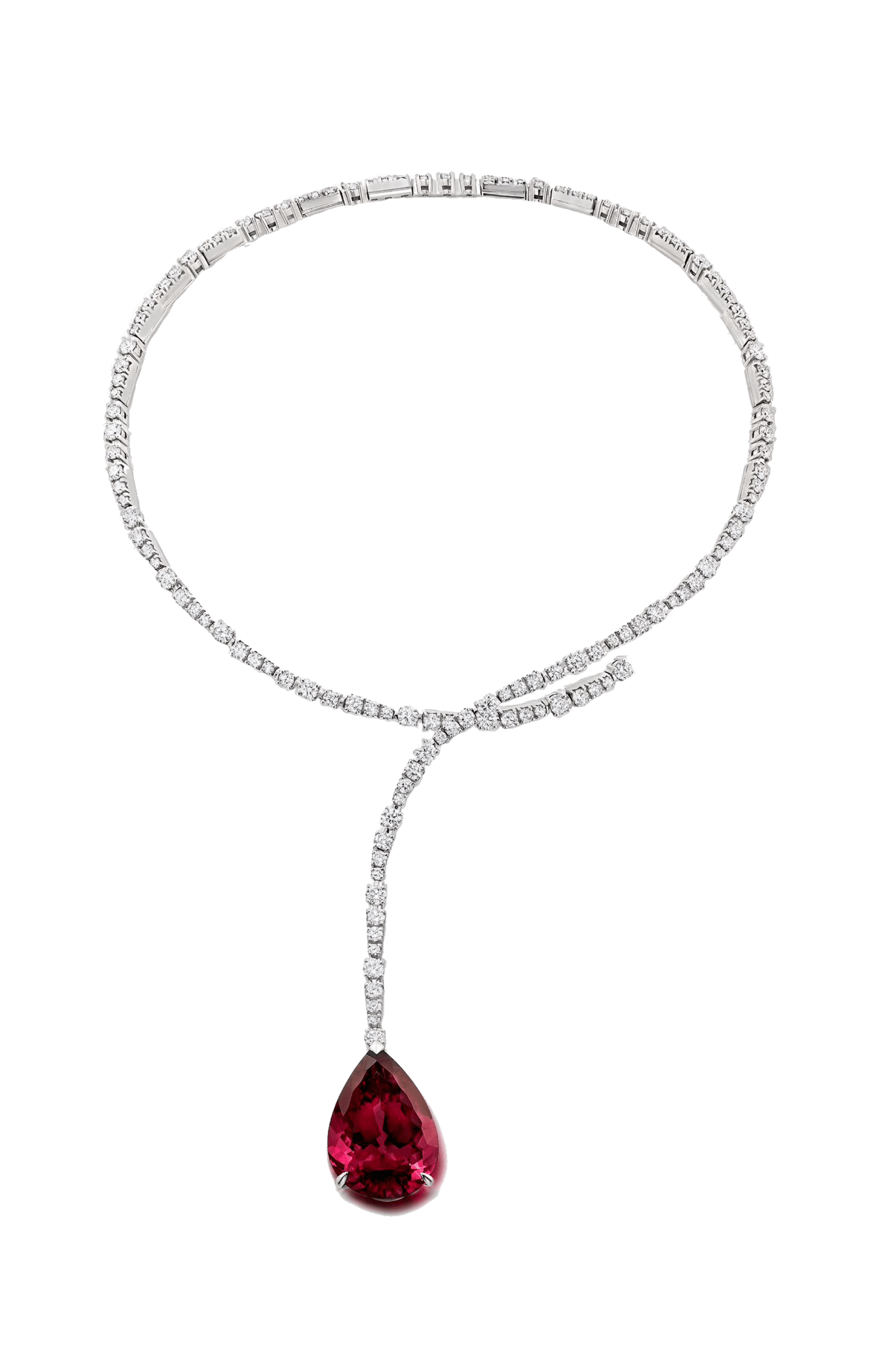
A ring with Lagoon tourmaline suits people who love a calm bluish green. As a tourmaline, the stone has the same hardness as a Paraíba and needs the same protective setting. It is not a substitute in the strict sense, however: without copper as the cause of color, it lacks the characteristic luminosity of Paraíba. What decides is the hue, saturation, and cut of the individual stone.
At a glance
- Lagoon
- Trade name for bluish green tourmalines, not a laboratory term
- Cause of color
- For blue and green in tourmaline usually iron, possibly titanium
- Mohs hardness
- 7 to 7.5, toughness fair according to GIA
- Pleochroism
- Color changes with the viewing direction; the cut controls it
- Report
- Calls the stone tourmaline, not Lagoon
- Care
- Warm soapy water, no ultrasonic, no steam
What defines a Lagoon ring
A Lagoon ring carries a tourmaline in clear bluish green. The name comes from the trade and describes a color, not an origin and not a quality grade. Laboratories simply call the stone tourmaline. According to GIA, tourmalines have one of the broadest color ranges of all gemstones, and in them blue and green are generally attributed to traces of iron and possibly titanium. What the term covers exactly is explained in the entry Lagoon tourmaline.

In a ring, this color looks calmer than the glow of a Paraíba. It goes with white and rose gold as well as with diamonds as accent stones. Because the name draws no fixed boundary, Lagoon tourmalines of different origin look different: sometimes more blue, sometimes more green, sometimes light, sometimes deep. For a ring, what counts is therefore always the individual stone, not the name on the label.
Lagoon as an alternative to a Paraíba ring
Lagoon tourmaline works as an alternative if you are looking for the color family, not the luminosity. Both stones are tourmalines and equally durable in daily wear. The difference lies in the cause of color. In Paraíba tourmaline, under the laboratories' standard, the color is produced mainly by copper and manganese. GIA emphasizes that copper acts as a coloring agent in no other tourmaline. This is exactly what gives Paraíba its particular glow.
A Lagoon tourmaline without this cause of color shows a clear but different bluish green. If you value Paraíba for its rarity or its glow, you will not find an equivalent substitute in Lagoon. If, on the other hand, you love the color and would like a larger stone or a calmer effect, Lagoon is a choice in its own right. The direct comparison by color and rarity is given in the guide Lagoon tourmaline or Paraíba.
| Question | Lagoon ring | Paraíba ring |
|---|---|---|
| Effect | Clear, calm bluish green | Saturated, glowing blue to green |
| Cause of color | Usually iron, possibly titanium | Mainly copper and manganese |
| Hardness and setting | 7 to 7.5, protective setting | 7 to 7.5, protective setting |
| Stone size | Depends on the stone | According to GIA rarely over one carat |
| Report | Tourmaline | Paraíba tourmaline or tourmaline with comment |
Typical characteristics. The individual stone may differ; its report is authoritative.
Judging the color correctly
In tourmaline, color depends on the viewing angle. According to GIA, most green tourmalines are strongly pleochroic, meaning they show two different colors depending on the direction. The cutter orients the table of the stone accordingly. If it lies across the length of the crystal, light material becomes darker. If it lies parallel, dark material becomes lighter. A well-cut Lagoon tourmaline therefore shows its finest bluish green from above, where the ring is looked at.
Dark stones are more common in tourmaline but less sought after. GIA writes that dark-toned stones are valued considerably lower than fine green or bluish green tourmalines. For a ring, it is worth looking at the stone in daylight and in artificial light, because a bluish green can appear greener in evening light. As for clarity: according to GIA, green tourmalines are expected to be free of inclusions visible to the naked eye.
Cut and shape for the ring
Tourmaline crystals grow long and narrow. GIA describes how this yields many narrow stones with non-standard dimensions, and how cutters often choose long rectangles to lose little material. For a ring, this has two consequences. Elongated shapes such as an emerald cut or a slender oval are natural choices for Lagoon tourmalines. And a ready-made, off-the-shelf setting rarely fits exactly, because the stone has unusual dimensions.

It is therefore worth planning the setting around the stone. An elongated stone can sit lengthwise along the finger and lengthen the hand, or lie across and appear wider. An emerald cut shows the bluish green as a calm, clear surface; an oval cut lets it sparkle more vividly. Which shape suits your own hand is best seen in a visualization before the piece is made.
Hardness, setting, and daily wear on the finger
Tourmaline has a Mohs hardness of 7 to 7.5, and according to GIA its toughness is fair. On the finger, a ring is exposed to the most knocks. A bezel setting, in which a rim of metal encloses the stone, protects the edges very well according to GIA. Prongs show more of the stone but must be checked regularly for a secure fit. Many tourmalines are cut as long rectangles to save material, one reason why corners in particular should be protected.
- Have the corners and points of the stone covered with metal.
- Set the stone rather low so that it is knocked less often.
- Take the ring off for sports, gardening, and rough work.
- Clean with warm soapy water; avoid ultrasonic and steam.
- Avoid great heat and rapid changes in temperature; they can harm the color and the stone.
What the report says about Lagoon tourmaline
A laboratory report on a Lagoon tourmaline identifies the material as tourmaline and names detectable treatments. It does not carry the name Lagoon, because laboratories do not use trade names for colors. SSEF describes the color in factual terms such as blue or greenish blue. The report becomes interesting when a bluish green tourmaline contains copper. If it meets the criteria for color, saturation, and copper and manganese, it counts as Paraíba tourmaline, whatever name the trade gives it.
On treatment, GIA writes that heating and irradiation are the most important treatments for tourmaline. Heating is stable, and green material that is too dark can become lighter through it. Irradiated colors, by contrast, can fade under heat or strong light. A report should therefore state what was detected. An overview is given in the guide on the treatment of tourmalines.
Typical mistakes with a Lagoon ring
- Taking the name for a statement of quality: Lagoon describes only a color.
- Judging the stone only from the side or in a photo: the color changes with the viewing direction.
- Choosing a stone that is too dark: on the finger, it quickly looks blackish green.
- Regarding a Lagoon as a less expensive Paraíba: these are stones with different causes of color.
- Choosing an open setting for an everyday ring that leaves corners and edges unprotected.
Lagoon tourmalines at the Maison Vikar Ahmed
Among the pieces by Vikar Ahmed are works with Lagoon tourmalines as well as with Brazilian Paraíba tourmalines. Each piece is created as a one-of-a-kind piece in three steps: design by in-house designers, three-dimensional visualization, and realization in the in-house atelier. For Lagoon tourmaline, Vikar Ahmed expects almost eye-clean clarity, with the brilliance of the color and a precise cut as the most important criteria. The visualization makes it possible to check how stone, setting, and ring shank work together. If you would like to compare Lagoon and Paraíba tourmaline on the finger, it is best to mention this when you request the appointment.
Frequently asked questions
Is a ring with Lagoon tourmaline a good alternative to the much rarer Paraíba ring?
Yes, if you are looking for the color and not the characteristic glow. Both stones are tourmalines of the same hardness and need the same protective setting. Lagoon, however, lacks copper as the cause of color, which distinguishes Paraíba. It is a choice in its own right, not an equivalent substitute.
Is Lagoon tourmaline a gemstone of its own?
No. Lagoon is a trade name for tourmalines in light to clear bluish green. Gemologically, the stone is a tourmaline, and the laboratory report calls it that as well. The name says nothing about locality, clarity, or treatment.
Is a Lagoon tourmaline hard enough for a ring worn every day?
It is wearable but needs protection. Tourmaline has a Mohs hardness of 7 to 7.5 and fair toughness. A setting that covers edges and corners with metal and a stone set rather low make the ring suitable for everyday wear. It should be taken off for rough work.
Why does my Lagoon tourmaline look different from different directions?
Because tourmalines are pleochroic. They show two different colors depending on the viewing direction, in bluish green often a bluer and a greener tone. A good cutter orients the table so that the finest color is seen from above.
Can a Lagoon tourmaline also be a Paraíba tourmaline?
Yes, if it meets the laboratories' criteria. If its bluish green color is caused mainly by copper and manganese and is sufficiently saturated, it counts as Paraíba tourmaline. The trade name plays no role in this. Only a laboratory report provides clarity.
How do I clean a ring with Lagoon tourmaline?
With warm soapy water and a soft brush. GIA does not recommend ultrasonic or steam cleaners for tourmaline. The stone should also not be exposed to great heat or rapid changes in temperature, because they can alter the color or cause fractures.
Private consultation
Whether a Lagoon tourmaline or a Paraíba tourmaline suits your ring becomes clear when you look at both colors. Vikar Ahmed advises in the house's showroom in Idar-Oberstein by appointment or in a virtual appointment, discreetly and without haste. Request an appointment for a private consultation.
Further reading
- Glossary: Lagoon tourmaline
- Gemstone: Lagoon tourmaline
- Lagoon tourmaline or Paraíba compared
- Guide: Paraíba ring
- Settings for colored gemstones
Sources
- GIA: Tourmaline, Gem Facts, accessed 2026-11-17
- GIA: Tourmaline Quality Factors, accessed 2026-11-17
- GIA: Tourmaline Care and Cleaning, accessed 2026-11-17
- GIA: Gem Treatment, accessed 2026-11-17
- GIA 4Cs: Complete Guide to Engagement Ring Settings, accessed 2026-11-17
- LMHC Information Sheet #6: Paraiba Tourmaline (Version 8, 2023), accessed 2026-11-17
- SSEF: Paraiba Tourmaline, Report Explanation, accessed 2026-11-17
- Vikar Ahmed: Meisterstücke und Kollektionen, accessed 2026-11-17
- Vikar Ahmed: Bespoke, accessed 2026-11-17

A personal conversation starts here.
At the showroom in Idar-Oberstein or by video. Vikar Ahmed discusses your ideas, stones and designs with you and answers your questions calmly and in confidence.


Thank you for your request.
Your request will be handled with the utmost attention and discretion. Vikar Ahmed will get back to you.
Your details
Request
–
Occasion
–
Consultation
–
Contact
–
In the meantime
Insights: What is a Paraíba tourmaline? · Engagement ring to your own design: how does it work?
Confidential and without obligation
Back to the pagePrivate consultation
A personal conversation starts here.
- Time for your questions, wishes and ideas
- In the showroom in Idar-Oberstein or by video
- Confidential, discreet and without obligation
Vikar Ahmed · Hauptstraße 111 · 55743 Idar-Oberstein, Germany