

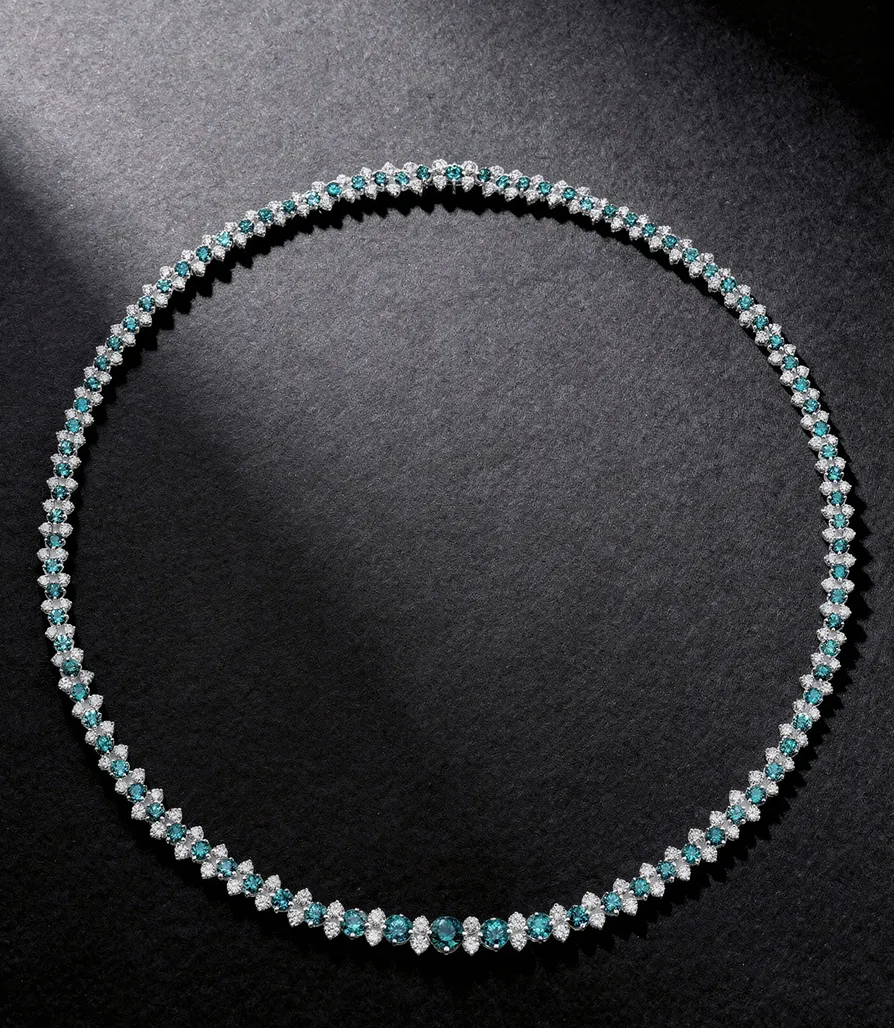
You recognize a good Paraíba bracelet by three things: the tourmalines are matched to one another in color and saturation, the setting protects the softer tourmalines better than the diamonds beside them, and laboratory reports on species, treatment, and origin are available for the important stones. A secure clasp and a suitable size are just as much part of it.
At a glance
- Hardness of tourmaline
- 7 to 7.5 on the Mohs scale, toughness only fair according to GIA
- Hardness of diamond
- 10 on the Mohs scale
- Cause of Paraíba color
- Mainly copper, with manganese
- Typical size
- According to GIA, rarely over one carat
- Treatment
- Heating is common, not detectable in tourmaline according to GIA
- Cleaning
- Warm soapy water, no ultrasonic, no steam
- Size
- According to GIA, one finger fits between wrist and bracelet
Three touchstones for a Paraíba bracelet
A bracelet with Paraíba tourmalines and diamonds combines two stones with very different properties. Diamond is the hardest gemstone, tourmaline considerably softer and more sensitive to heat. A successful bracelet takes this into account in every setting. Then there is color: several Paraíbas in a row must match one another, otherwise the bracelet looks restless. And finally, documentation counts, because the name Paraíba does not mean the same thing everywhere.
For collectors who already own colored stones, the bracelet is a special form. It is in motion, knocks against table edges, and lies close to the skin. A ring is often taken off, a bracelet rarely. The criteria below are therefore stricter than for a pendant. Anyone undecided between the two forms will find a comparison in the article Paraíba bracelet or pendant?.
Many stones, one color
According to GIA, Paraíba tourmalines show hues ranging from greenish blue through blue-green and green to blue and violet. Their color comes mainly from copper, with manganese. According to GIA, blue and violet are the most sought after. In a single stone, this range is a selection criterion; in a bracelet, it is a challenge: even small differences in tone or saturation become noticeable when the stones lie close together.

Then there is size. According to GIA, Paraíba tourmalines rarely exceed one carat, and color counts for more than size. A bracelet with many stones of equal size and equal color therefore requires patient selection. Because tourmaline is strongly pleochroic, meaning it shows different colors depending on the viewing direction, the cutter deliberately orients the table. This, too, influences how uniform the row will look later.
Good to know
Color and origin are not reliably linked. According to GIA, the color ranges of Brazilian, Nigerian, and Mozambican stones overlap considerably. More on this in the article Paraíba tourmaline: classifying color and origin.
The setting must protect the tourmaline
Tourmaline reaches 7 to 7.5 on the Mohs scale, and GIA rates its toughness only as fair. The diamond beside it has a hardness of 10. In a bracelet that knocks against edges, the tourmalines are therefore the vulnerable stones. A good setting gives them more protection than the diamonds, for example through a bezel setting that encloses the edge, or through slightly raised metal edges that absorb knocks.
| Setting | For Paraíba tourmalines | For colorless diamonds |
|---|---|---|
| Prongs | Plenty of light, but open edges, regular checks needed | Proven, according to GIA the most popular setting in a tennis bracelet |
| Bezel | Encloses the edge, protects against knocks and chipping | Calm look, somewhat less light |
| Channel | Stones sit between two metal rails, smooth surface | According to GIA no snagging, often for brilliants and baguettes |
| Pavé | Intended for small diamonds rather than larger tourmalines | Small diamonds as a surface, needs occasional care |
Setting types according to their benefit for both stones.
More on choosing the setting for this stone can be found in the article Which setting suits Paraíba tourmaline?. For the bracelet, flexibility is added: every link must move freely without the stones rubbing against one another. Where tourmalines lie directly beside diamonds, the settings should be designed so that the stones do not touch.
Clasp, size, and wearing
The clasp is the most important component that cannot be seen in photos. For tennis bracelets, GIA advises secure clasps, often with an additional safety catch. With a Paraíba bracelet this applies all the more, because a lost bracelet costs not only diamonds but colored stones that are difficult to replace. A double safety catch and a clasp that can be checked with one hand are sensible minimum standards.
The size determines how much the bracelet moves. According to GIA, one finger should fit between wrist and bracelet. A bracelet that is too loose slides over the back of the hand and knocks against things more often; one that is too tight presses. With a rigid bangle, the question is different, because it is slipped over the hand. Here, shape and inner dimension are what count.
Treatment, name, and documentation
According to SSEF, Paraíba tourmalines are frequently heated to change their color. According to GIA, the result is stable, but in tourmaline it is not detectable. GIA therefore advises always regarding the color of Paraíba tourmalines as possibly altered by heating. A report cannot reliably prove that a tourmaline is untreated. Fillings of fissures with oil or resin, on the other hand, are named and graded by the SSEF laboratory in its reports.

The name is not uniform either. According to GIA, the LMHC, an association of major laboratories, calls copper- and manganese-bearing tourmalines of suitable color Paraíba tourmaline regardless of the country of origin. The SSEF laboratory, by contrast, uses the name only for stones from Brazil and describes stones from Nigeria and Mozambique as tourmaline with a reference to the trade name. For a bracelet, this means: for the important stones, a report that states species, treatment, and origin is worthwhile.
GIA expressly offers origin reports for Paraíba tourmalines as well, for unmounted and mounted stones alike. The laboratory determines origin through trace elements. In some cases, according to GIA, the result remains undetermined. With the many small stones of a bracelet, a report for each stone is rarely customary. It is useful for the largest stones that define the bracelet. More on this in the glossary under origin report.
Everyday care
For tourmalines, GIA recommends warm soapy water. Ultrasonic and steam cleaners are not recommended. High heat can change the color, and sudden temperature changes can cause fractures. This also affects repairs: if soldering is needed on the bracelet, this question should be clarified beforehand so that the tourmalines are not exposed to heat. The diamonds tolerate more, but the bracelet should always be cared for according to the needs of the more sensitive stone.
- After wearing, wipe with a soft cloth and store separately from other jewelry.
- Check the clasp and safety catch regularly, especially before traveling.
- Take it off for sports, gardening, and when handling heat.
- Have the settings checked by a goldsmith at regular intervals.
Paraíba jewelry at Vikar Ahmed
Paraíba tourmaline is the heart of the house. Vikar Ahmed creates Paraíba high jewelry as one-of-a-kind pieces in 18 karat gold, platinum, and with diamonds, designed and realized in the in-house atelier in Idar-Oberstein. Whether a stone may be called Paraíba tourmaline is assessed by a laboratory. For high-quality Paraíbas, the house works with Gübelin, SSEF, GRS, and the DGemG. Note the laboratory and the report number. For collectors from Trier or Kirn: the house has no location there, and consultations take place in the showroom in Idar-Oberstein.
Frequently asked questions
How do Paraíba bracelets with colorless diamonds compare in terms of setting quality?
A good setting protects the tourmalines first, because at 7 to 7.5 on the Mohs scale they are considerably softer than diamonds. Bezels or raised metal edges absorb knocks; prongs give more light but must be checked regularly. The stones should not touch one another, and every link must remain freely movable.
I have been collecting colored stones for years and now want to treat myself to a Paraíba bracelet. Where in Bad Kreuznach can I see one in person before I decide?
Vikar Ahmed has no location in Bad Kreuznach. Consultations take place in the showroom in Idar-Oberstein by appointment. It is best to name the pieces you would like to see when you inquire. Check the color in daylight and artificial light. Directions at Jeweler for Bad Kreuznach.
I am looking for a bracelet with Paraíba tourmalines but cannot find a suitable finished piece. Which workshop in Kaiserslautern designs something like this especially for me?
What matters is a workshop that can match stones by color, set tourmalines gently, and show the design in advance. Vikar Ahmed has no location in Kaiserslautern, but designs one-of-a-kind pieces in Idar-Oberstein, with sketch and CAD visualization. More at Jeweler for Kaiserslautern.
How delicate is a Paraíba bracelet in everyday wear?
More delicate than a pure diamond bracelet. Tourmalines are softer than diamonds, their toughness is considered fair, and they react to heat. The bracelet should be taken off for sports or rough work. A protective setting and a secure clasp reduce the risk considerably.
Does every Paraíba in the bracelet get its own report?
Usually not. With many small stones, a report for each stone is uncommon. It is useful for the larger stones that define the bracelet. According to GIA, an origin report is also possible for mounted Paraíba tourmalines, but in individual cases it may remain without a conclusive result.
How do you clean a bracelet with Paraíba tourmalines?
With warm soapy water and a soft brush, then rinse thoroughly and dry. According to GIA, ultrasonic and steam cleaners are not recommended for tourmaline, because heat and temperature changes can damage the stone. For thorough cleaning, the goldsmith is the better address.
Private consultation
Whether the stones of a bracelet match in color can only be seen on the piece itself and under changing light. Vikar Ahmed advises in the showroom in Idar-Oberstein by appointment, and virtually if you wish. Your inquiry is treated with discretion. Request an appointment for a private consultation.
Further reading
- Paraíba or Lagoon tourmaline in a bracelet?
- Which setting suits Paraíba tourmaline?
- Glossary: Paraíba tourmaline
- The tourmaline bracelet: matching colors, protecting stones
- Jeweler for Trier
- Jeweler for Kirn
Sources
- GIA: Tourmaline Quality Factors (Paraíba-Farben, Größe, Schliff), accessed 2026-11-17
- GIA: Tourmaline Care and Cleaning, accessed 2026-11-17
- GIA 4Cs: Tennis Bracelet Buying Guide, accessed 2026-11-17
- GIA, Gems & Gemology Winter 2019: Paraíba Tourmaline, Geographic Origin Determination, accessed 2026-11-17
- GIA: Colored Stone Reports (Identification und Origin Report), accessed 2026-11-17
- SSEF: Paraiba Tourmaline, accessed 2026-11-17
- GIA: Diamond Care and Cleaning, accessed 2026-11-17
- Vikar Ahmed: Paraíba, accessed 2026-11-16

A personal conversation starts here.
At the showroom in Idar-Oberstein or by video. Vikar Ahmed discusses your ideas, stones and designs with you and answers your questions calmly and in confidence.


Thank you for your request.
Your request will be handled with the utmost attention and discretion. Vikar Ahmed will get back to you.
Your details
Request
–
Occasion
–
Consultation
–
Contact
–
In the meantime
Insights: What is a Paraíba tourmaline? · Engagement ring to your own design: how does it work?
Confidential and without obligation
Back to the pagePrivate consultation
A personal conversation starts here.
- Time for your questions, wishes and ideas
- In the showroom in Idar-Oberstein or by video
- Confidential, discreet and without obligation
Vikar Ahmed · Hauptstraße 111 · 55743 Idar-Oberstein, Germany