

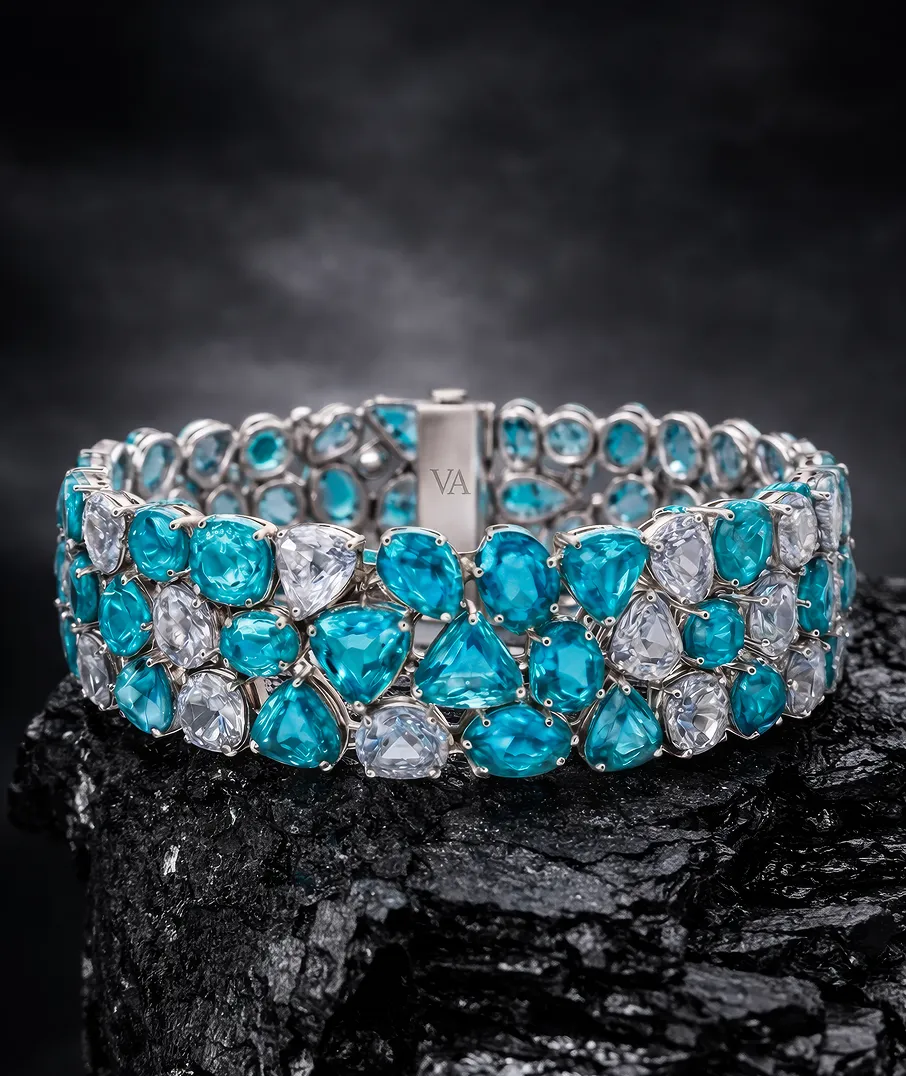
The color and the origin of a Paraíba tourmaline are two separate questions. You judge the color yourself, ideally in direct comparison under the same light: according to GIA, blue and violet are the most sought after. The origin cannot be read from the color. Only a laboratory determines it, through trace elements, and even then the result sometimes remains open.
At a glance
- Color range
- Greenish blue, blue-green, green, blue, violet
- Most sought after
- Blue and violet, according to GIA
- Cause of color
- Mainly copper and manganese
- Countries of origin
- Brazil since the late 1980s, Nigeria and Mozambique since the early 2000s
- Origin determination
- In the laboratory via trace elements; the result is an opinion and can remain open
- Name
- LMHC independent of origin, SSEF only for Brazilian stones
Two questions, two tools
Anyone assessing a Paraíba tourmaline usually asks two questions at once: how beautiful is the color, and where does the stone come from? The two questions are often mixed up, because Brazilian stones are said to have a particularly intense color. In fact, they need different tools. The trained eye judges color by comparison. A laboratory determines origin through chemical analysis, and it formulates the result as an opinion.

This separation protects against two typical false conclusions. The first is: the stone is very blue, so it comes from Brazil. The second: the stone comes from Brazil, so its color is particularly good. Both may be true, but neither follows from the other. A collector who answers the two questions separately can assess a stone objectively and knows what a report is needed for.
The color range of Paraíba tourmaline
According to GIA, Paraíba tourmalines show hues from greenish blue through blue-green and green to blue and violet. The color comes mainly from copper, with manganese in addition. In other tourmalines, copper plays no role as a coloring agent. According to GIA, strong saturation at light to medium tone was typical of the Paraíba deposit. This produces the glow described in the trade as neon or electric.
These trade terms are not laboratory statements. According to its own statement, the SSEF laboratory does not use terms such as electric blue or neon blue on its reports, but descriptive color terms such as blue, light blue, greenish blue, or green. When comparing stones, you should therefore pay attention to the described color and your own impression, not to marketing words. More on the term itself in the glossary under Neon quality.
Neon blue or green-blue: which is more sought after
According to GIA, blue and violet are the most sought-after hues of Paraíba tourmaline. A stone in intense blue is therefore generally considered more desirable in the trade than a green-blue stone of the same saturation. Green Paraíbas nevertheless have their own standing: GIA describes them as more saturated and brighter than any other green tourmaline. For collectors building a color series, a clear green in particular can be appealing. For Vikar Ahmed, the luminous “Windex Blue” makes a perfect Paraíba, a neon glow in which the stone shines from within.

More important than the exact hue is the intensity. According to GIA, color counts for more than size in Paraíba; a vivid smaller stone is often preferred to a larger, paler one. The stones also rarely exceed one carat. If you are torn between a large, light stone and a small, saturated one, you should therefore pay attention to saturation. More on this trade-off in the article Paraíba: size or color.
Comparing color: how to proceed
Tourmaline is strongly pleochroic: it shows different colors depending on the viewing direction. Cutters therefore orient the table so that the desired depth of color faces upward. For comparison, this means a stone can look different from an angle than from above. The following sequence helps you judge stones fairly side by side.
- Choose the same lightView all stones under the same light source, once in daylight and once under warm artificial light.
- Use a neutral backgroundPlace the stones on a white, matte surface so that no surrounding color distorts the impression.
- From above and from the sideFirst compare the face-up view, then tilt slightly. This shows how strongly the color impression changes with the viewing angle.
- Saturation before hueFirst ask which stone glows most intensely, then whether it looks more blue, green-blue, or green.
- Note your impressionRecord the color, brilliance, and any notable features of each stone before reading a report.
Origin: what laboratories can determine
According to GIA, copper-bearing tourmaline was discovered in the late 1980s in the Brazilian state of Paraíba, and later also in neighboring Rio Grande do Norte. In the early 2000s, similar stones were found in Nigeria and Mozambique. The Brazilian deposits are predominantly pegmatites, meaning veins in the rock, while the African ones are mostly secondary deposits in river gravels. According to GIA, Brazilian stones are generally valued more highly than African ones.
The origin cannot be read from the color. GIA states that the color ranges of all countries of origin overlap considerably. The usual gemological testing is not sufficient either. Laboratories therefore measure trace elements such as copper, zinc, gallium, strontium, tin, and lead and compare them with reference stones. If a stone falls between the known ranges, the result according to GIA is undetermined. SSEF explicitly describes origin determination as an expert opinion.
For collectors, this means: an origin statement without a laboratory report is a claim. GIA offers a report with origin determination for Paraíba tourmalines, for unmounted as well as mounted stones. An unmounted stone, however, can be viewed and examined from all sides before it goes into a piece of jewelry. More on the process in the article Origin report for Paraíba tourmaline.
The name depends on the laboratory's view
Laboratories do not answer uniformly whether a stone is called Paraíba tourmaline. Both views are widespread; neither applies alone. The table sets them side by side according to the same questions. For assessing a stone, what matters is which laboratory issued the report and what the comment says.
| Question | LMHC, as also cited by GIA | SSEF |
|---|---|---|
| What is called Paraíba? | Blue to green tourmaline with copper and manganese, regardless of origin | Only stones from Brazil, where the stone was first found |
| Stones from Nigeria and Mozambique | Also Paraíba tourmaline | Tourmaline, with a note on the trade name Paraíba |
| Color terms in the report | Not part of the naming rule | Descriptive, no trade terms such as neon |
| Origin | Separate statement, determined via trace elements | Separate statement, as an expert opinion |
Two widespread views on the name Paraíba tourmaline.
Treatment changes the color
According to SSEF, Paraíba tourmalines are frequently heated. In tourmaline, heating cannot be detected according to GIA, so the color should always be regarded as possibly altered by heating. A report therefore cannot reliably prove that a tourmaline is untreated. SSEF names fillings of fractures with oil or resin in the report and classifies them as minor, moderate, or significant. More on this in the article Disclosing treatment of Paraíba tourmaline.
Paraíba tourmalines at Vikar Ahmed
Paraíba tourmaline is the centerpiece of the house; its specialty is original Brazilian Paraíbas, and Vikar Ahmed also works with stones from Mozambique and Nigeria. Vikar Ahmed sets them as one-of-a-kind pieces in its in-house atelier in Idar-Oberstein. Whether a stone comes from Brazil is only established by a laboratory report. For high-quality Paraíbas from 1 carat, a report with origin determination is standard at the house, and for Brazilian stones often well below that. Clients inquiring from Trier or Birkenfeld are advised in Idar-Oberstein; the house has no location in either town.
Frequently asked questions
How do I compare loose Paraíba tourmalines by color, and which is more sought after, neon blue or green-blue?
According to GIA, blue and violet are the most sought-after hues, so an intense blue is usually considered more desirable than green-blue. Compare the stones under the same light on a white background and look first at saturation. A glowing green-blue can be superior to a pale blue.
Rubellite or Paraíba tourmaline: which loose stone is more interesting for my collection?
Both are tourmalines, but with different causes of color. Rubellite is the trade name for pink to red tourmalines, colored mainly by manganese. In Paraíba, copper is added, which according to GIA occurs only very rarely in tourmaline. For a collection, placing both colors side by side can be particularly appealing.
Emerald or Paraíba tourmaline: which is rarer as a loose stone?
Laboratories do not give a general ranking. For Paraíba, according to GIA, copper is very rare in tourmaline, and the stones rarely exceed one carat. With emerald, rarity likewise depends on color, clarity, and size. A comparison is only possible stone by stone. More under Emerald or Paraíba.
I collect Paraíba tourmalines and look above all for intense color. Which High Jewelry pieces show the typical neon blue most strongly?
Pieces whose stones are strongly saturated and have a light to medium tone, because that is what creates the glow. The setting should let as much light into the stone as possible. Check each piece in daylight and under artificial light, because the color impression changes with light and viewing angle.
Can the origin of a Paraíba tourmaline be recognized by its color?
No. According to GIA, the color ranges of stones from Brazil, Nigeria, and Mozambique overlap considerably. The usual gemological testing is not sufficient either. A laboratory determines the origin via trace elements, and even then the result can remain undetermined.
Why does an SSEF report call some stones only tourmaline?
Because SSEF ties the name Paraíba tourmaline to Brazilian origin. Stones from Nigeria or Mozambique with matching color and chemistry are called tourmaline there, with the note that they are also called Paraíba in the trade. According to the LMHC view, they carry the name regardless of the country of origin.
Private consultation
How a Paraíba tourmaline looks and what its report states is best clarified with the stone in hand and in conversation. Vikar Ahmed advises in the showroom in Idar-Oberstein by appointment, and virtually on request. Your inquiry is treated with discretion. Request an appointment for a private consultation.
Further reading
- Glossary: Paraíba Tourmaline
- Origin report for Paraíba tourmaline
- The Brazilian Paraíba tourmaline
- Paraíba: color or clarity?
- Jeweler in Idar-Oberstein
Sources
- GIA: Tourmaline Quality Factors (Paraíba-Farben, Sättigung, Größe), accessed 2026-11-17
- GIA: Tourmaline Description (Farbursachen, Rubellit), accessed 2026-11-17
- GIA, Gems & Gemology Winter 2019: Paraíba Tourmaline, Geographic Origin Determination, accessed 2026-11-17
- SSEF: Paraiba Tourmaline (Name, Farbangaben, Erhitzen, Füllung, Herkunft), accessed 2026-11-17
- GIA: Colored Stone Reports (Identification und Origin Report), accessed 2026-11-17
- GIA: Tourmaline Care and Cleaning (Behandlungen), accessed 2026-11-17
- Vikar Ahmed: Paraíba, accessed 2026-11-16
- Vikar Ahmed: Collections, accessed 2026-11-16

A personal conversation starts here.
At the showroom in Idar-Oberstein or by video. Vikar Ahmed discusses your ideas, stones and designs with you and answers your questions calmly and in confidence.


Thank you for your request.
Your request will be handled with the utmost attention and discretion. Vikar Ahmed will get back to you.
Your details
Request
–
Occasion
–
Consultation
–
Contact
–
In the meantime
Insights: What is a Paraíba tourmaline? · Engagement ring to your own design: how does it work?
Confidential and without obligation
Back to the pagePrivate consultation
A personal conversation starts here.
- Time for your questions, wishes and ideas
- In the showroom in Idar-Oberstein or by video
- Confidential, discreet and without obligation
Vikar Ahmed · Hauptstraße 111 · 55743 Idar-Oberstein, Germany